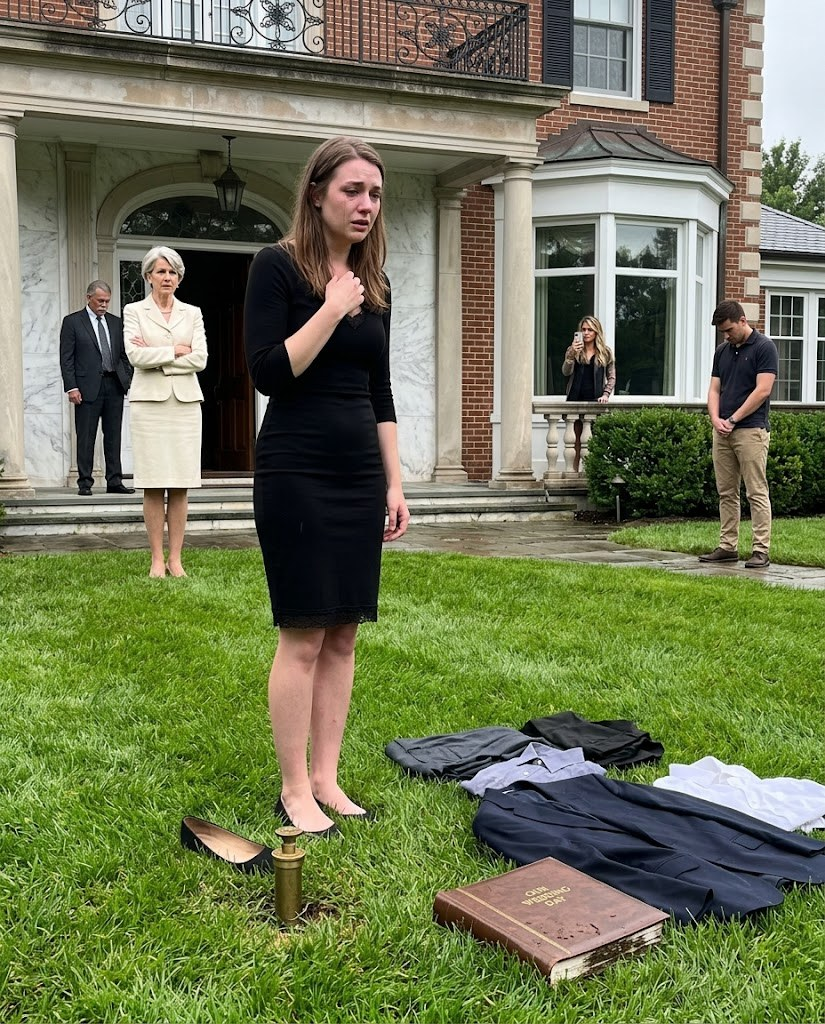
Twenty-four hours after I buried my husband, my clothes were thrown onto a lawn so perfect it looked like it had never met a worm.
Not packed.
Not folded.
Not even shoved into boxes with fake courtesy.
Thrown.
A black dress landed in wet grass like a dead bird.
One heel skidded toward the sprinkler heads.
My wedding album fell open in the mud, its bright white pages swallowing brown water while the house behind me stood polished and untouched, like it had never held a marriage at all.
On the marble porch, Beverly Washington folded her arms and looked at me with the kind of triumph decent people reserve for winning battles, not funerals.
“You got what you wanted,” she shouted.
“Now get out of our house!”
Her husband, Howard, stood in the doorway with his jaw clenched and his eyes fixed somewhere above my head.
My sister-in-law, Crystal, filmed from the steps with her phone tilted for the best angle.
And Andre, Terrence’s younger brother, stared at the floor and did what he always did when courage was required.
Nothing.
They all believed the same thing about me.
That I had married Terrence for money.
That the waitress he fell in love with and the nursing student he encouraged were both costumes.
That I had spent years smiling my way into the Washington family so I could eventually steal what belonged to them.
The truth was simpler and uglier for them.
I had married Terrence because he was the first rich man I ever met who treated money like a tool instead of a personality.
He tipped servers without making them perform gratitude.
He asked janitors their names.
He listened when I talked, even before he knew how to pronounce the names of my anatomy textbooks.
His family never forgave him for loving me without embarrassment.
A week before he died, he sat on the edge of our bed and held my face in both hands.
He had been pretending his chest pain was stress for months, but there was a tremor in him that night I had never heard before.
“Baby,” he whispered, “I changed everything.
Every document.
Every account.
Every share that mattered.
You’re protected now.
No matter what happens, they can’t touch you.”
I tried to laugh because I didn’t want the fear in his voice to become real.
“Why are you talking like that?”
He looked toward the bedroom door, toward the hallway where his family moved like expensive weather.
“Because I know them,” he said.
“And the minute I’m not standing between you and them, they’re going to show you exactly who they are.”
Terrence had known more than I did.
Three weeks earlier, a specialist had told him a heart defect he had ignored for years had become dangerous.
He scheduled surgery.
He called attorneys first.
He said it was because he liked being organized.
I knew later it was because he didn’t trust blood to behave better than strangers once fear and money were in the same room.
He died before the surgery happened.
A collapse in his office.
A rushed trip to the hospital.
One impossible phone call.
And then there I was, two days after the funeral, watching my belongings soak on a lawn while the family he came
from acted as if grief had made them landlords of my pain.
By sunset, I was in the back of a town car with one suitcase, my ruined wedding album on my lap, and my phone buzzing with a number Terrence had made me save months earlier under one name only: Elena.
Elena Price was his attorney, and unlike everyone else in those first brutal hours, she did not offer me sympathy as a substitute for usefulness.
She offered privacy.
When I arrived at her office the next morning, she locked the door, set a thick folder in front of me, and said, “Before I tell you anything else, I need to read the note your husband attached to the trust.”
My hands shook as I unfolded the page.
It was Terrence’s handwriting.
Let them show you who they are before you show them who you are.
Then Elena told me what he had done.
He had transferred cash, insurance, property, and private positions into a protected structure I controlled entirely.
The number was so large I stopped understanding it halfway through.
Then she said the part that changed the air in the room.
Terrence’s personal wealth was only one layer.
Hidden beneath it was his controlling block in Washington Crescent Holdings, the family company Howard had always assumed would stay in male hands.
The total value of everything Terrence had placed under my control sat just over $500 million.
I stared at Elena because numbers that big are obscene when the person you would have laughed about them with is already gone.
“There is more,” she said.
“He built a thirty-day control window into the trust.
Nothing has to be announced before then.
If you stay silent, they will assume you were cut out.
And he also added a conduct clause.
If anyone threatens, evicts, coerces, or publicly humiliates you during that window, control accelerates immediately.”
I thought of Beverly’s voice on the porch.
Crystal’s phone.
Howard’s silence.
“I’m staying quiet,” I said.
So I disappeared in the one way wealthy people never imagine possible.
I lived small.
I rented a modest furnished apartment under my maiden name on the other side of the city.
I wore old jeans.
I bought coffee from corner stores instead of hotel lobbies.
I took the bus twice, not because I had to, but because I wanted to remember whether scarcity still made me ashamed.
It didn’t.
Grief did enough of that on its own.
I cried in parking lots.
I woke up reaching for Terrence in the dark and finding only sheets.
I ate toast over the sink because preparing a full meal for one felt like admitting something permanent.
Meanwhile, the money sat untouched, vast and silent, protected behind layers of law and strategy his family had never bothered to imagine he would use against them.
And because they believed I was broke, the Washingtons finally became honest.
Beverly called first.
Her voice dripped with the fake tenderness of women who weaponize church language.
She said she was worried about me, worried about how I’d manage, worried about whether the press might misunderstand the family’s boundaries.
Then she asked me to sign a statement saying I had no role in the Washington family foundation and would not speak publicly as Terrence’s
widow at any future events.
Howard was more direct.
He sent legal papers by courier asking me to waive any challenge to Terrence’s board seat, voting rights, private collection, and deferred compensation.
The settlement offer attached to the last page would not have covered a year of property taxes on the house they had thrown me out of.
Crystal chose humiliation with better lighting.
She posted a video from the funeral luncheon with me blurred in the background and captioned it with something nasty about people who know exactly where the cameras are when it’s time to cry.
It gathered thousands of likes from strangers who didn’t know my name but decided they knew my motives.
Andre came to my apartment once holding a paper bag of groceries and looking like regret had finally located him.
For one full breath, I thought he might actually be there to apologize.
Then he cleared his throat and asked whether I still had Terrence’s platinum watch because Howard wanted “family pieces returned to the bloodline.”
I laughed in his face.
He flinched, and for a second shame cracked through him.
“I didn’t mean it like that,” he muttered.
“How exactly did you mean it?” I asked.
He had no answer.
The only person from that house who treated me like a human being was Miss Loretta, the housekeeper who had served the Washingtons for more than twenty years and somehow never absorbed their cruelty.
She arrived at my apartment one rainy evening with sweet potato pie, two casseroles, and the silk scarf I had left in Terrence’s closet.
She didn’t ask what I inherited.
She didn’t ask whether I had a plan.
She held my face in both hands and said, “Baby, grief is loud enough.
Don’t let their noise sound like truth.”
Then she glanced around my tiny kitchen and quietly added, “Your husband loved you in front of people who hated that.
Don’t ever let them rewrite that part.”
I nearly broke in half on the spot.
A week later, Elena called with the piece that explained the family’s sudden aggression.
Washington Crescent was not as stable as Howard pretended.
He had taken on ugly debt to cover failed expansion bets Terrence had wanted to unwind.
If Terrence’s voting block truly passed outside Howard’s control, Howard’s position would become fragile overnight.
That meant the Washingtons were not only arrogant.
They were scared.
The night before the board meeting, Andre sent me a text at 11:48 p.m.
Don’t sign anything they put in front of you.
I stared at the message for a long time.
It didn’t erase the porch.
It didn’t erase the groceries or the watch.
But it was the first thing anyone from that bloodline had done that cost them something.
The next morning, I dressed simply.
Cream blouse.
Dark slacks.
Small gold earrings Terrence bought me when I passed my clinical exams.
No diamonds.
No visible war paint.
I wanted them confident.
When I walked into the Washington Crescent boardroom, the family was already arranged like they had rehearsed it.
Howard at the head.
Beverly beside him in pearls sharp enough to cut skin.
Crystal with her phone face-down but close.
Andre pale and restless.
No one stood.
Howard slid a folder toward me before I even sat
down.
“Standard spousal acknowledgment,” he said.
“Sign it, and we can keep this orderly.”
“Orderly for who?” I asked.
His jaw hardened.
Then Elena entered carrying three binders and a sealed black envelope with Terrence’s handwriting across the front.
The room shifted.
Howard sat straighter.
Beverly’s confidence flickered.
Crystal moved her hand away from her phone.
Andre looked at me fully for the first time in weeks.
Elena placed the envelope in the center of the polished table.
“Before any signatures are requested from Mrs.
Washington,” she said, “we need to address the controlling transfer provisions left by Terrence Washington.”
Howard gave a dismissive laugh.
“My son’s shares revert through family governance.”
Elena looked at him with almost clinical pity.
“No, Mr.
Washington.
They do not.”
Silence hit so hard it felt like pressure in my ears.
Beverly turned to me, then back to Elena.
“What exactly is she saying?”
Elena opened the first binder.
“I am saying that as of this morning, Mrs.
Washington controls Terrence Washington’s full block of shares, his voting rights, and his succession authority.
Because of the conduct clause triggered by her forced removal from the marital residence, acceleration took effect immediately at 9:14 a.m.”
Crystal made a small sound that didn’t quite qualify as a word.
Howard stood up so quickly his chair rolled back.
“That clause is unenforceable.”
Without raising her voice, Elena nodded toward the screen at the end of the room.
Security footage filled it.
My dress in the grass.
My album in the mud.
Beverly on the porch screaming.
Crystal filming.
Howard standing there.
Andre frozen like a man who knew he would hate his own reflection later.
Beverly went white.
“Where did you get that?”
“From your own house,” Elena said.
“Mr.
Washington preserved all exterior feeds.”
Howard slammed his palms on the table.
“Turn that off.”
“No,” I said.
And for the first time since Terrence died, everyone listened when I spoke.
Elena opened the black envelope next.
Her expression changed as she read the first page, hardening in a way that made even Howard nervous.
Terrence had left more than money.
He had left a map.
For nearly a year, he had quietly commissioned a forensic audit after noticing discrepancies Howard kept dismissing.
The audit showed Howard had moved company funds through shell entities tied to a personal real estate gamble.
Beverly had charged private expenses to the family foundation.
Crystal had leveraged company vendors for gifts, travel, and undeclared sponsorships.
Andre’s name appeared on one approval chain, but attached to the file was a note from Terrence stating that Andre had later come to him, shaken, and admitted something was wrong.
I looked at Andre.
His face had collapsed into shame.
Terrence’s final directive was brutal in its clarity.
If the conduct clause was triggered, I was to choose whether to bury the findings for the sake of the family name or act in full authority to protect the company.
I had loved my husband too much to protect the people who had celebrated my humiliation before his grave flowers had wilted.
So I made my choice.
I called for a formal vote.
With Terrence’s block now under my control, I had the majority.
Howard was removed as chairman effective immediately.
Beverly was stripped of all
foundation access pending independent review.
Crystal was suspended from every public-facing role and ordered to surrender company devices.
Outside counsel was authorized to preserve records and notify regulators where required.
Howard stared at me as if I had become something nonhuman.
“You ungrateful little opportunist,” he hissed.
“No,” I said.
“I’m the woman your son trusted when he stopped trusting his own family.”
Security arrived before Howard could say anything smarter.
He shouted the whole way out.
Beverly did not shout.
She simply sat there, rigid and colorless, the shape of a woman finally realizing that cruelty is not a substitute for control.
Crystal cried once she understood none of this was a bluff.
Andre stayed seated.
After the room emptied, he looked at me and said, “I should have stopped them on the lawn.”
“Yes,” I said.
“I was scared of him.” He didn’t need to say which him.
“Yes,” I said again.
He nodded like a man swallowing something sharp.
“I told Terrence months ago that Dad was moving money.
I didn’t know how bad it was.
I should have done more.”
He was right.
But guilt that tells the truth is worth more than innocence that hides.
“I’m not giving you a free pass because you found your conscience late,” I told him.
“But I’m not pretending late is the same as never.”
He cried then, silently, with his head bowed.
It did not fix anything.
Still, it was the first honest thing I had seen from him.
The months that followed were ugly in the public way and clean in the private one.
Auditors came in.
Lawyers circled.
Headlines bloomed.
Howard resigned from three other boards before he was pushed.
Beverly’s foundation spending became impossible to explain.
Crystal discovered that influencer tears do not hold much market value when subpoenas enter the frame.
I sold the mansion.
I never wanted to sleep in a place where my wedding album had been left to drown on the lawn.
I kept only a few things: Terrence’s sweaters, his old coffee mug, the handwritten note from the trust, and one warped photograph from the ruined album where we were both laughing so hard neither of us was looking at the camera.
In Terrence’s name, I funded nursing scholarships for students who worked nights the way I once had.
I set up a patient-support fund at the hospital where he died so families in crisis would never have to choose between parking fees and sitting beside someone they loved.
I gave Miss Loretta a paid retirement package so generous she cried, then asked if she could still call me when she baked too much pie.
“Only if you bring it warm,” I told her.
Andre kept a smaller role at the company under strict oversight.
He earned that much one careful day at a time.
We were never close, but sometimes broken people tell the truth better than polished ones, and I learned to value the effort without rewriting the past.
A year later, I drove past the old estate on a gray morning and pulled over across the street.
The lawn looked perfect again.
No trace of mud.
No trace of the woman Beverly thought she had erased.
But I still remembered every soaked page, every stare, every second
of silence that cost them more than they knew.
Terrence had not just left me $500 million.
He had left me proof.
Proof that blood is not character.
Proof that grief does not make people cruel; it reveals who has been waiting for permission.
Proof that the people who will feed you, comfort you, and sit with you when they think you have nothing are the only people who understand what love costs.
Sometimes I still hold that warped photograph and wonder what the biggest red flag really was.
The family’s contempt? Andre’s silence? My own hope that money could teach people gratitude instead of entitlement?
I never found a perfect answer.
I only found this one: Terrence was right to protect me, but the money was never the inheritance that changed my life.
The truth was.