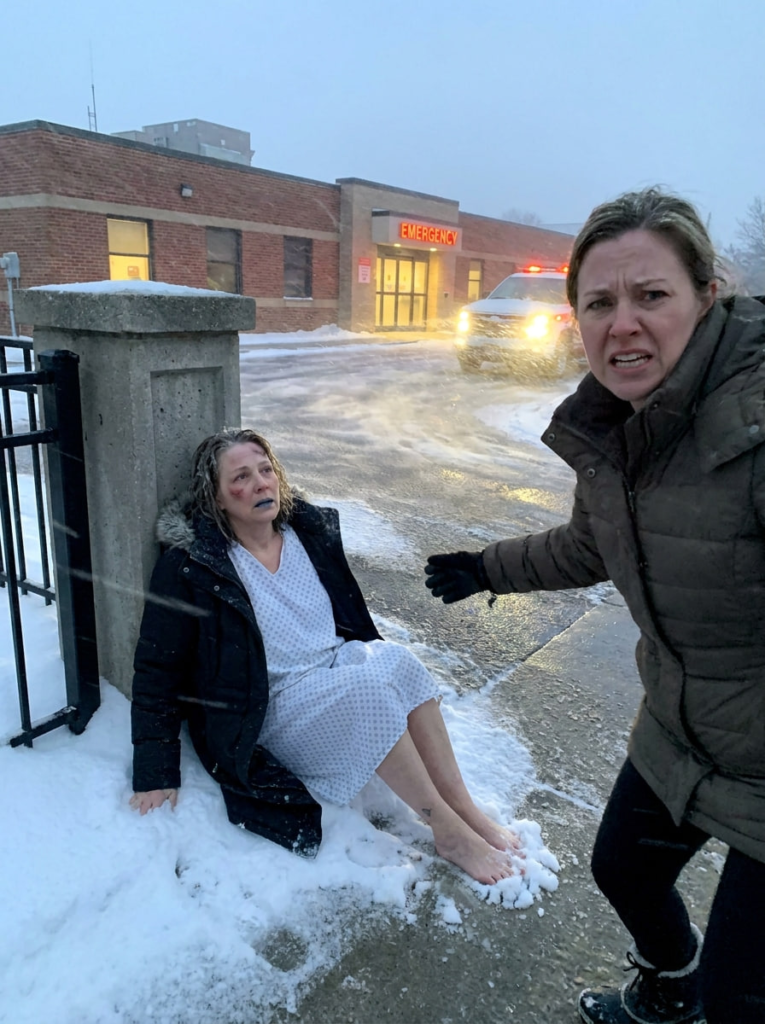
At 3:07 a.m., Lena Mercer woke to the sound of her phone vibrating across the nightstand.
It was not the normal ring of an ordinary call. It came in with a violence that seemed too loud for the dark, too sharp for the hour, the kind of sound that pulled a person awake already afraid.
Snow battered the windows of her small Chicago apartment. Wind shoved against the brick building hard enough to make the glass hum. The street outside had disappeared under a white blur of drifting ice and reflected light. It was the kind of winter storm that made the city look less abandoned than erased.
Lena fumbled for the phone and answered on the second ring.
For a second, there was only breathing.
Thin breathing. Fragile. Uneven.
Then her mother whispered, “Lena… help… me.”
The line went dead.
Lena sat upright so fast the blanket twisted around her legs. Her heart slammed hard enough to hurt. She stared into the dark as if the room itself might explain what she had just heard.
She called back immediately.
No answer.
Again.
Nothing.
By the sixth call she was already standing, dragging jeans over numb legs. By the tenth she was pulling on a sweater with one hand and reaching for her keys with the other. By the thirteenth, the call finally connected.
“St. Agnes Hospital,” a woman said.
Lena froze.
“My mother just called me from this number. Evelyn Hale. What happened?”
The woman’s voice changed. More guarded. “Are you immediate family?”
“I’m her daughter.”
Keyboard clicks. Muffled conversation in the background. Then a long breath.
“Your mother was brought in around one forty this morning. Collapse, cardiac concerns, medication issues. We were preparing to admit her, but her husband arrived with a man identified as her son. They removed her against medical advice.”
Lena pressed her fingers into the kitchen counter. “Removed her?”
“He presented power-of-attorney paperwork and insisted she was mentally confused. Staff objected. There were concerns. But they left before we could involve administration.”
“Where is she now?”
Silence, and then the answer Lena dreaded.
“We don’t know.”
The room became very still.
Her mother lived in Cedar Hollow, nearly three hundred miles away, in the house she had inherited from her own parents. She lived there with Richard Hale, Lena’s stepfather, and saw far too much of Caleb, Richard’s golden boy from Evelyn’s first marriage. Caleb was technically Lena’s half-brother, though the word had never sat naturally in Lena’s mouth.
Richard had always been one of those men the world rewarded for seeming composed. He wore expensive shoes even in bad weather, donated visibly to public causes, remembered every receptionist’s first name when someone important was looking, and knew how to lower his voice just enough to make everyone else look hysterical. He never shouted if he could humiliate quietly. He never hit where a bruise could be seen. He preferred paperwork, implication, pressure, and the slow theft of another person’s confidence.
Lena had seen that years before her mother admitted it.
She got dressed in four minutes.
Before leaving, she unlocked a wall safe hidden behind a row of old law books and took out three things: a black folder, a flash drive, and her bar card. Richard liked telling people that Lena was “just a quiet legal researcher in Chicago,” as if her job involved little more than reading memos and stapling things.
He never mentioned that she was the chief fraud investigator for the state attorney’s office.
She was on the road by 3:26.
The blizzard was vicious. Headlights dissolved in blowing snow. Twice she nearly missed lane lines altogether. A semi had slid half into a ditch outside Joliet. State troopers crawled past with emergency lights flashing blue and red through the white. Lena drove with both hands locked on the wheel and her jaw clenched so hard it hurt.
Every few minutes she heard her mother’s voice again.
Help… me.
There had been terror in it, yes, but something worse too. Shame. The dreadful, defeated shame of someone who had been taught not to ask until the pain was unbearable.
That voice sent Lena backward through years she tried not to revisit.
Her mother covering a bruise with makeup and saying she bumped a cabinet door.
Richard laughing at dinner when Evelyn forgot a date and saying, “See? This is what I deal with.”
Caleb rolling his eyes and telling Lena not to be dramatic.
The first time Lena suggested something was wrong, her mother had begged her not to start trouble. Richard always made trouble worse. Caleb always sided with Richard. And Evelyn, who had once painted whole landscapes from memory and sung loudly while she cooked, had become quieter each year, like someone folding inward to take up less room.
By sunrise Lena reached Cedar Hollow. The town looked trapped beneath the storm. Main Street was nearly empty. Church steps disappeared under white drifts. The diner’s neon sign flickered weakly through frost.
She drove straight to St. Agnes.
Inside, a nurse from the night shift recognized her name and hurried over. The woman’s face was pale with anger that had survived all the way to morning.
“We tried to stop him,” she said. “Your mother kept saying she wanted to stay. She was weak. She was cold. He kept calling her unstable. The son backed him up.”
“Do you have cameras outside?” Lena asked.
The nurse looked at her, then nodded once. “Security does.”
That was when Lena glanced toward the side entrance and saw movement beyond the glass.
A shape near the service gate.
She ran.
The cold hit her face so hard it burned her lungs. Snow crunched under her boots as she crossed the plowed edge of the lot and reached the concrete wall by the gate.
Her mother lay curled there, half shielded from the wind by nothing more than a drifted bank of snow. She wore a hospital gown under a coat too thin to matter. Her feet were bare. Her skin had the bluish cast of dangerous cold. There was dried blood at the corner of her mouth. A purple bruise darkened one cheek. Finger marks circled one wrist.
For one terrible second Lena could not make herself breathe.
“Mom.”
Evelyn’s eyes fluttered open. Fear flashed through them before recognition arrived. Then she began to cry soundlessly, lips trembling.
“They left me,” she whispered.
Lena dropped to her knees in the snow and pulled her into her arms. Evelyn weighed almost nothing. That frightened Lena more than the bruises.
She carried her through the hospital doors shouting for help. A gurney appeared. Nurses rushed forward. Someone cut away the wet gown. Oxygen, monitors, blankets, heat packs. The emergency room snapped into motion around them.
Even while doctors worked, Evelyn clung to the sleeve of Lena’s coat like a child afraid of being abandoned again.
Hours later, after treatment for hypothermia, dehydration, medication withdrawal, and a mild cardiac episode, Lena sat beside her mother in a private room.
The fluorescent lights were unforgiving. So was the truth.
Richard had been tightening control for months. First he insisted that Evelyn stop driving because she seemed “forgetful.” Then he took over the bills to “make things easier.” He changed passwords. Moved money. Replaced her longtime doctor with one of his golf partners. Refills went missing. Her phone disappeared for hours or whole days. When friends called, Richard said she was resting. When she did speak to anyone, Caleb later mocked her for sounding confused.
The confusion was partly real, but it had a cause.
Richard had been reducing her medication and adding sedatives not prescribed for her. Enough to make her sluggish. Enough to make her doubt herself. Enough to make other people believe his version first.
The night before, Evelyn found a bank statement in the shred pile. One of her separate investment accounts, the one her first husband had left for her security, had been drained in increments over months. The transfers led to a shell consulting company Richard controlled.
She confronted him in the kitchen.
Richard smiled and told her she was imagining things.
Caleb came in halfway through and sided with Richard before he even knew the details. Evelyn said she wanted to call Lena. Richard took her phone. Evelyn tried to leave the house. Caleb stood in the doorway with his arms spread and told her she was “not making a scene at midnight.”
When she reached for the landline, Richard grabbed her wrist. She fell against the counter. Her chest tightened. She remembers the floor coming up too quickly.
That was when Caleb finally drove her to St. Agnes.
At the hospital, when a nurse started asking about the bruises and missing medications, Caleb panicked and called Richard. Richard arrived with paperwork naming himself power of attorney. He spoke to the staff in a voice full of weary patience. He called Evelyn disoriented. Said she had episodes. Said Lena was estranged and dramatic and would weaponize anything.
Evelyn tried to tell them she wanted treatment.
Richard signed her out.
Caleb took her arm.
“He was hurting me,” Evelyn said in a voice so thin Lena had to lean closer to hear. “I kept telling Caleb. He wouldn’t look at me.”
Lena sat very still.
Then Evelyn said, without looking up, “Caleb told me I should have died quietly so we could all move on.”
The words seemed to drain the sound from the room.
Lena kissed her mother’s forehead and told her, carefully, clearly, “You are safe now. No one is touching you again.”
She stepped out into the hallway and called three people.
The first was an assistant state attorney she trusted.
The second was a detective in elder financial abuse.
The third was the hospital administrator, whose voice changed instantly when Lena identified herself and asked for every piece of video, intake documentation, and staff notation from the night preserved immediately.
By noon she was driving to the house.
Her mother’s house.
Richard opened the door in a burgundy silk robe with a mug of coffee in his hand, as though winter, fraud, and attempted manslaughter were all things that happened to other families. His expression warmed with contempt when he saw her.
“Well,” he said. “The little librarian came running.”
Caleb drifted into the foyer behind him in sweatpants, phone in hand, hair uncombed, expression smug. “What are you going to do, Lena? File a complaint?”
Lena looked past them.
The entry hall told a story all by itself. Evelyn’s watercolors were gone from the walls. Her late father’s watch cabinet stood empty. A bronze sculpture Richard loved to brag about sat where family photographs used to be. The house looked occupied by someone who had been erasing a woman before he finished disposing of her.
Lena smiled.
“No,” she said softly. “Nothing loud.”
They laughed.
That was their first mistake.
The second was letting her in.
She stepped over the threshold slowly, taking in details the way some people took in weather. A legal envelope on the hall table. A bank receipt half hidden under junk mail. A home security panel in bypass mode, which meant certain interior sensors had been intentionally disabled. Richard had always loved the performance of security more than the reality of it.
“How is she?” he asked with fake concern.
“Alive,” Lena said.
Richard’s eyes narrowed. Caleb looked away.
“Your mother has not been well,” Richard said. “She gets confused. You know that.”
“Confused enough to remove her own medication from the house?” Lena asked.
Caleb’s head snapped up.
Richard did not answer quickly enough.
Lena pulled out her phone and, in plain view, started a voice memo. Caleb blanched. Richard’s smile thinned.
“You can’t record me in my own house,” Richard said.
“I can record myself very easily,” Lena replied.
She moved toward the study. Richard stepped in front of her.
“You don’t belong in there.”
The absurdity of that sentence nearly made her laugh. Her mother’s name was on the deed. Richard had married into the house, into the accounts, into the art, into everything he now treated as his private kingdom.
“Move,” Lena said.
He did not.
Caleb moved closer, broadening himself the way men do when they think size is persuasion. Lena turned and looked him full in the face.
“Say it again,” she said.
“Say what?”
“What you said to Mom. About dying quietly.”
He flushed. “I didn’t mean it like that.”
“There is no other way to mean it.”
Richard cut in smoothly. “This is grief talking. You’re upset. I understand.”
“No,” Lena said. “This is evidence talking. I’m very calm.”
She reached into her coat and laid her bar card on the hall table beside his coffee mug. Then she laid down a printed copy of the intake log from St. Agnes, with timestamps. Then a form from the county recorder’s office showing that the power-of-attorney document Richard had filed carried an electronic notarization from a notary whose commission had expired eleven months earlier.
Richard stared at the papers. For the first time, his face lost color.
Lena took one more page from the folder. A preliminary transfer summary from Evelyn’s investment account.
“You forged authority over a vulnerable adult,” she said. “You moved money into shell entities. You interfered with medical care. You abandoned a cardiac patient in freezing conditions. The staff who saw her injuries are willing to testify. The surveillance footage has been preserved. And every second you continue speaking to me right now is being documented.”
Caleb looked from the papers to Richard. The smugness vanished from his face so completely it was almost childlike.
“Dad?”
Richard ignored him. “This is a misunderstanding.”
“No,” Lena said. “It’s a charging sequence.”
Then the sirens sounded outside.
Not one. More than one.
Caleb stumbled to the front window. “Richard.”
Richard spun toward the study.
That told Lena everything.
Whatever was in that room mattered more to him than the hospital footage, more than the forged document, more than the money trail she had already found.
He lunged for the desk drawer.
Lena moved at the same time, slamming the study door with her shoulder before he could close it. The drawer came open in his hand. Caleb hovered in the doorway, panicked and useless.
Inside the drawer were passports, a cashier’s check, a sealed envelope, and a fresh real-estate contract.
The house was under sale.
Closing in nine days.
Evelyn’s signature sat on the seller line, shaky but convincing at first glance.
Forgery again.
Beneath the contract was a typed draft of a long-term care placement authorization for a private facility two states away. Signature line ready. Medication notes attached. Contact restrictions listed.
Richard had not just been stealing from Evelyn.
He had been preparing to disappear her.
The detective entered with two uniformed officers just as Richard tried to snatch the papers back. One officer caught his wrist. The other moved Caleb away from the doorway.
Lena stepped back, breathing hard but steady.
“Those are hers,” she said.
The detective took in the room quickly, the desk contents, the folder on the floor, Richard’s face, Caleb’s panic. Experienced eyes. Nothing theatrical.
“Mr. Hale,” he said, “you need to step away from the desk.”
Richard’s composure cracked at last. “This is my house. My wife is sick. This girl has always hated me.”
“Your wife is in a hospital bed with hypothermia and bruising,” the detective said. “This is not going your way.”
Caleb started talking then, too fast, too loud. He said he didn’t know about the sale. He said Richard handled the paperwork. He said he only did what Richard told him to do. He said he was trying to help. He said his mother had been impossible lately. He said too many things, and each one sounded smaller than the last.
Richard turned on him with naked fury.
“Shut up.”
That was all it took.
Caleb broke.
He told them Richard had been moving money for months. He admitted Richard made him drive Evelyn to doctors who would “adjust” her medications. He admitted they had discussed placing her in a facility where Lena would have trouble finding her. He admitted Richard promised him part of the proceeds from the house sale once Evelyn was declared incompetent.
Then he said the thing that finally made even the officers look at him differently.
“I didn’t think he’d really leave her outside,” Caleb whispered. “I thought he was just trying to scare her.”
Lena looked at him and felt something colder than rage.
Not hatred.
Recognition.
A lifetime of small cowardices had led him here. He had not become monstrous in one night. He had become useful to a monster one excuse at a time.
Richard was arrested that afternoon on probable cause related to elder abuse, fraud, document forgery, and reckless endangerment, with additional charges developing as financial records were subpoenaed.
Caleb was not arrested at the scene, but only because the detective wanted his full statement first and knew panic made people generous with the truth. By evening, that truth had spread far enough to close around him too.
Over the next six weeks, the rest came out.
Richard had siphoned nearly four hundred thousand dollars through fake consulting invoices and sham property maintenance companies. He had altered Evelyn’s prescriptions through a complicit telehealth provider now under separate investigation. He had isolated her from friends, intercepted mail, and told neighbors she was showing signs of dementia. Two forged legal documents were linked to him. A third was linked partly to Caleb, whose digital trail was far less polished than he imagined.
The hospital footage was devastating.
So was the side gate camera.
It showed Richard and Caleb escorting Evelyn out into the dark. It showed her barely able to stand. It showed Richard pointing toward the parking lot, then getting back into the car. It showed Caleb hesitating for one long second before following him inside the vehicle. And it showed the taillights disappearing while Evelyn sank against the concrete.
There are moments from which image can never recover character.
That was one of them.
Richard took a plea months later when his attorneys failed to suppress the financial trail and the medical evidence. He lost almost everything he had built his identity around before sentencing even began. His club membership was revoked. His consulting clients fled. His photograph vanished from charity websites as if the institutions he fed had never known him.
Caleb tried to save himself by testifying. He received a lesser sentence than Richard, but not the mercy he begged for. The judge, after reviewing the footage and the hospital records, called his conduct “an appalling betrayal of both filial duty and basic human decency.”
Lena attended every hearing.
So did Evelyn, eventually.
Recovery was not swift. Hypothermia healed faster than humiliation. The bruises faded faster than the memory of being called a burden in her own home. There were weeks when Evelyn startled at footsteps in hallways and cried when nurses adjusted blankets. There were longer weeks when she apologized for things that had never been her fault. For being difficult. For not leaving sooner. For not calling Lena months earlier.
Each time, Lena answered the same way.
“You survived. That is not something to apologize for.”
Spring came late to Cedar Hollow that year. Snowmelt ran in silver streams along the curbs. The bare trees outside Evelyn’s hospital window softened into green. When she was finally strong enough, Lena brought her back to the house.
Not because the house mattered more than peace, but because Evelyn had the right to walk through her own front door without fear.
The trophies were gone. The bronze sculpture was gone. The watch cabinet had been recovered from a storage unit. Most of the paintings were returned. A few had been sold, but Lena tracked them down one by one through auction records and private dealers until all but one came home.
Evelyn stood in the living room staring at the walls where her watercolors hung again.
Then she did something Lena had not seen in years.
She laughed.
It was shaky and tearful and interrupted by a hand over her mouth, but it was laughter all the same.
Later, in the kitchen, Evelyn made tea while Lena sorted mail at the table. The windows were open a crack. The air smelled like wet soil and fresh leaves.
“I keep thinking,” Evelyn said quietly, “that I should have known.”
Lena looked up.
“You did know,” she said. “That’s why he worked so hard to make you doubt yourself.”
Evelyn nodded, eyes bright. “And Caleb?”
That question lingered between them.
There were easier answers. That he was weak. That Richard poisoned him. That greed got there first. All of them were partly true. None of them were enough.
“Caleb knew more than he admitted,” Lena said at last. “And less than he should have wanted to.”
Evelyn sat down slowly. “Do you think he loved me at all?”
Lena did not answer right away.
Outside, a bird landed on the porch rail and sang into the mild afternoon as if the world had not nearly ended in winter.
“I think,” Lena said carefully, “some people confuse comfort with love. And when loving someone costs them something, they find out too late that they were never brave enough for it.”
Evelyn lowered her gaze to her teacup.
After a while, she said, “Richard was obvious, wasn’t he? In the end. But Caleb… Caleb was the red flag I kept calling loyalty.”
Lena reached across the table and took her hand.
Neither of them said anything for a long time.
Richard went to prison. Caleb followed on a shorter sentence and a much longer shame. The money that could be recovered was returned. The house remained in Evelyn’s name. The doctors corrected her medications. Her strength returned little by little, in stairs climbed without stopping, in color returning to her face, in the first day she drove herself to the art store and came back with new brushes.
By summer, there was a half-finished landscape on an easel in the dining room.
By autumn, Evelyn hosted three old friends for dinner and did not once apologize for talking too much.
And yet some truths never settled into comfort.
It stayed with Lena that Richard had been easy to identify. He had always looked like danger if you stood close enough. The harder truth was Caleb: the son who chose convenience over courage until convenience became cruelty. The one who did not strike the first blow, but opened the door. The one who did not plan every theft, but benefited. The one who heard his mother plead and decided peace in the house mattered more than the person who gave him life.
When people later asked Lena what the worst part had been, they expected her to say the bruises, the snow, the hospital gate, the video.
But it was something smaller and somehow more devastating.
It was the memory of her mother, wrapped in blankets under hospital lights, whispering not that Richard hurt her.
That she had been left.
Because in the end, that was the deepest injury of all.
Not the cold. Not the fraud. Not even the bruises.
The moment a woman realized the men in her own home had already decided her suffering was more convenient than her survival.
And once you understand that, it becomes impossible not to ask yourself the question that lingers long after justice is done:
Which betrayal is worse—the monster you fear, or the family member who watches, knows, and still steps aside?