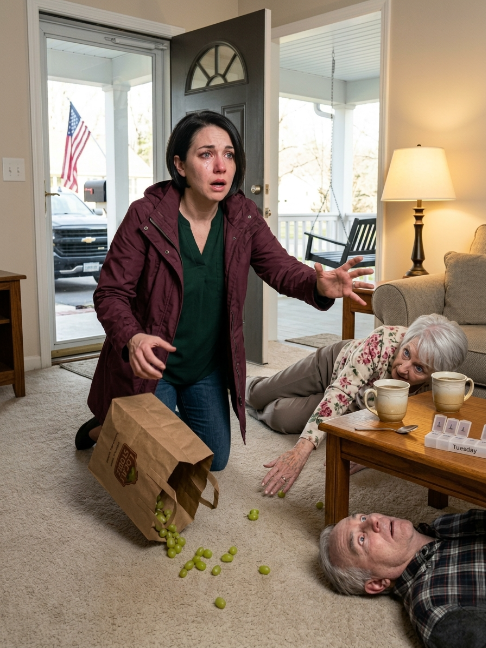
I was so excited to surprise my parents that I stopped to buy their favorite snacks on the way over, grapes, sourdough, and the fancy butter my dad always pretended was no different from the cheap kind, but when I unlocked their front door and stepped inside, the grocery bag slipped from my hand and grapes rolled across the floor because my mother was lying motionless near the coffee table and my father was collapsed beside the couch with his glasses crooked on his face. I found a pulse on both of them, barely there and terrifyingly weak, and I called 911 with hands shaking so badly I could hardly hold the phone. At the hospital that night, the doctor told us they were alive, then his expression shifted and he said something harmful had been found in their systems. Not a fall. Not a stroke. Someone had put something in their food. My parents, the most ordinary and kind people I have ever known, people who remembered every birthday and cried at sad dog movies, were now at the center of a police investigation and nobody could explain why. For one full week our family lived in that nightmare with no answers, and then Michael, my husband, went back to their house to collect a few things and found something we had all completely forgotten about. My father had installed a doorbell camera two years earlier and complained it stopped working, so we all assumed it was useless and never thought about it again, but it had never actually stopped recording. Michael walked into our kitchen soaking wet, holding a tiny memory card between two fingers, and the look on his face made my whole body go cold before he even said a single word. Whatever is on that footage is going to change everything we thought we knew about the people closest to us, and I am not sure our family will ever be the same again.
Michael set the memory card on the kitchen counter like it was something fragile enough to shatter, and for a long moment neither of us moved because some part of me already understood that once we watched whatever was on that footage, there would be no going back to the version of life we had before that night. He borrowed a small adapter from our neighbor and plugged the card into his laptop right there at the kitchen table, and I pulled my chair so close to his that our shoulders were pressed together, and I remember thinking how strange it was that I could smell the rain on his jacket while my entire world was about to collapse. The footage was grainy and timestamped in pale green numbers in the corner, and we fast forwarded through two days of nothing, a delivery driver, a squirrel on the porch railing, wind moving through the rose bushes my mother refuses to trim, and then at 4:47 in the afternoon, the day before I found them, someone walked up the front path and my breath stopped completely. It was not a stranger. It was not some random face I could dismiss or hand over to police without it costing me something. It was someone I recognized immediately, someone who had sat at my parents’ dining room table, someone who had hugged my mother and shaken my father’s hand, and I heard myself make a sound I did not recognize as my own voice. Michael paused the video and looked at me and said my name very quietly, the way you speak to someone standing too close to the edge of something, and I just kept staring at the frozen image on the screen because my brain refused to accept what my eyes were clearly seeing. That person had been inside the house. That person had been alone with my parents. That person had carried something into the kitchen and left without it, and my parents had been unconscious on the floor less than four hours later. I grabbed my phone and called Detective Harmon, the officer assigned to the case, and my voice was so unsteady that Michael ended up taking the phone from me and explaining what we had found while I sat there with my hands pressed flat against the table trying to feel something solid underneath me. The detective arrived within twenty minutes and when he saw the paused image on the laptop screen, he went very still in a way that told me he had not been expecting this either, and he asked us both to please not discuss what we had seen with anyone, not with Kara, not with friends, not with anyone at all, because the moment this person found out we had footage, everything would become dangerous very fast. That night I lay in bed staring at the ceiling while Michael slept restlessly beside me and I kept replaying every family gathering, every holiday dinner, every ordinary afternoon I had spent completely unaware that someone I trusted had been capable of something this terrible, and by morning I had made a decision that Michael begged me not to make, but I had already picked up my phone, and I had already typed the message, and I had already pressed send.
Part 2
The message I sent was only six words long and I had written and deleted it four times before I finally let it go, and those six words were: I know what you did. I know it sounds reckless and I know Detective Harmon had specifically told me not to make contact, but something inside me had broken open overnight and I needed that person to know that the secret they thought was buried was already standing in the light, and within eleven minutes my phone lit up with a response that made my stomach drop straight through the floor because the reply was not panic, not denial, not an apology, it was a single question mark, just one, cold and calm and completely unbothered, as if I were the one who had done something wrong, and that one tiny punctuation mark told me more about this person’s character than twenty years of shared holidays ever had. I screenshotted everything and called Detective Harmon immediately and he was not happy with me, not even a little, but he told me to stay home, lock my doors, and under absolutely no circumstances go anywhere alone, and I agreed to all of it while already knowing there was one thing I had not yet told him, one piece of this story that I had been holding back because I was still not ready to say it out loud, because saying it out loud would make it permanently real in a way I could not take back. You see the person on that doorbell camera was not a distant relative or an old neighbor or someone existing comfortably on the edges of our lives. It was someone inside the very center of our family, someone my parents had loved completely and without question, someone who had a key to that house, someone who knew my father’s medication schedule and my mother’s daily routine and exactly which afternoons the house would be quiet and uninterrupted, and when I finally spoke the name out loud to Michael that morning over cold untouched coffee, he pushed back from the table and walked to the window and stood there for a long time without saying anything at all because there was simply nothing to say. The investigation moved quickly after we handed over the memory card and within forty eight hours Detective Harmon called me to say they had brought the person in for questioning, and I sat in my car in the hospital parking lot when that call came because I had just finished visiting my parents, who were improving slowly, my mother able to squeeze my hand, my father managing a few words, both of them still unaware of who had done this to them, and I was not ready to be the one to tell them, I was not sure I would ever be ready for that. Then three days later everything cracked open in a direction none of us had anticipated because Kara called me from her car crying so hard she could barely form sentences and she told me that she had known something, not everything, not the full plan, not what was actually in the food, but she had known this person had been angry at our parents, deeply and privately angry, over something that had happened months earlier involving money and a promise my parents had made and then quietly broken, and Kara had kept that to herself because she thought it was just family tension, just the kind of wound that heals on its own if you give it enough silence and time, and I sat in my parked car listening to my sister fall apart on the phone and I felt the ground shift beneath everything I had ever believed about the people I loved most, because the story was so much larger and older and more tangled than a doorbell camera or a poisoned meal or a single text message with a question mark, and now with my parents still recovering, a suspect in police custody, my sister drowning in guilt, and Michael finding something else, something new, tucked inside an envelope at the back of my father’s desk drawer, I realized with a certainty that settled into my bones like cold water that we were not at the end of this story, we were not even close, we were still standing at the very beginning of something none of us were prepared to face.
Part 3
Michael stood in the doorway of my father’s small home office holding a white envelope that had been sealed and then opened and then sealed again with a strip of clear tape, and written on the front in my father’s careful handwriting was a single word that was not my name or my sister’s name or my mother’s name, it was the name of the person who had been brought in for questioning, and my hands were trembling before I even touched it because my father had known, some part of him had known, and he had written it down and hidden it and said nothing, and inside the envelope was a letter that was three pages long and handwritten on the pale blue stationery my father kept in his desk for important things, and as I read it standing right there in that doorway with Michael’s hand pressed warm and steady against my back, the entire history of my family rearranged itself around me like furniture being moved in a dark room. The letter explained everything. Months before that terrible Tuesday, my parents had quietly changed their will. They had done it without telling anyone, without warning, without explanation, because my father had discovered something deeply troubling about the person who had previously been named as a significant beneficiary, something involving a pattern of dishonesty and financial manipulation that my father had uncovered slowly and painfully over the course of nearly a year, and rather than confront that person directly, rather than cause the kind of scene my gentle father had avoided his entire life, he had simply and quietly removed them, and he had written this letter as a record, a private account of everything he had learned and everything he had done about it, tucked away in the back of his drawer like an insurance policy he prayed he would never need to use. But he had needed it. And he was not awake to know that we had found it. Detective Harmon arrived within the hour and sat at my parents’ kitchen table reading every word of that letter with the careful stillness of someone assembling something that had been broken into many pieces, and when he finished he looked up and told us that what my father had written aligned precisely with the financial records they had already begun pulling, and that the motive was now not just clear but documented in my father’s own hand, and that the case had shifted from serious to airtight in the space of three handwritten pages. The arrest happened four days later. I was sitting with my mother in her hospital room when my phone buzzed with the message from Detective Harmon, and my mother was finally strong enough to sit up and hold a cup of tea with both hands, and she was telling me about a dream she had had, something soft and wandering about a garden she used to visit as a child, and I read the message and I held my face very carefully still so she would not see anything shift in my expression because I was not ready to tell her yet, not in that room, not while she was still so fragile and the garden in her dream still sounded so peaceful. My father was moved out of intensive care two days after that and the first afternoon he was well enough to have a real conversation I sat beside his bed and I took his hand and I told him we had found the letter, and he looked at me for a long moment with those steady eyes of his and he said quietly that he had hoped no one would ever have to read it, and then he said he was sorry, not for writing it, but for not finding a way to protect us from needing it, and I had to press my lips together very hard and look at the ceiling for a moment before I could answer him. The person was charged. The trial would take months. There were lawyers and statements and documents and long difficult phone calls and days when the weight of all of it made it nearly impossible to get out of bed, and there were nights when Michael would find me sitting at the kitchen table at two in the morning staring at nothing and he would simply make tea and sit down beside me without asking any questions because some things are too large and too close for questions. Kara carried her guilt like a stone she did not know how to put down and we had long and painful and necessary conversations about what she had known and what she had chosen not to say and what that silence had cost our family, and it was not easy and it was not quick and there were moments when I was not sure we would find our way back to each other, but we did, slowly and imperfectly, the way you repair something precious that has been cracked, not by pretending the crack was never there but by filling it with something honest. My parents came home on a Thursday afternoon in early spring and my mother stood on the porch for a moment before going inside, just stood there in the thin sunlight with her eyes closed, and my father put his arm around her shoulders and they stayed like that for a minute that felt like something sacred, and I stood at the bottom of the porch steps watching them and thinking about doorbell cameras and hidden letters and warm containers of chicken soup and all the ordinary moments we move through carelessly, not yet knowing they are the ones we will hold onto when everything else falls apart. I do not have a clean ending to offer you because life did not give us one. What I have instead is this: my parents are home, they are healing, the person responsible is facing consequences, and I have stopped waiting for the perfect weekend to visit the people I love because I learned the hardest possible way that the porch light will not always be on, the kitchen will not always be warm, and the people standing in the doorway waving goodbye will not always be standing there the next time you come back, so please, whatever you are putting off, whatever visit you keep rescheduling, whatever phone call you keep meaning to make, do it today, do it now, do not let another ordinary Tuesday pass without telling the people who matter most that they matter, because some stories do not end the way ours did, and the only thing standing between you and a regret you cannot survive is the simple and urgent act of showing up while you still can.
SHORT SUMMARY:
Emily stopped by her parents’ house on an ordinary Tuesday evening to grab the mail and surprise them with their favorite snacks, but instead of finding them at the door smiling, she found them both collapsed and unconscious on the floor. Doctors confirmed something harmful had been placed in their food. With no clear motive and no obvious suspect, the family was shattered and desperate for answers. One week later, Emily’s husband Michael returned to the house and discovered an old doorbell camera that everyone had written off as broken, but had never actually stopped recording. The footage revealed a familiar face, someone trusted, someone loved, someone who had sat at that very family’s dinner table. As the investigation unfolded, a hidden letter in her father’s desk exposed a secret involving a changed will, financial betrayal, and a motive that had been quietly building for nearly a year. The person was arrested, the family was forever changed, and Emily was left standing on her parents’ porch steps watching her mother and father hold each other in the thin spring sunlight, grateful beyond words that she had shown up that Tuesday evening instead of waiting for a better day.
THE LESSON:
The most dangerous thing Emily almost did was nothing. She almost did not stop by that evening. She almost let another week pass. She almost remained the daughter who was always too busy, always meaning to visit, always saving it for a perfect day that kept not coming. What this story teaches us is painfully simple but something most of us need to hear repeatedly until it finally sticks: the people you love are not guaranteed to be there the next time you get around to showing up. A phone call you keep postponing, a visit you keep rescheduling, a conversation you keep telling yourself can wait, none of it can wait as safely as you think it can. Emily showed up on an ordinary Tuesday with grapes and sourdough bread and fancy butter, not because she had planned a grand reunion but because guilt nudged her into one small act of presence, and that one small act saved two lives. You do not need a special occasion to love people out loud. You just need to decide that today is reason enough.