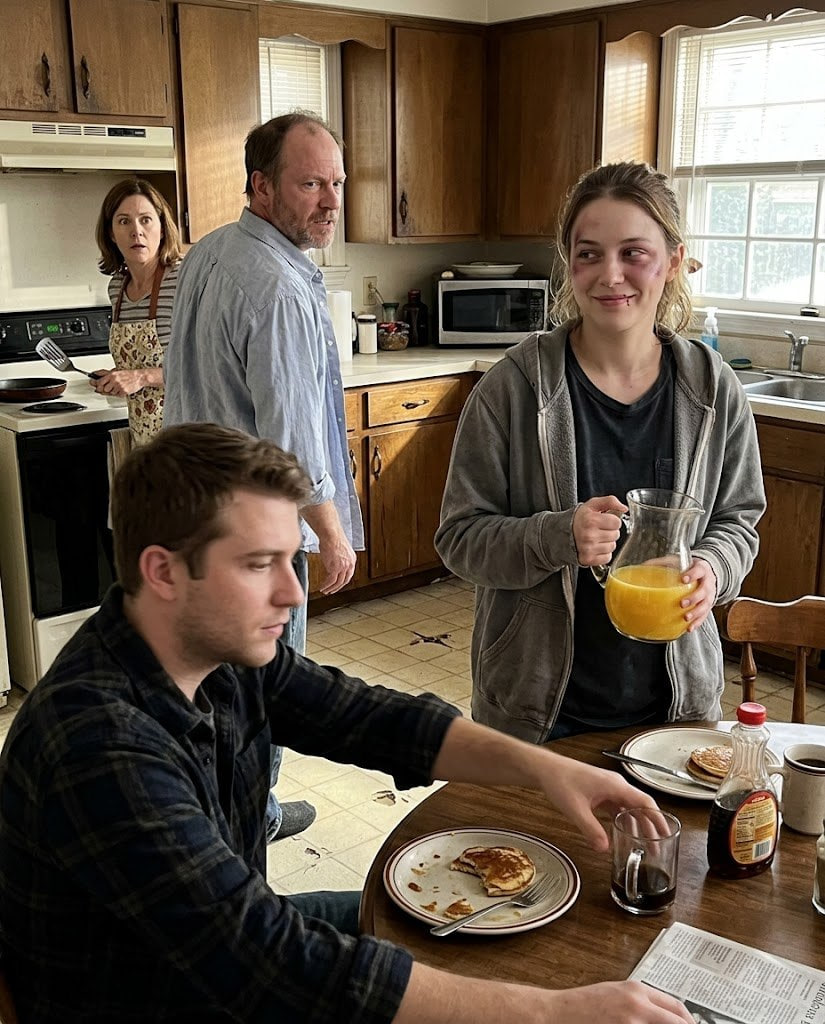
My dad smashed my jaw for “talking back.” Mom laughed, “That’s what you get for being useless.” Dad said, “Maybe now you’ll learn to keep that gutter mouth shut.”
I smiled.
They had no idea what was coming.
The crack wasn’t just bone.
It was the sound a lie finally breaking under its own weight.
My father’s fist hit with the confidence of repetition.
Not rage out of control.
Not some wild accident.
It was the measured, familiar violence of a man who had always believed pain was his right to distribute.
My teeth collided so hard a burst of light flashed behind my eyes.
The kitchen lurched sideways.
The yellow light overhead turned watery.
The coffee on the counter became a dark blur.
My hands hit tile, then slid through something wet.
When I looked down, there was blood in the lines of my palm.
For a moment, all I could hear was static.
Then sound came back in layers.
My father’s breathing.
The oil snapping in the pan.
The television in the living room.
And my mother laughing.
Laughing.
“That’s what you get for being worthless,” she said, stepping over me on her way to the sink.
“Maybe now you’ll learn your place.”
I had asked a question.
That was all.
Kyle, my older brother, was stretched across the couch doing what he did best, which was nothing at all, while I had been ordered to clean the backyard before lunch.
I asked why he couldn’t help.
The sentence had barely left my mouth before my father stood up.
In our house, fairness was disrespect.
Boundaries were attitude.
Truth was aggression if it embarrassed the wrong person.
Kyle watched from the doorway, one shoulder against the frame, expression loose and entertained.
That half-smile on his face bothered me more than the pain in my jaw.
He always looked like that when I was in trouble.
Not surprised.
Not uncomfortable.
Pleased.
As if life kept proving him right.
“Get up,” my father said.
“Or do you need another one?”
I tasted metal.
My lip was already swelling.
Tears came to my eyes from the force of the hit, but I forced myself up anyway.
“I’m fine,” I said, though it came out crooked.
“You’ll be fine when you stop talking like you matter,” he said, and sat back down to his pancakes.
That line would have broken me once.
Maybe not that exact line.
But the belief under it.
The steady campaign, year after year, to reduce me into someone who existed only to absorb damage and keep functioning.
By twenty-six, I knew every rule of that house.
Don’t ask why.
Don’t defend yourself.
Don’t question Kyle.
Don’t cry too loudly.
Don’t be too happy.
Don’t be too quiet.
Don’t make plans they can’t control.
My mother told people I was sensitive.
My father called me difficult.
Kyle called me dramatic whenever I reacted to something that would have crushed him in an hour.
What none of them understood was that the performance had already started to fail.
I went outside with the broom because routine kept them calm.
My hands shook so badly I had to stop every few minutes and tighten my grip on the handle.
Through the window, I could see Kyle still on the couch,
lit blue by the TV.
At one point he glanced out and saw me looking.
He smirked.
It was that same look I had known since childhood.
When we were kids, he learned quickly that breaking things himself got him punished, but getting me blamed got him rewarded.
He cracked our mother’s favorite vase and cried until she slapped me for “carelessness.” He stole money from our father’s dresser and let them search my room.
He wrecked my first bike and told everyone I had left it in the rain.
Every time he was lazy, I was ungrateful.
Every time he failed, I was expected to save him.
By adulthood, the system was refined.
When Kyle tried selling custom T-shirts and lost money, my savings disappeared to “help family.” When he got into some ridiculous drop-shipping hustle and ran up debt, my parents said contributing to his recovery would build character.
When he became obsessed with crypto after two podcast episodes and a week of fake confidence, he talked my father into using my emergency fund because I “lived at home anyway” and “didn’t understand investment.” I protested once.
My mother cried about selfishness for two hours.
Every escape attempt failed in a way that made me sound paranoid when I described it.
My car stalled on the exact morning of two job interviews and ran perfectly the next day.
My phone vanished before important calls.
Mail I was expecting never reached me.
My mother would smile and say maybe God was telling me to wait.
My father said the world would eat me alive.
Kyle said nothing, but his eyes always gave away that he knew more than he pretended.
That night, after the punch, I stood in the bathroom pressing a cold spoon against my face and saw something in the mirror I had not seen before.
Not weakness.
Evidence.
My split lip.
The deepening bruise.
The swelling at the jawline.
The blood dried near my ear.
I looked like a person no reasonable stranger could mistake for fine.
In my bedroom, I pulled out the folder hidden behind the loose panel in the closet floor.
I had started building it in secret three weeks earlier after opening a letter addressed to me that I had never seen before.
It was a late notice for a credit card I did not own.
At first I thought it was a clerical error.
Then I pulled my credit report at the library.
Two cards.
One personal loan inquiry.
A utility account from an address I had never lived at.
My name linked to debts I had never authorized.
I thought I was going to be sick.
I started gathering everything.
Bank statements.
Screenshots.
Mail.
Photographs of old bruises.
Voice memos recorded through my bedroom wall.
Copies of text messages from my mother demanding transfers for Kyle and threatening to throw me out if I “kept acting ungrateful” about money.
I dug through the printer history and found what changed everything: an email chain Kyle had forgotten to delete.
He was writing to someone about moving money around before I “got suspicious.”
Underneath it was my mother’s reply from her own email, because she had apparently used the same printer and forgotten that I sometimes cleaned the tray.
Make sure she
doesn’t leave before the refinance clears.
I stared at that sentence for a very long time.
It took me a while to understand what it meant.
Then the shape of it came together.
They weren’t just taking from me when they could.
They were organizing their future around my captivity.
The refinance was tied to the house.
My father had complained for months about rates, about debt, about how unfair it was that life rewarded lazy people.
I hadn’t realized they were trying to use my credit and my income to make it happen.
Keep me at home.
Keep me earning.
Keep me confused.
Keep me too depleted to look closely.
If I left, their numbers would collapse.
That was when fear finally changed into something colder.
The next morning I woke before dawn with my jaw on fire.
I used the backup phone I had hidden in an old boot box, took clearer photos of my face in the bathroom mirror, then emailed every file in my folder to a new address I had created from a library computer days earlier.
I forwarded everything to a domestic violence legal aid clinic whose number I had saved under a fake name.
I filed a police report online for assault and identity fraud with as much detail as I could type through shaking hands.
Then I did something I had never managed before.
I called my aunt Lena.
Lena was my mother’s younger sister, the one person in the family my parents spoke about with a kind of nervous contempt.
They called her dramatic because she left her first husband the first time he shoved her.
They called her unstable because she didn’t come to holidays after my grandfather died.
They called her bitter because she remembered things too clearly.
When she answered, I almost hung up.
Instead I said, “I need help.”
There was a pause.
Then her voice changed completely.
“Where are you?”
“Home.”
“Are you in immediate danger?”
I looked at my face in the mirror.
“Yes.”
“Listen carefully,” she said.
“I’m already getting my keys.
Do not tell them I’m coming.
And do not let them take your phone.”
I sat at breakfast because I needed them unworried for a few more minutes.
My father had the business section open.
My mother was making pancakes.
Blueberries in Kyle’s.
Plain in mine, as always, if there was anything left.
Kyle shuffled in wearing yesterday’s shirt and that same effortless smugness.
“Pour juice for your brother,” my mother said.
I did.
Kyle took the glass and looked at my mouth.
“Still talking funny,” he said.
“Guess Dad finally knocked some sense into you.”
I smiled.
Not big.
Just enough.
At 8:31, someone knocked on the front door.
My father frowned.
We weren’t expecting anyone.
My mother turned halfway from the stove, spatula in hand.
Kyle rolled his eyes.
Then the knock came again, harder.
“Mr.
Mercer?” a male voice called.
“Police department.
We need to speak with you.”
The room changed instantly.
My father stood up too fast.
My mother’s face emptied in a way I had never seen before.
Kyle made a small sound—half laugh, half choke—and looked at me.
He knew.
Not everything.
But enough.
“What did you do?” my mother whispered.
I held her stare.
“I
told the truth.”
The officers entered after my father opened the door.
They took one look at my face and their posture changed.
One of them, a woman with dark hair pulled into a low bun, asked me quietly if I was safe enough to speak in another room.
My father started talking over her immediately.
“This is family business,” he said.
“She’s unstable.
She fell yesterday and now she’s trying to punish everyone because—”
“Sir,” the officer said, without raising her voice, “stop talking.”
It was the first time in my life I had ever seen my father silenced by anything other than a stronger man.
I gave my statement in the living room while the second officer remained near the doorway.
My hands trembled, but my voice steadied as I kept going.
The punch.
The previous incidents.
The money.
The accounts.
The email.
The loan inquiry.
The hidden mail.
The threats.
When I mentioned identity fraud, Kyle stood up so abruptly his chair tipped.
“That’s insane,” he said.
“You can’t prove that.”
The female officer looked at him.
“Sit down.”
He sat.
I showed them the printed documents from the folder.
Then I opened the backup phone and showed the photographed emails, the screenshots, the saved audio of my mother telling me that if I embarrassed the family, I would regret it, and another recording from two nights earlier where my father said, “As long as she’s under my roof, her paycheck goes where I say it goes.”
My mother started crying then, but not from shame.
It was the furious cry of someone who cannot believe the target moved.
“After everything we’ve done for you,” she said.
The words almost made me laugh.
The officer asked if I had somewhere safe to go.
Before I could answer, there was another car outside.
Aunt Lena walked in like a storm that had taken human form.
She looked at my face, went very still, then turned to my mother.
“You let this happen?”
My mother drew herself up.
“This doesn’t concern you.”
Lena took one step closer.
“It concerns me now.”
My father tried to reassert himself.
“You don’t get to walk in here and judge this family.”
Lena’s eyes cut to him.
“I’ve been judging you for twenty years.
Today I just have witnesses.”
The officers separated us and kept the conversation formal.
They photographed my injuries.
They took copies of everything.
They informed my father that, based on visible injury and my statement, he was being detained pending further investigation.
He shouted then—finally lost the performance—and called me a liar, a parasite, a vindictive little snake.
My mother tried to stop them from leading him out.
Kyle backed toward the hallway like if he moved slowly enough no one would see him.
But the identity fraud piece had already shifted the ground.
One officer asked Kyle for identification and told him not to leave town while investigators reviewed the financial evidence.
That was the first time I saw real fear on his face.
Not annoyance.
Not arrogance.
Fear.
Lena got me into her car with a trash bag of clothes, my folder, and the small lockbox of documents I had hidden under my bed for years.
I kept waiting for someone to drag me back inside.
Even
after we turned onto the main road, my body stayed tense, as if freedom was a trap door.
At Lena’s apartment, I slept for eleven hours.
When I woke up, my jaw still hurt, but the silence was different.
No footsteps outside my room.
No sudden door thrown open.
No voice demanding I come clean something, fetch something, fix something, fund something.
Just quiet.
The next few weeks were a blur of statements, paperwork, and the strange humiliation of learning how much had been done in my name.
The legal aid clinic connected me with a fraud specialist and helped me file disputes with the credit bureaus.
The police pulled records.
Subpoenas followed.
My father had signed forms he had no right to sign.
My mother had transferred money from my account after getting access through an old shared banking login I had forgotten to remove.
Kyle had used one of the fraudulently opened cards for business expenses and online gambling, then lied about both.
The refinance application had indeed included my income.
I was never supposed to know.
What shocked me most was how sloppy they had become.
Entitlement rots caution.
They had done it for so long, in so many ways, that they no longer believed I could fight back.
They had mistaken exhaustion for consent.
Charges were filed against my father for assault.
The financial case moved more slowly, but the evidence held.
Kyle tried calling me nineteen times from unknown numbers.
I blocked every one.
My mother sent a handwritten letter to Lena’s address saying families made mistakes and decent daughters did not involve outsiders.
At the bottom she had written, You know your father could lose everything.
I stared at that sentence for a while.
Then I folded the letter and handed it to my attorney.
Three months later, there was a hearing.
I saw them all in the courthouse hallway.
My father looked smaller in a suit that suddenly seemed cheap.
My mother looked furious in the brittle, polished way she wore to church.
Kyle looked wrecked.
Not from guilt.
From inconvenience.
His hair was cut.
His shirt was pressed.
He had dressed himself as a person worth believing.
When he saw me, he tried a softer version of the old family tone.
“You’ve made your point,” he said.
“This has gone too far.”
I looked at him and felt almost nothing.
“No,” I said.
“It finally went far enough.”
Inside, my father’s lawyer tried to suggest the punch had been accidental during a heated family moment.
The photos answered that.
They tried to describe the financial records as misunderstandings between relatives.
The email chain answered that.
They tried to present me as unstable, resentful, influenced by outsiders.
Then Lena testified.
She told the court what she had seen across years: the isolation, the controlling behavior, the money taken, the way every family gathering bent around protecting Kyle and shrinking me.
She admitted she had stayed away too long because contact with my mother made her feel like she was drowning.
Then she looked straight at the judge and said, “That was my failure.
Hers was worse.
She handed her daughter to a house built on fear and called it loyalty.”
My mother cried again.
Nobody rushed to comfort her.
The criminal case endedwith my father pleading to reduced charges that still left him with probation, mandatory counseling, and a protective order requiring no contact.
The financial case hit harder.
The fraudulent accounts were traced, the refinance was halted, and both Kyle and my mother were named in the investigation tied to forged signatures and unauthorized transfers.
Civil recovery took longer, but eventually a portion of what had been taken was ordered repaid through the sale of assets and wage garnishment.
It wasn’t cinematic.
There was no magical restitution, no instant clean slate.
My credit took time to repair.
My face healed faster than my finances.
Some nights I still woke up convinced I had heard my father in the hall.
But reality had changed.
Their version of me was no longer the official story.
I found a small apartment six months later.
It was nothing special.
One bedroom, uneven floors, a radiator that hissed in winter, and a kitchen so narrow I had to open the oven carefully or it would bump the opposite cabinet.
It was perfect.
The first morning there, I woke up before my alarm and just stood in the center of the room holding a mug of coffee, staring at the lock on my own front door.
No one else had a key.
I cannot explain what that felt like without sounding dramatic, and maybe I no longer care about sounding dramatic.
Safety is dramatic when you’ve gone without it long enough.
A year after the assault, Kyle sent one final message through a relative I barely knew.
He said the family was broken and I needed to ask myself whether being right had been worth all this damage.
I read it twice.
Then I deleted it.
Because that was the real poison in the house I came from: the belief that the person who finally speaks is the one who destroys the family.
Not the one who hits.
Not the one who steals.
Not the one who watches and benefits.
The one who names it.
Some days I still touch the left side of my jaw when I’m stressed.
There is no obvious scar, but I remember the crack.
I remember my mother laughing.
I remember Kyle smirking over a glass of juice like cruelty was breakfast and I was just what the house was built to consume.
I also remember the knock at the door.
And I think about how close they came to getting away with it forever.
That part stays with me most.
Not because it makes me feel weak.
Because it reminds me how ordinary evil can look from across a kitchen table.
Pancakes on plates.
Coffee brewing.
A business section folded open.
A family insisting it is a family while feeding on one of its own.
People always ask where the biggest red flag was, as if there was one obvious moment that should have made everything clear.
But abuse rarely arrives waving a sign.
Sometimes it sounds like a joke everyone else expects you to tolerate.
Sometimes it looks like help.
Sometimes it hides inside the sentence, We’re only doing this because we love you.
Maybe the real red flag was how normal they needed it all to seem.
Maybe the truth is that nobody who loves you laughs when you
bleed.
Or maybe the hardest part is admitting that freedom did not begin when I walked out the front door.
It began when I stopped arguing with what I already knew.