My father had always believed distance was a form of obedience. If I lived far enough away, called often enough, and showed up when summoned, he could decide how much family I was allowed to have.
That had been the arrangement after my mother died and he remarried. My stepmother learned quickly that I was useful. I could explain forms, calm Dad down, cover my brother when rent went sideways, and leave before dessert.
My brother was not cruel in a loud way. He was softer than that, which made the damage easier for everyone to ignore. He needed help, needed chances, needed space, needed the benefit of the doubt.
I became the person who gave it. For years, I handed over small pieces of myself and called it peace. My trust signal was availability. They later turned that into evidence that I had no boundaries.
By the December everything changed, I had already begun to feel the shift. Calls came only when something needed fixing. Invitations arrived late. Family plans were described as if my absence had already been agreed upon without me.
Then came the message three days before Christmas. Dad wrote, ‘Christmas dinner will be small this year. Everyone’s already aware of the plan.’ I stared at those words until the screen dimmed in my hand.
I called him first. Voicemail. I texted that I was flying in on the 23rd. The answer did not come from him. It came from my stepmother: ‘Don’t take it personal.’
On Christmas Eve, I drove anyway. The storm had turned the road white, and every passing truck shoved dirty snow against my windshield. I told myself families made mistakes. I told myself pride could ruin repair.
At the end of Dad’s driveway, that hope died quietly. The house glowed warm behind curtains. Shapes moved inside. Laughter pressed against the glass, muffled by snow, and no one looked toward the door.
There was no extra plate visible through the dining room window. No coat hook waiting in the entry. No flicker of confusion, no rushed apology, no father stepping outside to explain.
I left before anyone saw my car. At a roadside diner, the heat smelled like old grease and coffee. A slice of pecan pie sat in front of me, sweet enough to hurt and too thick to swallow.
That was where the decision arrived. Not as revenge. Not as drama. As a correction. If I was not welcome at someone else’s table, I would build a home where no one could decide whether I belonged.
One week later, Montana met me with air so cold it scraped my lungs clean. The ranch was foreclosed, weathered, and plain: a sagging porch, a line of tired fencing, and fields wide enough to make silence feel honest.
I bought it in my own name. The warranty deed went through the county clerk. The closing disclosure, title insurance binder, foreclosure packet, and property tax account all went into a blue folder on my kitchen counter.
I changed the locks before I unpacked the last box. I installed a gate camera, a porch camera, and a keypad lock. Every receipt was scanned. Every contractor invoice was saved. Every access code belonged to me.
The county sheriff stopped by on January 16 at 4:36 p.m. after the alarm company filed the rural access notice. He was not dramatic. He looked at the gate, the road, the camera angle, and understood too much.
‘Funny thing about land,’ he said, half-smiling. ‘It tends to draw folks out of the woodwork.’ I laughed because I thought he meant neighbors. Later, I understood he meant blood relatives too.
At 6:09 a.m., weeks later, my phone began flashing camera alerts. The house was dark. Frost glowed along the porch rail, and my coffee sat untouched beside the blue folder with the deed inside.
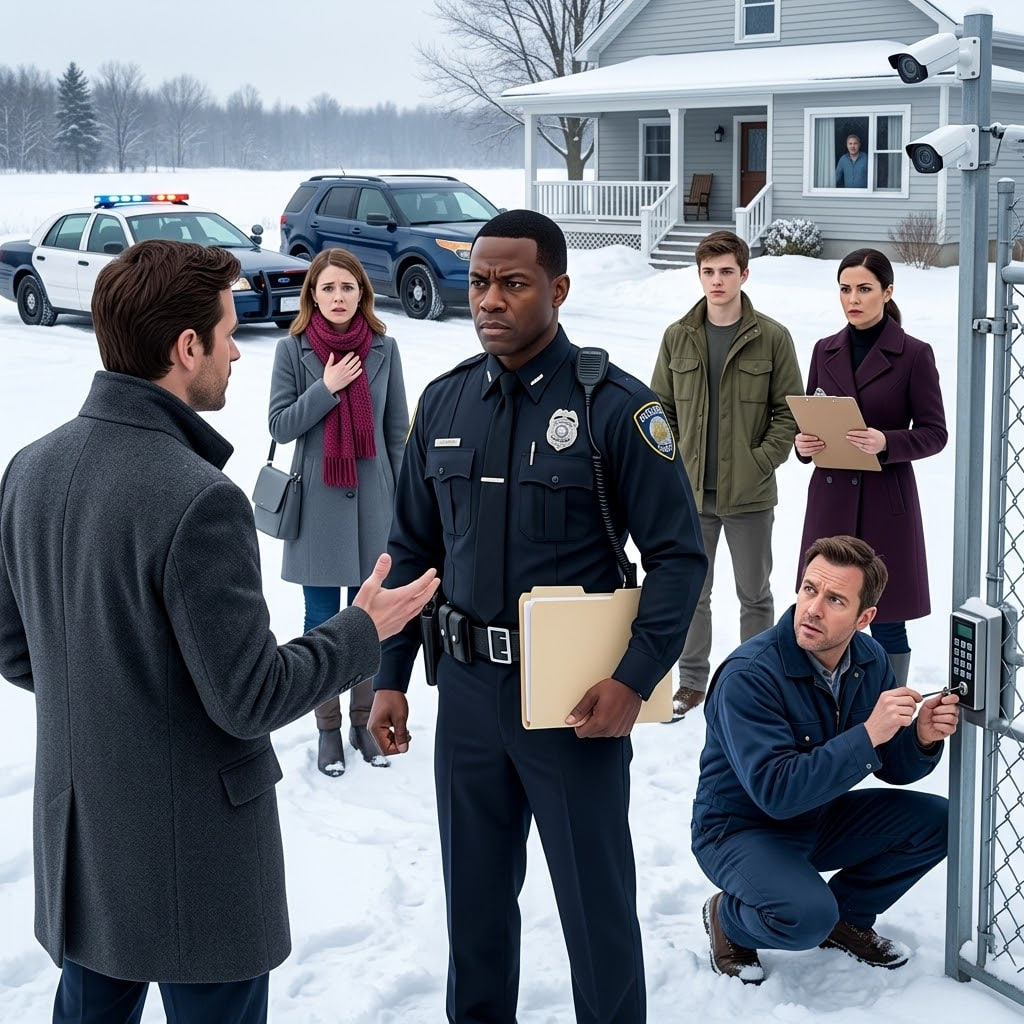
The first headlights belonged to Dad’s truck. The second belonged to my stepmother’s SUV. The third belonged to my brother’s sedan. Behind them, a realtor parked with a clipboard, and a locksmith opened the back of a van.
I watched from the living room while my father pointed at my fence line. He spoke like a man leading a tour. My brother looked toward the pasture with that familiar patient hunger, as if waiting was the same as earning.
The realtor lifted a paper. My stepmother smoothed her scarf. The locksmith carried his tools toward the gate, and the sound of metal in the morning air made my stomach go cold.
I called the JAG attorney first because I had promised myself never to meet chaos without a witness. He listened for ten seconds, then said, ‘Stay inside. Do not engage. Call the sheriff now.’
The sheriff was already close. That was the part my father never imagined. The day after the first warning, my attorney had helped me send the sheriff’s office a packet labeled PROPERTY INTERFERENCE RISK.
Inside were the deed number, closing date, security camera stills, and a written note explaining that no relatives had permission to enter, market, inspect, access, or sell the ranch. It felt excessive when we made it.
It did not feel excessive anymore.
The locksmith knelt at the gate just as the sheriff’s cruiser turned onto the county road. Red and blue light washed over the snow. My father’s face shifted from irritation to recognition before the cruiser even stopped.
The sheriff stepped out with the beige folder in his hand. He did not perform anger. He did something worse for Dad. He performed procedure.
He asked the locksmith whether he had written permission from the titled owner. The man looked at Dad. Dad said, ‘This is family property.’ The sheriff asked again, slower. The locksmith stopped touching the lock.
Then the sheriff asked the realtor whose signature authorized the property assessment. She looked at her clipboard, then at my father, and finally at the gate camera. Her professional smile fell apart one inch at a time.
I stayed inside as instructed. My attorney remained on speaker. Through the monitor, I watched my brother whisper, ‘You told me she agreed to sell.’ That sentence cut through the morning sharper than any accusation.
Dad tried to recover. He said I was being emotional. He said the ranch had been purchased with family in mind. He said my brother needed a clean start and I had always understood that.
The sheriff opened the folder. ‘The recorded owner has provided notice that none of you has permission to enter, alter, list, inspect, or interfere with this property,’ he said. ‘That includes locksmith services.’
My stepmother’s face went flat. Not shocked. Exposed. She had expected tears from me, maybe shouting, maybe a chance to make me look unstable. She had not expected a paper trail.
The realtor stepped back from my father. ‘You represented that you had authority,’ she said. Her voice was low, but the camera caught it. Dad’s mouth opened, closed, and opened again.
The sheriff asked the locksmith to pack his tools. Then he warned all four of them that crossing the gate would be treated as trespass. The warning was calm enough to be printed in a report.
My brother finally looked toward the house. For a moment I saw the boy who used to ask me to fix things before Dad found out. Then that look vanished, replaced by resentment.
Consequences rarely feel fair to people who expected gifts.
My attorney told me to save the full video, export the audio, and email both files before noon. He also told me not to answer family texts for at least twenty-four hours.
By 9:42 a.m., the realtor had sent a written apology stating that she had relied on false statements about authorization. The locksmith sent an invoice marked canceled. The sheriff’s incident number arrived by email.
Dad sent nothing until evening. Then came one line: ‘You embarrassed me.’ Not ‘I’m sorry.’ Not ‘I was wrong.’ Embarrassment was the wound he recognized because it was the only one he felt.
I did not answer. I forwarded the message to my attorney and added it to the folder. Not anger. Evidence. There is a difference, and learning that difference saved me from becoming the version of myself they knew how to manipulate.
Over the next month, the sheriff’s warning became a formal no-trespass notice. My attorney sent letters to Dad, my stepmother, my brother, the realtor’s brokerage, and the locksmith company. Each letter was boring, clean, and final.
Boring is underrated. Boring paperwork does what screaming cannot. It takes a private wound and gives it edges other people are forced to respect.
My father tried once more through a cousin, claiming I had overreacted and that family should not involve law enforcement. I asked the cousin one question: ‘Would you let someone bring a locksmith to your gate?’
There was a long silence after that. Some questions do not need eloquence. They need only a fence, a lock, and the truth standing beside them.
Spring came slowly to the ranch. Snow pulled back from the fence posts. The porch stopped groaning under ice. I learned where the wind hit hardest and which hinge needed oil before every storm.
I also learned that peace can feel strange when you have lived too long inside conditional love. At first, quiet felt like punishment. Then it became space. Then it became mine.
On the next Christmas Eve, I did not park at the end of anyone’s driveway. I stayed home in Montana. I made coffee, baked a pie badly, and set one plate at my own table.
One honest place is better than a crowded room that erases you.
The sentence that saved me began in a diner and ended at a locked ranch gate: If I wasn’t welcome at someone else’s table, I would build a home where no one could decide whether I belonged.
My dad didn’t invite me for Christmas, so I bought my own ranch. When they later arrived with a realtor, intent on selling my land for my brother, they assumed I’d be powerless. They learned too late that I was not.