“Read the second page,” I told Mara.
For several seconds, there was only silence on the phone.
Then Mara said, “He’s reading it.”
I could picture my son standing inside the lobby of the company his father and I had built for thirty-four years. He had arrived expecting employees to step aside, keys to appear in his hand, and every account to become his simply because his father was gone.
Instead, he was discovering that his father had prepared for the possibility that grief would not make his son more responsible.
The second page explained the part my son had never bothered to ask about.
The house was protected. It was mine.
The company’s controlling interest had been placed into a trust, and I was the trustee.
My son still had an inheritance. His father had not cut him out. But inheritance was not ownership, and family was not permission to take control of something he had not built.
Mara came back on the line.
“He says your husband promised him the house.”
“He promised him an inheritance,” I said. “Those are not the same thing.”
My son heard her repeat my words.
Then he demanded to speak to me.
Mara hesitated.
I said yes.
A moment later, his voice came through the borrowed phone.
“Mom, what did you do?”
It was the first time since the funeral that he sounded less like an owner and more like a son who had suddenly realized he had misunderstood everything.
“I didn’t do this to you,” I said. “Your father did this because he understood what you were becoming.”
“He would never leave me without the company.”
“He didn’t.”
My son went quiet.
“He left you a future,” I continued. “He just refused to make you responsible for something you were already trying to take before he was dead.”
His voice hardened again.
“You’re still my mother.”
“Yes.”
“Then you should give me the company.”
That sentence told me more than the locksmith ever could.
He still wasn’t asking what his father had wanted.
He was asking what I would surrender.
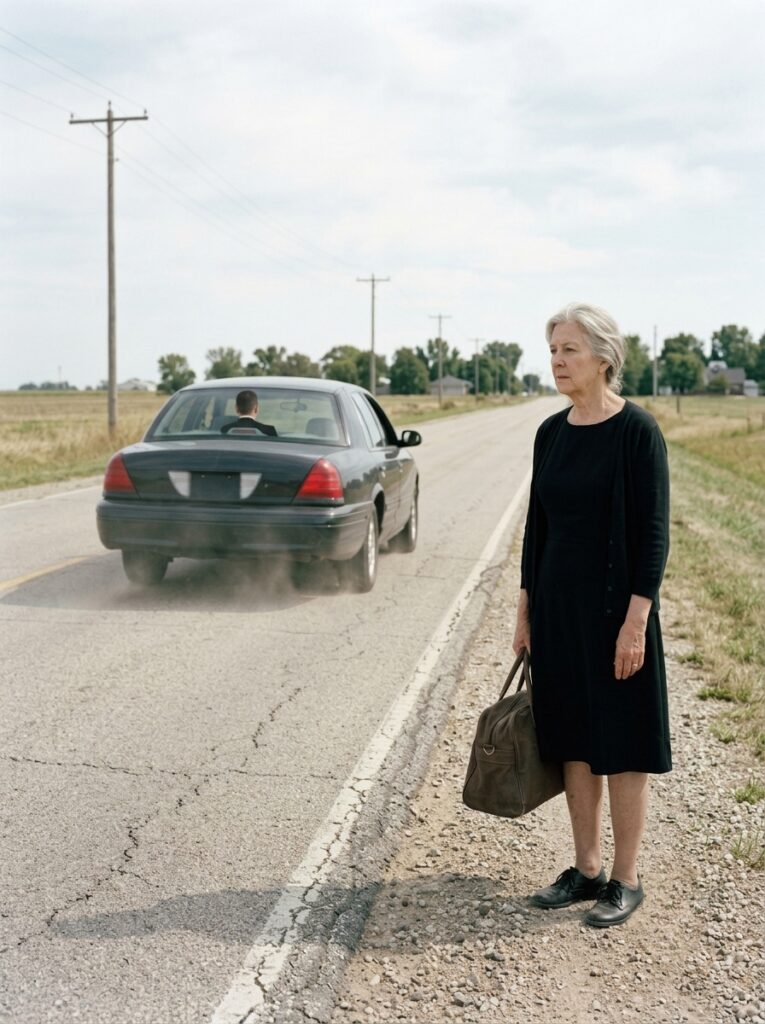
I looked down at my funeral clothes, dusty shoes, and the bag sitting beside me at the gas station counter.
Only a few hours earlier, I had believed losing my home, my phone, my money, and my husband all at once might be the loneliest moment of my life.
Now I understood something different.
My son had not made me powerless.
He had simply removed the last reason I had to keep protecting him from the consequences of his own choices.
“I won’t give you the company,” I said.
He hung up.
Mara was silent for a while.
Then she said, “There’s another problem.”
I straightened.
“What?”
“Your son brought papers with him. He says they’re documents your husband signed giving him authority over the business.”
My stomach tightened.
“Did he show them to you?”
“Yes.”
“Are they original?”
“I don’t know.”
I thought about the attorney’s meeting three weeks earlier. My husband had been weak, but lucid. He had answered every question himself. He had understood exactly what he was signing.
And the attorney had kept copies.
“Tell Mara to photograph the documents,” I said. “Then tell her not to let anyone leave with them.”
She did.
Twenty minutes later, the attorney called me directly.
He had already reviewed the photographs.
“They don’t give him what he thinks they give him,” he said.
I closed my eyes.
“What are they?”
“An old authorization related to his work at the company. Your husband signed it years ago. It allowed your son to handle certain operational matters when he was an employee.”
“And he thinks it makes him owner?”
“He either doesn’t understand the document or doesn’t want to understand it.”
That was the first time I laughed that day.
Not because anything was funny.
Because the truth had finally become simpler than the fear.
My son had spent the afternoon trying to take something that had already been legally protected from him.
But there was still one thing I had not told the attorney.
I wanted to return home.
Not to fight my son.
Not to reclaim the house like a trophy.
I wanted to see the place where my husband and I had raised our family and decide what came next for me.
The attorney arranged for someone to bring me there safely.
By the time I arrived, the sun had fallen low behind the trees.
My son was still at the company.
The house was empty.
I stood in the doorway for a long moment before stepping inside.
Everything looked exactly as it had that morning.
My husband’s chair.
The photographs on the wall.
The coffee cup he had left beside his papers.
For the first time since he died, the silence didn’t feel like something pressing down on me.
It felt like permission.
I walked into our bedroom and sat on the edge of the bed.
That was where he had squeezed my hand and asked me to make the call.
He had known our son might be angry.
He had known I might be blamed.
But he had also known something I had been too afraid to admit.
Protecting our son from consequences had stopped being the same thing as loving him.
The next morning, my son came to the house.
He did not knock gently.
He opened the door and walked in like he had done for years.
Then he saw me sitting at the kitchen table.
His expression changed.
“You came back.”
“I live here.”
He stared at me.
For once, neither of us spoke immediately.
Then he placed a folder on the table.
“I want to fix this.”
I looked at the folder but didn’t touch it.
“What do you want?”
“I want the company.”
I shook my head.
He sighed.
“Then I want my share.”
“You’ll receive what your father left you.”
“When?”
“When the trust requires it.”
His jaw tightened.
“You really chose paperwork over your own son?”
“No,” I said. “Your father chose responsibility over entitlement.”
That stopped him.
I pushed the folder back toward him.
“If you want to work for the company, you can speak to the attorney and apply like anyone else. If you want to manage it someday, you can prove you are capable of managing it. But you don’t get to inherit control simply because you are his son.”
He looked toward the hallway.
“Dad would have wanted me to have it.”
“He wanted you to become the kind of man who could be trusted with it.”
My son looked down.
For the first time, he had nothing to say.
Then he asked the question I had been waiting to hear.
“Why didn’t you tell me?”
I answered honestly.
“Because your father wanted you to show us who you were without knowing we were watching.”
His face changed.
Not dramatically.
Just enough.
The anger gave way to something quieter.
Shame, perhaps.
Or the beginning of it.
He stood there for a long time before picking up the folder.
At the doorway, he stopped.
“Mom.”
I looked at him.
“I’m sorry about the road.”
Those were the first words he had said that had nothing to do with money, property, keys, or ownership.
I didn’t rush to forgive him.
I didn’t tell him everything was fine.
It wasn’t.
But I nodded.
He left.
A week later, the attorney finalized the arrangements. The business continued under the structure my husband had chosen, with me overseeing the controlling interest. Employees who had spent years wondering whether the company would survive my husband’s illness finally knew it would continue.
Mara stayed in her position.
The locksmith never returned.
And my son did not become the owner simply because he had been the first person to start counting what his father left behind.
Months passed.
He eventually asked whether he could return to work.
This time, he didn’t demand a title.
He asked what he needed to learn.
That question mattered more than an apology.
I told him he could start at the bottom of the management structure and earn responsibility one piece at a time.
He agreed.
It was not a miracle.
He didn’t become a different man overnight.
But for the first time, he understood that being family was not a shortcut around accountability.
And I understood something about myself too.
The woman he left beside that empty road was not the same woman who came home.
She had spent years believing that keeping peace meant carrying everyone else’s burdens quietly.
She had mistaken sacrifice for duty.
She had allowed herself to become invisible inside a family she had helped build.
My husband had seen that long before I did.
He had not protected me because he thought I was helpless.
He protected me because he knew I had spent too long pretending I didn’t need protection.
The house was still mine.
The business was still standing.
My husband’s memory was no longer tied to the fear of what would happen after he died.
And my son finally understood that what his father left behind was not a prize waiting for whoever reached it first.
It was a responsibility.
One he would have to become worthy of.
Sometimes losing everything you thought you needed is the moment you discover what nobody can take from you.
That empty road looked like abandonment when my son drove away.
But it became the first place where I realized I could stop living for everyone else.
I had my husband’s final decision.
I had the truth.
And, finally, I had my own life back.