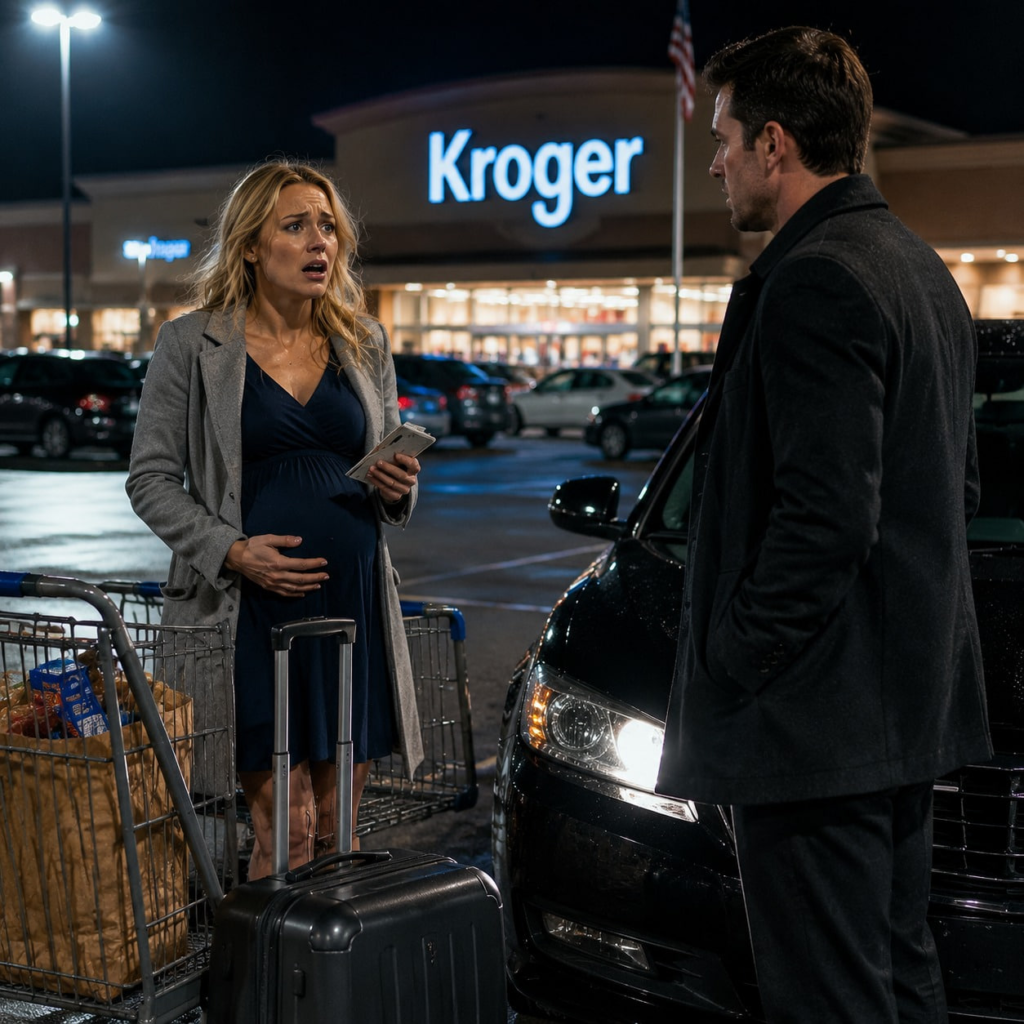
“That’s not my child,” Derek said, dropping the ultrasound like trash while Megan stood frozen, eight weeks pregnant and suddenly homeless. By midnight, she was shivering in a Kroger parking lot with $400, a baby onesie beside her, and one terrifying question burning through her tears: why had he planned this before she even told him the news at all?
The night my husband threw me out, he did not slam the door like an angry man losing control. He closed it softly, almost politely, as if I were a saleswoman he had decided not to invite inside. That was what terrified me most. Not the words he had said. Not the cold February air slicing through my sweater. Not even the tiny ultrasound photo trembling in my hand. It was the calm on Derek Harper’s face as he looked at my pregnancy announcement, set the little white onesie back into the gift bag, and said, “That’s not my child.”
For a second, I laughed. I truly laughed, because the human mind will do anything to protect itself from a truth too ugly to enter all at once. I thought he was making a cruel joke. I thought he was stunned. I thought maybe the shock had twisted his face into something unfamiliar. But Derek did not laugh. He did not blink. He stared at me across our kitchen island with the expression of a man who had rehearsed the moment, and then he said it again.
“That is not my child, Megan.”
The house seemed to pull all its warmth away from me. The lights over the island were bright, the counters spotless, the refrigerator humming behind me, everything exactly as it had been when I walked in carrying what I believed would be the happiest news of our six-year marriage. I had imagined tears. A hug. His hand on my stomach. Maybe disbelief turning into joy. I had bought a tiny onesie that said future architect because Derek always joked that our child would inherit my obsession with straight lines and blueprints.
Instead, he told me I had betrayed him.
I tried to speak, but he stepped back as if my reaching hand disgusted him.
“You need to leave,” he said.
“What?”
“Tonight.”
“Derek, I’m pregnant.”
“I know what you are.”
That sentence hit harder than shouting could have. I stood there with my mouth open, my body already protecting the life inside me before my mind understood that I had just become homeless in my own kitchen. I asked him what he was talking about. I asked who had put this idea in his head. I asked how he could look at me after six years and believe, instantly, without proof, without hesitation, that I had been unfaithful.
He did not answer any of it. He walked to the front door, opened it, and waited.
By nine o’clock, I was sitting in my car in a Kroger parking lot two miles from the house, still wearing my work heels, the pregnancy gift bag on the passenger seat like evidence from a crime scene. My breath fogged the windshield. Shoppers pushed carts under harsh white lights. Children complained about cereal. A man loaded paper towels into his trunk. The whole world kept moving while mine collapsed in silence.
I did not cry right away. That was the strangest part. I sat with both hands on the steering wheel and stared at the store entrance, asking myself one question over and over.
What kind of husband hears that his wife is pregnant and reacts with immediate certainty that the child is not his?
Not suspicion. Not fear. Certainty.
That was the first crack in the story Derek wanted me to believe. And through that crack, something colder than grief began to enter.
I had been married to Derek Harper for six years. We lived in a quiet suburb north of Atlanta, in a four-bedroom house with trimmed hedges, neighborhood barbecues, and an HOA that sent dramatic letters if your grass dared to grow half an inch too high. I was an architect at a midsized firm downtown. Derek worked in commercial real estate. We were the kind of couple people praised without really knowing us. Stable. Successful. Polished. Fine.
But “fine” is often just a curtain people hang over rot.
The warning signs had started more than a year earlier. At first they were small enough to dismiss. Derek began taking phone calls in the garage. He would stand between the tool shelves and his golf clubs, voice low, back turned, then come inside with an easy smile and say it was a client issue. I believed him because belief is easier than suspicion when your life depends on trust.
Then came the withdrawals. Two hundred dollars here. Three hundred there. Always cash. Always during work hours. When I asked, Derek said he had been taking clients to lunch and forgetting receipts. He smiled in that calm, reasonable way of his, the one that made me feel dramatic for even asking.
After that, he began mentioning Thomas.
Thomas Caldwell was my first husband. We married when I was twenty-four and divorced four years later, not with screaming or betrayal, but with the quiet sadness of two people who had grown in different directions. He moved to Portland, built a software company, and disappeared from my life completely. I had not spoken to him in over a decade.
So when Derek casually asked, “Whatever happened to that first husband of yours? The tech one?” I thought it was jealousy. Then he asked again a few weeks later. Then a third time, hidden inside some joke about entrepreneurs and startup money.
I should have paid attention. Derek was not curious without purpose. He valued information the way other men valued money, because to him they were the same thing.
That night in the parking lot, with four hundred dollars in my personal checking account and most of my savings locked in a joint account Derek controlled, I opened my phone and searched Thomas Caldwell’s name for the first time in years.
His company had been acquired three years earlier. The price had not been disclosed, but the buyer was large enough to make my stomach tighten. There were old interviews, a business profile, a LinkedIn page frozen in time, and then almost nothing. Thomas had gone quiet after the sale.
Why had Derek been asking about him?
By midnight, my grief had become a list.
I needed my documents from the house: passport, Social Security card, laptop, external hard drive, work files. I needed a lawyer. I needed to know whether Derek could legally lock me out of a house with both our names on the mortgage. I needed health insurance because I was eight weeks pregnant and suddenly alone. And I needed to find out what Derek knew about Thomas that I did not.
I spent the rest of the night in the driver’s seat with the heater running until the air smelled dry and metallic. At dawn, I drove to a twenty-four-hour diner on Peachtree, ordered coffee and eggs I barely touched, and texted Claire Sutton, a family law attorney I had met at a networking event.
Claire, it’s Megan Harper. I need a consultation as soon as possible. Family matter. Urgent.
She replied eleven minutes later.
Come at 8:45. I’ll move my first meeting.
Her office was on the fourteenth floor of a Buckhead building with glass walls and quiet carpets. I arrived in yesterday’s clothes, my hair pulled back with a rubber band from my glove compartment. Claire entered with a yellow legal pad and the calm expression of a woman who had heard every version of betrayal and knew exactly where to begin.
“Tell me everything,” she said. “Don’t edit.”
So I didn’t.
I told her about the pregnancy. The accusation. The cash withdrawals. The garage calls. Thomas. The questions Derek had asked. The parking lot. The joint account.
When I finished, she asked me to log into the bank app.
Two days earlier, our joint account had held just over thirty-one thousand dollars.
Now it held forty-three dollars.
I stared at the screen, expecting panic to hit. Instead, my hand went very still.
“He moved it last night,” I said.
Claire leaned forward. “Show me the transfers.”
There were three of them, made between 9:47 and 10:12 p.m., less than an hour after Derek forced me out. The money had gone into an account I did not recognize.
“That,” Claire said, writing quickly, “is marital asset dissipation. We can move immediately.”
Something in me steadied. Not healed. Not safe. But steadied. Derek had not merely hurt me. He had acted. Actions left records. Records could be used.
Then Claire asked about Thomas.
I told her what I had found online and what I suspected. She listened without interrupting, then said, “If your current husband knew or suspected you were about to inherit something from your first husband, and he tried to push you out before you learned about it, that changes everything.”
“Can he touch it?” I asked.
“An inheritance can often be separate property, depending on how it is handled. But legal architecture matters. You need an estate attorney immediately.”
By the time I left Claire’s office, I had a folder, instructions, and the first feeling of direction I had had since Derek opened the front door.
I sat in my car in the parking garage and began moving through the list. I saved screenshots of the bank transfers. I emailed them to an old personal account Derek did not know about. I contacted the bank using language Claire had given me. Then, with my thumb hovering over the screen, I searched for Thomas’s sister, Rachel Caldwell.
We had not spoken in years. She had been kind to me during my first marriage, kind in a quiet way that never demanded closeness. I found her on Facebook and sent a message explaining that I was sorry to contact her suddenly, but I had reason to believe I might need information about Thomas’s estate.
She called within forty minutes.
“Megan,” she said softly. “Thomas died in September. A stroke. He was forty-seven.”
The parking garage seemed to tilt.
“I didn’t know,” I whispered.
“We wondered why you never responded. His attorneys have been trying to reach you.”
Trying to reach me.
The words slid into place with a terrible click.
Rachel continued, “He never remarried. Near the end, he talked about you sometimes. He said you were the one person who never wanted anything from him.”
I closed my eyes.
“His estate attorney is Gordon Reeves in Portland,” she said. “Megan, you need to call him today.”
I sat there long after the call ended, staring at the concrete wall marked Level 3. Thomas had been dead for five months. His lawyers had been looking for me. Derek had been asking about him for months. Derek had moved money within an hour of throwing me out.
He had known.
Maybe not everything. Maybe not the amount. But he had known enough.
I called Gordon Reeves’s office with my heart beating so hard it hurt. His assistant placed me on hold. Four minutes later, a careful male voice came on the line.
“Mrs. Harper,” he said, “I’m very glad you called. There is a matter of considerable importance regarding the estate of Thomas Caldwell. You are a named beneficiary.”
“How considerable?” I asked.
A pause.
“Seventy-seven million dollars,” he said. “But there is one condition.”
For a moment, the world became soundless.
Seventy-seven million dollars.
I did not feel rich. I did not feel lucky. I felt as if someone had opened a door beneath my feet. Gordon explained that Thomas had created a revocable trust. Most of the assets came from the sale of his software company, along with real estate holdings and investment accounts. The condition was simple: I had to appear in person at the Portland law office within sixty days of formal notification to verify my identity and sign beneficiary documents.
“Was the trust public?” I asked.
“The specific terms, no,” Gordon said carefully. “But someone with resources, motivation, and enough patience might infer its existence through indirect filings.”
I told him about Derek.
Gordon went quiet.
“Mrs. Harper,” he said finally, “you need to ensure that any inheritance remains separate property and goes into accounts your husband cannot access. Given your marital situation, the structure matters enormously.”
“I have an attorney,” I said.
“Good. Come to Portland as soon as possible.”
Four days later, I flew there.
Before I left Atlanta, Claire obtained a temporary order freezing further transfers and sent a formal letter demanding access to the house so I could retrieve my property. A sheriff’s deputy accompanied me. Derek was home when I arrived.
He stood in the kitchen doorway, arms crossed, face unreadable.
His mother, Linda Harper, sat at the kitchen table.
Linda was seventy-one, small, white-haired, and soft-spoken in the way some people are soft-spoken because they know everyone leans closer to listen. She had never liked me, though she had always been too polished to show it crudely. Her disapproval came in teaspoons: a surprised compliment about my career, a gentle correction of my memory, a question that sounded harmless until it landed.
That day, she watched every item I carried out.
My laptop. My passport. My hard drive. A box of books. The ultrasound photo.
As I lifted the last box, she spoke.
“You’re making a mistake, Megan.”
I looked at her for one second, then walked out.
In Portland, Gordon Reeves’s office overlooked the city from tall windows. The meeting took four hours. Identity verification. Trust documents. Marital status affidavits. Tax disclosures. The first distribution would be around eight million dollars within thirty days, with the remainder released over eighteen months as assets were liquidated.
I signed where Gordon told me to sign.
But the money did not feel like rescue. Not yet. It felt like a spotlight. And I knew Derek and Linda could see it.
The first threat came the next morning after I returned to Atlanta. I was staying in the spare room of my friend Jess, who had handed me a key without a speech and said, “Stay as long as you need.”
My phone rang from an unknown number.
A man’s voice said, “Megan, I’m a friend of Derek’s. Just calling as a courtesy. Women in your position should be careful. Professional licenses can be challenged. Reputations can get complicated.”
I stood in Jess’s kitchen, one hand on the counter.
“I’m recording this call,” I said. “Tell me your name.”
The line went dead.
I called Claire. She filed a harassment motion by Monday.
Derek’s attorney, Stuart Pell, suddenly wanted a more “constructive” approach.
“They expected you to be scrambling,” Claire told me. “They did not expect you to already have counsel.”
“They’ll try something else,” I said.
They did.
A week later, Stuart sent a settlement offer. Derek would not contest the divorce. He would “generously” waive any claim against the Portland inheritance. In exchange, I would accept a reduced share of the marital assets, drop the harassment motion, and sign an NDA agreeing never to discuss the circumstances of our separation.
I read the letter twice.
“He’s buying silence,” Claire said when I called.
“Yes.”
“The NDA is the point. Not the money.”
I knew that. Derek’s reputation mattered. Commercial real estate was built on confidence, connections, private handshakes, and the illusion of good judgment. A public record showing that he had researched his wife’s ex-husband’s estate, accused his pregnant wife of infidelity, drained the marital account, and tried to intimidate her professionally would be poison.
But I also knew Derek had not acted alone.
So I called Rachel Caldwell and asked whether anyone had contacted her after Thomas died, asking about his estate or about me.
Rachel was quiet.
“A woman called,” she said. “About two months after Thomas died. She said she was a journalist writing about tech acquisitions. She asked whether Thomas had left any significant bequests.”
My fingers tightened around the phone.
“Did you get a name?”
“No. But I remember the area code. Atlanta.”
Linda.
That evening, Jess found me at her kitchen table surrounded by papers.
She made pasta, poured herself wine and me water, then sat across from me.
“Tell me where we are,” she said.
I told her everything. The inheritance. The fake journalist call. The settlement offer. The threat. The money transfers.
Jess listened in silence.
“So his mother found out before he threw you out,” she said.
“I think so.”
“And they wanted you gone before the estate reached you.”
“I think they miscalculated. Maybe they thought Thomas left me something modest. Maybe they thought if Derek separated from me fast enough, he could control the narrative or pressure me into sharing. Then I got pregnant, and he panicked.”
Jess twirled pasta around her fork.
“What do you need from me?”
“I may need a witness. Someone who can speak to where I stayed, what condition I was in, the timeline.”
“Done.”
That was Jess. No drama. Just a locked door behind me and a light left on.
Linda came on a Sunday morning.
She called Jess’s number, which I had never given her. That alone told me Derek was still digging. She asked if she could come over “just to talk.” I said yes because refusing would give me nothing. Meeting her might give me information.
She arrived with homemade cookies.
That detail almost made me laugh. Linda understood theater. She knew exactly what kind of woman brings cookies to a pregnant daughter-in-law she helped destroy.
She sat in Jess’s living room, placed the container on the coffee table, and folded her hands.
“I want to apologize for Derek,” she said. “He panicked.”
I said nothing.
“He’s been under enormous stress. The pregnancy overwhelmed him. He reacted badly, and he knows that.”
Still, I said nothing.
“Megan, this does not have to become a war. Six years of marriage. A baby coming. A child needs a father. A complete family.”
There it was. The blade wrapped in velvet.
“And the inheritance?” I asked.
For half a second, something flickered in her eyes.
“That is a private matter.”
“Who called Rachel Caldwell pretending to be a journalist?”
Her face did not move enough for most people to notice. But I noticed.
“I have no idea what you mean.”
“I think you do.”
Linda leaned back, warmth returning like a mask lowered into place.
“I am asking you, as the grandmother of your unborn child, to think about what you are destroying.”
“No,” I said. “You’re asking me to protect Derek.”
“He wants his wife back.”
“He wants the lawsuit gone and an NDA signed.”
Her smile tightened.
I stood.
“Tell Derek the answer is no. Tell him I know about the transfers, the research, the call to Rachel, and the timing. Tell him my attorney knows. And if anyone contacts my employer, my witnesses, my doctor, or my friends again, we will file additional motions immediately.”
Linda stood too. The grandmother vanished. What remained was dry, sharp, and cold.
“You are making an enemy,” she said.
“I already had one,” I replied. “I just wanted to know who she was.”
At the door, she turned.
“You have no idea who you’re dealing with.”
After she left, my hands shook. Not because I regretted it. Because my body had held still while my fear had nowhere to go.
I had recorded the conversation. Georgia allows one-party consent. Claire listened to it and said one word.
“Excellent.”
Discovery began in March.
Derek’s attorney objected to almost everything. Claire pushed. The judge overruled most of the objections. Slowly, the truth came out in documents, records, and timestamps.
Derek had searched Thomas Caldwell’s name the previous April. His work laptop showed visits to business articles about the acquisition, Thomas’s LinkedIn profile, and a Portland estate law firm’s page explaining revocable trusts. Linda’s phone records showed a seventeen-minute call to Rachel Caldwell in November, the same fake journalist call Rachel remembered. There were eleven calls between Linda and Derek in the seventy-two hours before he threw me out.
Then came the email.
Derek had written to Stuart Pell the Thursday before my pregnancy announcement.
Need situation resolved before Portland attorneys make contact with M.
M.
Me.
The deposition took place in Claire’s conference room. Derek sat across from me in a gray suit, looking composed in the stiff, artificial way of a man coached to appear innocent. For forty minutes, he said “I don’t recall” so often the words lost meaning.
Then Claire slid the printed email across the table.
“Mr. Harper, do you recognize this?”
He looked down.
A tiny shift moved through his shoulders.
“It appears to be from my account.”
“Did you write it?”
“I may have.”
“The email refers to Portland attorneys making contact with M. Who is M?”
His attorney objected. Claire rephrased.
Derek said, “I don’t recall.”
Claire’s voice stayed pleasant.
“Were you aware before October fourteenth that your wife was a named beneficiary in Thomas Caldwell’s estate?”
Silence.
I counted four seconds.
“I had some information that suggested there might be—”
“Yes or no, Mr. Harper.”
Derek looked at his attorney.
In that glance, I saw the collapse begin. Not loud. Not cinematic. Just the quiet failure of a structure built on hidden rot.
He looked at me then.
For months, I had imagined that moment. I thought I would feel rage, triumph, grief. Instead, I felt calm. Clear, clean calm.
He looked away first.
Eleven days later, Derek settled.
He had no choice.
The settlement acknowledged Thomas’s estate as my separate property. Derek relinquished any claim to it permanently. He repaid the thirty-one thousand dollars with interest. I received sixty percent of the marital assets, including my share of the house equity and investment accounts, because the court had already recognized dissipation and bad faith. The NDA disappeared.
I signed nothing that silenced me.
At twelve weeks, a prenatal DNA test confirmed what I had known from the beginning.
Derek was the father.
The accusation that had thrown me into a parking lot, pregnant and terrified, had always been a lie.
I hope he read that page carefully.
The first estate distribution arrived on a Wednesday morning in April while I was sitting in Jess’s kitchen. The notification appeared on my phone, and for a long time I just stared at the number.
Eight million dollars.
Jess came home to find me still sitting there.
“It came through,” I said.
She dropped her bag and hugged me so tightly I cried for the first time in days.
Not because of the money. Because survival had become real.
Derek signed the final divorce papers on a Thursday. He did not look at me. I did not need him to.
On the drive home, stuck in Atlanta traffic, my daughter moved inside me for the first time. A flutter, small and certain, like a knock from the other side of a door.
I placed my hand on my stomach.
“I know,” I whispered. “I’m here too.”
Her name is Ellie.
She was born on a bright Tuesday in July, seven pounds, four ounces, with Derek’s dark eyes and my stubborn chin. The nurse placed her on my chest, and she opened her mouth in furious protest at being introduced to the world. I laughed through tears because of course my daughter arrived angry and alive and unwilling to be ignored.
We live now in a house in Decatur with better light than the old one. I bought it myself. There is a garden I am learning not to kill, a porch where I drink coffee in the mornings, and an office with my name on the door. My architecture practice has seven steady clients. Not because Thomas’s gift bought my talent, but because it bought me room to breathe, and sometimes room is the difference between surviving and building.
Derek sees Ellie according to the visitation schedule. I do not pretend that is easy. Some days, when I watch him lift her into his arms, I remember the kitchen island, the onesie, the door closing softly. But Ellie deserves a father who is held accountable, not erased. I am still learning how to separate what he did to me from who he must become for her.
Linda has never apologized. I have not spoken to her since the day she left Jess’s apartment with her untouched cookies. I do not expect that to change.
Rachel visited once and brought photos of Thomas from the years after our divorce. Thomas hiking in Oregon. Thomas standing on a dock in a yellow windbreaker. Thomas squinting into the sun, peaceful in a way I had never seen when we were young and trying too hard to become people we did not yet understand.
“He said you were the most structurally honest person he had ever known,” Rachel told me.
I looked at the photograph for a long time.
“I tried to be,” I said.
Sometimes, in the quiet after Ellie falls asleep, I think about the sequence that brought us here. A pregnancy announcement. A lie. A parking lot. A diner booth. A lawyer’s office. A call from Portland. A woman with cookies and cold eyes. A deposition table. A flutter in traffic.
At the time, it did not feel like a story with meaning. It felt like standing inside a building as it came apart, listening for which beams would hold.
But the beams held.
Jess held. Claire held. Rachel held. My own anger held. My records held. The truth held.
And I held.
That is what I will tell Ellie someday when she is old enough to ask why her parents are not together, why her grandmother is not in our lives, why her mother keeps documents in careful folders and never signs anything she has not read twice.
I will tell her that people who want to diminish you usually depend on one thing: that you do not know your own worth.
Derek counted on my fear.
Linda counted on my isolation.
They were both wrong.
I was pregnant, broke, humiliated, and sleeping in a car when I began to understand the truth. But even then, even in that parking lot under fluorescent lights, with my whole future reduced to a gift bag and an ultrasound photo, I was not nothing.
I was a woman with a name, a child, a voice, and a record of what had been done to me.
And once I remembered that, there was no door Derek Harper could close that I could not open somewhere else.