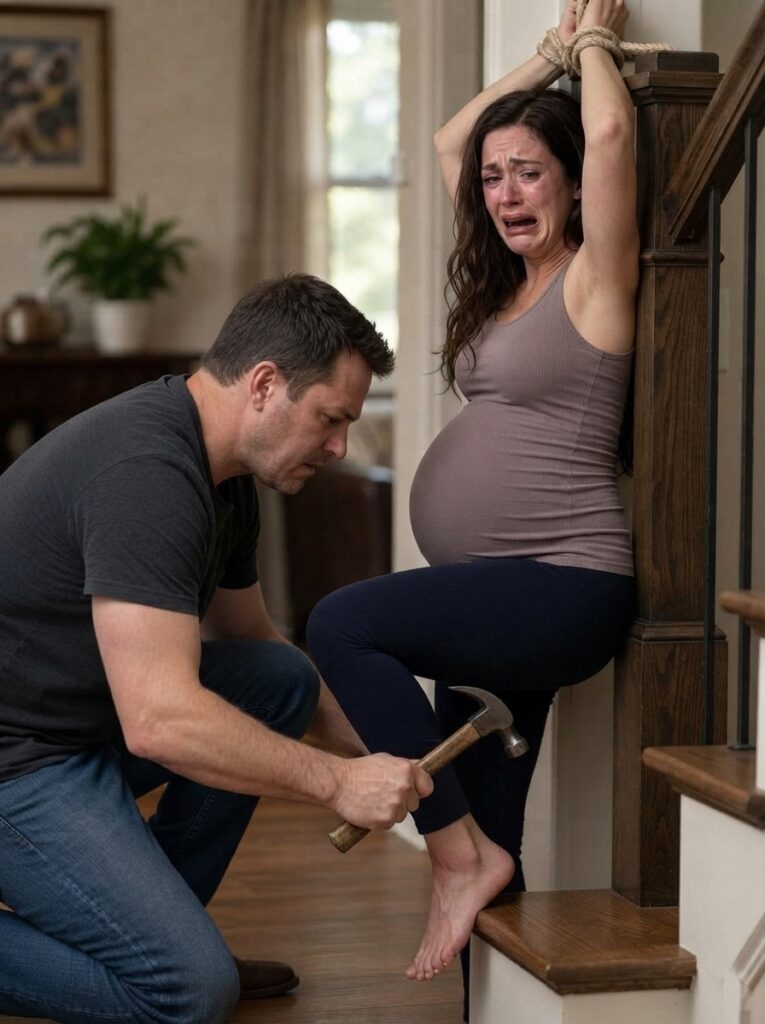
The first time she understood she had a choice, she was lying in a hospital bed with a broken foot, a swollen stomach, and a fear she could not explain away anymore.
For months, she had learned to measure every word. She learned when to stay quiet, when to avoid an argument, and when to make herself smaller so the people around her would not become angry. She had convinced herself that keeping the peace was the safest path.
But the night her husband and mother-in-law tied her to an iron doorframe and turned cruelty into a punishment, something changed. The pain was impossible to ignore. The injury was impossible to hide. And the evidence they left behind would become the thing they feared most.
Her husband had recorded the abuse and shared it in the family group chat, treating what happened as if it were something to brag about. He claimed he was teaching his wife a lesson. He did not realize that the same clip he used to humiliate her would later prove exactly what he had done.
When her sister arrived at the hospital, she did not come with empty sympathy. She came with the truth saved on her phone.
She had kept the video before anyone could remove it. She saved the post from his account. She preserved the proof that could no longer be dismissed as a private disagreement or a misunderstanding between a married couple.
Then she asked the question the woman had been avoiding since she opened her eyes in the hospital.
“Are you going back with him?”
The question was simple, but the answer carried everything she had been afraid to admit.
She looked at her injured foot. She looked at the child she was carrying. And she realized that even after everything, part of her was still thinking about how to avoid making him angry.
That was the habit abuse had created. She was no longer only afraid of what he might do. She was afraid of his reaction to her choices.
Her sister did not demand an answer immediately. She only waited.
Finally, the woman said the word that changed everything.
“No.”
Her voice was weak from pain, but the decision was stronger than the fear that had controlled her.
Her sister asked her to say it again.
“I’m not going back.”
That was the moment the room changed. Not because the injury disappeared. Not because the danger was suddenly gone. But because she finally stopped protecting the people who had hurt her and started protecting herself and her unborn child.
The hospital staff had already asked questions about her safety. Before, she had avoided saying too much. She had softened the truth. She had tried to survive the situation by making it sound smaller.
This time, she answered honestly.
She told them her husband had used the hammer. She told them his mother had been there encouraging him. She told them she had been pregnant when it happened.
When they asked whether her husband should be allowed into her room, she gave another answer she had never felt strong enough to give before.
“No.”
Her sister stayed beside her while the evidence was protected and the truth was finally spoken clearly.
Then the phone started buzzing.
The family group chat was changing.
The post with the video disappeared. Some messages around it were deleted. Someone was trying to erase what had been shared.
But it was too late.
The important evidence was already saved.
A short time later, her husband contacted her sister directly. He did not ask whether his wife was safe. He did not ask whether the baby was okay. He did not ask how serious the injury was.
He demanded that the video be deleted.
That request revealed more than any explanation could have.
His first concern was not the person he had injured. It was the proof of what he had done.
Her sister read the message and locked her phone.
“Do you want me to answer him?” she asked.
The woman shook her head.
“No. Keep it.”
Then her husband called.
His name appeared on the screen. The phone rang until the call ended. Then it happened again.
Again and again.
Her mother-in-law called as well.
She ignored both.
She was no longer ready to listen to explanations that could not change what her body had already experienced.
Then her sister looked at the phone again.
Her expression changed.
“He knows I still have the video,” she said. “And he says he’s coming here.”
For a moment, fear returned.
The hospital room suddenly felt smaller. The memory of the doorframe, the hammer, and the voices came rushing back.
But there was one difference this time.
She was not alone.
And there was a door between her and him.
This time, she had the right to decide whether that door opened.
She looked at her sister and made the choice.
“Tell the front desk he does not come through that door.”
Her sister walked out before he reached the floor.
The staff did exactly what they were supposed to do. They checked with the patient directly. They did not assume that being married gave him access. They did not treat the situation as a simple family argument.
When they asked again, she repeated the same sentence.
“I do not want him in my room.”
Outside, her husband demanded to see his wife.
He called it a private family matter. He acted as though the hospital was only a temporary obstacle between him and control over the situation.
But the moment he saw her sister standing nearby with the phone in her hand, his focus changed.
The video.
Again, it was the video.
“Delete the clip,” he told her.
Her sister did not move.
From inside the room, the woman spoke.
“You posted it yourself.”
For the first time, his attention shifted away from taking her home and toward explaining himself.
He said people were misunderstanding him. He said the family should not be involved. He said private problems should stay private.
But the facts were already there.
The injury was there.
The recording was there.
The witnesses were there.
And the woman who had spent so long trying not to upset him was now refusing to help him hide what happened.
Her sister quietly asked whether she wanted her to remain outside or come back into the room.
The answer was immediate.
“Yes.”
The door closed.
For the first time, the barrier between them was not something used to trap her.
It was something that protected her.
Then his voice came through from the hallway.
“If you walk out of here with her, don’t come back to my house.”
The threat was meant to create fear. It was meant to make her think about losing the life she knew.
Instead, she looked at the person standing beside her and made her decision.
“When they discharge me,” she said, “I’m leaving with my sister.”
That choice did not erase what happened. It did not repair the injury overnight. It did not remove the fear created by months of control.
But it marked the moment when she stopped asking how to return to the life she had before.
She began deciding what kind of life she wanted after.
Her sister had saved the evidence. The hospital had recorded the truth. The door had stayed closed because she said it should.
The person who once controlled every conversation no longer controlled the next step.
The woman who had been forced into silence had finally spoken the one sentence that mattered most.
She was not going back.