I used to think the worst thing my family could do was look down on me.
I was wrong.
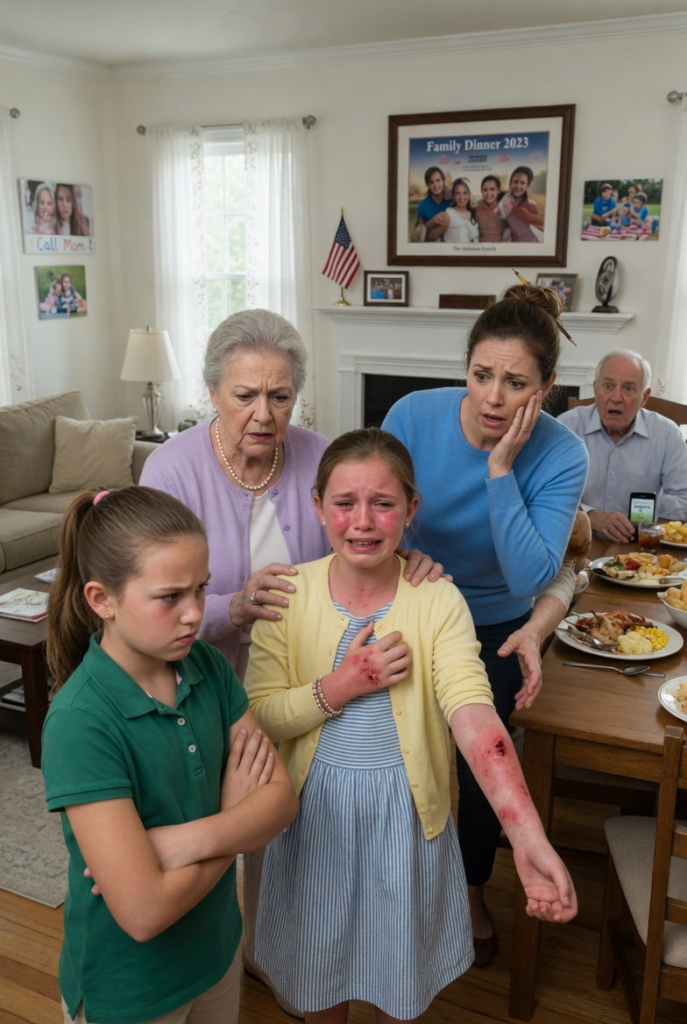
The worst thing they did was wait until my little girl was standing in their living room, small and trusting and desperate to be loved by them, then prove to her that her pain meant nothing.
Her name is Lily.
She was seven years old that night, still young enough to believe adults would stop bad things before they got too big, still young enough to bring a drawing to dinner and hope her grandmother would tape it to the fridge.
I had been bringing her to my parents’ house in Beaverton every Sunday because I kept telling myself it was good for her.
I told myself children needed grandparents.
I told myself she needed an aunt, a cousin, a table full of familiar faces, and maybe some memory of family that did not feel like bills on the counter and me coming home tired from another long shift.
That was the story I kept repeating because the truth was harder.
The truth was that I wanted Lily to have what I never really had.
I wanted her to walk into that house and be seen.
My older sister, Claire, had always been the daughter my parents knew how to love out loud.
She had the kind of life they liked to talk about at dinner.
Her husband had a steady job, her house was always clean in photos, her Christmas cards looked professionally arranged even when she swore they were casual, and her daughter Harper had a closet full of little outfits my mother praised like each one was an achievement.
Claire could complain about being exhausted, and my mother would tell her she worked too hard.
I could come in with Lily after a double shift and hear, “You look tired,” in a tone that somehow made tired sound like a character flaw.
They never had to say I was the disappointment.
They had better manners than that.
They said it with the tiny pause before calling my apartment “simple.”
They said it with the way my father asked whether I was still at the same job, as if honest work turned sour if it did not come with a title.
They said it with the way Claire smiled when Lily’s shoes were scuffed, the way my mother noticed every little thing my daughter lacked and none of the things she carried.
Lily carried kindness.
She carried patience.
She carried the kind of hope that made her ask, every Sunday, whether Grandma would like the picture she made that week.
Most weeks, my mother would glance at it for two seconds, say, “That’s nice,” then turn back to Harper before Lily had even finished explaining the clouds or the dog or the crooked house she had drawn.
I saw Lily’s face each time.
She would smile anyway.
She would fold the paper carefully.
She would sit a little straighter at dinner, like maybe good posture could earn affection.
That evening, the house smelled like roasted chicken, lemon cleaner, and the faint metallic heat of an iron.
Claire had been pressing a blouse in the living room because she had plans after dinner, and somehow even that was treated like normal, like an iron board beside two children was just part of the furniture.
The iron was upright.
The cord ran down the board and toward the wall.
I remember seeing it.
I remember thinking someone should unplug it.
Then my mother called me into the kitchen to help with plates, and I made the mistake of trusting the adults in the room.
That mistake will live in my body forever.
Lily and Harper were on the rug near the coffee table, surrounded by a few toys that had been kept at my parents’ house for years.
One of them was a stuffed rabbit, the cheap kind with matted ears and a faded ribbon, the kind most children love for no reason except that it is soft.
Harper had ignored it all evening.
Lily picked it up gently and tucked it under her chin.
Harper spun around like Lily had stolen something valuable.
“That’s mine,” she snapped.
Lily looked confused.
“You weren’t using it,” she said. “Can we take turns?”
There was nothing bold in her voice.
There was no challenge.
There was only a child asking for a turn with a toy in a room full of adults.
Harper’s mouth twisted.
“I don’t share with garbage.”
I heard that word before I saw her move.
Garbage.
It did not sound like a child trying out an insult from a cartoon.
It sounded rehearsed.
It sounded familiar in her mouth.
Children do not learn contempt from empty air.
They learn it from adults who say things when they think the right people are listening.
They learn it from dinner tables and closed doors and small comments dressed up as concern.
I turned from the kitchen doorway.
By then, Harper was already moving toward the ironing board.
For one breath, my mind refused to understand what was happening.
Harper’s hand wrapped around the iron handle.
Lily stepped back.
My sister watched from the sofa.
My father sat in his chair.
My mother stood closer to Lily than anyone else.
There were so many adults in that room that someone should have stopped it before it became a memory.
Nobody moved.
Harper lifted the hot iron and pressed it against Lily’s arm.
Lily screamed.
It was not a regular cry.
It was not the sound children make when they fall and wait to see if everyone else is scared.
It was raw and sharp and so full of betrayal that every part of me moved before thought could catch up.
I ran toward her.
The room seemed to stretch.
The sofa, the coffee table, the rug, the ironing board, all of it turned unreal, like a nightmare where your feet will not obey you.
Lily was twisting away, sobbing, her small body trying to escape the heat and the people around her.
Harper still had the iron.
Then Claire laughed.
It was not nervous laughter.
It was not shock.
It was the kind of laugh people make when they think someone has finally been put in their place.
“Garbage should learn what heat feels like,” Claire said.
I had heard cruelty from my family before.
I had heard polished insults, quiet digs, and little jokes designed to make me feel grateful for scraps.
But hearing my sister say that while my daughter cried changed the air in my lungs.
I reached for Lily.
My mother stepped forward.
For one half-second, I thought she was going to protect my child.
I thought some old instinct would wake up in her and she would grab Harper’s wrist or unplug the iron or shout for everyone to stop.
Instead, my mother grabbed Lily by the shoulders.
She held her still.
“Stop fighting,” she said, sharp and irritated, like Lily was the one making a scene. “Harper is teaching you not to take things.”
Teaching her.
That word has stayed with me almost as much as the scream.
It was the word that told me this was not confusion.
It was not panic.
It was not a bad moment that got out of hand before anyone understood it.
They understood.
They simply believed Lily deserved it.
My father leaned back in his chair and looked at my daughter’s terrified face.
“If it were me,” he muttered, “I would’ve aimed higher.”
That was when something inside me closed.
Not broke.
Closed.
There is a kind of grief that makes you fall apart, and there is another kind that puts a wall inside you so fast you can hear the lock slide into place.
The people in that room were not my safety net.
They were not flawed family.
They were danger wearing familiar faces.
I pulled Lily away so hard we both nearly fell.
She collapsed against me, shaking and making small broken sounds into my shirt.
Her hand was clamped over her arm.
I could feel her whole body trembling.
No one apologized.
No one looked ashamed.
No one even pretended to be shocked.
Claire sat there with that thin smile.
My mother looked annoyed, like I had interrupted a lesson.
My father stared as if Lily’s crying was an inconvenience.
Harper still looked angry about the rabbit.
I wanted to scream until the windows shook.
I wanted to grab the iron and throw it through the wall.
I wanted to point at each of them and ask what kind of family holds a child still while she hurts.
But I knew them.
I knew how fast they could turn a story.
They had practiced on me for years.
If I yelled, I would be unstable.
If I cried, I would be dramatic.
If I argued, they would say I was jealous of Claire, resentful of Harper, overreacting because my life had not turned out the way theirs had.
Anger would have given them something to hold.
So I gave them nothing.
I picked Lily up.
I grabbed my purse.
I walked toward the front door.
Behind me, Claire called, “That’s right, run away. That’s all you ever do.”
I did not answer.
I did not turn around.
Sometimes the strongest thing a mother can do is stop explaining herself to people who already chose not to hear.
Outside, the evening air hit my face cold enough to steady me.
Lily was crying against my shoulder.
The small American flag on my parents’ porch moved in the wind beside the mailbox, bright and ordinary and useless.
I buckled Lily into the back seat of my car with hands that shook so badly I had to try twice.
Then I drove.
I did not drive home.
I did not sit in a parking lot and wonder whether I was making too much of it.
I did not call Claire and ask for an explanation.
I drove straight to the emergency room in Portland.
Lily cried most of the way.
Every little sound she made felt like another accusation against every adult who had stood there and watched.
At a red light, she whispered, “Mommy, why did Harper hurt me?”
I gripped the steering wheel so hard my fingers hurt.
There are questions children ask that no mother can answer without losing some part of herself.
“Because Harper made a terrible choice,” I said.
My voice sounded calm.
It did not feel calm.
A few minutes later, Lily asked, “Why did Grandma hold me?”
That one nearly took me under.
How do you explain betrayal to a seven-year-old?
How do you tell a child that love and blood are not the same thing?
How do you tell her that sometimes the people with the family title are the last people who deserve family access?
I swallowed until I could speak.
“Because Grandma made an even worse choice,” I said.
Lily was quiet for a moment.
Then came the question I will hate forever.
“Did I do something bad?”
“No,” I said immediately. “No, baby. You did nothing wrong.”
I said it again.
I said it because she needed to hear it, and because I needed the universe to hear it too.
At the hospital intake desk, the nurse looked up from the computer with that practiced expression people use before they understand what kind of night they are about to enter.
Then she saw Lily’s arm.
Her face changed.
It was not pity.
It was recognition.
She did not ask me whether I wanted to wait.
She did not tell us to take a seat with the other families.
She scanned Lily’s wristband, stood up, and told another nurse to get a doctor.
We were brought back immediately.
The room smelled like sanitizer and paper sheets.
A monitor blinked in the corner.
A nurse pulled on gloves and spoke to Lily so gently that my daughter started crying again, not because the nurse scared her, but because kindness felt unfamiliar after that living room.
A doctor came in.
Then a social worker.
The questions began, careful and precise.
How did this happen?
Who was holding the iron?
Were adults present?
Did anyone try to stop it?
Was Lily restrained?
That word made my stomach turn.
Restrained.
It sounded official.
It sounded clean.
It did not sound like my mother putting both hands on my child’s shoulders while my niece hurt her.
I answered every question.
My niece pressed the hot iron against my daughter’s arm.
My sister laughed.
My father encouraged it.
My mother held Lily still.
The doctor stopped writing for a second.
The social worker looked at Lily, then back at me.
Nobody in that room treated my words like family drama.
Nobody told me I was emotional.
Nobody asked what I had done to provoke it.
The doctor examined Lily gently and documented everything.
She told the nurse what to note on the chart.
She asked about pain.
She explained each step before touching my daughter.
Lily cried until she was exhausted.
I sat beside her, brushing damp hair off her forehead and repeating, “You’re safe now,” even though I knew those words had changed.
Safety used to mean locked doors, working brakes, enough groceries, enough money for rent.
Now safety meant evidence.
It meant documentation.
It meant people outside the family hearing the truth before the family could bury it.
The doctor finally looked at me with controlled fury in her eyes.
“This was not an accident,” she said.
The sentence hit me like a verdict.
Not because I did not know it.
Because someone else finally said it out loud.
She told me the hospital had to report it.
Police and child protective services would be contacted.
I nodded.
“Please do,” I said.
Two words.
They were the easiest two words I had spoken all night.
The nurse stayed with Lily while they cleaned and treated her injuries.
The social worker stayed close too, never crowding her, never forcing her, just letting Lily understand that every adult in the room was there to protect her, not punish her for being hurt.
Later that night, the police arrived.
Two detectives came in with quiet voices and serious faces.
They did not tower over Lily.
They did not rush her.
They asked simple questions and gave her time to answer.
I sat close enough for her to see me, but I did not speak over her.
That mattered.
For once, nobody in my family was going to tell the story for her.
Nobody was going to call it a misunderstanding.
Nobody was going to say children fight.
Nobody was going to hide behind family.
Lily looked at the detectives and told them.
“Harper burned me.”
She swallowed.
“Grandma held me.”
Then her face crumpled.
“Everyone laughed.”
Every word cut through me, but I let her speak.
I owed her that.
One detective wrote carefully in his notebook.
The other looked toward the doorway, his jaw tight in a way he was trying to control.
When he stepped into the hallway with the doctor, I watched through the glass panel and listened to their voices lower.
I could not hear everything.
But I heard enough.
Intentional.
Evidence.
Charges.
Arrests.
Those words should have scared me.
Instead, they steadied me.
For years, my family had believed they could define reality as long as they said it first and said it with enough confidence.
They could make cruelty sound like concern.
They could make neglect sound like discipline.
They could make a child feel lucky to be tolerated.
Not anymore.
The hospital chart existed.
The report existed.
The photos existed.
Lily’s words existed in a room full of mandated witnesses who did not owe Claire anything and did not fear my mother.
That changed everything.
Lily finally fell asleep under a thin hospital blanket, turned toward me, her bandaged arm resting carefully on top of the sheet.
The fluorescent light made her face look smaller.
Her lashes were clumped from crying.
Her other hand held the edge of my sleeve, even in sleep, as if she needed proof I had not left.
I sat there and made her a promise.
I did not say it out loud.
I did not make a speech for the detectives or the doctor or anyone in that hallway.
I made it in the quiet place inside me that had been trained for years to accept less than I deserved.
I would not let them bury it.
I would not let them explain it away.
I would not let them use the word family as a shield after they had used it as a weapon.
For years, they thought I was weak because I came back to Sunday dinner.
They thought I was weak because I swallowed insults and kept my voice down.
They thought I was weak because I wanted Lily to have grandparents badly enough to ignore the way those grandparents treated me.
They misunderstood the whole time.
I was not weak.
I was hoping.
And when they touched my daughter, hope ended.
By morning, a pale sunrise spread across the hospital window.
The city outside was just starting to move, cars passing below, people carrying coffee, another ordinary day beginning for everyone who had not had their family collapse overnight.
The detective called while Lily was still asleep.
He said they were going to my parents’ house.
He said the evidence was strong.
He said Lily had been very brave.
I looked at my daughter’s bandaged arm and felt the last piece of guilt leave me.
My family thought silence meant I would protect them.
They thought I would be too ashamed, too tired, too trained to keep the peace.
They thought my little girl was beneath them.
They thought garbage deserved to burn.
They had no idea what a mother becomes after she walks quietly out of the fire.
And when the detectives knocked on my parents’ door that morning, Claire’s perfect life was about to meet the truth before lunch.