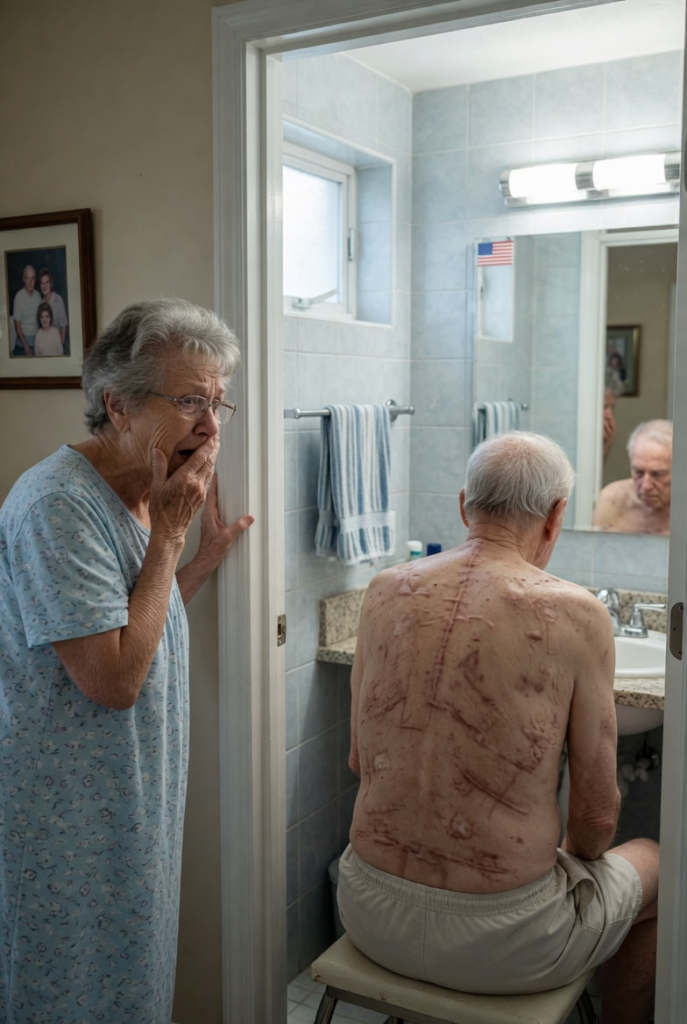
My husband locked himself away every dawn for 35 years, and when I finally looked through the keyhole, I understood why he always said, “I do it to protect you.”
At 3:58 every morning, before the first bus groaned past the corner and before the neighbor’s porch light clicked off, Michael got out of bed.
He moved like a man trying not to disturb the dust.
The old furnace pushed warm air through the vents with a dry little rattle, and the hallway smelled of coffee grounds, laundry soap, and the antiseptic bite I had spent years pretending not to notice.
I would lie still with my eyes closed and listen.
One foot on the carpet.
Then the next.
Then the bathroom door.
Click.
That small click became the sound my marriage made when it stopped letting me in.
My name is Sarah, and I am seventy-eight years old.
For 35 years, I slept beside a man people called steady, decent, dependable, the kind of husband women at church said did not come around twice.
They were right in many ways.
Michael paid bills even when there was barely enough in the account to cover them.
He kept a flashlight in my glove compartment.
He took the trash out before I had to ask.
He never forgot to scrape ice from my windshield.
But every good man has a room inside him that no one else can enter unless he opens the door.
Michael had an actual one.
It was our bathroom at four in the morning.
We lived in a modest one-story house in a working neighborhood where people knew which car belonged in which driveway and which dog barked at delivery trucks.
There was a dent in our mailbox from the winter Daniel learned to back out too fast.
There was a faded chair on the porch Michael kept meaning to repaint.
There was a small American flag he set out on certain holidays, always straightening the stick in the bracket as if the angle mattered.
That was Michael.
Care showed up in his hands before it showed up in his words.
I met him late in life compared with the girls I had grown up with.
He was quiet, broad-shouldered, and shy at a church fundraiser, standing beside a folding table of donated pies while everyone else tried to make conversation over weak coffee.
He worked in a metal parts factory then.
His hands were always clean when he came to see me, but the lines around his fingernails held a gray darkness soap could not reach.
I liked that about him.
A man who worked with his hands did not frighten me.
A man who hid his hands might have.
Michael never hid his hands.
He hid everything else.
When we married, I thought his modesty was old-fashioned.
He changed clothes behind a closed bedroom door.
He did not like swimming.
He would not sleep without a shirt.
If my fingers brushed his back in the dark, his whole body tightened so fast it felt like a wire pulled inside him.
“Ticklish?” I asked once, trying to make it gentle.
He rolled away.
“Something like that.”
I accepted that answer because marriage teaches women to accept many answers that are not answers at all.
Our children, Daniel and Emma, grew up in that house.
They knew their father as a man who fixed loose cabinet hinges, sat through school concerts without checking his watch, and listened more than he spoke.
They also knew not to knock on the bathroom door at dawn.
Nobody made a rule.
The rule simply existed.
One morning, when Daniel was nine, he stood in the hallway holding a broken toy truck while Michael was locked inside.
“Dad?” he called.
The water stopped.
The silence after it felt too sharp for a child.
“Later,” Michael said through the door.
Daniel came back to the kitchen with the truck in both hands and an expression too old for his face.
By lunch, Michael had fixed the toy and set it by Daniel’s plate.
That was how he apologized.
Not with words.
With repairs.
Over the years, I built a whole wall of explanations around that locked door.
Stomach trouble.
Prayer.
Bad memories from work.
A private medical problem.
Something shameful but harmless.
Then the noises changed.
Water still ran.
Plastic still rustled.
But sometimes I heard a bottle tap the porcelain sink, followed by a low sound that did not belong to ordinary discomfort.
It was not a groan exactly.
It was pain being folded smaller.
If I asked, Michael turned pale.
“It’s my stomach, Sarah.”
“Every day?”
“Please.”
He said please like a warning.
So I stopped asking.
There is a kind of peace that is really fear wearing house slippers.
You keep breakfast warm.
You make the bed.
You let one locked door stand because the rest of the house seems steady enough.
Then years pass, and the locked door becomes part of the furniture.
It becomes normal.
That is the most dangerous thing about secrets in a family.
They do not always explode.
Sometimes they simply become the place everyone walks around.
When Michael was hot, he suffered in long sleeves.
When neighbors invited us to backyard cookouts, he sat in the shade with his cuffs buttoned.
When Emma teased him about looking like he was dressed for November in July, he smiled and changed the subject.
At night, he undressed in darkness.
In the rare times we were close, he kept the lamp off and his back turned away from my hands.
I mistook that for distance.
I mistook pain for coldness.
A woman can live beside a mystery so long that she starts blaming herself for not being enough to solve it.
The ugliest night came after the kids had moved out.
We were eating dinner at the little kitchen table, the same table where permission slips had been signed and birthday cakes had been cut.
Michael reached for the salt.
His sleeve pulled back a little.
I saw a strip of skin near his wrist, raised and shiny, like melted wax that had cooled wrong.
He yanked the cuff down.
My heart kicked.
“Michael.”
“Drop it.”
“Are you sick?”
“No.”
“Then what is it?”
He stared at his plate.
I had carried thirty years of questions by then, and they all came out wearing the wrong face.
“Do you have another woman?”
The fork fell from his hand.
It hit the plate with a clean little crack.
His eyes lifted to mine, and for the first time in our marriage, I saw fear before he had time to hide it.
“Don’t say that.”
“Then tell me what you’re hiding.”
His mouth trembled.
Michael, the man who had stood quiet through layoffs, funerals, surgeries, and every hard bill we ever received, pushed back from the table with tears in his eyes.
“I hide it to protect you.”
Then he left the room.
I sat there with the salt shaker between us and felt something colder than jealousy move through me.
Protect me from what?
That question became a second person in the house.
It stood beside me when I folded towels.
It sat in the passenger seat when I drove to the grocery store.
It waited outside the bathroom every dawn.
Daniel told me his father had always been private.
Emma told me some men from that generation carried pain differently.
They were both trying to comfort me.
Neither of them understood that privacy has walls, but fear has teeth.
On Thursday, March 12, I found the pharmacy receipt.
It was crumpled under a coffee filter in the trash.
I almost threw it away without reading it, but the words “nonstick pads” caught my eye.
I smoothed it flat on the counter.
4×4 gauze.
Medical tape.
Antiseptic wash.
Nonstick pads.
The timestamp read 6:17 PM.
Paid cash.
My hands went cold.
A receipt is such a small thing.
Thin paper.
Cheap ink.
A record nobody expects to become evidence.
But I stared at it like it had been notarized by every unanswered morning of my marriage.
That night, Michael came to bed with his usual careful movements.
He kissed my forehead.
His lips were dry.
“Sleep,” he said.
I pretended to.
At 3:56 a.m., his side of the bed shifted.
The room was blue with dawn.
Outside, tires hissed on damp pavement as a pickup rolled past.
Michael sat on the edge of the mattress for a moment, breathing through his nose.
Then he reached into the back of the closet and removed a white pharmacy bag.
He had hidden it behind an old shoebox of family photos.
That detail hurt me more than it should have.
Not because of the bag.
Because our children’s Christmas pictures had been sheltering his pain.
He walked down the hallway.
The door clicked.
I counted seven minutes.
I do not know why seven.
Long enough for him to begin.
Not long enough for me to lose courage.
At 4:05, I stepped into the hallway.
The carpet felt cold under my feet.
The bathroom light made a thin yellow line beneath the door.
Water ran.
Stopped.
Ran again.
Tape tore.
Then came the sound I had heard for years and never named properly.
A man trying not to scream.
My hand went to the trim above the door.
The skeleton key was still there, dusty from disuse.
We kept it for the grandchildren, for accidental locks and silly emergencies.
I took it down.
My fingers shook so hard the key tapped once against the frame.
Inside, Michael froze.
“Sarah?” he said.
I did not answer.
I slid the key from the outside of the old lock slowly, because if I opened the door outright, he would stop me, and I knew this secret had survived too long on my obedience.
Then I bent down.
Through the keyhole, I saw my husband.
Shirtless.
Bent over the sink.
His back did not look like a back.
It looked like a map of everything a body can survive without ever being allowed to tell the story.
Burn scars crossed his shoulders.
Old wounds pulled his skin into ridges.
There were sunken places, shiny places, places that looked stitched by time instead of hands.
Near his left shoulder blade, he was cleaning an angry raw-looking spot with gauze, careful and practiced, biting down on a towel to trap the sound.
I covered my mouth.
For years, I had wondered whether another woman lived inside that room.
Instead, pain lived there.
Pain with a pharmacy schedule.
Pain with cash receipts.
Pain with folded towels and hidden tape.
Pain that woke before me every morning and made itself invisible by breakfast.
The pharmacy bag sat open by the sink.
Medical tape clung to the counter.
His wedding ring lay beside the faucet, small and gold and terribly ordinary.
That was when his eyes lifted to the mirror.
In the reflection, he saw the shadow of me through the keyhole.
“Sarah… don’t.”
He said it softly.
Not as a command.
As a plea.
I stayed crouched there with the key in my palm until my knees started to ache.
“Open the door,” I said.
“No.”
“Michael.”
“No, Sarah. Please.”
The word please was ruined by then.
It no longer meant kindness.
It meant stay away from the truth.
The pharmacy bag tipped when he reached for it.
Something slid under the door and stopped against my slipper.
A folded clinic discharge sheet.
It was creased until the paper felt almost like cloth.
At the top was yesterday’s date.
Under that was Michael’s name.
Under that, in plain block letters, was WOUND CARE.
I sat back against the hallway wall.
The house was very quiet.
Even the refrigerator seemed to have stopped humming.
“Michael,” I said, “I am opening this door.”
“Don’t look at that paper.”
But I already had it in my hands.
Under cause/history, the first line said: chronic burn graft breakdown, industrial injury, long-term self-managed care.
Industrial injury.
I read those words again and again, trying to force them into the man I knew.
Michael opened the door before I could stand.
He had pulled a towel around his shoulders, but it did not cover enough.
Not for him.
Not for me.
He looked smaller than I had ever seen him.
His face was wet, and not from the sink.
“I was twenty-nine,” he said.
That was where the story finally began.
Before me, before our children, before the house with the dented mailbox, there had been a factory accident.
A pressure line failed near a heat process.
Michael did not give me the technical words at first.
He gave me fragments.
A flash.
Hot air.
Metal screaming.
Men running.
His shirt catching.
Someone dragging him by the belt.
A hospital intake desk.
Weeks of white sheets.
Months of bandages.
The first time a nurse told him to look away before they changed the dressings.
He said his parents visited twice and then stopped coming as often because they could not bear the smell of the ointments or the sight of what had happened to their son.
He said the company settled some bills but not enough of a life.
He said he learned how to clean wounds because insurance ended before healing did.
He said people looked at his back and forgot his face.
Then he met me.
“You laughed at my joke about the pie table,” he said, a broken little smile appearing and disappearing. “Nobody had laughed at me in a long time.”
I remembered that joke.
It was terrible.
I laughed anyway because he looked so pleased with himself for trying.
“You should have told me,” I said.
“I was going to.”
“When?”
“After the wedding. Then after Daniel was born. Then after Emma. Then after the kids were old enough. Then after your mother got sick. Then after the mortgage was paid down.”
He wiped his face with the heel of his hand.
“Then it had been too long.”
Secrets do not always begin as lies.
Sometimes they begin as one postponed sentence.
Then another.
Then a whole life is built around not saying the thing that would have changed the shape of the room.
I stood slowly.
He looked away when the towel slipped.
I moved toward him, and he flinched so hard I stopped.
That flinch told me more about his suffering than the scars did.
“Did you think I would leave?” I asked.
He did not answer.
“Michael.”
“I thought you would stay.”
The words landed wrong until he explained them.
“I thought you would stay because you felt sorry for me,” he whispered. “I thought every time you touched me, you would be thinking about this. I thought you would stop being my wife and become my nurse.”
He pressed the towel to his chest.
“I did it to protect you from that.”
I laughed once, but there was no humor in it.
“You protected me from being trusted.”
His face crumpled.
That was the first honest injury of the morning.
Not his back.
Mine.
I wanted to shout.
I wanted to ask him how many nights he had let me blame myself.
I wanted to line up every year he had locked me out and make him look at each one.
Instead, I picked up the gauze from the sink.
My hands were shaking, but they were steady enough.
“Sit down,” I said.
He stared at me.
“Sarah.”
“Sit down.”
He obeyed because he was too tired to keep fighting.
I washed my hands the way I had seen nurses do in hospital rooms over the years.
Then I read the clinic sheet.
Clean with antiseptic wash.
Pat dry.
Apply nonstick pad.
Secure with tape.
Monitor for fever, streaking, odor, increased drainage.
Return if worsening.
It was ordinary language.
That almost made it crueler.
All these years, his private war had been written in instructions anyone could follow if he had only let someone stand close enough.
The first time the gauze touched his skin from my hand instead of his, Michael made a sound like a door coming loose from swollen wood.
I froze.
“Too much?”
He shook his head.
“No.”
“Then what?”
“I didn’t know it could feel different.”
I had to look away.
Because anger is easier than tenderness when tenderness arrives late.
By six-thirty, the sky had turned pale.
I made coffee.
Michael sat at the kitchen table with a clean bandage under his shirt and his hands wrapped around a mug like he needed the heat to hold him together.
The house looked exactly the same.
The scratched table.
The bills clipped to the fridge.
The old magnet from Emma’s college bookstore.
The grocery list written in my handwriting.
Everything ordinary.
Nothing ordinary.
At 7:12, I called the county clinic listed on the discharge sheet.
Michael shook his head when he heard me ask for a follow-up appointment.
I put one finger up, the way I used to do with the children when they interrupted.
That almost made him smile.
Almost.
The nurse on the phone asked if I was the patient.
“No,” I said. “I’m his wife.”
The word felt different in my mouth.
Not smaller.
Larger.
That afternoon, I called Daniel and Emma.
I did not tell them everything over the phone.
Some truths deserve a chair.
Daniel arrived first, still wearing his work jacket, his face guarded the way Michael’s had always been.
Emma came in fifteen minutes later with grocery bags she did not remember buying.
She set milk, bread, bananas, and dish soap on the counter as if ordinary items could soften what she was about to hear.
Michael sat in the living room.
He had changed into a long-sleeve shirt.
Of course he had.
I sat beside him.
That mattered.
He told them about the accident.
Not all at once.
Not cleanly.
His voice broke in places.
Daniel stared at the floor for most of it.
Emma cried without wiping her face.
When Michael apologized for being distant, Daniel looked up.
“You fixed my truck,” he said.
Michael blinked.
“What?”
“When I was a kid. I knocked on the bathroom door. You told me later. I thought you were mad at me.”
Michael closed his eyes.
“I remember.”
“You fixed it by lunch.”
“I didn’t know how else to say I was sorry.”
Daniel’s jaw worked.
“You could have just said it.”
The room went still.
Then Daniel covered his face with one hand.
Emma moved first.
She crossed the room and sat on the other side of her father, careful not to touch his back.
“Can I hold your hand?” she asked.
Michael nodded.
That question broke him worse than any accusation would have.
People think healing begins with forgiveness.
Sometimes it begins with permission.
The next few weeks were humiliating for him and holy for me in ways I still do not have language for.
We went to the clinic.
We sat under bright waiting room lights while a television played a morning show no one watched.
Michael filled out forms with a pen that shook in his hand.
At the line marked emergency contact, he wrote my name.
For the first time.
I watched the letters appear one by one.
Sarah.
Wife.
The wound care nurse was kind without pity.
That helped.
She explained scar tissue, graft breakdown, chronic irritation, pressure points, and infections that can come and go for decades.
She did not gasp.
She did not stare.
She treated Michael’s body as something worthy of care instead of shock.
I saw his shoulders lower half an inch.
It was not a miracle.
It was paperwork, clean hands, and being spoken to like a man.
At home, we made changes.
Supplies moved from the back of the closet to a clear bin under the bathroom sink.
Appointments went on the calendar.
Cash receipts stopped hiding in trash cans.
I learned which tape pulled less.
Michael learned not to apologize every time I helped.
That was harder.
One morning, at 4:00, he sat up out of habit.
I sat up too.
He looked startled.
“You don’t have to,” he said.
“I know.”
We walked to the bathroom together.
The door stayed open.
Not wide.
Not at first.
Just enough.
Enough became our new measurement.
Enough light.
Enough truth.
Enough trust for one morning.
Months later, Michael wore short sleeves on the porch.
Only for ten minutes.
Only with me.
His scars caught the late afternoon sun in pale lines and rough shadows.
He kept his eyes on the maple tree across the street.
I kept my eyes on him.
Not his back.
Him.
“You’re staring,” he said.
“I’m allowed.”
He gave a small huff.
It was not quite laughter, but it was closer than silence.
Daniel came by that evening and saw before Michael could hide.
He did not comment.
He simply handed his father a socket wrench and asked for help with the loose rail on the porch.
That was Daniel’s way.
Not words.
Repairs.
Emma brought dinner the next Sunday.
She made too much pasta and fussed with the salad until no one had to talk for a minute.
Then she sat beside her father and put the serving spoon in his hand.
“Your turn,” she said.
Michael served himself first.
It sounds small.
It was not.
For 35 years, my husband had woken before dawn to keep pain from becoming visible.
He thought that was protection.
He thought love meant hiding the wound so no one else had to carry it.
But love is not always being spared.
Sometimes love is being trusted with the bandage.
I think back now to all those mornings I lay in bed listening to the lock click and telling myself the quiet was normal.
I think about the man behind the door, biting down on a towel, making himself presentable before breakfast.
I think about every ordinary kindness he gave us with hands that were already exhausted.
And I think about the receipt, the key, the strip of yellow light under the bathroom door.
The man who slept beside me for 35 years had been breaking in that bathroom every morning before I opened my eyes, and I had called it distance.
Now, when dawn comes, the door does not lock.
Sometimes Michael still wakes before me.
Sometimes I wake first.
But there are two mugs on the counter now.
There is gauze in the bin, tape in the drawer, and an appointment card clipped to the refrigerator where grocery lists used to hide the important things.
The scars did not disappear.
Neither did the years.
But the secret lost its room.
And one morning, as the first school bus groaned past our corner and warm light touched the hallway, Michael reached for my hand before he reached for the bathroom door.
That was when I understood what protection should have meant all along.
Not silence.
Not a locked door.
A hand held out before the pain begins.