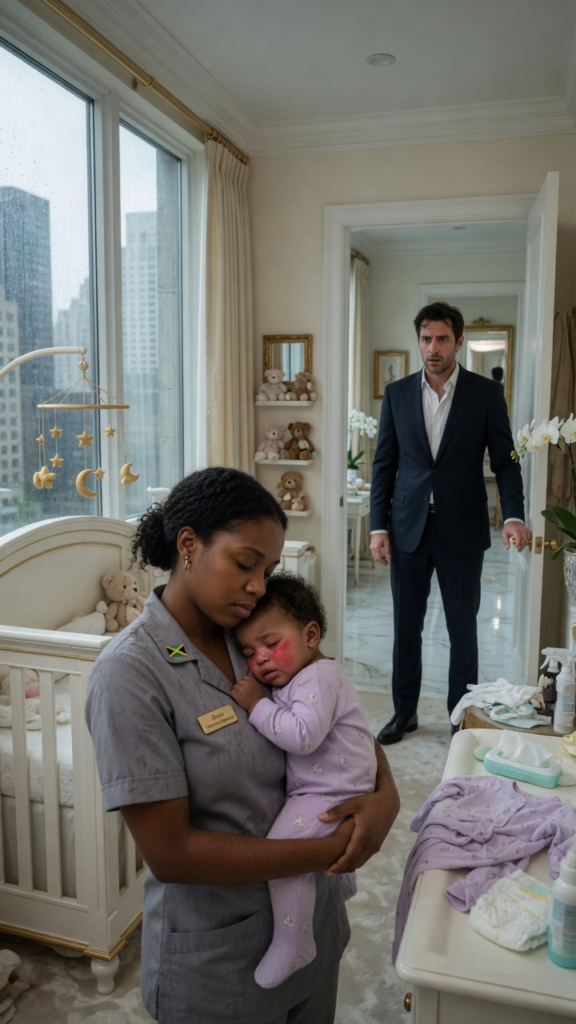
The Billionaire’s Baby Wouldn’t Stop Crying — Until The Cleaner Picked Her Up And Revealed A Secret No One Was Ready For…
Three professional nannies quit in a single week.
The billionaire offered higher pay, private rooms, personal drivers, anything they asked for… but his baby daughter kept crying as if something inside her had been broken.
Then a Jamaican cleaner walked upstairs, held the child for five minutes, and the entire mansion went silent.
Nathan Cole had built his empire on control.
Control over boardrooms. Control over contracts. Control over men who lowered their voices when his name appeared on a meeting schedule. In New York City, especially in the glass towers of the Financial District, Nathan Cole was not merely wealthy. He was a force. A billionaire investor known for buying collapsing companies, stripping them down to their bones, and rebuilding them into machines that made money.
People called him brilliant.
Merciless.
Untouchable.
But at 7:42 on a rainy Tuesday morning, standing inside the private office on the top floor of his Manhattan mansion, Nathan looked nothing like an untouchable man.
“No,” he said into the phone, pacing in front of the tall window as rain streaked silver lines down the glass. “That is unacceptable. That is three nannies this week.”
His assistant sounded frightened on the other end.
“I understand, Mr. Cole, but she said she couldn’t continue. She said she had never heard an infant cry like that before. She said it was… disturbing.”
Nathan closed his eyes.
From somewhere below, through polished marble floors and imported wood, came the sound that had been slowly taking his life apart.
His daughter crying.
Ava Cole was eight months old. Tiny, beautiful, dark-eyed, with soft brown curls and a trembling mouth that seemed to fold before every sob. Since her mother died three months earlier, Ava had cried as if grief had entered her little body and made a home there.
She cried in the morning.
She cried after bottles.
She cried in the bath.
She cried through the night until even the walls seemed tired.
She refused strangers. Refused sleep. Refused the expensive crib a specialist recommended. Refused the imported lullaby machine Nathan ordered because one consultant claimed “consistent sound cues” might calm her.
Nothing worked.
The mansion had become a place of noise and helplessness.
Doctors found nothing physically wrong.
Nannies blamed temperament.
Nathan blamed himself.
But guilt did not feed a baby. It did not make her sleep. It did not bring Claire back.
“Find another nanny,” Nathan said, voice low. “I don’t care what it costs.”
“Mr. Cole, the agencies are becoming hesitant. Some are saying—”
“I said find another one.”
He ended the call and threw the phone onto his desk.
For one moment, he stood completely still.
Then Ava’s crying rose again.
Sharp.
Desperate.
Unbearable.
Downstairs, Grace Bennett stopped wiping a window.
She had arrived at the Cole mansion before sunrise for an emergency cleaning shift. The agency had warned her that the client was rich, difficult, and extremely particular. Grace had heard those words before. In New York, “particular” usually meant people who expected workers to become invisible.
That was fine.
Grace knew how to disappear.
She had been in America for six months, long enough to understand that a city could sparkle and still feel cold. She rented a small room above a corner deli, accepted every cleaning job the agency gave her, and sent most of her money back to Jamaica, where her grandmother needed medication Grace could barely afford.
New York was colder than she expected.
Not only the weather.
The people, sometimes.
The rush.
The way no one looked at anyone too long unless money gave them a reason.
Grace cleaned quietly because quiet women got called back.
But when Ava cried, Grace lowered the cloth.
She frowned and looked toward the ceiling.
That was not an ordinary cry.
Grace had helped raise cousins in Montego Bay. She had bathed babies in plastic tubs, rocked toddlers through fevers, and listened to hunger cries, sleepy cries, angry cries, and dramatic little cries from children who simply wanted the blue cup instead of the yellow one.
This was none of those.
This was distress.
Not spoiled.
Not difficult.
Lonely.
Grace waited.
Surely someone would go.
The crying continued.
She set the cloth down.
A voice inside her warned, This is not your place.
Another voice answered, A baby does not care about your place.
So Grace climbed the stairs.
The higher she went, the louder the crying became. It echoed through the hallway, bouncing off framed paintings and polished mirrors, turning all that luxury into something strangely helpless.
On the second floor, she found the nursery door partly open.
“Hello?” Grace called softly. “Is anyone here?”
No one answered.
She pushed the door open.
The nursery was perfect.
Too perfect.
Cream walls. White furniture. A gold mobile above the crib. Stuffed animals lined up by size. A rocking chair placed beside a wide window. Everything expensive, beautiful, and useless against the red-faced baby lying in the crib.
Ava was on her back, fists waving, cheeks wet with tears. Her small body arched with each cry.
Grace stepped closer.
“Oh, sweetheart,” she whispered. “What happened to you?”
The baby’s diaper was dirty. Her clothes were damp with sweat. Her little neck was sticky from crying too long.
Grace’s mouth tightened.
No wonder.
She found diapers and clean clothes in a drawer and moved quickly, but gently.
“I know, baby. I know. It’s all right. I’m here now.”
She changed Ava with practiced hands, cleaned her carefully, and replaced the damp outfit with a soft cotton onesie. Then she lifted the baby against her shoulder.
Ava fought for one second.
Then stopped.
Grace began to rock her.
Slowly.
Steadily.
She hummed an old Jamaican lullaby her grandmother used to sing when rain hit the tin roof back home. The melody was low and warm, not perfect, but remembered by the body more than the mind.
Ava’s cries broke.
Then softened.
Then became tiny hiccups.
Her little fingers caught in Grace’s blouse.
Grace rested her cheek lightly against the baby’s curls.
“There now,” she whispered. “You only wanted someone to hear you, didn’t you?”
Within minutes, the mansion changed.
Silence moved through the hallway.
Not the empty silence from before.
A peaceful silence.
A stunned one.
“What exactly are you doing?”
Grace turned.
A man stood in the doorway.
Tall. Dark suit. Sharp features. Handsome in a cold, exhausted way. His expression was furious, but his eyes looked like the eyes of a man who had not slept since grief entered his house.
Nathan Cole.
Grace recognized him from the agency file.
She froze, still holding Ava.
“The baby was crying,” she said.
His eyes narrowed. “And who gave you permission to touch my daughter?”
“No one, sir. But she was wet, and no one came, and—”
“Give her to me.”
Grace carefully placed Ava in his arms.
The moment Nathan took her, Ava’s mouth opened.
The crying began again.
Soft at first.
Then worse.
Nathan tried to shift her, bounce her, whisper to her. His movements were stiff and careful, as if he were holding something precious he feared he might break.
“Ava,” he murmured. “Please.”
The baby screamed.
Grace saw the exact moment his anger cracked into helplessness.
He looked at her.
“She stopped with you.”
Grace swallowed.
“Her diaper was dirty. Her clothes were wet. She may be hungry too.”
Nathan looked down at his daughter as though someone had told him something obvious and terrible.
He had not noticed.
Shame crossed his face.
“Have you cared for babies before?” he asked.
“Yes, sir. My cousins back home. And I worked for a family in Montego Bay before I came here.”
Nathan hesitated.
Then he extended Ava back toward her.
“Take her.”
Grace did.
Ava quieted almost immediately.
Her small hands clutched Grace’s blouse as if she had finally found land after drifting too long.
Nathan stared.
Three professional nannies had failed. Consultants had failed. Bottles, machines, schedules, and expensive advice had failed.
This cleaning woman, in a plain uniform with tired eyes and a soft Caribbean accent, had done in five minutes what his money had not done in weeks.
“What’s your name?”
“Grace Bennett.”
“You work for the cleaning company?”
“Yes, sir.”
“Where are you from?”
“Jamaica.”
“And you came to New York…”
“Six months ago.”
Nathan watched Ava’s breathing slow against Grace’s shoulder.
Then he said, “Prepare her bottle. The kitchen is downstairs.”
Grace obeyed.
In the kitchen, she warmed the milk properly, tested it on her wrist, adjusted Ava’s position, and spoke to the baby the whole time.
Nathan stood in the doorway, watching.
Ava drank.
Not all at once.
Not perfectly.
But she drank.
The house stayed quiet.
Nathan looked almost afraid to breathe.
For the first time in months, there was no desperate crying, no tense whispering among staff, no feeling that the mansion itself had failed.
Just Grace humming softly while Ava’s tiny fingers opened and closed against her sleeve.
“What time do you finish?” Nathan asked.
“In about an hour, sir.”
“When you’re done, come to my office.”
Grace looked up.
His face revealed nothing.
“I have a proposal.”
An hour later, Grace stood outside Nathan’s study feeling as if she had done something wrong.
She knocked.
“Come in.”
The office was enormous. Bookshelves. Awards. Art. A desk large enough to hold the paperwork of an empire. Nathan sat behind it, reviewing something on a tablet, but he set it down when she entered.
“Sit, please.”
Grace sat carefully, hands folded in her lap.
“You have experience with children,” Nathan said.
“A little.”
“More than a little, clearly.”
She did not answer.
“Why did you come to America?”
Grace hesitated. She did not like telling wealthy people about need. Need sounded different in front of someone who had never met a bill he could not pay.
“My grandmother is sick,” she said. “She is in Jamaica. Her medicine is expensive. I can earn more here than at home.”
Nathan nodded.
“I spoke to your agency. They say you are responsible, punctual, and reliable.”
“I try to be.”
“My daughter has not truly stopped crying in weeks,” Nathan said. His voice was controlled, but the control cost him. “No nanny has lasted longer than three days. I hired professionals with degrees, references, decades of experience. Ava rejects all of them.”
Grace looked down.
“But not you,” he said.
“She may have only needed changing, sir.”
“She needed more than that.”
For the first time, his voice softened.
“I want to offer you a position as Ava’s full-time nanny.”
Grace stared at him.
“Me?”
“Yes.”
“But I am not a professional nanny. I clean houses.”
“I don’t care what your title was yesterday. I care that my daughter was calm in your arms.”
Grace’s heart began beating faster.
“What would the position include?”
“You would live here. Staff quarters. Weekends off unless otherwise arranged. Salary: twenty-five thousand dollars a month.”
Grace nearly forgot how to breathe.
That was more money than she had ever imagined earning. Enough to pay for her grandmother’s medication. Enough to save. Enough to change everything.
It was also terrifying.
“Sir, that is… too much.”
“It is what I am willing to pay.”
“What if I fail?”
Nathan’s jaw tightened.
“Then you will join a long list of people who already have.”
It was not meant to be cruel.
But it was honest.
Grace thought of her grandmother. The medication. The surgery the doctors had mentioned as if money were a small inconvenience instead of a mountain.
“When would I start?”
“Tomorrow.”
Grace closed her eyes briefly.
Then opened them.
“All right,” she said. “I accept.”
The next morning, Grace arrived with one small suitcase.
Nathan showed her to a modest but comfortable room in the staff wing. Clean sheets. A wardrobe. A window facing the side garden. It was larger than the room she rented above the deli.
Then he took her to Ava.
The baby was awake in her crib, waving her tiny hands at the ceiling.
Grace approached slowly.
“Hello, little one. Do you remember me?”
Ava made a soft sound.
Not quite laughter.
But close.
Nathan watched from the doorway.
Grace lifted Ava, and the baby settled against her without protest.
“I’m going to build a routine for her,” Grace said.
Nathan frowned slightly. “A routine?”
“Babies need to know what comes next. Feeding, naps, bath, bedtime. When life changes too much, they feel it. She lost her mother. She lost her rhythm. She needs steady days again.”
Nathan looked as if no one had ever explained it to him so simply.
“Do what you think is best.”
So Grace did.
Breakfast at eight.
Playtime mid-morning.
A nap after lunch.
Quiet music in the afternoon.
Bath before dinner.
Dim lights at night.
The same lullaby before sleep.
For the first few days, Ava resisted. She cried when Grace left the room. She cried when Nathan tried to take her. She cried in the late afternoon, that fragile hour when daylight faded and babies remembered they were tired.
But the crying changed.
It no longer filled the house like a disaster.
It became communication.
Grace learned the difference.
Hungry.
Too warm.
Tired.
Wanting to be held.
Missing something she had no words for.
Slowly, Ava returned to life.
She giggled at Grace’s funny faces. She kicked during bath time. She grabbed for the spoon at meals. She slept longer at night.
And Nathan watched from the edges of rooms like a man standing outside a life he did not know how to enter.
He came home from work and found Grace sitting on the carpet with Ava, building towers from soft blocks just so Ava could knock them down. He found Grace singing in the kitchen while preparing baby food. He found Ava laughing with her whole body, a sound so unfamiliar that it stopped him in doorways.
One afternoon, Nathan came home early.
Laughter came from the kitchen.
He paused before entering.
Grace held Ava on her hip, making exaggerated surprised faces while stirring something in a bowl. Ava laughed so hard she hiccupped.
“Looks like you two are having fun,” Nathan said.
Grace startled.
“Mr. Cole. I didn’t hear you.”
“How was she today?”
“Very well. She ate all her food, slept two hours, and tried to put her sock in the oatmeal.”
Nathan almost smiled.
He held out his hands toward Ava.
The baby looked at him, uncertain but not crying.
Grace nodded gently.
“Go on. She knows you.”
Nathan took his daughter.
Ava stared up at him.
He held his breath.
No crying.
“She seems calmer,” he murmured.
“Babies can feel when adults are nervous,” Grace said. “If you are calm, she will feel safer.”
Nathan looked at her.
No one spoke to him like that anymore.
Not honestly.
Not kindly.
Not without wanting something.
“Thank you,” he said.
Grace nodded and returned to Ava’s dinner, but something in the air had shifted.
Not love.
Not yet.
Something quieter.
Recognition.
Weeks passed.
The mansion became less silent and more alive.
Grace’s warmth moved through the house in small, practical ways. Ava’s toys migrated from the nursery to the living room because Grace said children should not be kept only where adults found them convenient. The kitchen staff began smiling again because Ava’s babbling filled the mornings. Even Nathan started coming home earlier, though he never admitted why.
Then the power went out.
It was a Friday night, rain beating against the windows, wind shaking the trees outside the mansion. Grace was bathing Ava when the lights suddenly cut off.
The house went black.
“Oh!” Grace tightened her hold on the slippery baby.
Footsteps rushed up the stairs.
“Grace?” Nathan’s voice came through the hallway, sharper with concern than she had ever heard. “Are you all right?”
“We’re fine. Ava is in the bath.”
Nathan appeared in the doorway with his phone flashlight.
“Let me help.”
Together, awkwardly but carefully, they lifted Ava from the bath, wrapped her in a towel, and carried her downstairs. Nathan found candles in a drawer and lit them one by one until the living room glowed gold.
The outage softened the house.
Without the hum of machines and the bright perfection of chandeliers, the mansion felt less like an estate and more like shelter.
Grace spread a blanket on the carpet for Ava. The baby played with her feet, fascinated by the shadows moving across the walls.
Nathan sat on the floor.
Not in a chair.
On the floor.
Grace noticed.
“So,” he said after a while, watching Ava. “Do you miss Jamaica?”
Grace looked at him in surprise.
It was the first personal question he had asked her.
“Every day.”
“Your grandmother?”
“Especially her.”
“How is she?”
Grace’s smile faded.
“Not well. Diabetes. Heart problems. The doctors say she may need surgery, but it is expensive.”
Nathan looked at the candle flame.
“My wife was sick before she died.”
Grace stayed quiet.
Nathan rarely spoke Claire’s name.
“What was she like?” Grace asked gently.
He exhaled.
“Full of life. Always smiling. Always seeing good where I saw problems.” His mouth tightened. “She was the opposite of me.”
“Maybe that is why you loved her.”
“Maybe that is why she loved me despite myself.”
Ava yawned.
Grace lifted her, rocking her gently.
“You are not as bad as you think,” Grace said.
Nathan looked at her.
“You barely know me.”
“I know men who hurt because they enjoy hurting. And I know men who hurt because they are afraid.”
The candlelight moved across his face.
“You think I am afraid?”
“Yes.”
“Of what?”
Grace hesitated.
But honesty had already entered the room.
“Of feeling something again. Of loving someone and losing them. Of letting Ava need you and discovering you do not know how to give enough.”
Nathan said nothing.
The words had found him too precisely.
Ava fell asleep against Grace’s shoulder. Grace carried her upstairs and placed her in the crib. When she returned, Nathan was still sitting on the floor, staring into the candles.
“Are you afraid of anything?” he asked.
Grace sat near him.
“Many things.”
“Tell me one.”
“Not being able to help my grandmother.” She looked down. “Not finding my place in this country.”
“And?”
She swallowed.
“Getting too attached to people I cannot have.”
The room became very still.
Nathan looked at her.
They both understood.
“Grace,” he said softly.
“Don’t,” she whispered. “We both know this cannot happen.”
“Why not?”
“You are my employer. Your wife died only three months ago. We come from different worlds. You are grieving. I am…” She shook her head. “I am not the kind of woman men like you build lives with.”
Nathan moved closer.
“That is a cruel thing to say about yourself.”
“It is a practical thing.”
“I am tired of practical.”
His hand touched her cheek gently.
Grace closed her eyes.
She should have moved away.
She knew that.
Instead, she stayed.
Their first kiss was soft, uncertain, full of grief and hunger and every reason it should not happen.
When they pulled apart, their foreheads rested together.
“This is wrong,” Grace whispered.
“Maybe.”
“It will be complicated.”
“I know.”
They sat there in candlelight while rain struck the windows and Ava slept upstairs, both understanding that when the lights returned, nothing would be simple again.
They were right.
The next morning, Nathan was distant.
Polite.
Professional.
Cold.
He spoke to Grace about Ava’s schedule as though the night before had never happened. He left early for work and came home late. For three weeks, he hid behind the old version of himself, but Grace saw the cracks.
The way he looked at her when he thought she was not watching.
The way his hand paused on the doorframe if he heard her singing.
The way he wanted to reach for Ava but still waited for permission from his own fear.
Grace did not chase him.
She had too much dignity for that.
Too much hurt, too.
Then came the phone.
It happened while Nathan was at work.
Grace was cleaning the master bedroom while Ava napped nearby. In the back of the wardrobe, she found a dust-covered cardboard box filled with Claire’s things: photographs, letters, scarves, a perfume bottle, small objects preserved by grief more than order.
Grace froze.
This was not her place.
She should close it.
But Ava woke and began fussing, so Grace lifted her and brought her into the room. The baby reached toward something shiny inside the box.
A black cell phone.
“No, my love, that is not a toy.”
But Ava grabbed it and pressed buttons with determined little fingers.
The screen lit up.
Grace’s stomach tightened.
Several videos appeared.
The most recent was dated two months before Claire died.
Ava tapped it.
A woman appeared on the screen.
Beautiful. Brown hair. Green eyes. Thin, tired, but smiling with heartbreaking effort.
Claire.
“If anyone is watching this,” the woman said, “then I am probably not here anymore.”
Grace stopped breathing.
She should turn it off.
She knew that.
Then Claire said the words that made the whole room tilt.
“Nathan, if it is you who finds this, forgive me for not telling you the truth sooner. Ava is not our biological daughter.”
Grace sat down slowly, Ava in her lap.
Claire continued, voice breaking.
She explained the adoption agency. The baby she had seen and loved instantly. Her fear that Nathan, already drowning in work and her illness, would reject a child who was not his blood. The papers she had falsified. The secret she kept telling herself she would confess later.
Later never came.
“I know what I did was wrong,” Claire said through tears. “But I do not regret loving her. Ava is our daughter in every way that matters. Please do not punish her for my fear.”
The video ended.
Grace sat in silence.
Ava played with the phone case, unaware she had opened a truth powerful enough to break the house again.
When Nathan came home, Grace could not act normally.
She spilled juice. Forgot a bottle. Reached for the wrong cloth twice. Nathan noticed.
“Are you all right?”
“I’m fine.”
She was not fine.
That night, after Ava fell asleep, Grace found him in the sitting room.
“Mr. Cole, I need to talk to you.”
He looked up from the newspaper.
The formality in her voice registered.
“What happened?”
Grace held out the phone.
“I found this while cleaning. Ava pressed a video. I saw something I was not meant to see, but I think you need to watch it.”
Nathan’s face changed.
“That is Claire’s phone.”
“I know.”
“What video?”
Grace’s voice shook.
“Please watch it yourself.”
Nathan took the phone.
As Claire’s voice filled the room, Grace watched his face transform.
Confusion.
Disbelief.
Anger.
Pain.
When the video ended, he sat motionless.
Then he stood.
“This is a lie.”
Grace flinched.
“Sir—”
“This is a lie!” he shouted.
Ava’s monitor crackled softly on the table.
Grace kept her voice low.
“The video seems real.”
“You know nothing.”
“I know what she said.”
Nathan paced like a trapped animal.
“Why are you showing me this? What do you want from me?”
Grace stared at him.
“I want nothing. I thought you had a right to know.”
“A right?” He laughed harshly. “You found my dead wife’s private phone, watched a private video, and now you stand here acting noble?”
“It was an accident.”
“Was it?”
The accusation hit her like a slap.
“Nathan—”
His eyes flashed.
“Do not.”
Grace went still.
“You have been different since that night,” he said. “Maybe this is what you wanted. To insert yourself. To make me question everything. To make me need you.”
Tears filled her eyes.
“You cannot truly believe that.”
“I don’t know what to believe.”
“I loved Ava enough to tell you the truth.”
“You are not her mother.”
The words landed.
Cruel.
Careless.
Final.
Grace’s face changed in a way Nathan noticed too late.
“No,” she said softly. “I am not.”
But he was too far gone to stop.
“I want you out.”
“What?”
“Pack your things. Leave tonight.”
Grace stared at him.
The man who had kissed her by candlelight was gone.
In his place stood the wounded, frightened man she had warned him about.
The one who hurt because he was afraid.
“All right,” she said.
Her voice was calm.
That frightened him more than shouting would have.
Half an hour later, Grace came downstairs with her suitcase.
Nathan did not come out.
Before leaving, she entered Ava’s room. The baby slept on her side, one hand curled near her face.
Grace bent and kissed her forehead.
“Take care, my darling,” she whispered. “I love you very much.”
Then she walked out into the New York night with a suitcase in her hand and her heart broken cleanly in two.
Grace took the first bus out of New York.
She did not care where it went.
By morning, she was in Philadelphia with thirty dollars, swollen eyes, and no plan.
At the bus station, she saw a small advertisement.
Housekeeper wanted. Quiet home. Elderly widow.
She called from a public phone.
The Whitaker house was everything Nathan’s mansion was not. Small, warm, imperfect. Books on tables. Tea mugs near the sink. Curtains faded slightly by sunlight. Mrs. Eleanor Whitaker was an elderly woman with kind eyes and hands that smelled faintly of lavender soap.
The job paid much less.
Grace accepted immediately.
She needed money.
But more than that, she needed a place where no one would accuse her of stealing a life she had only tried to protect.
At night, Grace cried into her pillow.
Not for Nathan.
She told herself that.
Not only for Nathan.
For Ava.
Was she eating? Was she sleeping? Did she look toward the nursery door expecting Grace to return?
Mrs. Whitaker noticed.
“You look as if you left someone behind,” she said one evening.
Grace wiped her hands on her apron.
“A baby I cared for.”
“Was she yours?”
“No.”
Mrs. Whitaker looked at her gently.
“Love does not ask for paperwork, dear.”
That broke Grace open.
Meanwhile, in New York, Nathan was living inside the consequences of pride.
Four nannies in one week.
All gone.
Ava cried until her voice weakened. She refused food. Turned away from bottles. Slept in short, miserable bursts and woke reaching toward nothing.
The agency director finally said what Nathan refused to say.
“Mr. Cole, your daughter appears traumatized. Was there a sudden separation from a primary caregiver?”
Nathan ended the call.
That night, Ava cried for four hours.
Nathan held her, rocked her, changed her, begged her.
Nothing worked.
Finally, he sank onto the nursery floor with Ava against his chest and cried with her.
“You miss Grace,” he whispered. “Don’t you?”
Ava hiccupped weakly.
Nathan closed his eyes.
The next morning, he took Claire’s phone to a video analyst.
“I need to know if this is real.”
Two days later, the answer came.
No editing.
No manipulation.
No digital alteration.
Claire’s video was authentic.
Nathan sat in his office for hours.
Claire had lied.
Ava was adopted.
And Grace had told the truth.
The woman he accused.
The woman he dismissed.
The woman Ava loved.
The woman he had kissed and then punished for making him feel alive again.
He had thrown her out like she was nothing.
For the first time since Claire died, Nathan saw himself clearly.
And he hated what he saw.
A week later, Grace received a call from a pediatrician.
“I’m treating Ava Cole,” the doctor said.
Grace gripped the phone.
“What is wrong? Is she sick?”
“Physically, she is stable. But she is not eating well, not sleeping well, and crying constantly. Her symptoms are consistent with severe emotional distress in infants. Her father said you were her nanny.”
Grace closed her eyes.
“I was.”
“Did you leave suddenly?”
“Yes.”
“If you were her primary attachment figure, she may be grieving your absence.”
Grieving.
The word pierced her.
After the call, Grace sat on the edge of her bed for a long time.
Nathan had told her never to return.
But Ava had not.
The next day, Nathan drove to Philadelphia.
He found the Whitaker house in the afternoon, modest and warm-looking, with laundry moving on a line in the small backyard.
Mrs. Whitaker opened the door.
Her eyes moved over the expensive suit, watch, and car.
“You must be the man who made Grace cry.”
Nathan swallowed.
“Yes.”
“What do you want?”
“To speak to her. Please. It is about Ava.”
Mrs. Whitaker studied him long enough to make a billionaire feel like a schoolboy.
Then she called Grace.
Grace was in the garden hanging laundry when Mrs. Whitaker found her.
“There is a man at the door.”
Grace knew before she heard the name.
Nathan stood on the sidewalk with his hands in his pockets, looking exhausted. Not polished. Not powerful. Just tired.
“Hello, Grace.”
“What do you want, Mr. Cole?”
The title hit him hard.
He deserved it.
“You were right about the video. I had it verified. It is real.”
Grace crossed her arms.
“And?”
“I was wrong.”
She said nothing.
“I was wrong to accuse you. Wrong to shout. Wrong to throw you out. Wrong about almost everything.”
“Did you drive all this way to tell me that?”
“No.” His voice broke slightly. “Ava is not well.”
Grace’s expression changed despite herself.
“She is not eating. She is barely sleeping. The doctor says she is grieving. She misses you.”
Grace looked away quickly.
“Hire another nanny.”
“She does not want another nanny.”
“Then perhaps you should learn how to comfort your daughter.”
“I am trying.”
“Good.”
“I miss you too.”
The words sat between them.
Grace’s eyes filled, but her voice remained steady.
“She misses me, or she misses the employee who did her job well?”
“I miss the woman who saw my daughter when I didn’t. The woman who saw me when I tried not to be seen. The woman I kissed and then hurt because I was too much of a coward to admit I wanted a life after grief.”
Grace wiped one tear angrily.
“You called me a liar.”
“I know.”
“You accused me of manipulating you.”
“I know.”
“You kicked me out of your house like I was dirt.”
“I know.” His voice was quiet. “And I will regret it for the rest of my life.”
“What do you want, Nathan?”
His name slipped out before she could stop it.
He heard it.
Hope flickered, but he did not reach for it too quickly.
“I want you to come back. Not as an employee I can dismiss when I am afraid. I want you back in Ava’s life. And if someday you allow it, in mine.”
Grace stared at him.
“That is not how trust works. You cannot break something and ask it to look new because you are sorry.”
“I know.”
“Do you?”
“Yes.”
“If I come back, it is for Ava first.”
“I understand.”
“And things change.”
“Tell me how.”
“No more secrets. No more treating me like staff in daylight and like a woman when the lights go out. No more yelling at me because your grief is bigger than your control. No more making me pay for wounds I did not cause.”
Nathan nodded.
“I agree.”
“And we go slowly.”
“As slowly as you need.”
Grace looked toward the house behind her. Mrs. Whitaker watched discreetly through the curtain, clearly ready to come outside if needed.
Grace almost smiled.
“I will come back for Ava,” she said.
Nathan exhaled like a man allowed to breathe after weeks underwater.
“For now,” he said, “that is enough.”
The drive back to New York was quiet.
When Grace entered the mansion, she heard Ava before she saw her.
Not the sharp cry from the beginning.
A weaker sound.
Tired.
Almost resigned.
Grace’s chest tightened.
She climbed the stairs quickly.
Ava lay in her crib, thinner than before, eyes swollen, voice hoarse from crying.
“Oh, my darling,” Grace whispered.
The baby turned her head.
For one second, she simply stared.
Then she reached both arms toward Grace with a desperate little sound.
Grace lifted her, and Ava clung to her hair, her blouse, her neck, anything she could hold.
“I’m here,” Grace whispered, crying now. “I’m here, my love. I’m sorry.”
Nathan stood in the doorway, watching the child he loved come back to life in the arms of the woman he had sent away.
He had never felt smaller.
But small was honest.
And for Nathan Cole, honest was progress.
The next days were slow reconstruction.
Ava ate again, but only if Grace stayed close. She slept again, but woke often to check that Grace had not vanished. She smiled eventually, then laughed. Not immediately. Trust returns in drops, not floods.
Nathan changed too.
At first, Grace watched him carefully.
He came home earlier.
He asked before taking Ava.
He sat on the floor and played badly with stacking cups.
He learned the lullaby.
He burned Ava’s oatmeal once and looked genuinely wounded when Grace told him babies deserved better cuisine.
One night, Grace heard his voice from the nursery.
She stood in the doorway without interrupting.
Nathan sat beside Ava’s crib.
“I know I am not your biological father,” he whispered. “But I want to be your real one. I want to protect you, love you, and watch you grow. I have made mistakes. A lot of them. But I am going to keep trying until you know I am not leaving.”
Ava watched him with wide eyes.
Nathan extended one finger through the crib bars.
After a moment, she gripped it.
Grace whispered from the doorway, “She loves you too.”
Nathan turned.
His eyes were wet.
“Do you think so?”
“I know so.”
Three months later, Ava said her first clear word.
She crawled across the kitchen floor while Grace prepared breakfast, grabbed Nathan’s pant leg, and babbled, “Daddy.”
Nathan froze.
The entire room stopped.
“Did she…” he whispered.
Grace smiled, tears in her eyes.
“She did.”
Nathan lifted Ava carefully.
“Say it again?”
Ava patted his cheek.
“Daddy.”
That was the moment Nathan Cole finally understood that blood had never been the point.
Love was not biology.
It was presence.
It was return.
It was the hand that stayed.
That afternoon, Nathan received a call about the biggest deal of his career: a merger with a Japanese company that would multiply his fortune and require him to move to Tokyo for at least two years.
Once, he would have accepted before the sentence finished.
That night, he told Grace.
“It is a lot of money,” he said. “It would secure Ava’s future.”
Grace looked at the baby throwing mashed carrots onto her tray.
“Ava’s future is here. With people she trusts.”
“You could come.”
Grace’s face changed.
“You are asking me to leave my life again for your business?”
“That’s not what I meant.”
“But it is what you said.”
They went to bed without resolving it.
Nathan did not sleep.
In the morning, he went to the office, sat in front of the merger documents, and saw nothing but Ava’s small hand gripping his finger.
Daddy.
He heard Grace’s voice too.
Not angry.
Clear.
Ava’s future is here.
At noon, he drove home.
Grace was feeding Ava lunch.
“Have you decided?” she asked.
“Yes.”
Nathan sat across from them.
“I am rejecting the proposal.”
Grace stared.
“Nathan.”
“I have spent my life chasing the next deal, the next number, the next proof that I am successful. But I have never been as happy as I have been these last months, sitting at a burned breakfast table with you and Ava.”
Grace’s eyes softened.
“You may regret it.”
“Maybe. But I would regret losing this more.”
He reached into his pocket.
Grace went still.
Nathan knelt.
Not like a billionaire.
Not like an employer.
Like a man who finally understood that love was not something he could control from above.
“I love you,” he said. “I love the life we are building. I love the way you tell me the truth even when I don’t want to hear it. I love that Ava knows safety in your arms. I want to spend my life earning the trust I almost destroyed.”
He opened the box.
The ring was simple. Elegant. Beautiful without shouting.
“Marry me, Grace. Not as my employee. Not as the woman who saved my daughter. As my equal. My partner. The woman who made this house a home again.”
Grace cried openly.
For a moment, she said nothing.
Then Ava slapped both hands on the tray as if she were tired of adult drama.
Grace laughed through tears.
“Yes,” she whispered. “But step by step.”
Nathan smiled.
“Step by step.”
Two years later, on a Saturday morning, the Cole kitchen looked like a flour storm.
Ava — now officially Ava Claire Cole because Grace insisted Claire’s name deserved to remain in the family — stood on a chair in a tiny apron, trying to help make pancakes.
“I help, Mommy!” she announced, dumping flour across the counter.
Grace laughed.
“You are helping the floor more than the pancakes, my love.”
Nathan came downstairs in pajamas, hair messy, nothing like the cold billionaire from Grace’s first day.
“What are my two favorite chefs making?”
“Pancakes!” Ava shouted.
Nathan picked her up, not caring that she covered his shirt in flour.
“Excellent. May I assist?”
Grace raised one eyebrow.
“The last time you assisted, the fire department almost arrived.”
“That was one time.”
“The smoke alarm disagrees.”
Nathan tried to flip a pancake.
It folded into a tragic lump.
Ava clapped anyway.
Grace laughed until she had to lean against the counter.
Nathan threw a pinch of flour at her.
Grace gasped.
“Did you just attack your wife?”
“It was a gesture of affection.”
She threw flour back.
Within seconds, all three of them were on the kitchen floor, laughing, covered in white powder, pancakes forgotten.
Nathan looked at Grace and Ava curled against him and felt a happiness so ordinary it would have seemed impossible years ago.
Not perfect.
Never perfect.
They argued. He still worked too much sometimes. Grace still worried about money even when she did not need to. Ava had tantrums with the dramatic power of a stage actress. Nathan still burned food.
But it was theirs.
Built slowly.
Forgiveness by forgiveness.
Choice by choice.
Grace rested her head on his shoulder.
“What are you thinking?” she asked.
Nathan looked at Ava, who was drawing a smiley face in flour on his sleeve.
“That we are the strangest family I know.”
“A Jamaican woman, a stubborn American man, and a baby who brought us together by refusing to stop crying?”
He smiled.
“Yes.”
“Does that bother you?”
Nathan kissed her forehead.
“No. It reminds me that families are not always born in the usual way.”
Outside, rain began to fall softly against the windows.
Inside, Ava laughed.
Grace smiled.
Nathan held them both.
And the mansion that had once echoed with grief now sounded like Sunday mornings, burnt pancakes, lullabies, second chances, and a little girl calling for the two people who had chosen her with their whole hearts.
Because family is not only blood.
It is who stays.
Who returns.
Who learns.
Who apologizes.
Who changes.
And sometimes, the person hired to clean the windows is the one who lets the light back into the house.