### Part 1
The world ended on a Tuesday, but it did not look like an ending at first.
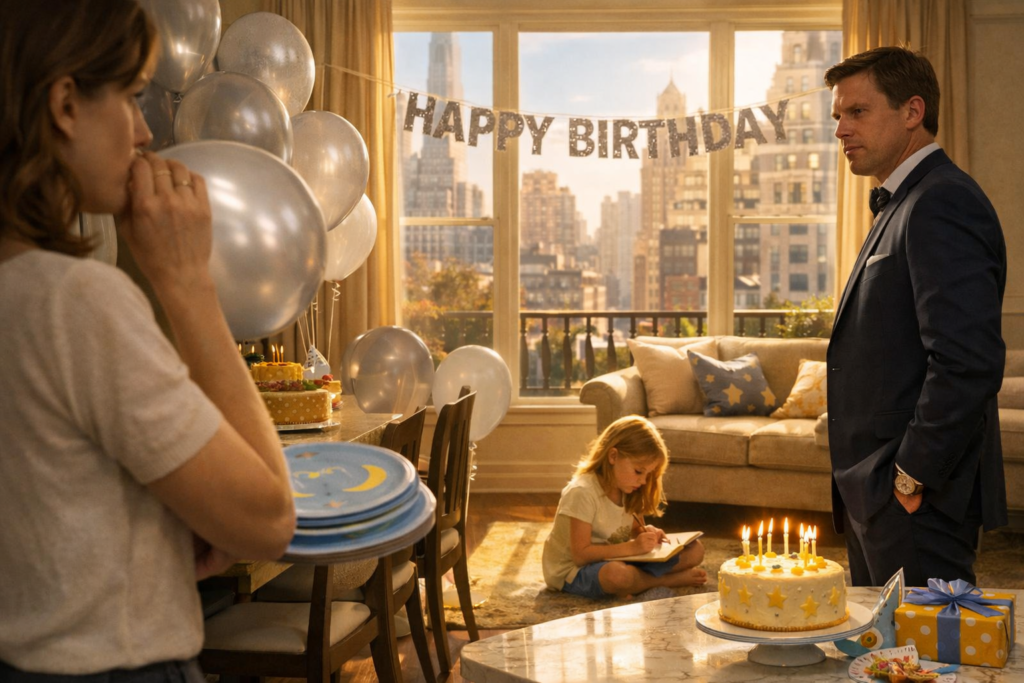
It looked like silver balloons tied to the backs of kitchen chairs. It smelled like lemon polish on marble counters and the vanilla cake I had hidden in the pantry because Lily hated surprises unless she could predict them. Sunlight came through the tall windows of our Upper West Side apartment in clean golden strips, making everything seem richer and safer than it really was.
I was standing barefoot in the kitchen, blowing up another balloon until my cheeks hurt.
“Lily, honey,” I called, holding up two stacks of paper plates. “Do you want the moons or the stars?”
My daughter sat cross-legged on the living room rug, inside a perfect square of sunlight. She did not look up. Her blond hair had fallen across one cheek, and her hand moved over her sketchbook with slow, careful lines.
“Moons are celestial bodies,” she said. “Stars are luminous spheres of plasma. Plates are surfaces. The cake is the important variable.”
I smiled, because that was Lily. Seven years old that morning, and already living in a world with sharper edges and cleaner rules than mine.
“Moons, then,” I said. “Good variable.”
Ryan came in while I was tying the balloon. He smelled like sandalwood cologne and money. His suit was navy, his watch flashed gold, and he had the restless look he always wore when his body was home but his mind was already at work.
He glanced at the decorations.
“You know we could have hired someone for this,” he said. “The party planner from Bergdorf’s would have done it better.”
“It’s just family,” I said. “Lily likes when I do it.”
Ryan made a small sound, not quite a laugh. “We are not exactly living like just-family people anymore, Lenor.”
I looked at him then. Really looked.
There had been a time when I mistook that tone for ambition. Now I heard what it really was: embarrassment. By me. By homemade parties. By the child on the rug who flinched when he came too close and corrected adults when their facts were wrong.
He poured the green juice I had made him and checked his phone.
“I’ll be late tonight,” he said. “Frankfurt call.”
“It’s her birthday.”
“I know.”
“You promised cake by seven.”
He didn’t answer right away. The silence stretched long enough for me to feel stupid for believing him.
“I’ll try,” he said finally. “This deal matters.”
I wanted to say, So does she. Instead, I walked into the living room and crouched beside Lily.
“Sweetheart, do you have Daddy’s picture?”
She paused. Then she pulled another sheet from her pile and held it out.
It was Ryan’s office building. Not a childish rectangle with windows, but a rigid tower of precise vertical lines. Each floor was spaced evenly. The roofline was exact. In the bottom corner, in careful block letters, she had written: Dad’s Building.
Ryan took it and gave it the same two-second scan he gave mail from charities.
“That’s great, kiddo,” he said. “Very tall.”
He leaned down for a kiss. Lily jerked back.
His jaw tightened.
I saw it. That flash of frustration. That small wound to his ego. Then he covered it with a smile, kissed the air near her hair, and walked to the door.
“Love you both,” he said.
The door clicked shut.
The apartment went quiet in that strange way a room does when someone leaves but their disappointment stays behind.
I picked up the drawing he had abandoned on the counter and tucked it into my purse beside the appointment card for Dr. Alicia Chen at two o’clock.
I had told myself the appointment was only a formality. Lily was sensitive. Brilliant. Particular. Maybe anxious. Maybe gifted. Maybe just Lily.
Dr. Chen’s office was soft blue and quiet. No ticking clocks. No harsh lights. The toys were lined up in labeled baskets, and Lily went straight to a wooden map of the United States. She placed the states in alphabetical order, whispering each one.
“Alabama. Alaska. Arizona.”
Dr. Chen wore a beige sweater and the kind of expression professionals use when they are about to change your life gently.
“Lenor,” she said, sitting across from me with a folder in her lap. “I’ve completed the evaluation.”
I gripped my purse strap.
She spoke carefully. Social communication differences. Restricted patterns of behavior. Sensory sensitivities. Exceptional visual-spatial reasoning. Strong pattern recognition.
Then came the words.
Autism spectrum disorder.
The room did not spin. There was no dramatic music. There was only my daughter humming softly over a wooden map while a new language settled over everything I already knew about her.
“What do we do?” I asked.
“We support her,” Dr. Chen said. “Occupational therapy. Speech support. A strong IEP. And we follow her strengths. Her visual reasoning is extraordinary.”
I nodded too many times. I made lists in my head. Therapists. Insurance. School meetings. Ryan. We would have to tell Ryan. We would have to become a team.
Outside, the city was loud and bright. Lily held my hand, humming one low note. I called Ryan before I lost courage.
He answered on the fourth ring.
“Lenor, I’m walking into a call.”
“We just left Dr. Chen’s,” I said. “It’s autism. Lily is autistic.”
There was a pause. Behind him, I heard voices, keyboards, a door opening.
“She says Lily is very bright,” I rushed on. “But she’ll need support. A lot of it. Ryan, we need to talk tonight.”
“I can’t process this right now.”
I stopped walking.
“Our daughter just got diagnosed.”
“I heard you,” he said. “But Frankfurt is in five minutes. We’ll talk later.”
Then the call ended.
I stood there with the phone still against my ear, surrounded by honking cabs and strangers and the smell of roasted nuts from a cart on the corner.
Lily tugged my hand.
“Home,” she whispered.
So I took her home.
And when I opened the apartment door, the balloons were still shining in the afternoon light, but the coffee table was covered with papers I had never seen before.
On top was a divorce petition.
Beside it sat one cream-colored envelope with my name written in Ryan’s perfect, cold handwriting.
I knew before I opened it that whatever was inside would not just hurt me.
It would explain him.
### Part 2
The note was short.
Ryan had always been good at making cruelty efficient.
Lenor,
I’m sorry it has come to this. We have been living separate lives for a long time. With Lily’s situation now clearer, it is obvious we want different futures. I can’t live like this.
I have taken a suite at the Maritime Hotel for now. My lawyer will contact you.
Please don’t make this difficult.
Ryan
P.S. I’ve handled the finances. You’ll need to be resourceful.
For a moment, I did not understand the words.
Handled the finances.
They sat there, neat and harmless-looking, until my body reacted before my mind did. My fingers went numb. I opened the banking app on my phone. It took too long to load. A little spinning circle turned and turned while the apartment lights hummed above me.
Joint checking: $3.24.
Joint savings: $0.00.
Money market: closed.
Credit cards: frozen.
I checked again. Then again, like numbers might become kinder if stared at long enough.
Behind me, Lily stood by the window, looking out at the Hudson. Her birthday dress still had a tag inside the collar because she hated the scratch of it and would not wear it. The cake was still hidden. The candles were still in the drawer. Seven blue candles for a party that no longer existed.
My knees gave out.
The hardwood floor was cold beneath me. Papers slid off my lap and scattered like white birds. A sound came from my throat that did not seem human. It was not a sob at first. It was smaller. A cracked little noise of disbelief.
Then everything came.
The diagnosis. The fear. The money. The humiliation of realizing my husband had planned his exit with spreadsheets and lawyers while I was planning a birthday party with moon plates.
I cried so hard my ribs hurt.
I cried until my face was wet, until my breath came in sharp hiccups, until the room blurred into streaks of silver balloons and black ink.
How was I supposed to pay for therapy? Rent? Groceries? A lawyer? How did a woman with a long gap in her resume and a child who needed stability rebuild a life with three dollars and twenty-four cents?
I did not know how long I sat there.
Then a small, cool hand slipped into mine.
Lily.
She was standing beside me, not looking into my eyes. Eye contact was too much when the world was gentle, impossible when it was broken. But she looked at our hands. Her fingers wrapped around mine with careful pressure.
“Mom,” she whispered.
I wiped my face with my sleeve.
“Yes, baby?”
“Come.”
She did not pull me toward the door. She did not lead me to her room. She guided my hand toward the sketchbook open in her lap.
I looked down.
At first I thought it was another building. Then I realized it was our building. Not from the outside, the way a child might draw windows and a roof, but from the inside out.
The walls were peeled away. She had drawn beams, ducts, pipes, wires, elevators, stairwells. The bones of the building. Things she had never seen. Things no seven-year-old should have known how to imagine, let alone place with such frightening precision.
In the center of the page, she had drawn our living room.
Two stick figures stood there.
One big. One small.
Around them, she had added darker beams. Extra supports. A kind of hidden cage of strength.
She touched the figures with one finger. Then traced the reinforced lines around them.
“Inside,” she said softly. “Safe.”
Something happened to me then.
Not healing. Not hope. Those words were too gentle for the moment.
It was more like a steel rod sliding down my spine.
Ryan had looked at Lily and seen a burden. A limitation. A future that embarrassed him.
But Lily had looked at a collapsing world and drawn support beams.
She had taken the ruins and shown me where to stand.
I put one arm around her, loose enough that she could pull away if she wanted. She stiffened, then leaned the smallest bit into me.
“You’re right,” I whispered into her hair. “Inside, we’re safe. And I’m going to keep us that way.”
The first call I made was to my sister.
Zoe answered on the second ring. “What happened?”
Maybe she heard it in my breathing.
“Ryan left,” I said. “He took the money. He filed for divorce. And Lily is autistic.”
There was a silence.
Then keys jingled.
“I’m coming,” Zoe said. “Don’t move. Don’t answer the door. Don’t call him. I’m bringing wine and my taser.”
I almost laughed. It came out like another sob.
“Just come.”
While we waited, I gathered the papers from the floor and stacked them in a pile. The action steadied me. Petition. Bank statement. Ryan’s note. Evidence. I did not know yet what I would do with it, but I knew I would keep every page.
Lily sat beside me, drawing again. Her marker scratched softly against the paper. Outside, the city lights blinked on one by one.
By the time Zoe arrived, breathless and furious, my crying had stopped.
She swept into the apartment wearing black boots, a leather jacket, and the expression of a woman ready to commit a felony for family.
“Where is he?”
“Gone.”
“Good,” she said. “Easier to plan without his cologne poisoning the air.”
Then she saw the bank balance on my phone.
Her face changed.
“Len,” she whispered.
“I know.”
Zoe picked up Ryan’s note and read it. When she reached the last line, her mouth went flat.
“Resourceful,” she said. “Okay. Then resourceful it is.”
That night, after Lily fell asleep with her sketchbook clutched to her chest, Zoe and I sat at the kitchen counter under the sad floating balloons and made the ugliest list of my life.
Housing. Job. Lawyer. School. Therapy. Debt.
Every word was a cliff.
But at the top of the page, beside Lily’s drawing, I wrote one sentence.
Build from the inside out.
I did not know then that the drawing on that cheap sketchbook paper would become the first weapon in a war Ryan did not know he had started.
And I did not know that Lily had already seen the one thing the rest of us had missed.
Our old life had not been strong.
It had only been expensive.
### Part 3
Three months later, I woke every morning at 4:15 to the scream of a plastic alarm clock I hated like a living enemy.
I slapped it silent before the second ring.
Noise could wake Lily. If Lily woke too early, her whole day tilted sideways. If her day tilted sideways, school called. If school called, I missed work. If I missed work, the rent slipped. Every minute of our new life was connected to another minute by thin wire.
We no longer lived in the apartment with river views.
We lived in a studio in Elmhurst that smelled faintly of cabbage, disinfectant, and old radiator steam. The kitchen window rattled whenever trucks passed below. A bookshelf and a faded floral sheet divided Lily’s sleeping space from mine. Zoe had co-signed the lease, and I had cried when she did, not because the place was nice, but because it was ours without Ryan.
That morning, I dressed in the dark: khaki pants, black polo shirt, grocery store logo over my heart. I brushed my teeth quietly, checked the budgeting notebook, and tried not to throw up.
Income if everything went perfectly:
Grocery stocking shift: $78.40 before taxes.
Data entry from Zoe’s kitchen table: $60 if I hit quota.
Cafe shift: maybe $64 plus tips.
Expenses:
Rent.
Therapy copays.
Food.
Subway.
Debt collectors.
Debt collectors.
Debt collectors.
Ryan’s lawyer had managed to delay support twice. Then he filed to reduce the temporary amount because Lily’s “long-term potential and needs required reassessment.”
Potential.
Needs.
He had turned our daughter into legal math.
At 4:40, I left a note for Zoe, who was asleep on the pullout couch after spending the night because the babysitter had canceled.
Lily has therapy at 4. Snack in fridge. Please make sure the apple cubes are all the same size. I owe you everything. L.
Then I stepped into the hallway and into the day.
The grocery store was cold enough to numb my hands. Cardboard dust stuck to my skin. The box cutter rubbed a blister into my thumb. I stocked canned soup while my mind ran through school forms, collection notices, and the way Lily had cried when the neighbor’s dog barked for nine straight minutes.
“You’re slow today,” Mr. Borov said from the end of the aisle.
“The train stalled.”
“Train is not my problem.”
“No,” I said, lifting another box. “It’s mine.”
At my seven-minute break, I checked my phone.
Three missed calls from numbers I did not know.
One text from Zoe: She’s okay. Drawing the fire escape. Says the design is inefficient. She’s not wrong.
I smiled for the first time that morning.
Then I opened my email and found the message from Ryan’s attorney.
They were seeking further reduction. They were questioning whether certain therapies were “necessary.” They were requesting proof that Lily’s diagnosis actually required “extraordinary financial support.”
I read the sentence twice.
My hands started shaking so badly I almost dropped the phone into my coffee.
At 9:30, I sat at Zoe’s kitchen table entering product numbers into a spreadsheet until the columns blurred.
Zoe worked across from me, sorting black-and-white photo prints. She had dyed-black hair, silver rings on every finger, and the emotional subtlety of a thrown brick.
“He is a financial terrorist,” she said after reading the lawyer’s email.
“He’s Lily’s father.”
“No. He’s a donor with a watch.”
“Zoe.”
“What? Biology did its part. Then it left the building.”
I laughed once, because if I did not laugh, I would start screaming and never stop.
Lily sat on the floor near the window, drawing the building across the street. Not the windows. Not the roof. The interior. Stairwells. Electrical paths. Pipes stacked in impossible layers.
Zoe went quiet.
“Len,” she said slowly. “Has she ever been inside that building?”
“No.”
“Then how is she drawing it like that?”
“She sees patterns.”
“No,” Zoe said. “This is more than patterns.”
I kept typing. “Please don’t make her into a miracle. I can’t handle miracles. Miracles require management.”
Zoe picked up the sketchbook like it was a rare photograph.
“Look at this perspective. Look at the load paths. This is architectural thinking.”
“She is seven.”
“Exactly.”
I stopped typing.
Zoe set the drawing beside my laptop. The product spreadsheet looked suddenly stupid next to Lily’s clean, living lines.
“What are you saying?”
“I’m saying this is her language. Maybe somebody out there speaks it.”
“No,” I said instantly.
“You don’t even know what I’m suggesting.”
“You want to put her online. Let strangers stare at her like she’s some sideshow genius.”
Zoe’s face softened.
“No. I want the right person to see what you see every day. Not Lily as a spectacle. Lily as an artist.”
I shook my head.
“She has meltdowns when the dishwasher changes cycles. She needs help tying her shoes. She can’t tell me when kids at school hurt her feelings.”
“And none of that makes this less real,” Zoe said quietly.
The thought stayed with me all day.
It followed me to the cafe, where I served lattes to women in yoga clothes who complained about foam. It followed me to Lily’s therapy appointment, where a debt collector called during a sensory exercise and sent her into a panic. It followed me to the parent support group in a library basement that smelled like old carpet and burned coffee.
When my turn came, I admitted I was drowning.
“My daughter draws buildings from the inside,” I said. “Like she can see the bones.”
The room went still.
Maria, the facilitator, leaned forward.
“Sometimes their gift is not separate from their struggle,” she said. “Sometimes the gift is the doorway.”
That night, Lily slept behind the sheet divider, one hand tucked under her cheek. The landlord’s late-rent notice sat on the counter like a white tooth.
I opened Zoe’s old laptop.
My heart thudded while I created an anonymous account on a design forum called Vantage Point.
Username: LsGuardian.
Title: Internal Structures, Child Age Seven.
I uploaded the drawing Lily made the night Ryan left.
The one with two figures standing inside reinforced walls.
My finger hovered over Submit.
I told myself I was protecting her. Then I looked at the rent notice and understood protection had become a room with no door.
So I clicked.
And for three days, nothing happened.
Then one comment appeared, and the name attached to it would change everything.
### Part 4
The comment was too long to be casual.
That was the first thing I noticed.
It was not one of those internet pats on the head that said Nice work! or My nephew draws too! It was a careful paragraph written by someone who understood lines the way Lily did.
This is extraordinary.
I read the first sentence while sitting on the edge of the bathtub, the only place in the apartment where I could close a door.
The precision suggests an unusual grasp of spatial relationships, but the real power is emotional. The artist has used structural grammar to describe safety. Notice the reinforcement around the central figures. They are not inside the building. They are the reason the building holds.
My breath stopped.
They are the reason the building holds.
I read it again.
The username was E_Cross.
I searched the name with one hand while holding the phone in the other. Ethan Cross. Principal, CrossThreads Architecture. Award-winning projects. Museums. Hospitals. A London office. A New York office. Articles in magazines I had once only flipped through in waiting rooms.
This was not a hobbyist.
This was not pity.
This was a professional seeing my daughter clearly.
By morning, the post had more comments. Some people argued it had to be fake. Others said the drawing was beautiful but impossible for a child. A few asked whether Lily had been coached. One person wrote, If this is real, the kid understands buildings as living systems.
I did not know whether to feel proud or sick.
Zoe came over with bagels and found me staring at the screen.
“Holy hell,” she said, reading the thread. “Lenor. Ethan Cross commented?”
“You know him?”
“I know his work. Everyone with eyeballs knows his work.”
“He sent a private message.”
Zoe froze.
“What does it say?”
I opened it.
Ms. or Mr. Guardian,
I hope this message finds you well. I commented publicly, but privately I want to say the piece moved me deeply. I understand the need for caution, especially with a child. I am not asking for access. I am offering a door, and only if you choose to open it.
If the young artist would enjoy a virtual exchange, I would be honored to show her structural models and images of buildings. She may respond however she wishes, including not at all.
My firm also sponsors small exhibitions of outsider and visionary spatial work. Any participation could remain anonymous.
Please protect her. But please consider that her way of seeing may matter to more people than you know.
Respectfully,
Ethan Cross
Zoe made a strangled sound.
“That is either the classiest approach in history or the best predator email ever written.”
“Exactly.”
“So we vet him.”
I laughed bitterly. “With what? My legal department is currently a notebook from Walgreens.”
“Then we start there.”
Zoe helped me make a list. Search his firm. Search lawsuits. Search interviews. Search complaints. Search staff turnover. Search the words scandal, exploitation, misconduct, fraud. By noon, my data-entry shift was ruined, but I knew more about Ethan Cross than I had ever known about Ryan before marrying him.
That realization stung.
Ryan had been charming. Ethan was merely documented.
Still, I did not reply that day. Or the next.
I watched Lily instead.
She drew the apartment’s radiator as if it were a sleeping animal. She drew the laundromat on the corner with hidden tunnels of heat. She drew Zoe’s camera, not the outside, but the little mirrors and mechanical chambers inside it.
At school pickup, her teacher mentioned Lily had refused to participate in circle time again but had reorganized the classroom blocks into a “structural sequence.”
“She’s very bright,” the teacher said in the tired tone people used when bright meant inconvenient.
On the subway home, Lily pressed both hands over her ears as the train screamed into the station. A man rolled his eyes because she was humming.
I wanted to turn to him and say, She sees more before breakfast than you will see in your whole life.
Instead, I held her close enough that she knew I was there but not so close that it trapped her.
That night, after Lily fell asleep, I replied to Ethan.
Mr. Cross,
I am Lily’s mother. Yes, she drew the picture. She is seven. She is also vulnerable, easily overwhelmed, and not available for anyone’s curiosity. If we discuss anything, it will be on my terms. No public use. No photos. No identity disclosure. No direct contact unless I approve every part of it.
I am willing to talk once.
Lenor Walker
I expected him to push.
He did not.
His answer came the next morning.
Lenor,
Thank you for trusting me with even that much. Your terms are reasonable. I will send an NDA before any conversation. I also recommend you have any agreement reviewed independently. Lily’s comfort comes first.
Ethan
I stared at the line for a long time.
Lily’s comfort comes first.
Ryan had never said anything like that. Not once. Not even in softer words.
The call happened a week later, after I paid a legal clinic $150 I absolutely did not have to review the NDA.
Ethan appeared on my laptop screen from a quiet office full of books, models, and soft light. He had tired eyes, a trimmed beard, and he did not smile too much. That mattered. People who tried too hard with Lily usually wanted something.
“Lenor,” he said. “Thank you.”
“Mr. Cross.”
“Ethan, if you’re comfortable.”
“I’m not comfortable yet.”
He nodded. “Fair.”
I watched his face. No offense. No wounded male pride. Another point in his favor.
He explained what he wanted: one virtual visit. He would share images of structures. Lily could watch, draw, leave, ignore him, anything. No questions forced. No performance expected.
“What’s in it for you?” I asked.
“Inspiration,” he said. “My work has become polished. Maybe too polished. Lily’s drawing reminded me buildings are not objects. They are nervous systems.”
I did not want to like that sentence.
I liked it anyway.
“And money?” I asked.
“A consultation fee,” he said. “Paid to you as her guardian. A thousand dollars for the first session. If there is any future use of her work, separate contract, separate approval, full ownership retained by Lily.”
A thousand dollars.
For seeing her.
Not fixing her. Not tolerating her. Seeing her.
My eyes burned, and I hated that.
“I’ll think about it,” I said.
“Of course.”
After the call ended, I sat in the blue light of the screen and listened to Lily sleeping.
A thousand dollars would pay rent. Therapy. Groceries. It could also be the first step onto a road I did not know how to protect.
Then Lily murmured in her sleep and rolled onto her side, one hand resting on her sketchbook.
I opened my notebook and wrote a new heading.
Rules for the world outside.
By the time I finished the first page, I understood something cold and useful.
If I was going to open the door, I would not do it as a desperate woman.
I would do it as a guard.
And anyone who wanted access to Lily would have to pass through me first.
### Part 5
I prepared Lily for Ethan’s virtual visit the way other mothers prepared children for dental appointments or family weddings.
Carefully. Repeatedly. With exits.
“A man named Mr. Cross will show us pictures of buildings on the computer,” I said at breakfast while cutting her apple into equal cubes. “You can watch. You can draw. You can leave. You do not have to talk.”
Lily lined up the apple pieces before eating them.
“Will he ask why?”
“No.”
“Good,” she said.
That was all.
Zoe came over for the call because I needed another adult in the room, and because if Ethan turned out to be strange, Zoe had promised to end the meeting by “accidentally” spilling coffee into the laptop.
She sat on the floor out of camera range, wearing combat boots and holding a mug like a weapon.
Lily sat at the tiny table in front of the laptop. I placed her favorite black fine-line pens to the left, blue pens to the right, sketchbook open in the middle. The apartment radiator hissed. A siren wailed somewhere outside. Lily hummed once, frowned, then settled.
I clicked the link.
Ethan appeared and did not say, “Hi, Lily!” in the bright, fake voice adults used when they were afraid of children.
He simply said, “Thank you for letting me visit. I’m going to show some structures now.”
Then his face disappeared, replaced by a rotating digital model of the Sydney Opera House.
Not the outside.
The inside.
Its shells opened like ribs. Beams arched. Supports curved. The building turned slowly against a gray background, and Lily went perfectly still.
Her humming began low in her throat.
Ethan did not interrupt it.
“This building is famous for its shape,” he said quietly. “But I like the way the bones solve the problem.”
Lily’s hand moved toward the sketchbook but did not pick up a pen.
Next came the Eiffel Tower, shown from below, iron crossing iron in thousands of dark lines. Then the vaulted ceiling of a cathedral, stone branching overhead like trees. Then a bridge whose cables made a web against fog.
Each time, Ethan gave one or two facts. No questions. No demands.
Zoe, who never stayed silent easily, had her mouth open.
Then Ethan showed something unfinished.
“This one is a problem,” he said.
On the screen appeared a model of stacked glass spheres, like bubbles caught in midair.
“It’s a greenhouse concept,” he continued. “I don’t like the rainwater system. Pipes ruin it.”
Lily picked up the pen.
She did not look down.
Her eyes stayed on the model while her hand flew over the paper. Fast. Certain. No hesitation. In less than a minute, she had drawn the bubble structure with thin leaf-like channels woven between the spheres, guiding water into a central column shaped like a tree trunk.
She held the sketchbook toward the camera.
Ethan said nothing.
The silence lasted long enough that my guard shot up.
Then he exhaled.
“Oh,” he said softly. “That’s elegant. That’s better than mine.”
Lily lowered the sketchbook.
A tiny smile touched her mouth and vanished.
Zoe looked at me with wet eyes and mouthed, He sees it.
The session lasted forty-five minutes. At the end, Ethan said, “Thank you, Lily. You solved something I had been making too complicated.”
Lily had already turned away, adding blue shading to the drawing.
After we ended the call, Zoe stood and walked around the room once like she needed somewhere to put her energy.
“Okay,” she said. “Not a creep. A respectful architecture nerd with money.”
“Zoe.”
“What? It’s my official assessment.”
The thousand dollars arrived in the custodial account I had opened for Lily. Seeing four digits there made me sit down on the floor. Not because it solved everything, but because for the first time since Ryan left, money had entered my life without shame attached to it.
A week later, Ethan sent a proposal.
An anonymous digital exhibition called Unseen Structures. Lily’s work would be credited only as L. No photo. No diagnosis. No location. A fee up front, plus a percentage if prints sold. Full approval by me. Full rights retained by Lily.
I took the contract to the legal clinic. The same law student, Anya, read it with a red pen in hand.
“This is surprisingly clean,” she said.
“Surprisingly?”
“In creative industries, people often bury knives in friendly language. I don’t see knives.”
I almost cried again, but this time from exhaustion rather than fear.
The exhibition went live on a Thursday.
By Friday, all three of Lily’s prints had sold.
The first was the apartment drawing. The second was the greenhouse she had corrected for Ethan. The third was a spiral interior she drew after seeing a photo of the Guggenheim, but in her version, the ramp became a helix of light and shadow.
Five thousand dollars.
Eight thousand.
Twelve thousand.
I stared at the numbers until Zoe took the phone from me.
“Breathe,” she said.
“I don’t know how.”
“Start with in, then out. Rich people do it all the time.”
I paid the late rent. I paid the loudest debt collector. I paid for three months of therapy in advance, then sat in the clinic parking lot and cried with my forehead on the steering wheel.
Not because everything was fixed.
Because something had shifted.
I was no longer only surviving Ryan’s destruction. I was managing something he had failed to see.
Lily’s work grew slowly and carefully. Ethan became a regular presence, never pushing, never asking for more than agreed. Some sessions Lily drew; some sessions she watched the screen and said nothing. I learned contracts at night. I learned words like licensing, royalties, usage rights, moral rights, trust structure.
I created a business name.
Luminous Blueprint.
Under it, in smaller type: representing the vision of L.
My old life had trained me to host dinners, smile at Ryan’s colleagues, and disappear politely when men discussed important things.
My new life taught me to read clauses like landmines.
Then, one afternoon, while Ethan and I reviewed a licensing request for a Danish lighting company, my phone lit up with a number I knew by muscle memory and nightmare.
Ryan.
I let it ring.
Then came the text.
Lenor. We need to talk. It’s about Lily.
The room seemed to tighten around me.
Because he had not said our daughter.
He had said Lily.
And somehow, I knew he had finally discovered what she was worth.
### Part 6
I waited until Lily was in her room, absorbed in a drawing of a library built inside a tree, before I called Ryan back.
I went into the bathroom and locked the door. It was the only room in the apartment with enough privacy to breathe.
He answered on the first ring.
“Lenor,” he said, like my name belonged to him. “Thank God.”
“What do you want?”
A pause. Then the old sigh. The long-suffering one that used to make me feel unreasonable before I learned it was a tool.
“I’m calling about Lily.”
“You lost the right to use concern as an opening line.”
“I deserve that,” he said quickly. Too quickly. Practiced. “I made mistakes.”
“You emptied our accounts the day she was diagnosed.”
“I panicked.”
“You hired a lawyer before I came home from the psychologist.”
“I was under pressure.”
“You left your child with three dollars.”
Silence.
For one bright second, I thought maybe that sentence had landed somewhere human inside him.
Then he said, “I’ve been following L.”
There it was.
Not Lily’s nightmares. Not her therapy. Not her school struggles. Not the birthday he abandoned.
L.
The name that meant money, mystery, praise.
My fingers tightened around the phone.
“Her work is incredible,” Ryan said. “Lenor, I had no idea.”
“No. You didn’t.”
“I want to be involved.”
“No.”
“I’m her father.”
“You are her abandonment story.”
His voice hardened, then softened again. He was adjusting, changing tactics.
“Listen to me. You’re doing an admirable job, but this is bigger than you. Contracts, branding, media, international licensing. You’re out of your depth.”
I almost laughed.
Not because it was funny, but because men like Ryan always underestimated the education a desperate mother could give herself at midnight.
“We are fine.”
“With Ethan Cross?” he said. “Come on, Lenor. He’s using her.”
My whole body went cold.
“Don’t say his name like you know him.”
“I know men like him. He sees a vulnerable mother and a gifted child. He gets prestige. You get scraps.”
“We have lawyers.”
“You have clinic lawyers and artists,” Ryan said, the polish slipping. “I have capital. I have media relationships. I know how to build this into something serious.”
“This?”
“Her talent.”
“You mean her income.”
“I mean her legacy.”
There was that word.
Legacy.
Ryan’s favorite perfume. More important than love. More flexible than morality.
“She already has a legacy,” I said. “It doesn’t include you.”
“Don’t be shortsighted.”
“Do not contact me again except through your lawyer.”
“Lenor—”
I hung up.
When I opened the bathroom door, Zoe was standing in the hallway. She had let herself in with the spare key and was holding a paper bag from the bakery.
“He knows,” she said.
I nodded.
“What does the parasite want?”
“Legacy.”
Zoe closed her eyes. “Of course he does.”
I walked to the small table where my notebooks were stacked. Budget notebook. Therapy notebook. Contract notebook. School notebook. I opened a fresh page and wrote:
Ryan is coming. Do not react. Document. Force him into the open.
Zoe read over my shoulder.
“Good,” she said. “Now we need a pit bull.”
Her name was Sylvia Grant.
She was sixty-one, sharp-eyed, and wore silver hair in a blunt bob that looked like it had been cut with a courtroom ruler. Ethan connected me to her after I sent him a carefully worded hypothetical email about absent parents and creative income.
Sylvia read my file for twenty minutes without speaking.
Ryan’s note. Bank statements. Support delays. Emails. Therapy bills. Texts I had sent him over the years with no reply.
When she finished, she removed her glasses.
“I hate men who treat children like tax deductions until they become trophies,” she said.
I knew instantly I wanted her in front of me in any storm.
“I can’t afford you,” I said.
“You can afford part of me,” she replied. “The rest I’ll take in personal satisfaction.”
Sylvia moved fast. She created boundaries. All contact through counsel. No discussion of Lily’s work with Ryan. No unsupervised meeting. No public statements. Keep records. Save voicemails. Archive emails. If he calls, note time and content. If he threatens, tell her immediately.
“Men like him do not disappear after one no,” she warned. “They rebrand the no as a misunderstanding.”
She was right.
Over the next month, Ryan sent messages through his lawyer about paternal rights, publicity concerns, and Lily’s “best commercial interests.” Then he sent personal emails written like regret had hired a publicist.
I have been doing a lot of reflection.
She deserves to know I’m proud.
There are sharks out there.
I want to help protect her.
Sylvia laughed when I forwarded them.
“He’s trying to make himself the solution to the danger he represents.”
Meanwhile, our life grew, but not without stress. Lily’s work gained attention. The hospital project with CrossThreads became real: a sky garden for a pediatric medical center, inspired by Lily’s drawings of spaces that felt safe from the inside.
Every contract made me stronger.
Every invoice paid on time felt like a brick in a wall.
We moved from Elmhurst to a quiet two-bedroom in Astoria. Lily got a studio corner with a north-facing window and shelves for her pens. The first night there, she walked the rooms in silence, touching doorframes, studying vents, measuring the distance from window to floor with her eyes.
Then she said, “The noise is lower here.”
It was the best blessing I had ever received.
But Ryan did not stop.
He adapted.
The email came late on a Monday.
Lenor,
I saw the hospital press materials. Extraordinary. I am not writing as an adversary, but as a father filled with regret. Please meet me once. Thirty minutes. Public place. I have information that could protect you and Lily from exploitation.
Please.
Ryan
I read it twice.
The old me heard apology.
The new me heard bait.
I forwarded it to Sylvia, Ethan, and Zoe.
Sylvia replied first.
Meet him only if we record everything. New York is one-party consent. You are the consenting party. Let him talk.
Zoe replied second.
I can sit nearby wearing sunglasses and looking threatening.
Ethan replied last.
He will try to isolate you from anyone who helped you. That is the move. Be careful.
I looked across the apartment at Lily, who was arranging broccoli and carrot sticks into a small city on her dinner plate.
“Mom,” she said without looking up.
“Yes?”
“The loud man on the phone is a liability.”
I went still.
She placed a carrot like a beam across two broccoli towers.
“The foundation must be stable,” she added.
My throat tightened.
“You’re right,” I said. “We’re fixing it.”
That night, I replied to Ryan.
Tomorrow. Blue Bench Cafe. Bryant Park. Thirty minutes. Public. Do not be late.
Then I opened the voice memo app and made a test recording.
I had spent months building walls.
Now I was setting the trapdoor.
### Part 7
Ryan arrived at the cafe wearing remorse like a tailored suit.
I had chosen a table in the middle of the room, not near windows, not near walls. My phone lay screen-down beside my tea, recording. Sylvia had made me practice starting the app three times before I left my apartment, as if I were learning to draw a weapon.
Ryan saw me and smiled.
For one stupid second, memory betrayed me.
I remembered him younger, laughing in our first kitchen, holding my hand in a cab during a thunderstorm, saying he wanted a family that felt like home.
Then he got closer, and I saw the calculation behind his eyes.
“Lenor,” he said softly. “You look strong.”
“Your thirty minutes started when you walked in.”
He sat.
“I deserve that.”
“You keep saying that.”
“Because it’s true.”
The waiter came. Ryan ordered black coffee, no sugar. He still wanted everyone to know he did not need sweetness.
“I was scared,” he began. “When we got the diagnosis, I saw a future I didn’t know how to handle. I was weak. I was selfish. I ran.”
I stirred my tea once.
“You planned.”
He blinked.
“You ran after moving the money, closing accounts, retaining counsel, and leaving a note telling me to be resourceful. That is not panic. That is strategy.”
A muscle moved in his jaw.
“I won’t defend my worst moment.”
“Good. We’d be here longer than thirty minutes.”
He leaned forward.
“I am trying to help now. Lily’s work is everywhere in my circles. People are talking. Investors. Media people. Design collectors. Lenor, this could become enormous.”
“It is already enough.”
“That’s fear talking.”
“No. That’s boundaries talking.”
He smiled then, small and sad. “You always did confuse the two.”
There he was.
Not the regretful father. The husband who had trained me to distrust my own instincts.
My hand twitched toward the phone, checking without looking that it was still there.
“Let’s not make this personal,” he said.
“You left your child. It is personal.”
“I want to protect her.”
“From whom?”
“Ethan Cross, for one.”
I kept my face still.
“He found her early,” Ryan continued. “He attached himself to the mystery, gained prestige, positioned his firm as the interpreter of her genius. Very clever. Very tasteful. But don’t confuse tasteful exploitation with kindness.”
“Ethan’s contracts were reviewed.”
“By whom? A clinic? Some family lawyer?”
“My counsel is not your concern.”
“It should be,” he said, voice lowering. “These people will own her before you realize what happened. They will license her future. Control her image. Turn her autism into a brand.”
The word landed like dirt on clean cloth.
“Her autism is not a brand.”
“Of course not,” he said quickly. “But public perception is brutal. The world will want the face behind L. Once they find out she’s autistic, the story changes. Poor little autistic prodigy. Poor single mother. Poor broken family. Is that the narrative you want?”
My blood went cold, but my voice stayed even.
“What narrative do you want?”
Relief flickered across his face. He thought the door had opened.
“We frame it as strength,” he said. “We control it. Lily Remington, visionary child artist. Supported by both parents. A family reunited by her gift. I can bring in a real media team. I can structure a management company. Equity, licensing, global partnerships.”
“And your role?”
“I’m her father.”
“Your role,” I repeated.
He hesitated.
“Strategic oversight.”
There it was, wrapped in a clean business phrase.
Strategic oversight.
I imagined Lily at her table, drawing safe rooms. I imagined Ryan standing over those drawings, turning them into pitch decks.
“No.”
His eyes narrowed.
“Don’t be emotional.”
“I’m not.”
“You are sitting on a once-in-a-generation opportunity and acting like a gatekeeper at a school bake sale.”
I laughed then. Quietly.
The mask slipped further.
“You want a percentage,” I said.
“I want what is best for my daughter.”
“You want a title.”
“She is a Remington.”
“She is Lily Walker in every contract, every account, every school form, every therapy file, every place that mattered while you were gone.”
His coffee arrived. He did not touch it.
“Be careful, Lenor,” he said.
I tilted my head. “Is that advice or a threat?”
“It’s reality. The bigger she gets, the more questions people will ask. Fathers have rights.”
“Fathers also have responsibilities. Sylvia Grant will be happy to discuss both with your attorney.”
His expression changed when he heard Sylvia’s name. Just a flicker, but enough.
He knew her.
Good.
I stood.
“This conversation is over. Do not contact me directly again. Any attempt to use Lily’s name, diagnosis, work, image, or story for your benefit will be treated as harassment and exploitation.”
“Lenor—”
“You are a liability, Ryan. And we are shoring up the foundation.”
I walked out before my legs could shake.
Outside, Bryant Park was full of sunlight and pigeons and people eating lunch like the world was simple. I stood by the curb, stopped the recording, and sent the file to Sylvia.
Then to Ethan.
Then to Zoe.
Zoe replied within seconds.
Please tell me you said something devastating.
I looked back through the cafe window.
Ryan was still sitting there, untouched coffee in front of him, his face hard now that no one useful was watching.
I typed back:
I let him say it himself.
And that was when the war became real.
### Part 8
Success did not arrive like a sunrise.
It arrived like construction.
Noise. Dust. Permits. Arguments. Hidden costs. People in expensive shoes telling me what could not be done until I opened a folder and showed them where it already had been.
A year after Ethan’s first virtual visit, I sat in a Midtown conference room across from Martin Thorne, director of the New York Institute for Pediatric Medicine. He had silver hair, cold eyes, and the kind of confidence that came from decades of being the most important man at every table.
He tapped Lily’s sky garden renderings with one finger.
“These are provocative,” he said.
“Good,” I replied.
His eyebrow lifted.
The room went still. Ethan sat to my left, silent by design. This was my meeting. Luminous Blueprint represented L. I represented Lily.
Thorne leaned back. “Provocative is not always buildable.”
“The engineering appendix addresses buildability,” I said. “Pages forty-two through sixty.”
His project manager flipped quickly through the binder.
“Provocative is not always affordable,” he added.
“Appendix C has three contractor estimates and a twenty-year maintenance projection.”
The woman from the hospital board reached for her copy.
I slid a one-page media analysis across the table.
“This is not a decorative patio. It’s a therapeutic environment. The sightlines are designed to reduce visual overwhelm. The materials avoid harsh glare. The circulation paths allow children to retreat without feeling excluded. That is not aesthetic indulgence. That is integrated care.”
Thorne’s face shifted slightly.
So I delivered the final beam.
“Architectural Digest has confirmed interest. The Times has asked for background. Donor response to a pediatric healing space shaped by the vision of L will likely offset a significant portion of the cost.”
The board woman picked up the media sheet.
Thorne looked at the renderings again. The garden floated on the page like leaves made of glass and light, each path branching gently from a central spine. It was Lily’s idea of calm made buildable.
Finally, he smiled.
“You’ve done your homework, Ms. Walker.”
“It’s my job.”
Two years earlier, I had stocked soup cans at dawn while debt collectors called my phone. Now men like Martin Thorne pretended they had always meant to respect me.
I let them.
Respect was useful whether it was sincere or not.
The deal moved forward.
Outside the building, the city wind cut between towers. I stood under the awning and checked my messages.
Ethan: You were terrifying. In a good way.
Zoe: Did you make the rich hospital goblin cry?
Sylvia: Call me before signing anything.
Then one from Ryan’s lawyer.
Ms. Walker,
My client has concerns regarding the upcoming public announcement of the pediatric hospital collaboration and its potential impact on his minor child’s identity, reputation, and paternal interests.
Paternal interests.
I stared at those words until they blurred.
That night in our Astoria apartment, Lily built a small city from broccoli and carrot sticks while Zoe ate takeout noodles beside her.
“The hospital approved the garden,” I told Lily.
She placed a carrot bridge between two broccoli towers.
“The children will need quiet exits,” she said.
“We added them.”
“And water sounds, but not spraying sounds.”
“Soft water only.”
She nodded.
Zoe grinned at me. “Your consultant approves.”
Lily looked up briefly.
“The loud man will try to enter through a weak wall,” she said.
The table went silent.
“What loud man?” Zoe asked gently.
“The one with the phone voice,” Lily said. “He says father like a key. But he is not a key. He is a crack.”
My eyes stung.
I had tried to shield her from Ryan’s ugliness. But Lily noticed structures, and people were structures too. She had mapped him faster than any of us.
“You don’t have to worry about him,” I said.
“I know,” she replied. “You are making the wall thicker.”
After she went to bed, I sat with Sylvia on a video call.
“He’s escalating,” I said.
“He’s fishing,” she corrected. “Escalation comes when fishing fails.”
“What do we do?”
“We prepare for both.”
Sylvia’s plan was precise. File for back support with interest. Seek a declaratory judgment confirming Ryan had no claim to Lily’s earnings. Prepare an injunction preventing him from using Lily’s name, work, diagnosis, or story for self-promotion. Keep the Bryant Park recording ready. Build a timeline. Make it impossible for him to rewrite the past.
“Men like Ryan count on everyone being too polite to show receipts,” Sylvia said. “We will be impolite with documentation.”
The hospital launch party was scheduled for six weeks later at the New York Public Library.
Design elite. Donors. Journalists. Cameras. A room full of reputations.
“Will he come?” I asked.
Sylvia gave me a look through the screen.
“Of course he will.”
I slept badly after that.
In dreams, Ryan walked through Lily’s drawings with muddy shoes. He peeled her name off contracts and replaced it with his. He stood under bright lights saying words like family, regret, legacy, while people applauded because he knew how to sound wounded.
The next morning, Lily came into the kitchen holding a new drawing.
It was not a building.
It was a stage.
A man stood in the center, smiling, but beneath him the floor beams were cracked. Off to the side, a woman stood near a control panel. Her hand rested on a switch.
“What is this?” I asked.
“False platform,” Lily said. “It collapses when the real weight is shown.”
A chill moved through me.
“What switch?”
She pointed.
“Light.”
I looked at the drawing.
For the first time, I understood how we would win.
Ryan did not fear being cruel.
He feared being seen.
### Part 9
The launch party glittered like a trap.
The New York Public Library’s great hall rose around us in marble, gold, and painted clouds. Servers moved through the crowd with trays of champagne. Donors laughed softly. Journalists whispered near the renderings of the sky garden, where Lily’s lines had been translated into terraces, pathways, and pools of filtered light.
I wore emerald silk because Zoe said if I had to destroy a man publicly, I should look like a woman people would remember.
“You look expensive and dangerous,” she said, adjusting my sleeve.
“I feel like I might throw up.”
“Also valid.”
Ethan stood near the main display, calm as ever, explaining the project without revealing what we had protected. Sylvia was across the room in burgundy, sharp as a blade, speaking quietly with the hospital’s communications director.
The plan was simple.
I would speak as Lily’s representative. Ethan would speak as lead architect. The hospital would announce the groundbreaking.
If Ryan stayed away, nothing happened.
If Ryan appeared and behaved, nothing happened.
If Ryan tried to claim Lily in public, we would answer publicly.
I kept my phone in my hand, screen dark, thumb resting against the side.
The program began with Martin Thorne praising “visionary collaboration” in the voice of a man who had recently learned humility could be good for fundraising. Ethan followed, generous and restrained.
“L’s vision taught us that safety is not the absence of complexity,” he said. “It is complexity organized with care.”
I almost cried at that. Not because it was poetic, but because it was true.
Then it was my turn.
I walked to the microphone.
The crowd became a blur of faces. Camera lenses. Diamonds. Dark suits. A thousand small judgments.
I took one breath.
“L experiences space differently than most of us,” I said. “Where many people see walls, she sees support. Where we see a room, she sees the nervous system of a place. This garden grew from her belief that healing spaces should not simply contain children. They should understand them.”
I spoke of privacy. Of collaboration. Of children whose minds are underestimated because they do not communicate in expected ways. I did not say autism. Not yet. I did not say daughter. Not yet.
Then I saw him.
Ryan stood just inside the archway.
Black tuxedo. Perfect hair. Somber expression. A blonde woman on his arm, polished and confused. He met my eyes and gave the small wounded smile of a man who believed he had arrived in time for his redemption scene.
My mouth went dry.
Zoe saw him too.
She moved closer to the stage.
Sylvia’s head turned slightly. Her expression did not change, but one hand went to the folder beside her.
I finished my prepared remarks.
“Tonight is about what becomes possible when we do not force extraordinary minds to become ordinary before we value them.”
Applause rose.
And Ryan moved.
He released the blonde woman’s arm and walked down the center aisle with deliberate steps. The applause faltered, then thinned. People turned. Cameras shifted.
He reached the front before event staff understood he was not part of the program.
“Lenor,” he said warmly.
I did not step away from the microphone.
He turned to the crowd.
“Ladies and gentlemen, forgive the interruption. My name is Ryan Remington.”
Murmurs.
A journalist near the front lifted her recorder.
“And the extraordinary young artist you know as L is my daughter, Lily.”
The room exploded.
Not with applause at first, but sound. Shock. Excitement. A sudden feeding energy. The mystery had a name. The name had a father. The story had just turned.
Ryan raised his hands as if calming them.
“I have been absent,” he said, voice thick. “Painfully absent. I failed my family when my daughter’s challenges frightened me in ways I was too weak to face.”
He turned toward me with wet eyes.
“Lenor has been heroic. I will never take that from her. But a father’s love, even delayed, does not die. I stand here tonight not to claim credit, but to bear witness. To say I am proud of my daughter. To say I want to help protect her legacy.”
A few people applauded.
Then more.
I watched him collect them.
The regret. The humility. The handsome father returning at the perfect public moment. He had rehearsed this. Maybe in a mirror. Maybe with a PR consultant. He had dressed abandonment in poetry, and the room was ready to forgive him because forgiveness makes a cleaner story.
He extended one hand toward me.
“A family reunited by art,” he said. “That is what Lily deserves.”
For half a second, no one breathed.
Then I leaned toward the microphone.
“Thank you, Ryan,” I said.
His face relaxed.
He thought he had won.
I looked past him to the AV technician and gave the nod.
The screen behind us went black.
Then the first document appeared.
Ryan’s smile froze.
And the room learned what kind of man had walked onto that stage.
### Part 10
The first slide showed two dates.
On the left was a page from my calendar.
Lily evaluation. Dr. Chen. 2:00 p.m.
On the right was Ryan’s divorce petition, signed the same day.
A murmur moved through the room, low and fast.
I kept my voice calm.
“This is the day our daughter received her autism spectrum diagnosis,” I said. “It is also the day Ryan Remington filed for divorce.”
Ryan turned toward me.
“Lenor,” he said under his breath.
I did not look at him.
Slide two appeared.
Bank statements.
Transfers out. Account closures. The final balance circled in red.
$3.24.
“This is what remained in our joint checking account when Lily and I came home from that appointment.”
A woman near the front covered her mouth.
Slide three.
Ryan’s handwritten note.
You’ll need to be resourceful.
The silence sharpened.
Ryan spoke louder now. “That is private marital documentation.”
“No,” I said into the microphone. “It is evidence.”
Slide four.
A spreadsheet. Clean. Brutal.
Debt left after separation. Therapy invoices. Rent arrears. Collection notices. Amounts paid by me after Lily’s work began earning income.
“At the same time Mr. Remington now offers to protect Lily’s legacy,” I said, “it is worth noting that Lily’s work helped pay obligations he abandoned.”
Ryan’s face had gone pale.
“That’s distorted,” he said. “Those were joint expenses.”
I clicked to slide five.
Messages.
Ryan, Lily started speech therapy today. She said “apple.”
No reply.
Ryan, her IEP meeting is Thursday. Can you attend?
Defer to you.
Ryan, copays are $200 a week. Please contribute.
Tight this quarter.
Ryan?
No reply.
No reply.
No reply.
I let the room read.
There are moments when silence testifies better than any speech.
Then came the Bryant Park recording.
The screen showed only the audio waveform, black against white. I had argued with Sylvia about playing it. She had said, “Let his own mouth do the work.”
Ryan’s voice filled the hall.
The world will want to know the face behind the genius. And when they find out about her condition, the narrative changes. Poor little autistic prodigy. Poor single mother. Is that what you want? Or do you want to control the narrative with me? We can own it.
The disgust in the room was physical.
I felt it roll past me.
Ryan shook his head.
“That’s out of context.”
His voice sounded smaller without a microphone.
I turned to him fully.
“You do not get to own her narrative,” I said. “You do not get to frame her autism as a public relations problem. You do not get to abandon the child and return for the artist.”
The blonde woman who had arrived with him stepped backward. Then another step. Then she disappeared into the crowd.
I faced the audience again.
“Tonight, my attorney filed motions seeking back child support with interest. We are also seeking a declaratory judgment that Ryan Remington has no legal or equitable claim to any past, present, or future income from Lily’s creative work. Additionally, we will pursue a permanent injunction barring him from using her name, image, diagnosis, work, or story for self-promotional or commercial purposes.”
Sylvia stepped forward then, taking the second microphone.
“My client has protected her daughter’s privacy and creative rights with extraordinary care,” she said. “Any attempt to exploit this child under the disguise of late paternal concern will be met in court.”
Ethan joined us on the stage.
His voice was quiet, but the room leaned in.
“CrossThreads Architecture recognizes only Lily and Lenor Walker in this collaboration. We will not work with any party attempting to profit from abandonment dressed as reconciliation.”
That was the blow Ryan did not expect.
Legal exposure was one thing. Social exile from the world he wanted to enter was another.
I watched his face as he understood.
The cameras were no longer admiring him.
They were documenting him.
Journalists surged, but not toward Ryan. Toward Sylvia. Toward Ethan. Toward me.
“Ms. Walker, how long has he been absent?”
“Is Lily safe?”
“Will the hospital continue the project?”
“Will you release the full recording?”
Ryan stood in the aisle alone.
For years, he had known how to control a room. He knew when to smile, when to lower his voice, when to look wounded. But he had never learned how to stand under the weight of truth.
Security approached him gently.
Not dramatically. Not like a villain dragged away.
Worse.
Like an embarrassment being removed.
He looked at me once.
There was hatred there now, naked and startled.
I felt no fear.
Only exhaustion.
Zoe appeared at my side and slipped an arm around my waist.
“You did it,” she whispered.
I looked at the renderings of Lily’s sky garden glowing on the screen again. Leaves of glass. Soft water. Quiet exits.
“No,” I said.
Lily had drawn the safe place.
I had only turned on the light.
### Part 11
The headlines lasted three weeks.
The Post called it The Podium Judgment. A design blog called it The Night L’s Mother Redrew the Line. More serious outlets used words like exploitation, guardianship, neurodivergent genius, and financial abandonment.
I hated most of it.
Not because it was false, but because strangers always wanted a simple shape.
Hero mother. Villain father. Genius child. Tearful triumph.
Real life had more wires inside the walls.
Lily did not attend school the day after the launch. She stayed home in her studio corner, drawing tide patterns even though we did not yet live near the sea. She did not ask about the articles. She asked whether the hospital garden would have benches with backs.
“Some children need pressure behind them,” she said.
I added it to the project notes.
Sylvia handled the legal storm with terrifying joy.
“He folded faster than I expected,” she told me two months later.
I was sitting in her office, where everything smelled faintly of paper, coffee, and expensive rage.
“What does that mean?”
“It means his attorneys do not want the recording played in open court. They also do not want discovery into his financial transfers before the divorce filing. Very wise of them.”
She slid the settlement summary across the desk.
Back child support. Interest. Reimbursement for a portion of therapy costs. Formal relinquishment of any claim to income from Lily’s creative work. Permanent injunction against using Lily’s identity, diagnosis, art, or story for commercial advantage.
I read every line.
Then again.
“And contact?”
“Through counsel only, unless you approve otherwise. Which you won’t.”
“No,” I said. “I won’t.”
Sylvia smiled slightly.
“Good.”
There are people who think not forgiving makes you bitter.
They are usually people who benefited from being forgiven too easily.
I did not forgive Ryan. I did not wish him dead. I did not spend my mornings imagining his suffering. I simply removed him from the structure. A rotten beam does not deserve emotional closure. It deserves replacement.
The money he owed went into Lily’s trust.
The old debts disappeared one by one. I paid the last collection agency on a rainy Wednesday and sat at my kitchen table afterward, waiting to feel joy. Instead, I felt quiet.
Debt had been a constant buzzing in my skull for so long that its absence sounded strange.
Ethan called that evening.
“Thorne wants to break ground in spring,” he said. “He also wants to send Lily a hard hat.”
“Is it adjustable?”
“I will make sure.”
“Then she might accept it.”
There was a pause.
“You okay?” he asked.
“I don’t know what okay feels like yet.”
“That’s fair.”
Ethan had become more than a professional contact, though neither of us rushed to name it. He knew Lily’s boundaries. He knew mine. He never arrived uninvited, never assumed closeness, never turned kindness into debt.
For a long time, that was enough.
Then one evening, after Lily had gone to bed, he came by with project documents and stayed for tea. We sat at the kitchen table in the quiet Astoria apartment, rain ticking against the window.
“You built something remarkable,” he said.
“I built a fence.”
“No,” he said. “You built a language around her language.”
The words stayed with me.
Maybe that was why I finally told him about the emails I had been receiving. Mothers. Fathers. Grandparents. People who had seen the story and wrote to me in the exhausted hope of the desperate.
My son can hear when machines are broken.
My daughter composes music but cannot speak.
My nephew draws maps of places he has never visited.
Schools called them difficult. Doctors called them complicated. Relatives called them too much. The world praised the gift only when it became marketable and ignored the caregiver bleeding quietly behind it.
“I don’t know what to do with them,” I said.
Ethan looked at me as if the answer was obvious.
“Yes, you do.”
That night, after he left, I opened a new notebook.
At the top of the first page, I wrote:
The Lighthouse Studio.
Not a school. Not a clinic. A shield.
Legal resources. Trust planning. Ethical representation. Vetted mentors. Parent support. A platform for work only if the child wanted it, and only under protection.
When I showed Zoe the idea, she cried and pretended she had allergies.
“When did you become a nonprofit founder?” she asked.
“When my husband left me with three dollars and a genius child.”
“Classic origin story.”
Lily studied the logo Zoe sketched: a lighthouse beam made of tiny drawings.
“The angle is wrong,” Lily said.
Zoe groaned. “Of course it is.”
But Lily touched the beam with one finger.
“This is good,” she added. “It shows the way without pulling.”
That became our rule.
Show the way. Do not pull.
A year after Ryan walked onto that stage, Lily and I walked into a cedar-shingled house near the water in Sag Harbor. It was not huge. It was not flashy. But it was quiet. Curved hallways. Soft light. No harsh corners. A studio with a round skylight.
Lily walked through every room, silent.
I waited by the kitchen island, terrified she would hate it.
Finally, she stood in the living room and looked through the glass wall at the Atlantic.
“The lines are correct,” she said.
I pressed one hand over my mouth.
For the first time in years, home did not feel like something a man could take.
It felt like something we had built.
### Part 12
The Lighthouse Studio opened in a converted warehouse in Bridgehampton with unfinished floors, white walls, and one bathroom whose pipes groaned like an elderly man clearing his throat.
I loved it instantly.
Zoe painted the sign herself. Ethan donated the first year of rent through his firm, then pretended it was “a standard community initiative” because he knew I hated feeling indebted. Sylvia joined the board for one dollar a year and said she was overpaid.
Our first families arrived carefully, like people approaching warmth after a long winter.
There was Maya from Oregon, whose non-speaking daughter composed entire symphonies in her head. There was Daniel from Ohio, twelve years old, who could diagnose engine problems by sound but melted down under fluorescent lights. There was Grace from New Jersey, who built mathematical sculptures from string and refused to enter classrooms with ticking clocks.
Their parents carried binders, medical files, guilt, hope, and the exhausted posture of people who had been told too many times that their children were problems to manage.
I recognized every face.
We did not promise miracles.
I stood in front of them on the first day and said, “We are not here to turn your children into brands. We are not here to polish them for public consumption. We are here to protect what is true and build supports around it.”
A father in the back put his head down.
A mother began to cry without making a sound.
I understood.
Sometimes relief feels like grief because you finally realize how long you have been holding your breath.
Lily did not attend the opening ceremony. Crowds were too much. But she had approved the floor plan and corrected the sensory room vents. She also drew the studio’s first poster: a lighthouse cut open like one of her buildings, showing stairs, wires, rooms, beams, and at the very center, a small child turning on the light.
That poster hung in the entrance.
People stopped in front of it and went quiet.
The work was hard. Not glamorous hard. Spreadsheet hard. Insurance hard. Parent crying in parking lot hard. School district refusing services hard. Contract clauses that tried to steal ownership hard.
But I knew how to fight those fights now.
“Never sign urgency,” I told families. “Urgency is where people hide theft.”
Sylvia ran legal clinics on Saturdays. Ethan built a mentor network of architects, engineers, composers, designers, coders, and one retired watchmaker who became Daniel’s favorite person alive. Zoe photographed the children’s work only when they wanted it documented and never photographed faces without permission.
Slowly, carefully, the Lighthouse became real.
And Lily kept growing.
She was nine when she illustrated her first children’s book, The Quiet City, written by a poet who understood silence was not emptiness. The story was about a city where buildings grew from seeds and people communicated through light, pattern, and pressure.
Lily’s drawings were extraordinary.
Not cold. Not mechanical. That was what critics always got wrong. Her work was full of feeling. It simply translated feeling into structure. Loneliness became a narrow bridge. Joy became a room with too many windows. Fear became a staircase with no railing. Love became hidden beams holding up the ceiling.
When the book was nominated for a national award, I almost refused the ceremony.
Too public. Too loud. Too many cameras.
But Lily surprised me.
“I want to see the rigging,” she said.
“The stage rigging?”
“Yes.”
So we went.
She wore a soft blue dress she had chosen because the seams did not scratch. I carried noise-canceling headphones, sour candy, a visual schedule, and three exit plans.
At the ceremony, Lily sat beside me, staring up at the lights. When her name was called as the winner for illustration, the applause hit like weather. I leaned close.
“We can leave.”
She shook her head.
We walked onto the stage together.
The host, a famous comedian who somehow understood not to be loud, adjusted the microphone.
“Lily,” she said gently, “your city feels magical. How did you imagine it?”
I crouched slightly, ready to translate. Ready to protect.
Lily stepped closer to the microphone.
Her hands were still. Her eyes focused somewhere beyond the crowd.
“The world is loud,” she said. “And many lines are wrong. I draw the quiet place inside. My mom built walls around it so I could draw. Now other children can draw their quiet places too.”
Thirty words.
Maybe fewer.
The room stood.
Applause thundered around us, but Lily did not flinch. She looked up at the rigging, satisfied, as if the building had responded correctly.
Backstage, a literary agent cornered me with a polished smile.
“Lenor, your story is incredible. Single mother. Betrayal. Autism. Genius. Have you considered a memoir? Raising the Prodigy could be huge.”
I smiled politely.
“Our story is not a product.”
Her smile tightened.
“Of course, but visibility matters.”
“Protection matters more.”
I took Lily’s hand and led her toward the exit.
Outside, the night air was cold and clean. Lily breathed it in, then looked at me.
“She wanted to take the walls,” she said.
“Yes.”
“You said no.”
“I did.”
“Good,” Lily said, and squeezed my hand.
That was the only review I needed.
### Part 13
Ryan tried once more.
Not directly. He was too careful after the injunction.
He gave an interview to a business podcast about “leadership after personal failure.” He did not say Lily’s name. He did not mention L. But he spoke of “a gifted child I was not strong enough to support” and “the pain of being erased from a success story I helped begin.”
Sylvia sent one letter.
One.
The episode disappeared within forty-eight hours.
After that, silence.
I heard rumors sometimes. Ryan had left his firm. Ryan was consulting in Florida. Ryan had remarried. Ryan had told people he preferred a private life now.
Good.
Privacy was the one gift I was happy to return to him permanently.
Lily asked about him only once.
She was ten. We were on the beach near our house, walking our usual path. She collected shells with spiral patterns and rejected any with cracks that interrupted the curve.
“The man who is a crack,” she said.
I knew who she meant.
“Yes?”
“Does he live in another structure now?”
“I think so.”
“Will he come here?”
“No.”
She nodded.
“Good. This house fits.”
I looked at the waves because my eyes had filled.
Our house did fit. The curved halls, the soft floors, the studio skylight, the windows facing the sea. At night, the water sounded like breath. Lily said the waves had a pattern of 12.7 seconds between major crests on calm days. I never checked. I liked believing her.
The Lighthouse grew beyond what I had imagined.
We opened a second studio space upstate. Then an online resource library. We created contract templates for families. We built a fund for emergency therapy copays, respite care, and legal reviews. We taught parents to ask better questions, to keep receipts, to trust their child’s language even when it was not made of speech.
Maya’s daughter’s first symphony premiered in Portland with a contract Sylvia personally approved. Daniel designed a diagnostic sound library for small engines and got paid through a protected trust. Grace’s string sculptures were exhibited anonymously until she chose, at sixteen, to sign them with her first name.
Not every child became famous.
That was never the point.
Some only became safer.
That mattered more.
As for Ethan, he stayed.
Not as a savior. I would never have loved a savior. I had no patience left for men who needed gratitude to feel useful.
He stayed as a steady person with clean boundaries and quiet humor. He learned Lily’s rhythms. He never touched her drawings without asking me first and later asking her directly. He came to dinner on Sundays when invited. He listened when she explained why the old bridge near the marina made her “structurally annoyed.”
One night, years after the first call, he and I sat on the back deck while Lily worked in her studio. The sea was black glass, and the house glowed behind us.
“I love you,” he said.
He said it without reaching for me, without leaning in, without making the sentence a demand.
I looked at him.
“I love you too,” I said.
It felt peaceful. No fireworks. No collapse. No desperate need to be chosen.
Just a door opening in a house already strong.
Lily accepted him slowly, then completely in her own way. When Ethan proposed to me two years later, he did not do it in front of a crowd. He asked during a walk, quietly, with no ring box snapping open, no pressure.
I told Lily before I answered.
She listened, then asked, “Will the structure change?”
“Some,” I said. “Only if we both approve the plans.”
She thought for a long moment.
“Ethan is not a load-bearing risk,” she said.
That was yes.
We married in the backyard with twelve people present. Lily wore gray linen and stood beside me holding a drawing instead of flowers. Zoe cried openly and denied it while crying. Sylvia officiated because apparently New York allowed that with enough paperwork, and Sylvia loved paperwork when it gave her power.
Ryan was not invited.
Ryan was not mentioned.
No empty chair. No symbolic closure. No forgiveness speech.
Some people are not missing from your happiness.
They are absent because you healed.
### Part 14
On the fifth anniversary of the day Ryan left, Lily and I went back to the city.
Not to the old apartment. I never wanted to see that lobby again, with its polished stone and doorman who had watched my life collapse through professional silence.
We went to the pediatric hospital.
The sky garden had opened that spring.
Children moved through it in wheelchairs, with IV poles, holding parents’ hands, wearing masks, bald heads, superhero pajamas, glitter sneakers. The space was full of soft light and curving paths. Water moved through narrow channels with a gentle sound, never splashing. Benches had backs. Quiet alcoves tucked into leafy corners. Nothing trapped the eye. Everything offered an exit.
Lily stood at the entrance and took it in.
At fourteen, she was taller than me. Her hair was darker now, usually tied back with no patience for style. She still carried a sketchbook everywhere. She still hated sudden applause. She still corrected angles under her breath. She had also learned to say no with a clarity that made adults step back.
Ethan stood a few feet away, giving her space. Zoe was photographing details, not faces. Sylvia, who claimed she did not cry, was wiping her glasses for no reason.
“Well?” Martin Thorne asked carefully.
The great man had learned to fear Lily’s honest reviews.
Lily walked along the main path. She touched the railing. Studied the water. Stopped beside a little boy sitting in a wheelchair under one of the leaf-like canopies. He was crying quietly, overwhelmed by whatever pain or fear had brought him there.
His mother looked exhausted.
Lily did not speak to them. Instead, she sat on a nearby bench, opened her sketchbook, and drew.
The boy slowly stopped crying.
He watched her hand.
After a few minutes, Lily tore out the page and gave it to him. It was a small drawing of the garden from underneath, showing the hidden supports like roots holding everything steady.
The boy traced the lines with one finger.
“Secret tunnels,” he whispered.
Lily nodded.
“Support structure,” she said.
His mother looked at me, eyes shining.
“Thank you,” she mouthed.
I had no words.
Later, Lily and I walked alone to the far edge of the garden where the city opened beyond the glass. Taxis moved below like yellow cells in a bloodstream. The sky was pale blue. Somewhere inside the hospital, machines beeped and doors opened and families waited for news that would change them.
Lily took my hand.
She did not need to. She was steady. Independent. Brilliant and difficult and funny and stubborn and herself.
But she took it anyway.
“Before,” she said, looking out at the city, “the lines were jagged.”
I waited.
“The noise was inside and outside. The structures were false.”
My throat tightened.
“And now?”
She squeezed my hand.
“Now the lines are correct.”
I looked at her profile, sharp and calm against the light.
“Our home fits,” she added. “The studio fits. The lighthouse fits. This garden fits.”
I swallowed hard.
“Do I fit?” I asked, trying to make it sound like a joke.
She turned her head and met my eyes for one full, impossible second.
“You are the first structure,” she said.
There are sentences that rebuild you even after you thought the building was finished.
That night, back in Sag Harbor, after the city and the hospital and the memories had fallen behind us, I stood at the great window of our house. Moonlight laid a silver path across the water. In Lily’s studio, a desk lamp glowed. Ethan was in the kitchen making tea. Zoe had texted seventeen photos and one message: We built this, babe.
An email came in from Maya in Oregon.
Her daughter’s second symphony had been accepted by a major orchestra. The contract was fair. The trust was secure. Maya wrote, I used to think we were surviving her gift. Now we are building with it.
I read that line twice.
Then I looked toward Lily’s studio.
On her wall hung the first drawing from the night Ryan left: the apartment cut open, the beams reinforced around two figures.
The paper had yellowed slightly. The lines were still strong.
Ryan had thought he was leaving us in ruins.
He had left us with the truth.
That money could vanish. A husband could become a stranger. A beautiful apartment could be nothing but decorated instability. But a child’s hand could reach for yours from the wreckage. A drawing could become a map. A mother could become a wall, then a door, then a lighthouse.
I never forgave Ryan.
I did not need to.
Forgiveness would not have paid for therapy. It would not have protected Lily’s work. It would not have erased the note he left or the balance in the account or the way he returned only when the world began clapping for the daughter he abandoned.
What I gave myself instead was freedom.
Freedom from explaining him. Freedom from softening the story. Freedom from mistaking late regret for love.
Lily once told me weak structures should not be hated.
“They should be removed,” she said, “before they hurt people.”
So I removed him.
And in the space he left behind, we built something stronger than revenge.
We built a life that fit.