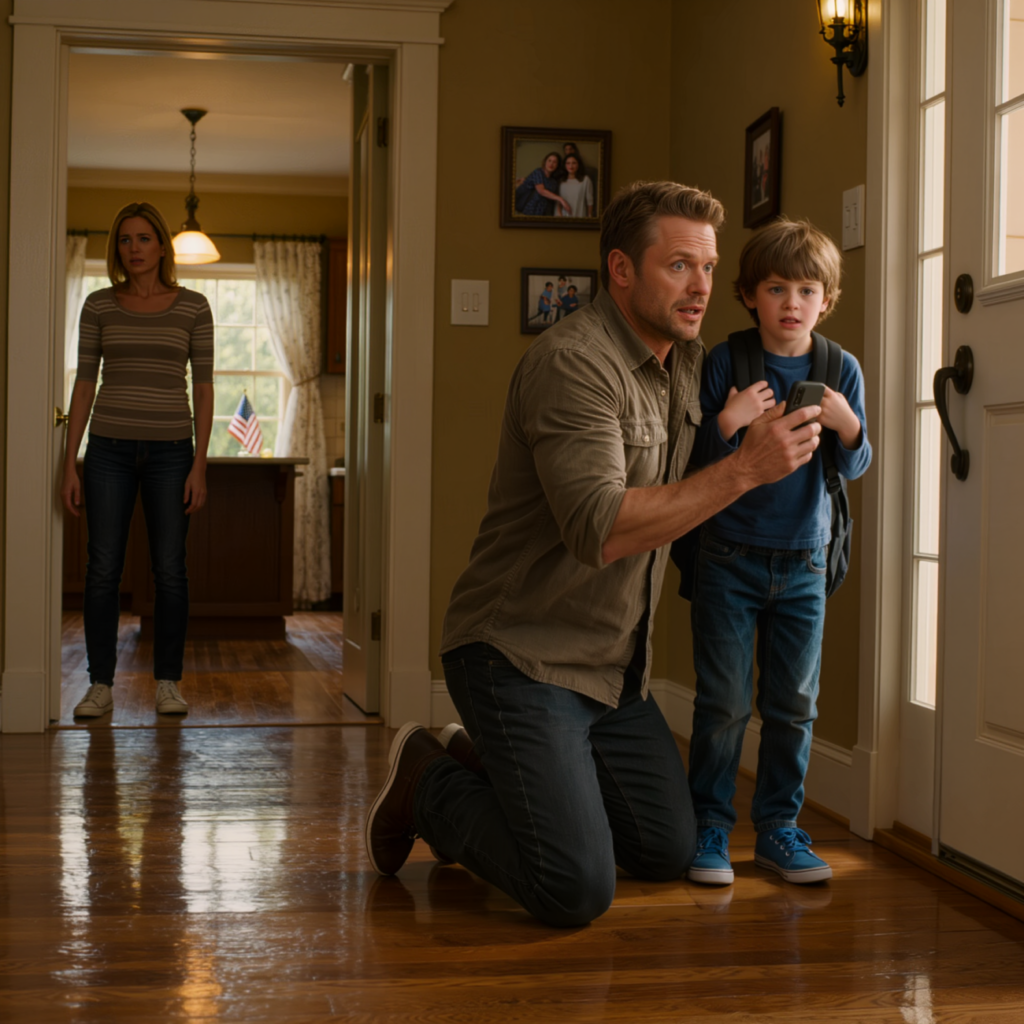
My nine-year-old son, Ethan, had spent a few days at my wife’s mother’s house during summer break. It was supposed to be simple, ordinary, the kind of visit families in our neighborhood arranged without thinking too hard about it. School had let out in late May, the sidewalks in our Ohio suburb were full of bikes and chalk drawings, and Joanne had offered to keep him for a long weekend while I finished a demanding project at work.
When he came home, something felt wrong before he even stepped through the door.
I was standing in the entryway with the porch light still on, the late afternoon heat pressing against the screen door, expecting him to burst inside the way he always did. Ethan usually came home talking before his shoes even hit the mat. He would tell me what snacks he ate, what show he watched, how many times his grandmother let him stay up past bedtime. He would toss his backpack on the bench, wrap his arms around my waist, and start bargaining for pizza before I had a chance to ask whether he had brushed his teeth.
That day, he walked in like a child entering a house he was no longer sure belonged to him.
His small hand gripped one strap of his backpack. His hair was flattened on one side from the car window. His sneakers, the blue ones he had begged for at the mall before school ended, dragged softly across the hardwood floor.
No smile.
No “Dad.”
No rush into my arms.
My wife, Natalie, came in behind him carrying an empty travel cup from the gas station. She looked annoyed, not worried, and went straight toward the kitchen without meeting my eyes.
“He’s tired,” she said. “Don’t make a big thing out of it.”
I looked at Ethan instead.
“Hey, champ,” I said gently, lowering myself to one knee. “You okay?”
He paused in front of me. For a second, I thought he might shrug and say he was fine. Children do that sometimes. They hide their bruised feelings behind one-word answers because they can sense when adults want convenience more than truth.
But then he lifted his eyes.
I will never forget what I saw there.
It was not simple sadness. It was not embarrassment or a sulk after a bad weekend. It was fear, sharp and quiet, the kind of fear a child carries when he has been warned not to speak.
He leaned closer, so close I could feel his breath against my cheek.
“Dad,” he whispered, “don’t ever go back to that house.”
The house seemed to narrow around us. The hum of the air conditioner, the faint clink of Natalie setting her cup in the sink, the distant sound of a lawn mower down the block—everything faded.
I kept my voice even because I could see how carefully he was watching me.
“Why?” I asked. “What happened?”
Ethan looked toward the kitchen, then back at me. He did not answer. He slipped his backpack off his shoulder, unzipped the front pocket, and pulled out the small phone I had given him months earlier for emergencies. It was an older model, nothing fancy, with a cracked rubber case and my number saved under a big blue star.
His fingers trembled as he handed it to me.
“Look at this, Dad.”
I took the phone. At first, I thought he meant a text, or maybe a photo. Then I saw the video thumbnail. It had been recorded the night before. The image was dark and tilted, a piece of beige carpet filling half the frame.
I pressed play.
The first thing I heard was laughter.
Not Ethan’s laughter.
A woman’s.
Familiar.
Joanne’s.
My mother-in-law had always laughed in a way that made people check themselves. At family barbecues, at Thanksgiving, at Ethan’s school concerts, she could make a room go stiff with one little chuckle. She had the gift of turning a harmless comment into a judgment and pretending anyone who noticed was too sensitive.
The camera was low, as if Ethan had hidden the phone between couch cushions or propped it against the leg of a side table. The angle caught only part of the living room at first: the bottom of a coffee table, Joanne’s slippers, the edge of the floral couch I had seen a dozen times during holidays.
Then her voice came through clearly.
“She thinks that boy is normal,” Joanne scoffed. “But he’s weak. Slow. Just like his father. No real spine in either one of them.”
I felt my face go cold.
A second voice answered, sharper and lower.
Natalie’s.
“I told you not to spoil him,” my wife said. “He needs to toughen up. If a few nights here scare him, maybe he’ll finally learn something.”
I stared at the screen, unable to move.
For a moment my mind refused to attach those words to the woman I had married. Natalie, who packed Ethan’s lunches on the first day of school. Natalie, who had cried when he was born. Natalie, who took pictures of him in pumpkin patches and posted captions about motherhood and blessings.
But the voice was hers. There was no mistaking it.
The camera shifted, probably because Ethan had moved. The frame widened enough to show him in the far corner of Joanne’s living room. He was sitting on the floor beside a tall wooden cabinet, his knees pulled to his chest, both arms wrapped around a pillow. He looked much smaller than nine. Smaller than he looked when he slept. Smaller than any child should look while adults talked about him as if he were not human.
Joanne walked into the frame.
“You crying, boy?” she said.
Ethan did not answer.
“That’s why your daddy is the way he is,” she said. “He raised you soft.”
She bent down and yanked the pillow from his arms. Then she swung it hard enough across his face that his head snapped to the side.
It was only a pillow. That was the kind of thing someone like Joanne would have said if challenged. Only a pillow. Only a joke. Only discipline. Only words.
But I watched my son flinch like a child who had learned that silence was safer than protest.
The video continued for another few seconds. Ethan did not cry. He pressed his lips together and stared at the floor. Joanne laughed. Natalie said nothing that helped him.
Then the recording stopped.
I sat back on my heels in our front hallway, holding the phone so tightly the case creaked. Ethan stood in front of me, waiting to see who I would become after seeing the truth.
I wanted to storm into the kitchen. I wanted to shout Natalie’s name so loudly the whole street would hear it. I wanted to demand answers, apologies, confessions—anything that might make sense of the impossible.
Instead, I looked at my son.
“How long has this been happening?” I asked.
His mouth tightened.
“Since last summer,” he whispered.
The words landed harder than the video.
“Last summer?”
He nodded, eyes fixed on the floor.
“When you were working,” he said. “Mom said not to tell you. She said you’d get mad at me for causing trouble.”
I felt something inside me break cleanly in two.
I had missed it. Not because I did not love him, not because I did not care, but because I had believed the easy explanations. Ethan was quiet because he was tired. Ethan did not want to visit Joanne because he was attached to home. Ethan complained of stomachaches before those weekends because he was dramatic about sleeping away from his own bed.
I had accepted the version of events that required the least disruption.
Now my son stood in front of me with proof in his hand because he had finally realized nobody was coming unless he called for help himself.
I pulled him into my arms. For a second he stayed stiff, as if even comfort had become something he needed permission to receive. Then his little body folded against me, and he began to shake without making a sound.
“I’m sorry,” he whispered.
I pressed my hand to the back of his head.
“No,” I said. “You do not apologize for telling the truth. Not to me. Not ever.”
Natalie was still in the kitchen. I could hear the cabinet door close, then the soft tapping of her nails on her phone. She had no idea what Ethan had just handed me. She had no idea that the life she thought she controlled had already begun to unravel.
I did not confront her that night.
That may sound strange. Even now, when I look back on it, a part of me wonders how I found the discipline to sit across from her at dinner and pass the green beans like my chest was not full of broken glass. But I knew my wife. I knew her mother better than I wanted to. If I came at them with rage, they would turn it into a performance. Joanne would cry about being accused. Natalie would say I misunderstood. They would call Ethan confused, sensitive, influenced by me. They would bury the truth under drama before I had enough to protect him.
So I stayed quiet.
I made Ethan macaroni and grilled chicken because it was one of the few meals he always ate without complaint. I sat beside him at the table instead of across from him. When Natalie asked why he was so clingy, I looked at her and said, “He had a long weekend.”
She rolled her eyes.
“He needs to stop acting like everything is a tragedy.”
Ethan’s fork froze above his plate.
I put my hand under the table and rested it lightly against his knee, just enough for him to know he was not alone.
After dinner, I helped him shower, brushed his damp hair back from his forehead, and let him sleep in my room. He tried to argue at first, not because he wanted to be alone but because he had been trained to think needing comfort made him weak.
I left the hallway light on. I sat in the chair near the window, phone in my hand, replaying the video with the sound low.
Once.
Twice.
A dozen times.
Each viewing showed me something new. The angle of Ethan’s shoulders. Natalie’s absence of alarm. Joanne’s comfort with cruelty. The casual way they spoke, as if this had become routine.
By two in the morning, the neighborhood was quiet. The last porch lights had gone dark. Somewhere down the street, a dog barked once and stopped. I was still awake.
Anger can make a person reckless, but fatherhood has a way of sharpening anger into purpose. I did not need one loud confrontation. I needed a record. Dates. Statements. Footage. Professional guidance. A plan that would hold up when Natalie and Joanne tried to rewrite the story.
By sunrise, I knew what I had to do.
The next morning, I drove Ethan to school myself.
It was a Tuesday, bright and humid, the kind of June morning when the American flag outside the elementary school hung limp against the pole and parents in pickup trucks and minivans formed an impatient line along the curb. Ethan sat in the back seat with his backpack on his lap, watching the other kids climb out of cars with water bottles and summer reading packets.
Before he got out, he looked at me through the rearview mirror.
“Are you mad?” he asked.
“At you?” I said.
He nodded.
I turned around in my seat.
“Ethan, listen to me carefully. I am not mad at you. I am proud of you.”
His eyes filled.
“You were brave,” I said. “You did exactly what you were supposed to do. You showed me the truth.”
“What happens now?”
I wanted to promise everything would be fixed by dinner. But children who have been lied to deserve careful truth.
“Now I handle the grown-up part,” I said. “Your only job today is to go to class, stay near your teacher, and remember that I’m picking you up. Nobody else.”
“Not Mom?”
“Not Mom.”
He studied me for a long second. Then he nodded.
When he climbed out, I hugged him longer than usual. The crossing guard smiled at us from the curb. Ethan did not smile back, but he squeezed my hand before walking toward the school doors.
That small squeeze was enough to keep me steady all the way to the law office.
Farah Malik’s office was on the second floor of an old brick building near the county courthouse. I had found her years earlier through a colleague who went through a difficult custody case. Back then, I only saved her number because I was the sort of person who kept useful contacts filed away. I never imagined I would be sitting across from her with my son’s emergency phone between us.
Farah was quiet, precise, and impossible to impress. She wore reading glasses on a thin chain and listened without interrupting while I explained the visit, the video, Ethan’s warning, and the pattern I had failed to understand.
Then we watched the footage together.
She did not gasp. She did not perform outrage. She simply went still in a way that told me she had seen too many families collapse behind closed doors.
When the video ended, she removed her glasses.
“This is serious,” she said.
“I know.”
“No,” she said, leaning forward. “I need you to understand what I mean. This is not just marital conflict. This is mistreatment of a child, and the involvement of his mother makes it legally and emotionally more complicated. You need to document everything, but you need to do it cleanly. No threats. No shouting. No messages you would not want read aloud in court.”
“I work in digital forensics,” I said. “I know records matter.”
“Good. Then treat your own home like a case file.”
Hearing it phrased that way steadied me.
She told me to preserve Ethan’s original video without altering it. She told me to back it up in two secure places. She told me to write down every date I could remember when Ethan had returned from Joanne’s house withdrawn, upset, sick, or unusually quiet. She told me to contact a licensed child counselor and request an emergency appointment. She told me to notify the school that only I was to pick him up until further notice.
“And cameras?” I asked.
“In your own home, in common areas only, after you understand your state’s recording laws,” she said. “No bathrooms. No bedrooms. No private spaces. You are protecting your child, not creating a circus.”
That was Farah. Direct. Careful. Useful.
Before I left, she looked me in the eye.
“Mr. Carter, whatever you discover next, do not let your wife provoke you into becoming the unstable one. People who rely on control often count on the truth-teller losing control first.”
I carried that sentence with me like a warning label.
Over the next few days, I acted like nothing had changed.
I made coffee in the morning. I packed Ethan’s lunch. I answered Natalie’s casual questions with casual answers. I listened to her complain about work, about traffic, about how Ethan was “too needy lately.” Every time she said something like that, my hands wanted to clench. Every time I wanted to answer, I heard Farah’s voice: Do not become the unstable one.
So I became calm.
Not weak. Not passive.
Calm.
I copied the video from Ethan’s phone to an encrypted drive. I saved the phone itself untouched in my desk drawer. I wrote a timeline, starting with the first summer visit Ethan had resisted. I added the stomachaches, the sudden nightmares, the way he stopped wanting to call Joanne “Grandma” and started saying “your mom” to Natalie when he thought I was not listening.
The pattern had been there. I had not known how to read it.
I spoke to Ethan’s school counselor first. Then, with Farah’s guidance, I scheduled him with a child therapist in a small office beside a pediatric clinic. Ethan did not want to go in at first. He stood beside my truck in the parking lot, staring at the cheerful painted butterflies on the clinic window like they were a trick.
“What if she thinks I’m lying?” he asked.
“She won’t,” I said.
“What if Mom says I made it up?”
“Then I will remind everyone that you told the truth with proof.”
He thought about that, then put his hand in mine.
The therapist, Dr. Lane, had a soft voice and a room full of board games, stuffed animals, and little baskets of crayons. I stayed for the beginning, then waited outside while Ethan talked to her alone. The waiting room smelled like coffee, crayons, and disinfectant. I sat under a bulletin board full of summer camp flyers and stared at my own hands.
When Dr. Lane came out, her expression told me enough before she said a word.
“He needs consistency,” she said carefully. “He needs to know the adults around him will believe him and keep him safe. I’ll prepare an initial clinical note for your attorney.”
I thanked her and signed what needed signing.
That weekend, Natalie went shopping with Joanne, claiming they needed “a girls’ day” after all the stress I was apparently creating by being “too serious.” Before she left, she stood at the bottom of the stairs and called up to Ethan.
“We’ll be back later,” she said. “Try not to act weird when Grandma comes around next time.”
Ethan did not answer.
I watched her leave with a department store coupon sticking out of her purse and a smile on her face.
As soon as her car pulled away, I sat with Ethan at the kitchen table. The late morning sun came through the blinds in thin white stripes. Outside, our neighbor was trimming hedges. Somewhere nearby, kids were shouting over a backyard sprinkler.
I placed his phone on the table between us, not recording yet.
“Ethan,” I said, “I need to ask you something, but you can say no.”
He looked frightened, so I slowed down.
“You already helped me by showing the video. That was enough. But there may come a time when adults like lawyers, counselors, or a judge need to understand what happened in your own words. Would you be willing to tell me on video, while we’re sitting here safely, what happened at Joanne’s house?”
His face went pale.
“Do I have to see her?”
“No.”
“Will Mom hear it?”
“Not today.”
He looked down at his hands. His nails were chewed short. I had noticed that habit only recently.
“If I say it,” he whispered, “does it mean it’s real?”
My throat tightened.
“It was already real,” I said. “Saying it just means you don’t have to carry it by yourself anymore.”
He nodded.
So I recorded.
I did not coach him. I did not put words in his mouth. I asked simple questions and let him answer in his own time.
He told me Joanne called him weak when he cried. He told me she made him stand in the hallway facing the wall when he asked to call me. He told me about being sent to sleep on the floor because, according to her, “boys who whine don’t need beds.” He told me about a narrow storage closet off the back hallway where Joanne had shut him in for short periods when he “talked back,” which, in Ethan’s case, meant asking when he could go home.
He told me Natalie knew.
That was the part that carved deepest.
“Mom said Grandma was old-school,” he said, rubbing his sleeve between his fingers. “She said it made boys tougher. She said you wouldn’t understand because you’re too soft too.”
He looked up quickly, as if he had insulted me by repeating it.
I kept my face steady.
“What did you think when she said that?”
“I thought maybe being soft was bad,” he said. “But I didn’t want to be like them.”
The recording ended with me moving around the table and holding him. He cried then, not loudly, not dramatically, just with the exhausted quiet of a child who finally had permission.
“You are not weak,” I told him. “You are kind. There is a difference.”
He nodded against my shirt.
“And you are not responsible for what grown people chose to do.”
He nodded again, but I knew it would take longer for him to believe that.
By then, I had enough to act. But I wanted one more thing, not because I needed to hurt Natalie, and not because I wanted revenge for myself. I wanted them to reveal, in their own words, how comfortable they had become inside the lie. People like Joanne were skilled at changing masks in public. She could become a sweet grandmother in a courthouse hallway if she needed to. Natalie could become a confused wife, wounded by accusations. I needed something they could not soften with tears.
Farah did not like risks. Neither did I. So we made the plan as safe as possible.
Ethan would not be in the house.
I arranged for him to spend the weekend with Mark and Sheila, an older couple from our church who lived three blocks away and had known him since kindergarten. Their grandson was visiting, and Ethan trusted them. I told Natalie he had been invited for a sleepover after a robotics workshop at the library. She barely listened.
I told Natalie I had to fly to Chicago for a weekend work conference. That part sounded believable because my job had taken me out of town before. I packed a bag. I kissed Ethan goodbye in front of Natalie, then drove to the airport long-term parking lot and left my car there.
But I did not board a plane.
I took a rideshare back into the neighborhood, got out two streets away, and entered our house through the side door using the key I kept hidden behind a loose brick in the garage. I had never used it for anything more dramatic than locking myself out while taking out the trash. That night, it felt like stepping behind the curtain of my own life.
The cameras I had placed in our common areas were small, legal, and limited: one facing the kitchen, one covering the living room, one in the hallway near the stairs. No private rooms. No tricks that could be challenged later as reckless. Just common spaces in my own home, where my child’s safety was now my first obligation.
I waited in the guest room with the lights off and my phone connected to the live feed. My overnight bag sat by the wall, still zipped, part of the lie Natalie believed. The house smelled faintly of lemon cleaner and the lavender candle Joanne always criticized as “cheap.” I remember that detail because when a person is waiting for his life to split open, the mind catches on ordinary things.
At 7:12 that evening, Joanne arrived.
She did not knock. She never did. She came through the front door like she owned not only the house but everyone inside it.
“Where’s the brat?” she called.
From the kitchen, Natalie answered, “At that sleepover. He’ll be back tomorrow.”
“Good,” Joanne said. “Maybe a night with normal people will teach him not to cling.”
I closed my eyes.
Natalie laughed tiredly. “He’s been worse since he came back. David keeps hovering over him like he’s made of glass.”
“He is made of glass,” Joanne said. “Because you let that man raise him like a little prince.”
I hit record on the backup device, even though the system was already saving.
They settled in the kitchen with wine. I watched from the phone screen as Joanne took the chair at the head of the table, the one Ethan liked to sit in when he helped me sort baseball cards. Natalie leaned against the counter, scrolling through her phone.
For ten minutes, they talked about coupons, a neighbor’s divorce, and a cousin’s new truck. Then Joanne circled back to Ethan the way cruel people circle back to their favorite target.
“You know he filmed me,” Joanne said suddenly.
Natalie looked up.
“What?”
“I saw the little phone in his bag before you left. He thinks he’s clever.”
My pulse slowed in a way that felt almost dangerous.
Natalie frowned. “Did he show David?”
“If he did, your husband would have come stomping over already. That man can’t hide a feeling to save his life.”
Natalie gave a short laugh.
“You’d be surprised,” she said. “He’s been acting normal.”
“Then the boy kept his mouth shut. Good.”
Natalie set her phone down.
“Mom, you shouldn’t have hit him with the pillow. Not where he could record it.”
Not because it was wrong.
Not because Ethan had been scared.
Because he could record it.
Joanne waved her hand.
“Please. It was a pillow. And if he cries again, take that ridiculous teddy bear he sleeps with and throw it out. Burn it in the grill if you have to. Sentimental nonsense is why he’s like this.”
Natalie did not object.
She sighed and said, “I just need him to stop making David suspicious.”
That was the moment I stood up.
My legs felt strangely steady as I opened the guest room door. The hallway was dim, lit only by the small lamp near the stairs. I walked toward the kitchen slowly, not because I wanted drama, but because I wanted every second to be captured clearly.
When I stepped into the doorway, Joanne’s wineglass slipped from her hand and shattered across the tile.
Natalie turned so fast her hip struck the counter.
For a few seconds, nobody spoke.
I held up my phone. The live feed was still open. The red recording dot glowed at the top of the screen.
“I heard everything,” I said.
Natalie’s face drained of color.
Joanne recovered first. She always did.
“What is this?” she demanded. “You spying in your own house now?”
“Documenting,” I said. “There’s a difference.”
Natalie took one step toward me.
“David, please. Let me explain.”
I looked at her hand reaching for mine and stepped back.
“No.”
Her eyes filled instantly, but I had seen her cry over parking tickets, canceled brunch plans, and a scratch on her SUV. Tears were not proof of remorse. Sometimes they were only another tool.
“Please,” she said. “You don’t understand what it was like growing up with her. I thought she was helping. I thought—”
“You thought what?” I asked. “That making a child afraid of his own grandmother’s house was parenting? That letting him sleep on the floor would build character? That calling him weak would make him strong?”
Joanne slammed her hand on the table.
“Don’t you twist this,” she said. “That boy needs discipline. You’ve made him fragile.”
I turned to her.
“You do not get to speak about my son like that in my house.”
She scoffed.
“Your son? She’s his mother. Mothers win these things. You work all day. You don’t know what happens when you’re gone.”
For the first time in days, I smiled.
It was not a happy smile.
“You really don’t know what I do for a living, do you, Joanne?”
“I don’t care what you do.”
“I work in digital forensics,” I said. “I recover deleted files. I authenticate recordings. I reconstruct timelines. I trace devices, preserve metadata, and prepare evidence so it can survive in court. I have built cases around people who thought nobody would ever prove what they did behind closed doors.”
Her mouth tightened.
“And now,” I said, placing a folder on the kitchen table, “I built one around you.”
Natalie sat down as if her knees had stopped holding her.
Inside the folder were printed timelines, screenshots of message threads between her and Joanne, copies of school pickup updates, my written notes, Dr. Lane’s initial clinical assessment, and still frames from Ethan’s video. There was also a small flash drive in a clear evidence sleeve.
Joanne stared at it.
“You planned this,” she said.
“Yes,” I replied. “Carefully.”
Natalie covered her mouth with one hand.
“David, please don’t call anyone. We can handle this privately.”
“That is exactly how this happened,” I said. “Privately.”
Then I dialed.
When the dispatcher answered, I gave my name, my address, and the plainest version of the truth I could manage.
“I need to report a child safety situation involving my minor son,” I said. “I have video evidence, recorded statements, and an attorney already notified.”
Natalie began crying then, real or not, I no longer had the strength to measure. Joanne stood so quickly her chair scraped backward.
“You don’t have to do this,” she snapped. “I’ll leave. Fine. I’ll go. But don’t ruin your family over a spoiled child’s drama.”
I looked at her, and whatever mercy I had left for her vanished.
“You ruined this family the first time you made my child feel unsafe,” I said. “And Natalie ruined it the moment she watched and chose silence.”
The police arrived within fifteen minutes. Two officers stood in my kitchen while Joanne transformed herself into the version of herself she used at church picnics: offended, elderly, misunderstood. She told them I had always disliked her. She said Ethan was dramatic. She said boys made up stories when they did not get their way.
I said very little.
I played the kitchen audio first. Then I showed them the original video Ethan had recorded. Then I handed over the flash drive and Farah’s card.
The officers’ expressions changed. Not dramatically. Not like television. Real people do not always react in ways that satisfy the moment. But they became sharper. More formal. They separated Joanne and Natalie. They asked questions. They asked where Ethan was, and I told them he was safe at a trusted family friend’s home.
One officer looked at Natalie.
“You were aware of this?”
Natalie stared at the floor.
“Not all of it,” she whispered.
The officer’s voice hardened.
“That is not what the recording suggests.”
By midnight, child protective services had been contacted. Joanne was removed from my property and later questioned further. Natalie was told to leave the home under a temporary safety plan while an emergency protective order was requested through the on-call judge. She packed a small bag in the bedroom while an officer waited in the hallway.
Before she left, she stopped near the front door.
“David,” she whispered, “I’m his mother.”
I looked at her standing under the porch light, mascara smudged beneath both eyes, her suitcase handle in one hand.
“Then you should have been the first person to protect him.”
She had no answer.
After the door closed behind her, the house went quiet.
It was not peaceful yet. Peace is too clean a word for the first night after a family breaks. The kitchen smelled like spilled wine and floor cleaner. A small piece of Joanne’s broken glass still glittered under the cabinet even after I swept twice. My hands shook when I finally sat down.
But for the first time in a long time, the house did not feel like it was keeping a secret.
I picked Ethan up the next morning.
He came out of Mark and Sheila’s house wearing a borrowed sweatshirt and carrying a bag of library books. He looked at my face before he looked at the truck.
“Is it over?” he asked.
“Not all of it,” I said. “But you’re not going back there.”
“Is Mom home?”
“No.”
He absorbed that quietly.
“Because of me?”
I knelt on the sidewalk in front of him. A sprinkler clicked across the lawn next door. A mail truck rolled slowly past us.
“No,” I said. “Because of choices adults made. Not because of you.”
He nodded, but the guilt in his eyes did not disappear. It would take time. I hated that. I hated that the people who hurt children often leave them carrying responsibility that was never theirs.
The weeks that followed were full of offices, forms, interviews, and careful routines.
Farah filed for emergency custody. Dr. Lane continued seeing Ethan twice a week. His school put a note in the pickup system. I changed the locks. I slept lightly, waking at every sound, while Ethan slept with his bedroom door open and the hall light on.
Natalie sent texts at first. Farah told me not to answer directly. Everything went through legal channels. Some messages were apologetic. Some were defensive. Some blamed Joanne. Some blamed stress. Some blamed me for “turning one mistake into a legal war.”
One mistake.
That phrase told me she still did not understand.
One mistake was forgetting to pack his inhaler. One mistake was snapping after a long day and apologizing immediately. What happened to Ethan was a pattern, protected by secrecy, dressed up as discipline, and repeated because the adults around him were comfortable with his silence.
The first court hearing took place on a gray morning that smelled like rain.
The courthouse sat downtown beside a row of government buildings and a diner with faded red booths. I remember seeing people on the sidewalk carrying umbrellas and coffee cups, going about ordinary errands while my entire life rested inside a folder under my arm.
Ethan sat with a child advocate in a small waiting area before we were called in. He wore a blue button-down shirt and the stiff new shoes he hated but agreed to wear because he wanted to look “serious.” His hands were clenched in his lap.
When he saw me, he managed a small smile.
That smile nearly undid me.
A child should never have to look relieved to find one safe face in a courthouse.
The courtroom itself was plain and cold. Fluorescent lights. Wooden benches. A seal mounted behind the judge’s chair. Natalie sat at the opposite table with her attorney, looking pale and thinner than I remembered. Joanne sat behind her, chin lifted, dressed in a lavender cardigan as if softness could be worn like evidence.
Farah sat beside me, calm as ever.
The judge was an older woman with silver hair, sharp eyes, and no patience for performance. She read the preliminary filings, then looked over the top of her glasses.
“I want to be very clear,” she said. “This court is concerned with the welfare of the child, not with family pride.”
Joanne shifted in her seat.
The evidence came in carefully. Farah did not dramatize it. She did not need to. She played the kitchen audio, then a portion of the hallway video. She submitted Ethan’s original recording, preserved with metadata. She provided copies of the text exchanges between Natalie and Joanne. Some of them mocked Ethan’s sensitivity. One mentioned “the closet cure” as if fear were a joke. Another included Natalie writing, “David would lose his mind if he knew, so don’t say anything where Ethan can repeat it.”
Natalie stared at the table.
Joanne’s face turned the color of paper.
Then the judge reviewed Dr. Lane’s initial report and the child advocate’s notes. Ethan was not forced to testify in open court that day. For that small mercy, I was grateful. His recorded statement was enough for the emergency hearing.
In the recording, his voice sounded smaller than it did at home.
“I don’t want to go back there,” he said. “Grandma scares me. She says I’m weak. She says if I cry she’ll put me in the closet again. Mom was there. She didn’t help.”
Silence followed.
Not the kind of silence that means nothing is happening. The kind that means everyone in the room understands that something cannot be unsaid.
The judge removed her glasses.
“I have seen many painful custody matters,” she said slowly. “What concerns me here is not only the alleged conduct of the grandmother, but the mother’s apparent knowledge of that conduct and her failure to protect the child.”
Natalie began to cry.
The judge did not soften.
“To the grandmother, Joanne Miller, this court is issuing a no-contact order regarding the minor child, effective immediately, pending further proceedings.”
Joanne opened her mouth.
“Do not interrupt me,” the judge said.
Joanne closed it.
The judge turned to Natalie.
“As to the mother, visitation will be supervised only, contingent upon psychological evaluation, parenting review, and recommendations from child protective services. There will be no unsupervised contact at this time.”
Then she looked at me.
“Mr. Carter, temporary full physical and legal custody is granted to you pending final review.”
Temporary.
The word mattered legally.
But to Ethan, when the advocate leaned down and explained it, it meant something simpler.
He was not going back.
He ran to me before anyone could stop him. His arms locked around my waist, and he buried his face in my jacket.
“I’m safe now?” he whispered.
I knelt in front of him.
“Yes,” I said. “You’re safe now.”
“For how long?”
I swallowed hard.
“For as long as I’m breathing.”
Farah touched my shoulder once, not as a lawyer, but as a human being who understood that a father can hold himself together for weeks and still almost fall apart when his child finally believes him.
The final custody process took longer, because courts move by calendars, not by the urgency inside a parent’s chest. There were evaluations. Reports. Additional hearings. Natalie attended supervised visits twice at first, in a neutral family center with beige walls and toys stacked in plastic bins. Ethan went because Dr. Lane said it might help him understand his own feelings if he felt safe enough to try.
He lasted nine minutes the first time.
Natalie cried and apologized. Ethan stared at the floor. When she reached toward him, he stepped behind the supervisor’s chair.
The second visit lasted six minutes.
After that, he told Dr. Lane he did not want to go again.
The court did not force him.
Natalie’s contact was reduced to letters screened through the advocate. She sent two in the first month. The first was full of apologies but still mentioned how hard it had been for her. The second blamed Joanne more clearly but circled back to asking Ethan to remember “the good times.”
Ethan never replied.
I kept the letters in a sealed envelope in my filing cabinet. Not hidden forever, not destroyed, just held for a future version of him who might want to read them when he was older. The choice would be his.
Two weeks after the emergency hearing, Natalie sent me a long email.
I read it in Farah’s office, not at home, because I no longer trusted myself to carry those words into the kitchen where Ethan ate cereal before school.
She wrote that she had been manipulated by her mother since childhood. She wrote that Joanne made her believe tenderness ruined boys. She wrote that she never meant for Ethan to be frightened. She wrote that she still loved me, still loved our son, still believed our family could heal if I stopped “punishing everyone.”
At the bottom, she wrote, Please don’t let our marriage die over this.
I stared at that line for a long time.
Then I replied with one sentence, copied through Farah so there could be no confusion.
You stood by while our son learned fear from the people who were supposed to love him, and there is no marriage left after that.
I did not send another word.
Joanne tried to sue me for defamation a month later. The complaint was thin, angry, and almost theatrical. She claimed I had damaged her reputation by sharing “false accusations” with authorities. Farah laughed only once, quietly, when she read it.
“She documented herself,” she said.
The case was dismissed quickly. Joanne left the courthouse that day without looking at me. For once, she had nothing sharp to say.
By autumn, Ethan and I moved.
Not far enough to disappear. Just far enough that the grocery store did not hold memories in every aisle, far enough that he would not have to pass Joanne’s street on the way to soccer practice, far enough that a new school could know him as Ethan Carter, robotics kid, mystery novel fan, careful builder of Lego cities—not as the boy from a custody file.
We rented a small house on a quiet street in a town with maple trees, Friday night football games, and a bakery that opened before sunrise. The front porch sagged a little on one side, and the kitchen cabinets were older than I liked, but the living room filled with afternoon light. Ethan picked the bedroom facing the backyard because he could see the bird feeder from his desk.
For the first week, he slept on top of the covers with his shoes beside the bed.
I did not comment.
I simply left the hall light on and checked the locks where he could see me.
Routines became our repair work.
On Mondays, therapy.
On Tuesdays, tacos from the place near the gas station because Ethan liked watching them press tortillas behind the counter.
On Wednesdays, homework at the kitchen table while I finished reports on my laptop.
On Fridays, movie night with popcorn in the big metal bowl my mother had given me when I moved into my first apartment.
Little by little, his laughter came back.
Not all at once. Healing does not arrive like a marching band. It slips in quietly. It shows up when a child sings in the shower again, when he leaves a toy in the middle of the hallway because he expects to come back and find it untouched, when he asks for seconds at dinner, when he stops apologizing for needing a nightlight.
One evening in November, I found him in the garage building a small robot from a kit Mark had given him. His tongue stuck out at the corner of his mouth the way it did when he concentrated. A college football game played low on the old radio. Rain tapped against the garage door.
“Dad?” he said without looking up.
“Yeah?”
“Why didn’t you leave earlier?”
The question did not accuse me. That made it hurt more.
I sat on the step beside him.
“Because I thought staying kept things normal,” I said. “I thought if I worked hard, paid the bills, kept the peace, and made sure you had a home, I was protecting you.”
He snapped two plastic pieces together.
“But you didn’t know.”
“I knew enough to notice you were unhappy,” I said. “I just didn’t understand why. And I should have looked harder.”
He was quiet for a while.
“Are you mad at yourself?”
“Sometimes.”
He set the robot down.
“I’m not mad at you.”
I could not speak immediately.
He leaned against my arm.
“I’m glad you walked away,” he said.
“So am I.”
The divorce became final in the spring. The final custody order gave me full physical and legal custody. Natalie remained limited to written contact unless a therapist and the court agreed otherwise in the future. Joanne remained barred from contact.
There was no dramatic celebration. I did not walk out of the courthouse cheering. I took Ethan for pancakes at a diner with vinyl booths and a waitress who called everyone honey. He poured too much syrup on his plate and grinned when I pretended not to notice.
That was our victory.
Not revenge.
Breakfast.
A safe ride home.
A child talking with his mouth full because he no longer feared being corrected for taking up space.
Nearly a year after the night Joanne shattered the wineglass in our kitchen, my phone rang during a rainy Thursday evening.
Ethan was on the couch in pajama pants, laughing at an old cartoon while a half-finished library book lay open beside him. The living room smelled like microwave popcorn and the vanilla candle he had picked at the grocery store because, he said, it made the house feel “less serious.”
I looked at the screen.
Natalie.
I had not heard her voice in months.
For a moment, I considered letting it go to voicemail. Then I stepped into the kitchen and answered.
“Hello.”
There was silence first. Then a breath.
“David?”
Her voice sounded different. Smaller. Stripped of the sharpness she used to borrow from her mother.
“Yes.”
“I know I’m not supposed to call unless it’s through the approved line,” she said quickly. “I know. I’m sorry. I just… I needed to tell you something.”
I said nothing.
“I left her,” Natalie whispered. “I left my mother.”
Rain streaked down the dark kitchen window. In the reflection, I could see Ethan laughing in the other room, unaware that the past had found the phone line.
“I’m in a transitional shelter,” she said. “It’s connected to a counseling program. I’ve been going to therapy. Real therapy, not just the evaluation. I know that doesn’t fix what I did. I know it doesn’t make me safe for him. But I’m trying to understand how I became someone who could stand there and do nothing.”
My hand tightened around the phone.
There had been a time when those words would have pulled me toward pity. I had spent years explaining Natalie to myself. Her moods. Her coldness. Her fear of Joanne’s disapproval. Her habit of turning cruel after every phone call with her mother.
But understanding a wound does not erase the damage it caused someone else.
“I’m not calling to ask you to forgive me,” she said. “I don’t deserve that. I just wanted to ask if someday—only if his therapist thinks it’s right—I could tell Ethan I’m sorry. Not to confuse him. Not to ask him for anything. Just to say it once.”
I looked toward the living room.
Ethan had pulled the blanket up to his chin. His face was soft with laughter, his whole body relaxed into the couch. That sight still felt miraculous to me.
“You’re not ready,” I said.
Her breath caught.
“And he is not ready to carry your apology,” I continued. “You may want to give it because it hurts to hold it. But he does not need to receive it just because you finally understand the weight of it.”
Quiet sobs came through the phone.
“I know,” she said. “I know you’re right.”
For the first time, she did not argue.
That silence between us was not forgiveness. It was not reconciliation. It was simply the absence of another fight.
“Keep doing the work,” I said. “For yourself. Not as a way back into his life. If that day ever comes, it will be because it is good for Ethan, not because it eases your guilt.”
“I understand.”
I was not sure she did. But she sounded like she wanted to, and that was more than I had heard before.
“Goodbye, Natalie.”
“Goodbye, David.”
I ended the call and stood in the kitchen for a moment, listening to the rain.
When I returned to the living room, Ethan looked up.
“Who was that?”
I sat beside him.
“Someone from the past.”
His smile faded a little.
“Do we have to go back there?”
I put my arm around him and pulled the blanket over both of us.
“No,” I said. “We don’t have to go back.”
He nodded, leaned into my side, and turned his eyes back to the television.
Outside, rain tapped steadily against the windows. Inside, our little house held its ordinary sounds: the cartoon voices, the hum of the refrigerator, the soft creak of the floor when I shifted my weight. Nothing dramatic. Nothing anyone would write down in a court record.
Just peace.
And maybe that was the deepest lesson I learned from all of it.
A family is not proven by photographs, holiday dinners, or the last name on a mailbox. It is proven in the moment a child is afraid and someone chooses to stand between him and the fear. It is proven by who tells the truth when silence would be easier. It is proven by who changes the locks, turns on the hall light, sits through therapy appointments, saves the evidence, makes the pancakes, and keeps showing up after everyone else has explained why they failed.
I could not give Ethan back the year he spent afraid.
I could not erase the voices he heard in that house or the nights he wondered whether being gentle made him weak.
But I could give him every day after.
A safe home.
A steady father.
A future that did not belong to Joanne, or Natalie, or any version of love that required a child to shrink himself to survive.
That night, Ethan fell asleep on the couch before the cartoon ended. I carried him to bed the way I had when he was little, though his legs were getting longer and his head no longer fit neatly under my chin. He stirred as I pulled the blanket over him.
“Dad?” he mumbled.
“I’m here.”
“Door open?”
“Always.”
I left it open. I left the hall light on. Then I stood there for one extra minute, watching him sleep in the quiet safety he should have had all along.
The past was still real. It always would be.
But it was behind us now.
And this time, if it ever tried to come back through the door, it would find me standing there first.