I Bu:ried My Husband Of Nearly Fifty Years On A Cold Pennsylvania Morning. By The Next Day, My Children Told Me, “Mom, This Farm Is Ours Now.” Then My Son Left Me On A Deserted Road With One Suitcase And Drove Away. They Thought They Had Taken Everything—But Never Imagined I Still Held The Secret That Could Destr0y Their Plan
Chapter I: The Silence of the Orchard
The hum of the old Kelvinator refrigerator in the kitchen of the main house at Hazelbrook Orchards had a steady, predictable rhythm that had anchor-stitched my mornings for nearly fifty years. It was six o’clock on a Friday in late October, and the Pennsylvania mist was rolling off the Blue Ridge hills in heavy, gray sheets, settling over the rows of Honeycrisp and Northern Spy apple trees like a wet shroud.
I sat at the heavy maple table—a piece of furniture my husband Richard had built out of a fallen sugar maple during our second year of marriage—holding a stoneware mug of lukewarm black coffee. I am sixty-eight years old. My name is Eleanor Grace Whitmore, and until three weeks ago, I believed that a life constructed out of manual labor, quiet faith, and cyclical patience was a fortified structure that could withstand any environmental shift.
The silence Richard left behind when his breathing finally ceased in the downstairs bedroom was not a simple absence of sound; it was a physical weight that seemed to alter the atmospheric pressure of the house. For five months, pancreatic cancer had systematically dismantled his six-foot frame, turning his thick, sun-browned forearms into narrow cords of gray skin and rendering his deep, resonant baritone into a dry, breathless whisper.
I had spent those five months in a state of absolute logistical precision: monitoring the dosage schedules of the liquid morphine, clearing the plastic oxygen lines, and turning his heavy body every two hours to protect his skin from the bedframe. When the monitor finally went flat on a Tuesday morning at dawn, I didn’t scream. I washed his face with a damp cloth, folded his hands over the linen sheet, and walked out to the packing shed to ensure the morning shipment of cider apples was loaded onto the regional distribution trucks on schedule.
The orchard was not merely a commercial enterprise; it was our biography written into eighty acres of fruit-bearing timber. When Richard and I cleared the first three acres of scrub pine in 1978, we possessed nothing but an old John Deere tractor with a slipping clutch, a shared five-hundred-dollar savings account, and a mutual conviction that the soil would return what we invested in its care. Every tree we planted by hand, every cedar post we hammered into the rocky clay perimeter, and every harvest we graded in the sorting bins was a physical recording of our contract with each other.
My children, Darren and Samantha, arrived from the city forty-eight hours after the funeral service. At first, when they sat on the living room sofa with their heads down, their fingers moving rapidly across the glass screens of their smartphones, I told myself that their cold, detached indifference was simply the contemporary architecture of sorrow. I assumed that growing up within the fast, digital layers of Philadelphia had left them with a different vocabulary for managing a loss.
But by the next morning, when the sun cleared the treeline and the morning mist began to steam off the barn roof, the veneer of their grief dissolved, exposing the raw, clinical calculation beneath.
They did not join me in the study to organize the estate manifests or check the inventory logs for the winter storage lockers. They waited until I had poured my first cup of coffee before they sat down on the high wooden stools across the maple island, their postures straight, their eyes unblinking, looking at me not as their mother, but as an administrative obstacle on a spreadsheet.
“The baseline data is entirely clear, Mom,” Darren said, his voice carrying that sharp, hurried commercial velocity he used when finalizing commercial real estate leases for his firm. He adjusted the cuff of his designer pullover, his fingers tapping a rhythmic, impatient pattern against the wood. “You are sixty-eight years old, your lumbar history is a permanent liability, and managing eighty acres of active agricultural timber without Dad’s physical participation is a structural impossibility. A premium assisted-living facility near the mainline would provide a far more secure environment for your remaining cycles.”
Samantha nodded in immediate, mechanical agreement, her manicured fingers sliding a thick stack of blue-backed legal documents across the maple surface toward my saucer. “We’ve already executed the preliminary review with an institutional investment group from Pittsburgh, Mom. They are prepared to wire seven million dollars liquid for the entirety of the Hazelbrook acreage. The closing can be completed through an escrow agent by Friday morning, provided you execute the title transfer and the probate waiver today.”
I looked down at the blue paper. Resting on top of the transfer files was a secondary document—a two-page will bearing the alleged signature of Richard Whitmore, dated four weeks prior to his death.
I didn’t reach for my reading glasses. I didn’t need to examine the text to find the variance. I had spent forty-eight years watching my husband sign his name to fruit contracts, machinery leases, and tax ledgers. I knew the specific, heavy drag of his pen, the way his hand stuttered slightly on the capital R due to an old tractor accident that had broken his wrist in his youth, and the precise, sharp termination of the final e. The ink on this paper was a fluid, unbroken line—a mechanical, smooth forgery that possessed his name but held absolutely none of his hand.
When I lifted my head and looked Darren in the eye, my hands remaining flat and still against the table, his smile didn’t fade; it simply stiffened into a white line of defense.
“Your father never saw this paper, Darren,” I said, my voice quiet, level, and entirely empty of emotional agitation. “And I am not signing the title of this ground over to an escrow agent from Pittsburgh.”
The commercial politeness left the room with the suddenness of a window being smashed. Darren stood up from the stool, his chair scraping loudly against the pine floorboards, his face turning an angry, mottled red.
“You don’t have the leverage to play the stoic matriarch anymore, Eleanor,” he snapped, omitting the maternal noun for the first time in his life. “The business accounts are leveraged to the limit after Dad’s medical cycles. If you don’t execute this closing, the regional bank will initiate a foreclosure audit on the packing house by the end of the quarter anyway. We are giving you an exit with seven million dollars of liquidity. You have until five o’clock to re-route your perspective.”
Before I could answer, Darren grabbed my winter coat from the peg near the door, tossed my old canvas suitcase onto the counter—a bag he had quietly packed from my closet while I was out in the equipment barn—and pointed toward the driveway.
“We’re driving down to the county office to file the preliminary probate logs,” he said, his hand coming down onto my shoulder with a firm, non-negotiable pressure that felt like an arrest. “We’ll give you the transit time to think about the reality of your position.”
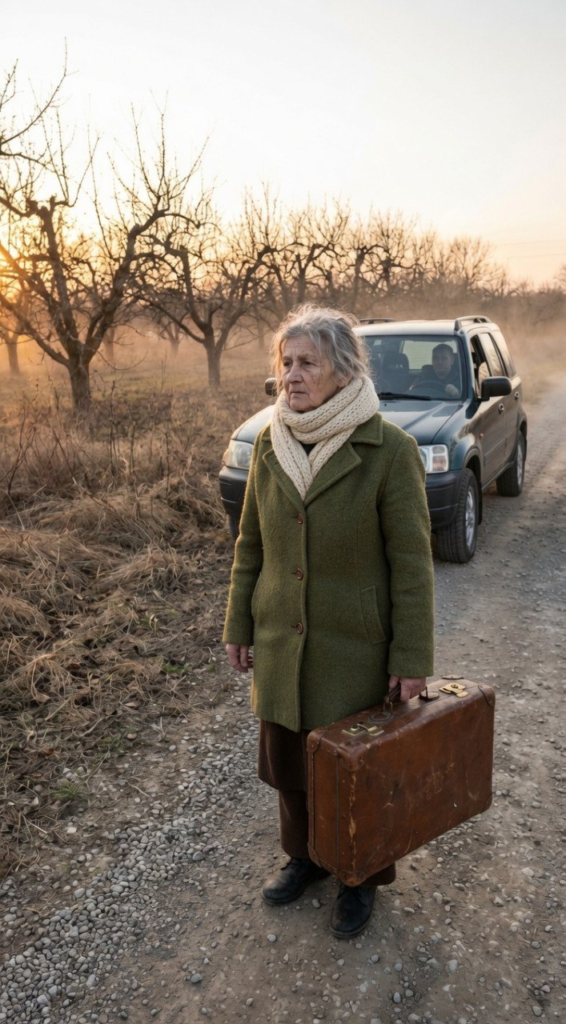
I didn’t fight his grip. I allowed him to guide me into the passenger seat of his luxury sedan, my canvas suitcase resting between my knees. We drove thirty miles down the state highway in absolute, dead silence, the sound of the tires hummed against the wet asphalt.
But when the car reached the isolated intersection near the old county stone quarry—a place five miles outside the town limits where the gravel roads crossed the abandoned rail line—Darren pulled the vehicle onto the shoulder. He stepped out, walked around to the passenger side, opened my door, and dropped my canvas suitcase onto the gravel ditch.
“The farm is no longer your operational sector, Eleanor,” he said, his face cold under the gray sky. “The locks on the main house will be altered by the security team at noon. When you’re ready to sign the probate waiver and accept the mainline facility, you can call my office line. Until then, let’s see how far your quiet strength carries you on the road.”
He slammed the door, the vehicle accelerating away from the margin of the gravel with a violent spray of stone that left a cloud of white dust hanging in the mist.
I stood alone on the shoulder of the highway, a sixty-eight-year-old widow in a damp winter coat, holding a canvas bag, with nothing but the sound of the wind through the dead goldenrod to anchor my presence.
Chapter II: The Hydrological Ledger
A person who has spent her life inside the city centers understands the world as a system of financial transactions and legal registries. They believe that power belongs to the individual with the most expensive legal counsel or the largest collection of corporate credentials.
But an old orchardist operates under a different literacy. For fifty years, I had survived frost cycles that killed sixty percent of the blooms in a single night; I had managed the drainage patterns of eighty acres of clay loam during five-inch mountain downpours, and I had learned that the survival of any structure depends entirely on its relationship to the natural infrastructure of the terrain.
I picked up my canvas suitcase, adjusted my wool scarf against the biting wind, and began to walk south toward the town line. My joints ached with a dull, familiar friction, and my low-heeled work shoes made a sharp, rhythmic crunch-crunch-crunch against the gravel shoulder.
I didn’t weep. The old text in my mind—the one Richard and I had lived by during the drought of 1999—remained steady: Silence is not a symptom of a broken spirit; it is the state of an operative who is currently gathering her data.
What Darren and Samantha had completely omitted from their financial calculations was a twenty-acre parcel of rocky, uncultivated timber ground that directly bordered the northern boundary of the Hazelbrook acreage.
In 1975, three years before I ever met Richard Whitmore, my father had passed away, leaving me a small, private life insurance payout of four thousand dollars. I hadn’t spent that money on consumer goods or a savings certificate. I had walked into the county land office and purchased those twenty acres of limestone ridge under my maiden name—Eleanor Grace Vance—explicitly because my father had taught me how to read a topographic survey.
That limestone ridge contained the Hazelbrook Spring—the single, deep mountain aquifer that supplied ninety-five percent of the natural water volume to the entire valley. When Richard and I constructed the irrigation lines for the orchards in the eighties, we didn’t use municipal lines; we ran a series of gravity-fed plastic pipes directly from my ridge ground down into the main holding tank behind the packing shed.
Hazelbrook Orchards was an eighty-acre body of fruit-bearing wood, but my twenty acres contained the jugular vein. Without the water from my private spring, the Honeycrisp trees would wither into kindling within a single dry July cycle, and the property value would drop from seven million dollars to the price of an abandoned stone quarry.
I reached the municipal borough line by noon, my coat soaked through at the shoulders, and walked straight into the red-brick office of Jennings & Vance on Market Street.
Harold Jennings was seventy-two years old, a man with a thick mane of silver hair and eyes that had spent forty years looking through the land registries of the county. He had been our family’s corporate counsel since we filed our first partnership charter, and he was the only person in the county who still remembered the exact boundary markers of the 1975 Vance deed.
He didn’t ask me why I arrived on foot with a mud-smeared suitcase. He looked at my face, saw the purple shadows of fatigue beneath my gray eyes, and immediately poured two mugs of black tea from his copper kettle.
“They served me with a copy of the probate petition two hours ago, Eleanor,” Harold said, his voice dropping into that deep, slow register that belongs to a veteran country lawyer. He laid the documents flat on his desk, his thumb running over the signature page of the forged will. “Darren’s legal representatives from Philadelphia are pushing for an expedited emergency declaration, claiming the orchard requires immediate corporate governance to satisfy a pending commercial acquisition. He submitted this signature as Richard’s final declaration.”
I set my tea mug down with a deliberate, soft click against the glass desk top. “Richard was unconscious by October first, Harold. His right hand had been paralyzed by the neurological degradation since the middle of September. He couldn’t have held a fountain pen, let alone executed a two-page estate trust modification.”
Harold reached into his desk drawer and pulled out a high-magnification loop, his eyes narrowing as he scanned the ink under the glass. “The stroke of the pen is entirely synthetic, Eleanor. It’s an electronic tracing executed through a digital signature client. It’s an absolute, unvarnished fraud. They haven’t just broken a familial boundary; they have committed a level of grand larceny that carries a mandatory federal penalty line.”
“I don’t want a criminal trial, Harold,” I said, leaning back against the leather cushion of the chair, my fingers resting openly against the wool of my scarf. “I don’t want a public spectacle for the local networks, and I don’t want to spend my remaining cycles sitting in a deposition room watching my children look at their shoes. I want the ground secure, and I want my dignity intact.”
Harold smiled—a small, sharp movement of his thin lips that caught the light of the desk lamp. He turned to the heavy green filing cabinet behind his chair, pulled a thick leather-bound binder marked Vance Registry 1975, and laid the original linen deed map across the desk.
“Then let’s show the investment firm from Pittsburgh the exact cost of their water rights,” he said.
Chapter III: The Collapse of the Transaction
The legal counter-measure was executed with the silent, non-linear velocity of a strategic military deployment.
By three o’clock that afternoon, Harold Jennings had transmitted a formal, certified legal notification directly to the managing partners of Caldwell Industrial Acquisitions in Pittsburgh—the firm that had agreed to wire the seven million dollars to Darren’s corporate account.
The letter didn’t contain an emotional plea regarding a mother’s abandonment or a widow’s grief. It was an airtight, clinical audit of the land deeds. It informed the investment board that the eighty acres of Hazelbrook Orchards were subject to a pending fraud investigation regarding the validity of the executor’s signature.
More importantly, it attached a certified copy of the 1975 Vance deed, explicitly stating that the primary gravity-fed water line supplying the orchard’s entire irrigation infrastructure was located on separate, non-marital property owned exclusively by Eleanor Grace Vance. The notification concluded with a formal notice that any unauthorized diversion of water from the Hazelbrook Spring into the orchard parcel after five o’clock that evening would be treated as a criminal trespass against a private environmental resource.
The response from the city was immediate and catastrophic for Darren’s schedule.
At four-fifteen, my personal mobile phone—an old-fashioned flip model I kept tucked into the internal zippered pocket of my coat—began to vibrate against my ribs. It was a continuous, frantic series of incoming ring cycles that didn’t cease for twenty minutes.
First came Darren’s name across the low-resolution digital screen. I didn’t press the green button. I let the device ring until it rolled into the automated voicemail system.
Then came Samantha’s name, her calls originating from a legal office downtown. I let it ring.
By five o’clock, the text messages began to flood the network, the language shifting rapidly from their previous arrogant authority to a high-pitched, frantic desperation that left no doubt regarding the structural health of their deal.
Mom, pick up the phone right now! Darren wrote. The Caldwell group just pulled their escrow authorization from the clearing bank. They are threatening to sue my firm for non-disclosure of critical encumbrances. What did you have Jennings send to their legal team?
Ten minutes later, Samantha’s message appeared:
Eleanor, please answer me. The bank has frozen the commercial bridge line because of the title cloud. If the Caldwell closing fails, Darren’s personal guarantee on the development loan defaults by Monday morning. We need to sit down at the house and restructure the parameters immediately. This is ruining our family’s reputation.
I sat in the small, quiet library room of the town apartment I had rented through Harold’s real estate network, watching the messages accumulate on the screen. For thirty-two years, I had carried these two human beings within the perimeter of my body and the center of my prayers. I had washed their clothing, checked their school logs, and tolerated their growing, city-bred condescension because I believed that a mother’s duty was an absolute, unconditional support line that could never be overdrawn.
But looking at the frantic script on the screen, I realized that some debts cannot be settled with additional grace. When you have given a person life, and their response is to use a forged signature to strip you of your shelter before your husband’s grave has even settled, you no longer owe them an administrative audience. Pity is a beautiful human quality, but it becomes a form of self-destruction when it is used to shield a predator from the natural consequences of his choices.
I turned the power switch of the phone to the off position, laid the plastic case on the wooden desk, and turned my attention to the small window that looked out over the town square. The rain had ceased, leaving the old brick buildings shining like wet slate under the early evening streetlamps. For the first time in five months, the internal monitoring loops in my brain were completely quiet. The orchard was still breathing, the spring was secure, and the execution was entirely under my control.
Chapter IV: The Agricultural Covenant
On Monday morning, the conference room of the Tri-County Agricultural Cooperative on Main Street was filled with the scent of old paper, damp wool, and the dark chicory coffee that the local farmers favored during the winter planning sessions.
Six members of the cooperative board—men and women whose hands were the color of walnut wood from decades of manual orchard labor—sat around the long oak table, their faces serious and silent as Harold Jennings spread the new deed alterations across the layout.
I sat at the foot of the table, dressed in a clean, plain wool suit, my grandmother’s silver wedding ring my only ornament.
“The configuration is entirely non-traditional, Eleanor,” said Ben Miller, a sixty-two-year-old fruit grower who managed two hundred acres of peaches in the northern valley. He looked at the deed map over his reading glasses, his thick thumb tracing the limestone ridge line. “You are proposing to transfer the absolute, permanent water rights of the Hazelbrook Spring directly to the cooperative’s environmental trust, bypassing the marital estate entirely?”
“The restriction is absolute, Ben,” I said, my voice carrying a natural, effortless density that left no room for legal debate among the board. “The cooperative will assume the full responsibility for the maintenance and distribution of the water volume. The gravity lines supplying the eighty acres of Hazelbrook Orchards will remain active, guaranteeing that the trees Richard and I planted will never go dry during a summer cycle. But the title to that water will be held in a permanent agricultural covenant. It cannot be sold, it cannot be leveraged for a commercial loan, and it cannot be liquidated by any future executor of the Whitmore estate.”
The board members looked at each other, a silent, profound understanding passing between them. They had spent their adult lives watching the old family farms in the county being systematically acquired by development groups from the cities—turned into uniform subdivisions, strip malls, and corporate logistics hubs because the children of the original owners preferred the quick liquidity of an escrow transfer to the slow, heavy labor of the soil. They recognized that my choice wasn’t an act of maternal revenge; it was a permanent structural fortification designed to preserve the integrity of the ground from the greed of the people I had raised.
“If we accept this covenant, Eleanor,” Ben Miller said softly, his hand coming down onto the linen map, “your children will never be able to sell that property for commercial development. The investment firms from the city won’t touch an orchard that doesn’t have an assignable water title. It will remain agricultural timber forever.”
“That is exactly why the document was drafted, Ben,” I said. “Richard and I didn’t spend fifty years sweating over that clay loam to provide a short-term margin account for a real estate firm in Philadelphia. We built a sanctuary for the fruit. The covenant ensures the sanctuary remains open long after my name has cleared the register.”
The six board members stood up in unison, their hands coming forward to sign the notary packets with a heavy, deliberate stroke of the pen. By noon, the documents were stamped with the official seal of the Commonwealth Land Registry, and the blue binder containing The Chloe File was officially stored in the county archives as an unchallengeable title defense.
When I walked out of the cooperative building onto the sidewalk, the afternoon sun was bright and cold, casting long, sharp shadows across the brick storefronts of the square.
Darren’s luxury sedan was parked near the curb, its hazard lights flashing rhythmically against the stone. He stepped out of the vehicle the moment the glass door clicked behind me, his face pale, his tailored coat open to the wind, his eyes holding none of the arrogant authority that had defined his presentation on my porch three days ago.
“Mom,” he said, his voice dropping into a raw, breathless whine as he stopped two feet from my coat. “Please. You have to sign the emergency rescission waiver with Jennings. The Caldwell group has officially filed a non-disclosure complaint with the licensing board. My firm is facing an administrative freeze by Friday if we don’t clear the title cloud. We can talk about the care facility parameters again. We can find a villa in Aspen instead of the mainline. Just clear the water rights.”
I looked at him—at the expensive leather of his shoes, the smooth, soft skin of his hands, and the complete absence of any real, human understanding in his face. He was thirty-eight years old, a man who had spent his life translating every human interaction into a calculation of immediate profit, and he was entirely blind to the reality that some structures cannot be bought with an escrow transfer.
“The ledger is closed, Darren,” I said quietly, my hand resting on the handle of my canvas suitcase. “The water rights have been transferred to the cooperative trust. They are no longer part of my estate, and they are no longer within the perimeter of your access tokens.”
He stared at me, his mouth opening slightly, his shoulders slumping inward until his tailored coat looked too large for his frame. “You’re destroying our inheritance, Eleanor,” he whispered, his voice cracking with a bitter, childlike spite. “You’re ruining your own children over an old piece of dirt.”
“No, Darren,” I said, turning my back to his sedan and stepping toward the crosswalk. “I am simply protecting the fruit from the locusted line.”
Chapter V: The Geography of the Small Room
The apartment on Pine Street was an architecture of absolute simplicity. It consisted of three rooms on the second floor of a restored Victorian brick townhouse, the windows looking out over the mature maple trees of the municipal park. The floors were plain, wide oak planks that I had scrubbed with linseed oil until the grain showed clear and deep under the morning sun; the walls were painted a soft, clean cream color, and the only furniture was the maple kitchen table Richard had built and the small library shelf that held my collection of botanical reference logs.
It was small, it was quiet, and for the first time in forty-eight years, it was entirely mine.
I began my new routine within the first week of November. I didn’t spend my mornings checking the regional wholesale apple prices or monitoring the fuel levels of the frost fans in the low orchards. I walked down to the community garden center near the old library every morning at eight o’clock, where I had accepted an informal position as the director of the municipal horticultural program.
The work was entirely unglamorous. I spent my hours sitting on a low wooden bench in the greenhouse, teaching local young people and retired municipal workers how to clean the roots of perennial stock, how to identify the subtle signs of nitrogen deficiency in the leaf tissue, and how to execute a clean, non-linear graft onto an old apple seedling.
“You have to look at the inner bark line, Clara,” I explained to a twenty-two-year-old student who was struggling to align a scion wood fragment against a rootstock container. “If the green layer doesn’t make an absolute physical connection with the cambium, the sap profile won’t clear the joint. The tree will simply reject the graft, and the wood will die in the dark. It doesn’t matter how much tape you wrap around the outside if the inner lines don’t match.”
The student looked up at me, her eyes wide behind her safety glasses, her fingers moving with a sudden, new care as she adjusted the wood. “It requires an extraordinary amount of patience, Mrs. Whitmore,” she murmured. “It looks so simple when you do it.”
“Patience is not a passive waiting, Clara,” I told her, my fingers clearing a dry leaf from the potting bench. “Patience is the systematic administration of the correct conditions over a prolonged duration. It’s the understanding that the growth has its own timeline, and you cannot rush the ink.”
By the second spring, the small apartment on Pine Street had become a sanctuary for the neighborhood’s emerging growers. My kitchen table was often covered in small pots of heirloom tomato seedlings, cuttings of wild elderberry from the hills, and jars of local honey brought by the farmers who came to consult me regarding their soil charts.
Darren and Samantha never returned to the county land office. The forensic audit executed by the Attorney General’s office had resulted in a formal, private reprimand from the corporate licensing board for my son’s real estate firm, and the legal costs of settling the non-disclosure complaint with the Caldwell group had liquidated the remaining liquid reserves of his PAC investments. Samantha had taken an administrative relocation to a secondary legal branch in Denver, her name completely missing from the state social registers, her connection to the Hazelbrook heritage reduced to an occasional, formal holiday card that I kept unread in the back drawer of my desk.
They had spent their lives believing that an inheritance was something you took from a dead man’s safe—a collection of numbers and titles that could replace the necessity of personal integrity. They had completely failed to understand that the true legacy of Hazelbrook was the capacity to endure the winter without losing your alignment with the truth.
Sometimes, usually on those quiet Sunday evenings when the moon was a bright, silver crescent above the maple trees of the park, I would walk down to the municipal station, board the regional transit bus, and ride the eight miles out to the northern ridge road that overlooked the Hazelbrook valley.
I would stand by the old stone wall of the cooperative trust ground, my hands tucked into the pockets of my wool coat, watching the long, dark rows of the apple trees stretch out across the clay loam below. The trees were fifty years old now, their branches heavy with the first green clusters of the spring buds, their roots sinking deep into the dark earth that Richard and I had cleared when our skin was smooth.
The gravity lines were functioning with an absolute, silent precision. The clear, cold water from my private spring was sliding through the plastic conduits far below the grass, filling the main tanks behind the packing house on a steady, unbothered count that required no corporate signatures or escrow clearances. The orchard was breathing, the timber was secure, and the sanctuary remained completely wide open to the sky.
I felt a single, sharp pang of grief cut through my chest—not for the loss of the grand colonial house or the seven million dollars of city money, but for the children who had been so entirely blinded by the flash of the numbers that they had forgotten how to look down and see the ground beneath their own boots.
But I no longer carried the weight of their choices as a deficit in my personal ledger. I had cleared the lines, I had verified the documentation, and I had delivered the assets to the only trust that was durable enough to preserve the history of our labor.
If my story holds any structural value for the operatives who are currently navigating their own winter cycles, it is this: never mistake the quietness of an old woman for a failure of her steel. The people who have spent their lives surviving the storms do not need to raise their voices to defend their border. They do not require a loud performance to demonstrate their position on the deck.
They endure. They analyze the terrain. They keep the records in the dark.
And when the time comes… they stand flat on the single, unvarnished truth that the blind were entirely too proud to find.