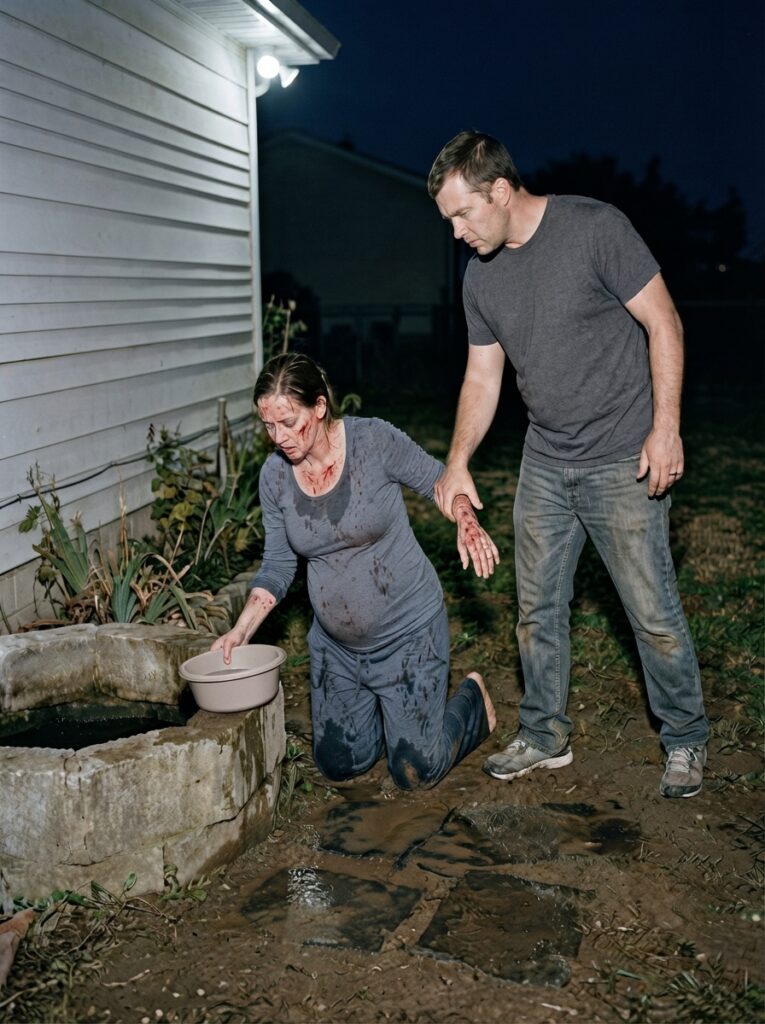
The responder came through the open gate, took one look at me beside the well, and put himself between my husband and the path back to the house.
He did not raise his voice.
That almost made it more serious.
He looked at my husband and said, “Stay there.”
My husband stopped.
For months, I had watched him ignore my words whenever ignoring them was convenient. No had meant keep arguing. Stop had meant I was being dramatic. I’m tired had meant I was lazy.
But one calm instruction from another man made him freeze in the middle of our yard.
The responder crouched near me without touching me.
“Can you tell me where you’re hurt?”
I pressed my hand harder against my lower back. “Here. Mostly.”
“Did you fall?”
My husband answered before I could.
“Yes. She got dizzy. She’s pregnant. She shouldn’t have been outside in the first place.”
The neighbor made a sound behind him, half disbelief and half anger.
The responder looked up.
“I asked her.”
My husband went quiet.
That tiny correction changed something in the yard.
I had spent so long being spoken for that I had almost forgotten how strange it sounded when someone refused to let him do it.
The responder turned back to me.
“Did you fall?”
I looked at the basin lying in the mud.
“Not at first.”
My husband’s jaw tightened.
The responder waited.
I could hear another vehicle arriving beyond the gate. Doors opened. Low voices carried toward us.
I swallowed.
“He brought me out here. He poured cold water on me. Then he made me keep scooping water from the well with that basin.”
The responder’s eyes moved to the basin and then back to me.
“How many times?”
“I don’t know. Hundreds.”
My husband laughed once, sharply.
“Hundreds? Come on. Now she’s exaggerating.”
The neighbor stepped forward.
“I saw her doing it.”
My husband spun toward him. “You saw five minutes.”
That was the first reversal of the night.
Until then, his explanation had been simple: I slipped.
Now that the neighbor had contradicted him, my husband changed the story without seeming to notice.
Suddenly, yes, I had been scooping water. Just not for as long as I claimed.
The responder noticed.
So did I.
He asked the neighbor, “How long were you watching?”
The neighbor hesitated.
“Maybe fifteen minutes. Twenty. I came outside because I heard voices.”
My husband jumped on the hesitation.
“Exactly. He doesn’t know what happened.”
For one frightened second, I thought the neighbor had damaged everything by admitting what he hadn’t seen.
I could feel my husband’s confidence return.
The neighbor looked at me, then at the responder.
“I didn’t see how it started,” he said. “That’s true. But I watched her bend over that well again and again while he stood there telling her to keep going. Then she collapsed. She tried to get up, and she couldn’t. That’s when I called.”
The responder nodded once.
The neighbor had been wrong to speak too broadly at first, but correcting himself made his account stronger, not weaker.
My husband seemed to understand that a second later.
His face changed.
Two more responders entered the yard. One went directly toward me. Another remained near my husband.
Someone brought a blanket. Someone asked whether I had abdominal pain, bleeding, dizziness, or tightening. I answered each question as carefully as I could.
No bleeding.
No sharp abdominal pain.
Yes, dizziness.
Yes, back pain.
Yes, I was five months pregnant.
When they helped me sit more securely, my body began shaking harder than before.
The cold had worked its way through my clothes, but that wasn’t the only reason.
I had finally said the story out loud in front of people my husband couldn’t order away.
And now those people were treating it like something real.
My husband folded his arms.
“She’s upset. That’s all. We had an argument.”
One responder asked, “Did you pour water on her?”
He paused.
“I splashed some water because she was hysterical.”
I stared at him.
Another version.
First I had slipped.
Then I had scooped some water but exaggerated how long.
Now he admitted putting water on me, but only because I was supposedly hysterical.
I had spent years thinking I was bad at arguments because he always seemed to win them.
That night I finally saw what he was actually good at.
He didn’t defend one story.
He kept building a new one around whatever fact he could no longer deny.
A responder asked whether I felt safe going back inside the house with him.
The answer rose in my throat immediately.
Still, saying it was harder than I expected.
Our house was only a few yards away.
My clothes were in there. My documents were in there. My bed was in there. Every ordinary thing that made up my life was behind that door.
My husband was watching me.
I knew that look.
It promised consequences later if I embarrassed him now.
For months, that promise had controlled me without needing to be spoken.
I looked at the open gate.
Then at the neighbor who had asked whether I wanted him to stay.
Then at the responder waiting for my answer instead of supplying one for me.
“No,” I said. “I don’t feel safe.”
My husband uncrossed his arms.
“That’s ridiculous.”
The responder nearest him said, “Don’t come closer.”
He stopped again.
That was when his anger finally became visible to everyone.
Not loud. Not yet.
His mouth went flat. His hands curled once and opened again.
“She’s my wife,” he said.
The responder answered, “She answered for herself.”
I don’t remember every word after that.
I remember fragments.
Questions.
A dry blanket around my shoulders.
Someone lifting the little basin with gloved hands and setting it aside instead of leaving it in the mud.
One responder asked when I had last eaten. Another asked whether I had prenatal care arranged. A third spoke quietly with the neighbor near the gate.
At some point, I noticed one of my slippers half buried near the well. I had lost it when I collapsed.
I stared at it for several seconds because my mind suddenly decided that one muddy slipper was the most important thing in the world.
Then I looked away and never thought about it again.
They wanted me checked medically because of the pregnancy, the cold exposure, the repeated bending and lifting, and the collapse.
My husband immediately said he would come with me.
I said, “No.”
He looked stunned.
Not angry this time.
Actually stunned.
It was the third no I had given him that night, and each one seemed to surprise him more than the last.
“I’m her husband,” he said.
A responder replied that I had already said I did not feel safe with him.
He tried another approach.
His shoulders dropped. His voice softened. He looked almost wounded.
“Baby, this is getting out of hand.”
Baby.
He hadn’t called me that once while I was bending over the well.
“Tell them we argued,” he said. “Tell them you were angry too. We can talk about this at home.”
Home.
The word almost worked.
That was the horizontal stretch of the night, the moment when nothing dramatic seemed to happen and yet I came closest to undoing everything.
Because home was not an abstract idea to me.
It was tomorrow morning.
It was the cup I used for tea.
It was the drawer where I kept the baby’s ultrasound pictures.
It was the room where I had already started folding tiny clothes.
If I left in that vehicle without him, I knew there would be no pretending afterward that this had been another private argument.
There would be a before and an after.
My husband saw me hesitate.
He stepped into that hesitation the way he always did.
“You know I would never hurt the baby.”
My hand moved instinctively over my stomach.
The neighbor was standing near the gate, listening.
He didn’t interrupt.
He didn’t tell me what to do.
That helped more than another speech would have.
I looked at my husband and asked the first question that came into my head.
“Then why didn’t you stop when I told you my back hurt?”
His expression emptied.
For once, he had no immediate answer.
I continued.
“Why did you keep telling me to scoop?”
“Because you—”
He stopped.
The responder waited.
My husband looked around the yard as though the right explanation might be hanging somewhere in the darkness.
Finally he said, “She needed to calm down.”
The words settled over all of us.
He had just admitted the basin had been punishment.
Maybe he didn’t realize it.
Maybe he did and couldn’t find another way out.
Either way, the responder nearest me asked, “So you required her to keep scooping water because you wanted her to calm down?”
My husband’s eyes snapped toward him.
“That’s not what I said.”
But it was.
The neighbor didn’t need to argue anymore.
Neither did I.
My husband had finally contradicted himself all the way into the truth.
I was taken for medical evaluation without him beside me.
That separation felt terrifying.
It also felt like the first full breath I had taken in months.
At the medical facility, they checked me and the pregnancy. I won’t pretend the fear disappeared when a clinician told me the baby showed no immediate sign of distress. Relief hit so hard that I cried into both hands.
But relief was not the same as safety.
My back still hurt. My muscles ached. My skin felt raw from cold water and wet fabric. Every time someone opened a door in the hallway, my body tightened before my mind caught up.
A staff member asked whether this was the first time my husband had forced me to do something physically painful.
I wanted to say yes.
Not because it was true.
Because yes would have made the night smaller.
I stared at the blanket over my knees.
“No.”
The word barely came out.
She didn’t rush me.
So I told her about the rules that were never called rules.
How he could decide I had been disrespectful and make me stand while he lectured me long after my legs hurt.
How he controlled when an argument was finished.
How he would block a doorway, not always touching me, but making it clear that leaving would create something worse.
How every incident by itself seemed almost too small to explain afterward.
And how, over time, I had started arranging my entire day around preventing the next one.
I did not suddenly become fearless while telling her.
I kept thinking about what would happen when my husband realized I was describing more than the well.
That was the collapse in me.
Not the physical one from the yard.
This one came after the immediate danger had passed.
I began crying so hard I couldn’t finish a sentence.
I told the staff member I had no idea where I would sleep.
I said I shouldn’t have let things get this far.
I said maybe I had made him angry too often.
I said maybe I was ruining everything over one terrible night.
She didn’t tell me what my marriage meant or what decision I had to make for the rest of my life.
She asked a simpler question.
“If you went home tonight, would you be afraid of what he’d do?”
“Yes.”
“Then we start with tonight.”
That was manageable.
Not forever.
Tonight.
Later, I learned that my husband’s story kept changing after I left the yard.
He said he had only wanted me to cool off.
Then he said I had insisted on finishing a chore.
Then he said the neighbor had misunderstood a private marital disagreement.
The neighbor repeated what he had actually seen, carefully this time, without adding anything he couldn’t support.
He described the repeated bending.
My husband’s commands.
My collapse.
My difficulty standing.
And the instruction my husband gave me before help arrived: tell them you got dizzy.
That last detail mattered because the neighbor had heard it too.
My husband could dismiss my memory as emotion.
He could accuse me of exaggeration.
He could claim pregnancy made me confused.
But he couldn’t make two people unhear the same sentence.
By morning, I had made a decision I had been unable to imagine the previous evening.
I wasn’t returning home alone with him.
That did not mean everything became easy.
It became complicated almost immediately.
I needed basic belongings. I needed access to documents. I needed to decide whom I trusted enough to tell. I needed to stop answering my husband’s messages, then fight the urge to read every one anyway.
His first messages were angry.
Then apologetic.
Then angry about the fact that I wasn’t accepting the apology.
He said I had humiliated him in front of the neighbor.
He said outsiders were turning me against him.
He said he was under pressure.
He said becoming a father scared him.
Then he wrote that if I loved our child, I wouldn’t destroy the family before the baby was even born.
That message nearly broke my resolve.
For years, he had found the exact place where guilt lived in me and pressed there.
Now he was using the baby.
I read the message twice.
Then I thought about the well.
Not the whole night.
One moment.
Me on my knees, soaked and shaking.
Him telling me to get up and go inside before help arrived.
He had been worried about what the neighbor saw before he was worried about whether I could stand.
That memory answered more than his apology did.
I stopped replying.
The next reversal came several days later when I returned for some of my belongings with support present.
I expected my husband to be furious.
Instead, he was almost gentle.
He had cleaned the yard.
The basin was gone.
The area around the well looked ordinary again.
If I hadn’t been there that night, I might have believed nothing had happened.
He stood inside the doorway and said, “Look at us. This is crazy.”
I stayed outside until I was told it was okay to enter.
He watched me pack a few clothes and then said, “You really think I’m some kind of monster?”
I looked at him.
For most of our marriage, that question would have trapped me.
If I said no, he would treat it as forgiveness.
If I said yes, he would make the conversation about whether the word monster was fair.
So I didn’t answer the question he wanted.
I answered the one that mattered.
“I think I was afraid of you.”
He flinched.
“Was?”
I hadn’t meant to use the past tense.
I noticed it only after he did.
And suddenly I understood something.
Fear had not disappeared.
But it was no longer the only thing making my decisions.
I had witnesses now.
I had people who knew.
I had spoken the truth while he was standing close enough to hear me do it.
He couldn’t put that truth back behind our door.
The consequences were slower than the rescue.
That surprised me.
There was no single morning when I woke up and felt completely safe, strong, or certain.
There were appointments and statements. There were practical arrangements about where I could stay and how contact would be handled. There were nights when I missed the version of my husband I had spent years hoping would return.
There were also moments when I wondered whether the neighbor regretted getting involved.
When I finally asked him, he shook his head.
“I almost stayed inside,” he admitted.
That frightened me more than I expected.
He told me he had heard us before. Arguments. Raised voices. Things he had convinced himself were private.
That night had been different because he saw me physically collapse.
“I knew if I went back inside,” he said, “I’d be choosing not to know.”
I didn’t know what to say to that.
So I thanked him.
Months later, as my pregnancy advanced, I still had pain some days. I still startled at certain tones of voice. I still caught myself preparing explanations for decisions nobody had challenged.
But I also began noticing smaller changes.
I could say I was tired without defending it.
I could close a door without wondering whether someone would block it.
I could make a choice and let it remain a choice.
When my baby was eventually born, I understood that leaving the yard had not been the end of the story.
It was the beginning of learning how much of myself I had surrendered just to keep each hour peaceful.
People sometimes ask why I didn’t refuse sooner.
I did refuse sooner.
Many times.
I refused in softer ways.
I said my back hurt.
I slowed down.
I asked to stop.
I tried to walk away from arguments.
What changed that night was not that I suddenly discovered the word no.
What changed was that someone stayed long enough to hear me say it, and my husband could no longer erase what followed.
For him, the well had been a place where he expected obedience.
For months afterward, I hated even thinking about it.
Then one afternoon I realized the memory had changed.
I no longer pictured myself endlessly bending toward the water.
I pictured myself on the ground after I collapsed.
My husband telling me what lie to repeat.
The neighbor asking whether I wanted him to stay.
And me saying yes.
That was the choice he hadn’t planned for.
Not the emergency call.
Not the responders.
Not even the witness.
My choice.
The little basin by my knee had been meant to prove that he could make me keep going no matter how badly I hurt.
Instead, it became the last thing he ever forced me to pick up.