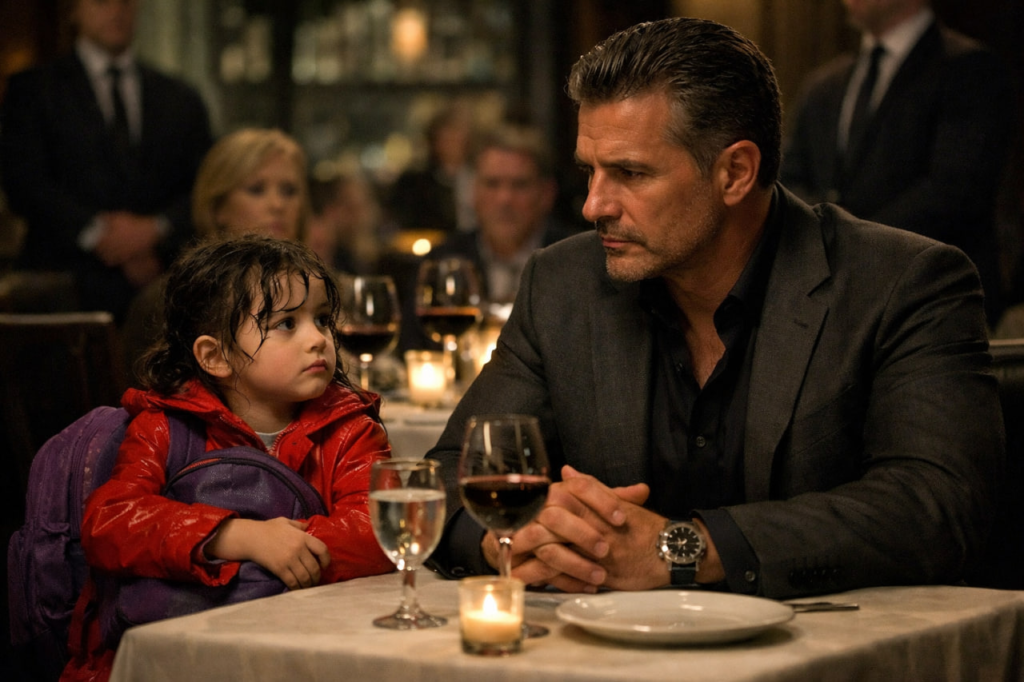
The woman froze in the middle of Belladonna’s like she had walked into a memory she had spent seven years trying to bury.
Julian Blackthorne did not stand. He did not blink. He simply stared at her across the candlelit restaurant, across the polished marble floor, across the years between them, and for the first time that night, the most feared man in Manhattan looked like someone had taken a knife to his past.
Her name was Elena Marlow.
Seven years ago, she had disappeared from his life without a goodbye, without an explanation, without even a final look back. One morning she had been the woman Julian trusted more than his own blood, and by nightfall, she was gone from New York with every trace of her wiped clean.
Now she stood ten feet away from his table, soaked from the rain, trembling under the weight of a secret that had just sat down across from him wearing a red raincoat and purple backpack.
Maya slid off her chair and ran to her mother.
Elena dropped to her knees and wrapped both arms around her daughter so tightly the child squeaked. She kissed Maya’s wet curls, touched her cheeks, checked her hands, her shoulders, her face, as if she had expected to find damage there. Then her eyes lifted toward Julian again, and fear moved across her face before she could hide it.
Julian saw it.
He had seen fear in judges, bankers, criminals, rivals, and men who begged for their careers at the edge of his conference table. But Elena’s fear cut through him differently because once, long ago, she had been the only person in New York who had never looked at him that way.
“Elena,” he said quietly.
The room shifted at the sound of her name. Everyone inside Belladonna’s knew when Julian Blackthorne spoke softly, it was more dangerous than when other men shouted. But Elena did not move closer. She kept one hand around Maya’s shoulder and one hand on the strap of the child’s backpack.
“We’re leaving,” Elena said.
Julian’s gaze moved from Elena to Maya.
The girl was watching him over her mother’s arm with curious, solemn eyes. His eyes. That was the first thought he hated himself for having. The same deep gray, the same steady focus, the same way of studying a room before trusting it.
A fresh chill moved through him.
“How old is she?” Julian asked.
Elena’s face changed.
It was only a flicker, but Julian had built an empire by noticing flickers. A delayed answer. A tightened mouth. A heartbeat of panic. Elena glanced toward the exits, then toward the security men pretending not to watch them.
“Maya,” Elena said, forcing calm into her voice. “Put your hood up.”
But Maya did not listen. She looked at Julian and said, “I’m six.”
The words landed between the three of them harder than the bomb threat.
Julian’s jaw tightened.
Six.
Seven years since Elena vanished. Six years old. Dark curls. Gray eyes. A stubborn chin he recognized from a hundred Blackthorne portraits lining the walls of houses he never called home.
“Elena,” he said again, this time lower.
“Not here,” she whispered.
That answer told him everything and nothing.
Before Julian could speak, one of his men approached from behind, leaning slightly toward his ear. It was Vincent, his oldest security chief, a former detective who had worked for Julian since before the Blackthorne name became respectable enough for charity galas.
“Mr. Blackthorne,” Vincent murmured. “NYPD is five blocks out. Bomb squad is delayed. We swept the dining room and kitchen. Nothing yet. But the call came from inside the building.”
Julian did not look away from Elena.
“Inside?” he asked.
Vincent nodded once.
A low tension spread through the restaurant. The vice mayor whispered something to her aide. A hedge fund manager reached for his phone, then stopped when one of Julian’s men looked at him. Somewhere near the bar, a glass shook against a tray.
Elena heard enough. Her face went white again.
Julian stood.
Every chair in the restaurant seemed to grow smaller when he rose. He buttoned his suit jacket with slow precision and looked down at Maya.
“Maya,” he said, “did anyone follow you here?”
Elena answered first. “No.”
But Maya hesitated.
Julian saw it.
Elena felt it.
The little girl clutched her backpack tighter and whispered, “A man in a black car.”
The room went silent again.
Elena closed her eyes for half a second, and Julian understood that this night was not an accident. Maya had not wandered into Belladonna’s because she was lost. Elena had brought danger to his door, or danger had brought them both.
“What black car?” Julian asked gently.
Maya looked at her mother.
Elena shook her head, barely visible.
Julian’s voice softened. “No one here is going to hurt you.”
Maya studied him carefully, as if deciding whether powerful men could tell the truth. Then she reached into the front pocket of her purple backpack and pulled out a folded napkin, damp at the edges. She handed it to Julian.
Elena’s breath caught.
Julian opened it.
There were numbers written in black marker.
Table 7. Red coat. Blackthorne blood.
For one moment, Julian’s face showed nothing. Then every man in the restaurant who worked for him subtly changed position. Shoulders squared. Hands moved. Doorways were covered. Belladonna’s was no longer a restaurant. It was a fortress.
Julian looked at Elena.
“Who knows?” he asked.
Her lips parted, but no sound came out.
“Who knows about her?” he repeated.
Elena swallowed.
“Someone who should be dead,” she said.
The sentence moved through Julian like a ghost walking across his grave.
Outside, thunder rolled over Manhattan.
Inside, Maya tugged at her mother’s sleeve and whispered, “Mommy, what does Blackthorne blood mean?”
Elena looked down at her daughter, and her entire face broke with a pain she had clearly been swallowing for years.
Julian answered before she could.
“It means someone wants to scare you,” he said.
Maya frowned. “Are you scared?”
Several people in Belladonna’s looked at Julian Blackthorne as if the child had asked the moon whether it feared the dark.
Julian’s mouth twitched faintly.
“No,” he said. “But whoever sent this should be.”
Elena shook her head. “You don’t understand. This isn’t one of your business threats. This isn’t a boardroom war or some politician trying to embarrass you. If they found Maya, they found everything.”
“Then tell me everything.”
“Not here.”
“Then upstairs.”
Elena stiffened.
Above Belladonna’s were three private floors nobody entered without Julian’s permission. Officially, they were event suites and offices for the Blackthorne Foundation. Unofficially, they were safer than most banks in Manhattan.
Elena knew that. She had helped design the original security protocols when she worked under a different name, before she became the woman who vanished.
“I’m not going upstairs with you,” she said.
Julian stepped closer, his eyes never leaving hers.
“There is a bomb threat in my restaurant. Someone sent your daughter into my dining room with a message naming my blood. And the last time I saw you, you disappeared with a secret that is now standing between us asking questions.” His voice dropped. “You are going upstairs.”
Elena’s expression hardened.
For a second, Julian saw the woman he remembered. Not soaked, not scared, not cornered. The woman who once walked into a room full of federal investigators and made every man there regret underestimating her.
“I don’t take orders from Blackthornes anymore,” she said.
Maya looked from one adult to the other.
“Mommy,” she whispered, “is he bad?”
That one question did what no threat in New York had ever done.
It stopped Julian cold.
Elena’s face softened instantly. She touched Maya’s cheek and spoke carefully.
“He’s dangerous,” she said.
Maya looked at Julian again. “Is that the same thing?”
No one answered.
Julian crouched until he was closer to Maya’s height. Vincent shifted behind him, uneasy, because Julian Blackthorne did not kneel in public. But Julian did not care who saw.
“It depends who you ask,” Julian said. “To people who hurt children, yes. I am very bad.”
Maya thought about that.
Then she nodded once, as if this was reasonable.
“All right,” she said. “We can go upstairs.”
Elena exhaled sharply. “Maya—”
“He has snacks,” Maya added, pointing toward the untouched bread basket on Julian’s table. “And his guards look like sad waiters. I think they know secrets.”
Vincent blinked.
Julian almost smiled.
Elena looked like she wanted to cry and scream at the same time.
Before she could refuse again, the lights flickered.
Every candle trembled.
Then Belladonna’s went dark.
Someone screamed.
Julian moved before the sound finished. His hand closed around Maya’s shoulder, not hard enough to frighten her, but firm enough to shield her with his body. Elena grabbed Maya from the other side. In the darkness, their hands collided over the child’s raincoat.
For one breath, Julian and Elena were touching again.
Seven years vanished.
Then emergency lights washed the restaurant in red.
A phone rang somewhere near the host stand.
Not one of the diners’ phones. The restaurant landline.
Vincent reached it first and answered.
His face changed.
He looked toward Julian.
“It’s for you.”
Julian’s eyes darkened.
He took the phone.
For several seconds, he listened without speaking. The entire restaurant watched him, terrified by how still he became. Then a voice came through loud enough for Elena to hear from several feet away.
“Did you enjoy meeting your daughter, Julian?”
Elena pressed Maya against her side.
Julian’s grip tightened on the receiver.
The voice on the line was distorted, mechanical, almost playful.
“You kept Manhattan,” it continued. “She kept your child. Seems unfair, doesn’t it?”
Julian looked at Elena.
Her face had gone blank with terror.
“Who is this?” Julian asked.
The caller laughed softly.
“Ask Elena what she buried under the old Blackthorne estate. Ask her why she ran. Ask her why your father died thinking she betrayed you.”
Julian’s expression changed at the mention of his father.
Elena whispered, “No.”
The caller continued, “You have twenty minutes. Bring the girl to the service elevator alone, or Belladonna’s becomes the most expensive grave in Manhattan.”
The line went dead.
For a second, nobody moved.
Then Julian slowly set the receiver down.
Vincent stepped closer. “Sir?”
Julian looked at Elena. “Who is alive?”
Elena shook her head, tears gathering but not falling. “I don’t know.”
“Don’t lie to me.”
“I’m not lying.” Her voice cracked. “I thought I killed the trail. I thought I erased everything.”
“Everything meaning what?”
Elena glanced at Maya, then back at Julian.
“Your father’s ledger,” she said.
The words struck Julian harder than the threat.
The Blackthorne ledger was supposed to be a myth, the kind of rumor journalists loved and prosecutors chased until their careers collapsed. It was said to contain forty years of payments, murders, shell companies, dirty judges, buried bodies, stolen land, political favors, and every real name behind the respectable masks of New York’s elite.
Julian had heard whispers of it since he was a boy.
His father, Conrad Blackthorne, always denied it existed.
Then Conrad died in a fire at the old family estate in Westchester, and Elena disappeared the same night.
Julian had spent years believing those two events were connected by betrayal.
Now he was beginning to understand they were connected by something far worse.
“You had it,” Julian said.
Elena nodded once.
“Where is it?”
She looked at Maya.
Julian followed her gaze.
Maya clutched her purple backpack.
A brutal silence settled over him.
“No,” Julian said.
Elena’s eyes filled.
“I had nowhere else to hide it.”
Julian stared at the backpack like it was a live grenade.
“What did you put in my daughter’s bag?”
The words were out before he could stop them.
My daughter.
Elena flinched.
Maya looked up sharply.
Julian saw the question form on the child’s face, and something inside him twisted. He had faced assassination attempts, federal raids, boardroom coups, and family funerals without losing his composure. But one little girl looking at him with those gray eyes nearly destroyed him.
“Mommy?” Maya whispered.
Elena’s mouth opened.
No answer came.
Julian turned away first, because if he looked at Maya another second, he might say something that could never be unsaid.
“Vincent,” he ordered. “Clear the upstairs. Lock down every exit. Nobody leaves until NYPD arrives and my people finish the sweep. Find the source of that call.”
Vincent nodded and moved fast.
Elena grabbed Julian’s sleeve. “You can’t keep everyone trapped in here. That’s exactly what he wants.”
“Who?”
“I don’t know.”
Julian looked down at her hand on his sleeve.
She let go.
He leaned closer and spoke so only she could hear.
“Elena, if someone knows Maya is mine, that means someone has been watching you. If someone has been watching you, they know where you live, where she goes to school, what time she sleeps, which hand she uses to hold your coat when she’s scared.” His voice grew colder. “So stop protecting secrets and start protecting her.”
Elena’s eyes broke.
That got through.
She lifted Maya into her arms even though the child was almost too big to be carried and followed Julian toward the private hallway behind the wine cellar.
As they moved, Belladonna’s guests stared from the dining room. Some looked frightened. Some looked hungry for scandal. One city councilman reached for his phone under the table. Vincent appeared from nowhere, took it, and dropped it into a silver champagne bucket full of melting ice.
“No recordings tonight,” Vincent said.
The councilman did not argue.
Julian led Elena and Maya through a concealed door behind shelves of imported wine. The hallway beyond was narrow, lined with black security cameras and soft floor lights. Maya lifted her head from Elena’s shoulder and looked around.
“Is this a secret tunnel?” she asked.
“It’s a service corridor,” Elena answered quickly.
Maya looked at Julian. “That means secret tunnel for rich people.”
Julian said, “More or less.”
Despite everything, Maya smiled.
Elena saw it and looked away as if it hurt.
They reached a private elevator that required Julian’s palm, a code, and a key Vincent carried. Inside, the walls were mirrored, and for the first time, Julian saw the three of them reflected together.
Elena, soaked and pale.
Maya, small and watchful.
Himself, standing beside them like a stranger outside the life he should have known.
The elevator rose.
No one spoke.
When the doors opened, they entered a private suite above Belladonna’s. It was not flashy, but every inch of it whispered power: dark wood, floor-to-ceiling windows, a view of rain-smeared Manhattan, and walls thick enough to mute the city. Maya stepped down from Elena’s arms and immediately noticed a bowl of wrapped chocolates on a side table.
“Can I have one?” she asked.
“No,” Elena said.
“Yes,” Julian said at the same time.
Maya looked between them.
Julian picked up a chocolate and held it out. “Your mother can inspect it first.”
Elena took it, unwrapped it, smelled it, then handed it to Maya.
Maya accepted it solemnly. “Thank you.”
“You’re welcome.”
She sat on the edge of a leather chair, her backpack still tight against her chest.
Julian walked to the windows and looked down at the city. Police lights reflected faintly through the rain below. Somewhere inside the building, his men were tearing apart walls, vents, service closets, and kitchens. But the real bomb was in the room with him.
He turned back to Elena.
“Start from the night of the fire.”
Elena’s face closed.
Then she looked at Maya.
“Maya,” she said gently, “can you sit with Mr. Vincent in the next room for five minutes?”
“No.”
“Maya.”
“No.” The child hugged her backpack. “When grown-ups say five minutes, they mean secrets.”
Julian studied her.
“She stays,” he said.
Elena looked at him like he had betrayed her.
“She is six,” Elena snapped.
“She is the target,” Julian replied. “And she already knows we’re lying.”
Maya nodded. “I do.”
Elena covered her mouth with one hand.
Julian walked toward the chair across from Maya and sat slowly, giving the child enough space not to feel cornered.
“Maya,” he said, “your mother has protected you from dangerous people. Some of those people may be coming tonight. We need to understand why.”
Maya looked at her mother. “Is this about the silver box?”
Elena’s entire body went still.
Julian’s eyes moved to the purple backpack.
“What silver box?” he asked.
Maya unzipped her backpack.
Elena lunged forward. “Maya, don’t—”
But it was too late.
The child pulled out a battered stuffed rabbit, a pencil case, a folded drawing, and finally a small silver metal box about the size of a paperback book. It had scratches along the lid and a Blackthorne crest engraved into the top.
Julian recognized it immediately.
His mother’s cigarette case.
She had died when he was nine, and Conrad Blackthorne had kept that silver case in his private office until the night of the fire.
Julian reached for it, then stopped.
He looked at Elena.
“You stole this from my father.”
Elena’s voice was barely audible. “No. Your father gave it to me.”
Julian’s face hardened. “My father trusted no one.”
“He trusted me at the end.”
“That’s convenient.”
Elena stepped closer, anger finally cutting through fear.
“You think I wanted this? You think I wanted to run pregnant through a burning house while your father bled on the floor and told me to disappear before his own men found me?”
Julian stood so fast the chair shifted behind him.
Maya flinched.
He immediately controlled himself, but the damage was done. Elena moved between them, protective as a wall.
Julian looked sickened by his own movement.
He lowered his voice. “My father was shot?”
Elena nodded.
“The official report said smoke inhalation,” he said.
“The official report was paid for.”
“By whom?”
Elena laughed once, bitter and broken. “By the same people who stood beside you at his funeral.”
Julian absorbed that with a stillness that made the room colder.
Elena continued, now unable to stop. “Conrad called me that night because he found out someone inside the family was selling access to Blackthorne land deals, laundering money through the foundation, and using your real estate projects to move weapons through waterfront properties. He kept records for leverage. Names, accounts, dates, payments. Everything.”
Julian’s voice was quiet. “The ledger.”
“Yes.”
“Why call you?”
“Because I wasn’t family.” Elena’s eyes filled again. “And because he knew you wouldn’t listen if he told you the truth.”
Julian stared at her.
“What truth?”
Elena looked at Maya, then back at him.
“That the person behind it wanted you dead next.”
The city lights flickered behind Julian through the rain.
Maya whispered, “Mommy, who wanted him dead?”
Elena did not answer.
Julian did.
“My uncle,” he said.
Elena closed her eyes.
There it was.
Victor Blackthorne.
Conrad’s younger brother. Julian’s uncle. The charming philanthropist. The grieving man who had stood beside Julian at the funeral and placed a hand on his shoulder while cameras flashed. The man who later moved to Switzerland after a convenient heart condition and continued donating millions to museums, hospitals, and senators.
Julian had not spoken to Victor in four years.
But Victor was alive.
And if Victor had found Maya, the old war had not ended. It had simply waited.
Julian turned toward Vincent, who had entered silently near the door.
“Find Victor.”
Vincent’s face tightened. “We’ve kept passive watch on him. Last confirmed location was Geneva.”
“Not good enough.”
“I’ll move.”
“Now.”
Vincent left.
Elena gripped the back of Maya’s chair.
“You can’t just hunt him,” she said.
Julian looked at her. “Watch me.”
“That is exactly what he wants. Victor never attacks directly unless someone else has already been placed to take the fall. That bomb threat, the note, the call—it’s theater. He wanted you emotional. He wanted you moving fast.”
Julian’s smile was cold.
“Then he remembers me badly.”
“No,” Elena said. “He remembers exactly who you become when someone touches what belongs to you.”
The words hung in the air.
Maya looked up. “Do I belong to him?”
Elena’s face crumpled.
Julian closed his eyes for half a second.
Then he crouched in front of Maya again, slowly this time, careful not to scare her.
“No,” he said. “You belong to yourself.”
Maya watched him.
“But,” he continued, “I think I should have known you existed.”
Elena whispered, “Julian.”
He ignored her.
Maya looked at her mother. “Is he my dad?”
Elena’s silence answered before she could.
The little girl turned back to Julian. She did not cry. She did not smile. She only studied his face with the strange, heartbreaking seriousness of a child who had learned to measure truth by what adults refused to say.
Julian felt something inside him collapse.
“Yes,” Elena said finally.
The word was small.
But it changed the room.
Maya’s lower lip trembled once. “You said my dad was gone.”
Elena knelt beside her. “I said he couldn’t be with us.”
“That is not the same thing.”
“I know.”
“Did he know about me?”
Elena looked at Julian.
Julian answered because Elena could not.
“No.”
Maya looked down at her stuffed rabbit.
“Would you have come?” she asked.
Julian had lied to presidents, prosecutors, reporters, enemies, and lovers. But he could not lie to her.
“Yes,” he said. “I would have torn the city apart.”
Maya nodded as if she believed him, and that made it worse.
Elena’s tears finally spilled over. “That is why I didn’t tell you.”
Julian stood.
His voice turned lethal. “Explain.”
Elena wiped her face quickly, ashamed of the tears. “Because if you had known, Victor would have known. Your world leaks secrets through men who call themselves loyal. I barely survived leaving the estate that night. I was pregnant, hunted, and carrying the only evidence that could destroy half the people around you. If I told you, you would have come after me, and he would have followed you straight to her.”
Julian looked like he wanted to deny it.
But he could not.
Seven years ago, he would have done exactly that. He would have summoned cars, men, helicopters, lawyers, hackers, investigators, every weapon his name could buy. And Victor, patient as poison, would have watched him.
Elena had not vanished because she did not love him.
She had vanished because she knew him too well.
Maya opened the silver box.
Inside was not paper.
It was a small encrypted drive taped beneath a false bottom, a stack of old photographs, and a tiny gold baby bracelet Julian recognized with a sharp inhale. It had belonged to him. His mother had saved it. Conrad had kept it.
Elena touched the bracelet with one finger.
“Your father told me to give that to the child if I survived,” she said. “I didn’t know he knew I was pregnant.”
Julian stared at it.
For the first time in years, Conrad Blackthorne was not only the ruthless man who raised him like an heir instead of a son. He was a dying father who had known a grandchild might exist and had tried, in his own brutal way, to protect her.
A knock came at the door.
Vincent entered, face grim.
“We found something,” he said.
Julian turned.
“The bomb?”
“No. There is no bomb.”
Elena whispered, “Of course there isn’t.”
Vincent held up a tablet. “But there is a man in the basement security footage. He entered through the vendor door eighteen minutes before the threat. He wore a kitchen uniform. Face partially covered.”
Julian took the tablet.
The footage showed a man moving through Belladonna’s service hall with practiced confidence. He never looked directly at a camera. But at one angle, as he turned near the freight elevator, his right hand appeared.
A missing ring finger.
Elena gasped.
Julian looked at her.
“You know him.”
Elena stepped back, as if the screen itself had reached for her.
“His name is Tomas Vale,” she said. “Victor’s fixer.”
Vincent frowned. “Tomas Vale died in 2019.”
“No,” Elena said. “Tomas Vale makes people die on paper.”
Julian watched the footage again.
The man disappeared into a blind spot near the basement wine vault. A second later, the lights flickered in the recording. Then nothing.
“What did he leave?” Julian asked.
Vincent hesitated.
Julian noticed.
“What did he leave?” he repeated.
Vincent handed him a sealed evidence bag.
Inside was a child’s hair ribbon.
Purple.
Maya touched her hair instinctively.
Elena turned toward her daughter. “Where is your ribbon?”
Maya’s face went pale.
“I had it this morning,” she whispered.
Elena looked at Julian with pure terror.
“They were close enough to touch her,” she said.
Julian’s face changed.
This was no longer about old ledgers, dead fathers, or the blood-soaked architecture of the Blackthorne empire. Someone had taken a ribbon from his daughter’s hair and left it in his building like a calling card.
When Julian spoke, his voice was almost calm.
“Seal Manhattan.”
Vincent did not ask if he meant it.
He knew.
Within minutes, phones began ringing across the city. Private security contractors moved from garages in Tribeca, Midtown, and Brooklyn Heights. Off-duty detectives who owed Julian favors received addresses. Traffic cameras near Belladonna’s were accessed through channels that officially did not exist. A quiet message moved through the underworld of New York: nobody helped Tomas Vale leave the city unless they wanted Julian Blackthorne at their door before sunrise.
Elena listened to all of it with growing dread.
“You’re doing it,” she said. “You’re becoming the storm he wanted.”
Julian looked out the window at the rain.
“No,” he said. “This time, I am choosing the direction.”
Maya raised her hand slightly.
Julian turned to her immediately.
“Yes?”
“Do I still get dinner?”
For one stunned second, nobody spoke.
Then Vincent coughed into his hand.
Elena let out a sound that was half laugh, half sob.
Julian looked at the child who had just found out the most dangerous man in Manhattan was her father, that someone had stolen a ribbon from her hair, that her backpack held a secret powerful adults might kill for—and she was hungry.
Something unfamiliar moved through his chest.
“Yes,” he said. “You still get dinner.”
“What do you have?”
“Anything.”
Maya considered this. “Mac and cheese?”
Julian turned to Vincent.
Vincent nodded gravely, as though receiving an order to move military assets.
“Mac and cheese,” Vincent said. “Immediately.”
Maya added, “Not fancy.”
Vincent paused.
Julian said, “Not fancy.”
Vincent left.
Elena sank into a chair and covered her face.
Julian walked toward her slowly.
For the first time since she arrived, he did not look like a judge demanding testimony. He looked like a man standing at the edge of a life stolen from him.
“Elena,” he said, quieter now. “Where have you been?”
She lowered her hands.
“Queens. Then Vermont. Then back to Queens under another name.”
“You were in New York?”
“Sometimes.”
“You let me live in the same city as my daughter and never told me.”
Pain flashed across her face. “I watched you from a distance once.”
Julian’s eyes sharpened.
“When?”
“Maya was two. You were outside the courthouse downtown. Reporters were shouting at you about the waterfront investigation. You looked so angry.” Elena swallowed. “I had Maya in a stroller across the street. I almost crossed.”
“Why didn’t you?”
“Because a black sedan pulled up behind your car.”
Julian said nothing.
“Victor’s man stepped out,” Elena continued. “Tomas. Missing finger. He watched you, then scanned the sidewalk. I knew then that if I came to you, we were dead.”
Julian looked away.
There were a thousand things he wanted to say, and none of them could change the fact that Elena had raised his daughter alone while he sat in boardrooms believing power meant control.
The door opened.
A young chef entered with a bowl of plain mac and cheese on a silver tray. He looked terrified to be carrying comfort food into what felt like a war room. Maya accepted it politely.
“Thank you,” she said.
The chef looked like he might faint from relief.
Julian nodded once, and the chef left quickly.
Maya ate while the adults stood in silence around her.
After three bites, she looked at Julian.
“Do you live upstairs from a restaurant?”
“Sometimes.”
“That’s weird.”
“Yes.”
“Do you know how to cook?”
“No.”
Maya frowned. “That’s also weird.”
Elena whispered, “Maya.”
Julian said, “She’s right.”
Maya seemed pleased with this honesty and returned to her food.
Vincent came back ten minutes later with new information.
“Tomas didn’t leave through the street,” he said. “He went down into the old utility level. There’s access to prewar service tunnels under this block. Most were sealed decades ago, but not all.”
Julian frowned. “Belladonna’s blueprints showed no tunnel access.”
“The public ones didn’t.”
Elena stood slowly.
“What?” Julian asked.
She looked toward the floor.
“Conrad used them.”
Julian turned fully toward her.
Elena continued, “The old Blackthorne properties had emergency routes built under several Midtown buildings. Your father said Manhattan was a city of doors if you knew where to look. Belladonna’s used to be one of his meeting points.”
Julian’s expression darkened.
“He never told me.”
“He didn’t tell you many things because he didn’t want you to become him.”
Julian almost laughed.
“That failed.”
Elena held his gaze.
“No,” she said softly. “It didn’t.”
Before Julian could answer, Vincent’s tablet chimed. He checked it, then stiffened.
“What?” Julian asked.
Vincent turned the screen.
A live security feed from the basement showed the freight elevator doors opening.
A man stepped inside wearing a kitchen uniform.
His face was uncovered now.
He looked older than the file photos, thinner, with gray in his beard and dead eyes. His right hand was missing the ring finger.
Tomas Vale looked up directly into the camera.
Then he held up a phone.
Julian’s phone rang.
Maya stopped eating.
Elena whispered, “Don’t answer.”
Julian answered.
Tomas’s voice came through calm and intimate.
“You always did like expensive rooms, Julian.”
Julian said nothing.
“Is Elena there? Tell her she looks tired. Motherhood does that.”
Julian’s eyes moved to the windows, the corners, the vents. “You’re in my building.”
“I was in your building,” Tomas said. “Now I’m under it.”
Vincent was already signaling men silently.
Tomas continued, “Don’t send your dogs into the tunnels. I left gifts.”
Julian’s voice remained cold. “You touched my daughter.”
A pause.
Then Tomas laughed softly.
“Your daughter? That was fast. Does she know what fathers in your family do to little girls? Use them as leverage. Trade them for silence. Marry them into alliances. Bury them under names and trust funds.”
Julian’s hand tightened around the phone.
Elena touched Maya’s shoulder.
Tomas’s voice sharpened. “Bring me the silver box. South utility tunnel, old Lexington spur, fifteen minutes. Just you and Elena. Leave the child upstairs, or I send the next ribbon with blood on it.”
The call ended.
Maya pushed the bowl away.
“I don’t like him,” she whispered.
Julian looked at Vincent. “Map the tunnels.”
“Already pulling city records.”
Elena shook her head. “City records won’t show the Lexington spur. Conrad had private maps.”
“Where?”
Elena pointed to the silver box.
Julian opened it again, removed the photographs, and searched beneath the lining. There, folded into a space so thin it nearly disappeared, was a piece of old drafting paper.
He unfolded it carefully.
A hand-drawn tunnel map spread across the table.
Conrad’s handwriting marked routes beneath Belladonna’s, the old Lexington steam corridors, a sealed subway maintenance path, and three exits. One led toward Grand Central. One toward an abandoned delivery bay. One toward Blackthorne Tower.
Julian’s eyes narrowed.
“He’s not trying to escape,” he said.
Elena followed his gaze. “He’s going to the tower.”
Blackthorne Tower stood twelve blocks away, Julian’s headquarters, the glass-and-steel monument that had made him the public face of the family empire. If Tomas reached it through old tunnels, he could access private infrastructure beneath the building.
Vincent understood at once.
“The archives,” he said.
Julian nodded.
Elena looked between them. “What archives?”
Julian’s voice was grim. “My father’s restricted files. Old property records, sealed trusts, offshore documents. Things even I haven’t fully opened.”
Elena whispered, “Victor doesn’t just want the ledger.”
“No,” Julian said. “He wants to erase whatever my father kept buried.”
Maya slid from her chair and walked to Julian. She held up the silver box.
“Then don’t give him this.”
Julian looked down at her.
Small hand. Purple backpack. Red raincoat. Blackthorne eyes.
For the first time in his life, Julian understood that legacy was not buildings, money, fear, or a name carved into stone. Legacy was a child handing him the truth and expecting him to be brave enough not to ruin it.
He took the box carefully.
“I won’t.”
Elena stepped forward. “Julian, no. You can’t go down there.”
“He asked for both of us.”
“And that’s why we shouldn’t go.”
“He knows the tunnels. He knows this building. He knows Maya.” Julian’s voice dropped. “If we stay here, we wait for his next move. If we go, we choose ours.”
Elena stared at him, furious and afraid.
“I ran from this life for seven years.”
“I know.”
“I built her a normal life.”
“I know.”
“I will not let you drag her into a war because your family never learned how to love without destroying everything.”
Julian flinched, almost invisibly.
Then he said, “You already dragged her into this by carrying the war alone.”
Elena slapped him.
The sound cracked through the suite.
Vincent looked away.
Maya gasped.
Julian did not move.
Elena’s hand shook. Her face was full of horror at herself, but also years of exhaustion, fear, and grief finally breaking through.
“You don’t get to say that,” she whispered. “You buried yourself so deep in the Blackthorne name that the only way to save your child was to keep her away from you.”
Julian absorbed the words like punishment.
Then Maya stepped between them.
“Stop,” she said.
Both adults looked down.
Her voice trembled, but she kept going.
“I don’t know what happened before I was born. I don’t know who the scary tunnel man is. I don’t know why everybody keeps saying blood like it’s a bad word.” Tears filled her eyes now. “But I know my mom is scared, and you are angry, and nobody asked me if I wanted to be Blackthorne blood.”
Elena broke.
She dropped to her knees and pulled Maya close.
“I’m sorry, baby.”
Julian stood frozen, unable to move toward them, unable to move away.
Maya cried quietly into Elena’s shoulder.
The sound did more damage to Julian than any bullet could have.
When he finally spoke, his voice was different.
“Maya.”
She looked up with wet eyes.
“You don’t have to be Blackthorne anything tonight,” he said. “You just have to be safe.”
She sniffed.
“Promise?”
Julian looked at Elena, then back at Maya.
“I promise.”
That promise changed his plan.
He turned to Vincent.
“Get Maya out through the roof.”
Elena looked up sharply. “What?”
“Helipad extraction. Use the north stairwell, not the elevator. No digital route. No radio chatter until she’s in the air.”
Vincent nodded. “Destination?”
Julian looked at Elena.
She hesitated.
Then she said, “There’s a woman in Brooklyn. Nora Bell. She helped me disappear. Maya knows her as Aunt Nora.”
Julian looked to Vincent. “Find her quietly. Confirm her. Then send Maya there with two women from security, no men she doesn’t know.”
Maya wiped her face. “Are you coming?”
Julian crouched again.
“Not yet.”
“Why?”
“Because I have to make sure the scary tunnel man can’t follow you.”
Maya looked at Elena. “Mommy?”
Elena kissed her forehead. “I’m coming too.”
“No,” Julian said.
Elena turned on him.
He met her eyes. “You go with Maya.”
“Tomas asked for both of us.”
“Tomas expects both of us. That’s why you won’t be there.”
Elena understood. “You’re going alone.”
“No,” Vincent said immediately. “Absolutely not.”
Julian ignored him.
Elena grabbed his arm. “He’ll kill you.”
Julian’s eyes softened for the briefest moment.
“He’s been trying since before she was born.”
Elena shook her head. “Julian—”
“You were right,” he said quietly. “My first instinct was to go to war. But war is loud. Tonight needs to be quiet.”
He lifted the silver box.
“I’ll give him what he thinks he wants.”
Vincent’s jaw tightened. “A decoy?”
Julian opened the box and removed the encrypted drive. “Make one.”
Vincent took it.
Elena stared at Julian, seeing the shift. He was not rushing into rage. He was thinking. Calculating. Protecting instead of possessing.
For a dangerous man, it was the closest thing to tenderness she had ever seen.
Maya reached into her backpack and pulled out the folded drawing Julian had noticed earlier.
She handed it to him.
“For luck,” she said.
Julian opened it.
The drawing showed a small girl in a red coat standing beside a tall man in a dark suit. The man had no smile, but he was holding an umbrella over her head. Above them, in crooked letters, Maya had written: SAFE PLACE.
Julian’s throat tightened.
“When did you draw this?” he asked.
“In the cab,” Maya said. “Mommy told me if we got separated, I should find the safest person in the room.”
Elena looked away.
Maya continued, “I picked you before I knew.”
Julian folded the drawing with more care than he had ever handled a million-dollar contract and placed it inside his jacket.
“Good choice,” he said.
Maya almost smiled.
Then Vincent returned with a duplicate drive.
“The decoy will open once, display partial ledger files, then trace any connected system if they plug it in.”
Julian nodded.
Elena reached for the real drive. “I’ll take it with Maya.”
Julian handed it to her without hesitation.
That surprised her.
He saw the surprise and said, “You kept it safe for seven years.”
Elena’s eyes filled again, but she only nodded.
Minutes later, Maya was dressed in a dry black hoodie from Julian’s emergency wardrobe, her red raincoat tucked under one arm. One of Julian’s female security officers, Grace, knelt to introduce herself, showed Maya her badge, and promised not to touch her backpack without asking.
Maya looked at Julian from the doorway.
“Are you actually my dad?” she asked.
The question was small, almost embarrassed.
Julian stepped closer but did not crowd her.
“Yes.”
“Are you going to disappear?”
“No.”
“People say that.”
“I’m not people.”
Maya thought about this.
Then she hugged him.
It was quick, awkward, and unexpected.
Julian did not move at first. He seemed unable to understand what was happening. Then his hand lifted carefully to the back of her head, barely touching her curls.
Elena watched, and whatever anger remained in her face folded under grief.
Maya let go and ran back to her mother.
Julian looked at Elena.
For a moment, neither of them spoke.
Then Elena stepped close and said, “Come back alive, or I’ll hate you forever.”
Julian’s mouth curved faintly.
“You already tried that.”
“It didn’t work.”
“I know.”
Elena grabbed his lapel and pulled him down just enough to kiss his cheek, fast and fierce and full of seven years of things neither of them could say.
Then she left with Maya.
Julian stood still until the door closed.
After that, the softness vanished.
He turned to Vincent.
“Take me to the tunnels.”
The descent beneath Belladonna’s felt like entering the bones of the city. The polished luxury above gave way to concrete, old pipes, damp brick, rusted service ladders, and the low mechanical breath of Manhattan. Julian moved without a tie now, sleeves rolled, the silver box in one hand and a gun at his back.
Vincent walked beside him with two men behind.
Julian stopped at the first junction.
“No farther.”
Vincent’s face hardened. “Sir.”
“Tomas said gifts. He meant traps. You follow me, he kills the lights, seals a door, and we lose the route.”
“You’re not trained for tunnel combat.”
Julian looked at him.
Vincent sighed. “Fine. You’re trained. That doesn’t make this smart.”
Julian handed him an earpiece. “Track me from the thermal grid. If I stop moving for more than ninety seconds, flood the tunnel with gas.”
Vincent stared. “You’d be down there.”
“I know.”
“That could kill you.”
“It could kill him too.”
Vincent muttered something under his breath, but stepped back.
Julian entered the south utility tunnel alone.
The city above disappeared behind him.
For several minutes, there was only dripping water, distant train vibrations, and the echo of his footsteps. He followed Conrad’s map by memory. Left at the steam conduit. Straight past the sealed maintenance gate. Down the narrow passage marked with a faded number seventeen.
Then Tomas’s voice came from the darkness.
“Your father walked slower.”
Julian stopped.
Tomas Vale stepped into the emergency light ahead, holding a gun low at his side. He looked almost amused. Older, yes, but not weaker. Men like Tomas did not age into softness. They aged into sharper corners.
Julian lifted the silver box.
“You wanted this.”
Tomas glanced at it.
“I wanted Elena.”
“You get me.”
“How disappointing.”
Julian took one step forward.
Tomas raised the gun slightly.
“Careful. I may be sentimental, but I’m not stupid.”
“No,” Julian said. “You’re a messenger who survived too long.”
Tomas smiled. “And you’re a little boy still trying to sound like Conrad.”
Julian’s face did not change.
Tomas tilted his head. “Did Elena tell you how your father begged?”
Julian said nothing.
“He did. Not for himself. For you. That was embarrassing, honestly. Conrad Blackthorne, bleeding on his own floor, asking me not to hurt his son. Then Elena came in, all brave and pregnant, though she didn’t know I knew.” Tomas chuckled. “Your father knew. Victor knew. Everyone knew except you.”
Julian’s eyes sharpened.
Tomas saw it and smiled wider.
“Yes. Victor knew about the baby before she was born. Why do you think Elena had to run so far? Why do you think every clinic record vanished? She wasn’t hiding from suspicion, Julian. She was hiding from an inheritance claim.”
Julian’s voice was low. “Explain.”
Tomas laughed. “Still giving orders in the dark.”
Julian opened the silver box and showed the drive.
“Explain, or I destroy it.”
Tomas’s smile faded.
There it was.
Fear.
Not of Julian. Of failure.
“Victor built the empire your father pretended to clean,” Tomas said. “But Conrad grew soft. He wanted legitimacy. Foundations, housing projects, hospitals. He wanted your name clean enough for politics one day. Victor wanted control.”
“And Maya?”
“Maya is blood proof.” Tomas’s eyes glittered. “A direct Blackthorne heir born outside every trust, every document, every controlled line of succession. If she exists publicly, lawyers start asking what Conrad knew, what he changed, what he protected. Old wills reopen. Sealed assets move. Victor loses things he spent decades stealing.”
Julian understood then.
This was not only revenge.
It was money. Power. Ownership. The oldest Blackthorne religion.
“How much?” Julian asked.
Tomas smiled again. “There he is.”
“How much did Victor steal?”
“From you? From her? From the city?” Tomas shrugged. “Depends which sin you count first. But the family reserve alone is worth over $4.8 billion.”
Julian absorbed the number.
Maya had eaten plain mac and cheese upstairs while men hunted her over billions she did not know existed.
Tomas extended one hand.
“The box.”
Julian held it out.
Tomas stepped closer.
That was when Julian noticed the thin red laser dot moving across the wall behind Tomas.
Vincent had found an angle.
Tomas noticed Julian notice.
He grabbed Julian and shoved the gun under his jaw.
“Call him off,” Tomas hissed.
Julian smiled faintly.
“You first.”
A gunshot cracked through the tunnel.
Not from Vincent.
From deeper in the dark.
Tomas jerked, hit in the shoulder, and fired wildly. Julian slammed into him, driving him against the brick wall. The silver box clattered across the wet floor. Tomas swung with the gun, catching Julian across the temple, but Julian drove his elbow into the wounded shoulder and heard the man scream.
Another figure emerged from the darkness.
Elena.
Julian stared in disbelief.
She held a gun with both hands, shaking but steady enough.
“I told you to go with Maya,” Julian snapped.
“I did,” Elena said. “Then I came back.”
Tomas laughed through blood. “Still romantic.”
Julian disarmed him with a brutal twist and kicked the gun away.
Elena kept her weapon raised.
Tomas slid down the wall, breathing hard.
“You stupid woman,” he spat. “You should have stayed buried.”
Elena stepped closer.
“I did,” she said. “For seven years.”
Tomas looked up at her.
Elena’s voice trembled, but her eyes did not. “I buried my name. My home. The man I loved. I buried every birthday Maya had without a father. I buried the truth because men like you taught me survival meant silence.”
She lowered the gun slightly, not enough to be careless.
“I’m done burying things.”
Julian picked up the silver box.
Tomas smiled through pain. “You think this ends with me?”
“No,” Julian said. “It begins with you.”
Vincent and his men rushed in then, weapons drawn. Tomas was cuffed before he could speak again. Blood darkened his sleeve, but he was alive, and that mattered because dead men could not testify.
Vincent looked at Elena.
“You were supposed to be in Brooklyn.”
Elena gave him a flat look. “And you were supposed to stop him from going alone.”
Vincent paused.
“Fair.”
Julian touched the cut at his temple and looked at her with a mix of fury and admiration.
“You shot him.”
“In the shoulder.”
“You followed me into a tunnel.”
“You left me upstairs with a child who asked if her father was going to die before breakfast.” Elena’s voice softened. “I couldn’t do that to her.”
Julian had no answer.
Vincent’s phone buzzed.
He listened, then looked at Julian.
“Maya is safe. Brooklyn location confirmed. Grace is with her.”
Julian exhaled for what felt like the first time in an hour.
Then Vincent added, “And we found Victor.”
Julian’s face turned cold.
“Where?”
Vincent hesitated.
“Blackthorne Tower.”
Of course.
Victor had not sent Tomas to retrieve the ledger and run. He had sent Tomas to distract Julian while he entered the tower from another route. The old man was cleaning the archives himself.
Julian looked at Elena.
She nodded once.
Together, they turned toward the tunnel leading north.
By the time Julian reached Blackthorne Tower, dawn was bleeding gray over Manhattan.
The building rose above Park Avenue like a blade of glass. Police barricades had begun forming around Belladonna’s blocks away, but here, the lobby remained quiet. Too quiet. Security guards stood rigidly by the elevators, faces pale, clearly aware that something had happened but not powerful enough to ask what.
Julian crossed the marble floor with Elena, Vincent, and six armed men behind him.
No one stopped them.
They descended not to the executive floors, but below them, past parking levels, mechanical rooms, and locked archives Julian had not visited in years. At the lowest restricted level, they found the vault door open.
Inside stood Victor Blackthorne.
He looked older than Julian remembered, but elegant in the way predators sometimes remain elegant to the end. Silver hair. Navy coat. Leather gloves. A cane he did not need except for theater. He stood beside a metal burn barrel filled with ash and curling paper.
Behind him, shelves of old files had been pulled open.
He turned when Julian entered.
“My boy,” Victor said warmly. “You look awful.”
Julian stepped into the vault.
Elena remained near the door, gun lowered but ready.
Victor’s eyes moved to her.
“Elena Marlow,” he said. “Seven years, and you still disappoint me by breathing.”
Elena smiled faintly. “I’ve been told it’s one of my strengths.”
Victor chuckled, then looked back at Julian. “You always liked spirited women. Your father had the same weakness.”
Julian’s voice was ice. “You killed him.”
Victor sighed.
“Conrad killed himself the day he mistook guilt for morality. He built an empire in blood, then wanted applause for washing his hands in charity money. Men like that become dangerous.”
“And Maya?”
Victor’s face changed slightly.
There was the flicker.
Not guilt.
Annoyance.
“The child complicates matters.”
Julian moved one step closer.
“My daughter has a name.”
Victor smiled. “Yes. Maya. Pretty. Soft. Unsuitable for what she is.”
Julian’s hand curled.
Victor leaned on his cane. “Don’t look at me that way. You should be thanking me. Had I wanted her dead, she would have never reached six.”
Elena raised the gun.
Julian lifted one hand, stopping her.
Victor watched the gesture with amusement.
“How touching. The family finally gathers.”
Julian looked at the burning barrel.
“What did you destroy?”
“Loose ends.”
“What remains?”
Victor’s smile thinned. “Enough to embarrass many important people. Not enough to hurt me.”
Julian removed the real encrypted drive from his jacket.
Victor’s eyes sharpened.
Elena stared at Julian, shocked. He had taken it from her when they reunited in the tunnel, and she had not noticed. Under other circumstances, she would have been furious. Now she understood.
Julian held up the drive.
“This hurts you.”
Victor’s expression hardened for the first time.
“Careful, boy.”
“There he is,” Julian said softly. “The frightened man under the expensive coat.”
Victor’s face twisted.
“You think one drive saves you? You think prosecutors can touch me? Judges retire on my money. Senators answer my calls. Police commissioners owe me their houses.”
Julian glanced at Vincent.
Vincent tapped his phone once.
A screen on the vault wall came alive.
Victor’s voice began playing through the speakers.
Had I wanted her dead, she would have never reached six.
Victor went still.
Julian looked at him.
“Old building,” Julian said. “New cameras.”
Victor’s eyes moved around the vault.
For the first time, he looked uncertain.
Julian continued, “You were right about one thing. Prosecutors may not scare you. Judges may not scare you. Senators may take your calls.” He stepped closer. “But billionaires hate losing money, and your partners are hearing every word.”
Victor’s phone began ringing.
Then another phone in his coat.
Then a third.
Vincent’s tablet lit up with incoming alerts. Offshore accounts frozen. Board members requesting emergency calls. Foundation trustees resigning. Private investors distancing themselves. Newsrooms receiving encrypted document packets scheduled for timed release.
Elena stared at Julian.
“What did you do?”
Julian did not look away from Victor.
“I stopped playing family.”
Victor’s face flushed with rage.
“You arrogant little—”
He lunged with the cane.
The blade hidden inside flashed under the vault lights.
Elena shouted.
Julian caught Victor’s wrist before the blade reached his ribs. The old man was stronger than he looked, fueled by panic and hatred, but Julian was no longer the boy at his father’s funeral. He twisted Victor’s arm, slammed him against the metal table, and knocked the blade away.
Victor gasped.
Julian leaned close.
“For seven years, you let my daughter live in fear.”
Victor spat, “She is nothing.”
Julian’s voice dropped to a whisper.
“She is the only Blackthorne who matters.”
Then he released him.
Vincent’s men took Victor down, cuffing him as he cursed, threatened, promised ruin, and finally shouted names of judges, banks, and officials who would protect him. Every word was recorded. Every word was another nail in the empire he had tried to steal.
Elena watched silently.
Julian stepped back, breathing hard.
Victor was dragged toward the vault door.
Just before he disappeared, he looked back and smiled with poisonous satisfaction.
“You think the girl will love you when she learns what you are?”
Julian did not answer.
Elena did.
“She already met him in a room full of frightened adults,” she said. “And she chose him as the safest person there.”
Victor’s smile died.
Then he was gone.
The fallout began before sunrise.
By 7:00 a.m., every major newsroom in New York had received portions of Conrad Blackthorne’s ledger. By 8:30, three judges had resigned, two former city officials had disappeared from public view, and federal agents had arrived at Blackthorne Tower with warrants that looked urgent and faces that looked embarrassed.
By noon, Victor Blackthorne’s name was everywhere.
So was Julian’s.
News anchors called it the largest corruption exposure in modern New York real estate history. Commentators debated whether Julian Blackthorne was a whistleblower, a criminal cleaning his legacy, or a ruthless man sacrificing old allies to save himself. None of them knew about Maya, and Julian made sure they never would.
For three days, he did not sleep more than an hour at a time.
He met with federal investigators. He turned over files. He removed board members. He shut down shell companies his father had created and Victor had corrupted. He signed documents that cost him hundreds of millions of dollars and did not hesitate once.
But he did not go to Brooklyn.
Not because he did not want to.
Because Elena asked him to wait.
Maya needed quiet, she said. Maya needed school, pancakes, cartoons, and one morning where no armed adults whispered in hallways. Maya needed to choose when to see him again.
Julian hated waiting.
So he did the only thing he knew how to do.
He built safety around the waiting.
Without announcing it, he bought the building next to Nora Bell’s brownstone through three clean entities and turned it into a private security residence. He assigned Grace nearby but instructed her to stay invisible unless needed. He had Maya’s school vetted, her routes changed, her medical records sealed legally this time, and every trace of her old false identity protected rather than erased.
Elena found out on the fourth day and called him furious.
“You bought a building?” she demanded.
Julian stood in his office overlooking Manhattan, phone to his ear.
“It was available.”
“It was not available. You made it available.”
“There’s a difference?”
“Julian.”
He closed his eyes.
“I don’t know how to do nothing.”
The line went quiet.
Then Elena sighed.
“I know.”
That evening, he received a drawing by courier.
No note.
Just a folded piece of paper.
Maya had drawn three people this time. A girl in a red coat. A woman with dark hair. A tall man holding an umbrella over both of them. Above it, she had written: MAYBE SAFE.
Julian placed it beside the first drawing in his locked desk.
The next morning, Elena called again.
“She wants to have lunch,” she said.
Julian stood so quickly his chair rolled back.
“When?”
“Saturday.”
“Where?”
There was a pause.
“Somewhere normal.”
Julian looked around his office with its private elevator, armed guards, imported stone, and bulletproof glass.
“I may need guidance.”
Despite herself, Elena laughed.
It was the first time he had heard that sound in seven years.
They met at a small diner in Brooklyn where the coffee was too strong, the booths were cracked, and nobody cared who Julian Blackthorne was because nobody there expected billionaires to eat toast under fluorescent lights.
Maya arrived holding Elena’s hand.
She wore yellow rain boots even though there was no rain.
Julian stood when they approached, then seemed unsure whether standing was too formal, so he sat, then stood again.
Maya watched him closely.
“You’re nervous,” she said.
Elena hid a smile.
Julian adjusted his cuff. “A little.”
“Good,” Maya said. “Mommy says nervous means you care.”
Julian looked at Elena.
“She says many smart things.”
Maya climbed into the booth across from him. Elena sat beside her. For a few moments, they were just three people in a diner, surrounded by clattering plates and the smell of syrup.
Then Maya placed a paper napkin on the table.
On it, she had written questions in purple marker.
Julian looked at it.
“An interview?” he asked.
“Yes.”
Elena sipped her coffee. “She insisted.”
Maya cleared her throat. “Question one. Do you have a dog?”
“No.”
“Why not?”
“I travel too much.”
“That is a bad reason.”
“I suspected it might be.”
“Question two. Are you still dangerous?”
Julian considered lying gently, but Maya deserved better.
“Yes.”
Elena’s hand tightened around her mug.
Maya nodded. “But mostly to bad people?”
“I’m working on that.”
“Question three.” Maya looked up. “Did you love my mom?”
The diner noise seemed to fade.
Elena froze.
Julian looked at her, then at Maya.
“Yes,” he said.
Maya’s eyes narrowed. “Past tense?”
Elena nearly choked on her coffee.
Julian sat very still.
Then he said, “No.”
Elena looked down.
Maya seemed satisfied and put a check mark beside the question.
“Question four. If I let you be my dad, do I have to be rich?”
Julian blinked.
“No.”
“Good. I don’t want people acting weird.”
“People act weird around money.”
“They act weird around you.”
“That too.”
Maya leaned closer. “Can you be less scary at school events?”
Elena covered her mouth.
Julian nodded solemnly. “I can try.”
“No black cars.”
“One black car?”
“No.”
“Gray?”
Maya thought about it. “Maybe.”
Julian nodded. “Gray car.”
“And no sad waiters.”
“No sad waiters.”
She put another check mark.
Then she looked at him with sudden seriousness.
“Question five. If Mommy gets scared and runs again, will you chase us?”
Elena’s face changed.
Julian understood the trap inside the child’s fear.
The old Julian would have said yes. He would have promised pursuit like devotion. He would have mistaken possession for love and protection for control.
This Julian looked at Elena, then back at his daughter.
“No,” he said. “I will ask where you are. I will ask if you are safe. And I will wait until you want me to come.”
Maya stared at him for a long moment.
Then she slid the napkin across the table.
At the bottom, in purple marker, she had drawn three boxes.
YES.
NO.
MAYBE.
She had checked MAYBE.
Julian looked at it like it was a court verdict.
“MAYBE is fair,” he said.
Maya smiled a little.
Over the next months, MAYBE became Saturday lunches.
Saturday lunches became walks through Prospect Park.
Walks became museum afternoons where Julian learned not to rent out entire galleries because Maya said empty museums felt haunted. He learned her favorite ice cream was mint chocolate chip, that she hated violin practice but liked the idea of being someone who played violin, that she asked difficult questions before bedtime, and that she could make Vincent carry glitter stickers on his phone case just by looking disappointed.
He also learned fatherhood was not an empire to claim.
It was permission granted in tiny pieces.
The first time Maya called him Dad, it was an accident.
They were leaving a bookstore in Brooklyn when a bike messenger swerved too close to the curb. Julian stepped in front of Maya without thinking, one arm out, his body between her and the street.
Maya grabbed his coat and said, “Dad, watch out!”
Then she froze.
Elena froze too.
Julian pretended not to notice because he could feel how fragile the moment was.
But that night, after he returned to his penthouse, he sat alone in the dark for nearly an hour with his hand over his mouth.
The next day, he started a trust in Maya’s name that did not carry the Blackthorne brand, could not be controlled by any family board, and required Elena’s approval until Maya was twenty-five. He funded it with money recovered from Victor’s hidden accounts and designated much of it for housing grants in neighborhoods his family had once exploited.
When Elena saw the documents, she cried.
Not because of the money.
Because the first line read: For Maya Marlow, who owes the Blackthorne name nothing.
Victor’s trial began the following spring.
The federal courthouse was surrounded by cameras, reporters, protestors, and former allies pretending they had always suspected him. Tomas Vale testified in exchange for protection, naming accounts, judges, shell companies, and every person who thought fear would keep history buried.
Elena testified too.
She walked into court wearing a navy dress, her hair pulled back, her voice steady. She told the truth about the night Conrad died, the ledger, the fire, the escape, the years of hiding, and the child she protected from men who saw bloodlines as property.
Julian sat behind her.
Maya was not there.
That had been Elena’s condition.
Their daughter would not sit in a courtroom listening to strangers discuss whether she was an heir, a threat, or evidence. She was at school that day, giving a presentation about sea turtles with a purple poster board and too much glitter.
When the prosecutor asked Elena why she had finally come forward, she looked toward Julian for only a second.
Then she said, “Because silence protected my daughter once. But truth protects her now.”
The quote was everywhere by evening.
Three weeks later, Victor Blackthorne was convicted on federal racketeering, conspiracy, obstruction, money laundering, and murder-related charges tied to Conrad’s death. He would spend the rest of his life in prison, surrounded not by enemies he respected, but by the one thing he hated most.
Irrelevance.
Julian watched the verdict without smiling.
When reporters shouted questions outside the courthouse, he gave only one statement.
“My father built an empire on fear. My uncle tried to preserve it through violence. I benefited from a name I did not fully question for too long. That ends with me.”
A reporter yelled, “Mr. Blackthorne, what changed?”
Julian paused.
Then he said, “Someone asked me if dangerous and bad were the same thing.”
He walked away before they could ask more.
That summer, Belladonna’s reopened.
But it was different.
The smoked glass came down. The private back rooms became public dining spaces. Half the restaurant’s profits were pledged to a foundation for children who needed legal protection, emergency relocation, and safe housing when adults around them became dangerous.
On opening night, the mayor attended.
So did judges, journalists, business leaders, and people who had once whispered Julian’s name with fear.
But the most important guest arrived twelve minutes late wearing a red raincoat, even though the sky was clear.
Maya walked in holding Elena’s hand.
Julian stood at table seven.
The same table.
This time, there was no bomb threat. No hidden note. No stolen ribbon. No room full of people waiting for violence to begin.
Maya looked around and nodded approvingly.
“It’s brighter,” she said.
Julian smiled faintly. “You said it was too dark.”
“It was.”
Elena looked at the table and then at Julian.
“You kept it?” she asked.
“Yes.”
“Why?”
Julian pulled out Maya’s chair first.
“Because this is where I met my daughter.”
Maya climbed into the seat and placed her purple backpack on the chair beside her.
Then she looked at the empty chair next to Julian.
“Mommy sits there,” she said.
Elena’s eyes softened.
Julian pulled out the chair for her too.
Dinner was not perfect.
Maya spilled lemonade on the tablecloth. Vincent, no longer dressed like a sad waiter, pretended not to notice. Elena laughed for real when Julian failed to understand why children’s menus had mazes on them. Julian ordered mac and cheese for himself because Maya insisted he needed to learn what normal food looked like.
Near dessert, Maya leaned against Elena, sleepy but happy.
The restaurant buzzed warmly around them.
Julian looked across the table at Elena.
“I can’t give back seven years,” he said quietly.
Elena’s smile faded, but not into sadness.
“No,” she said. “You can’t.”
“I can give her every year after.”
Elena studied him for a long moment.
“That’s not a promise you make once,” she said.
“I know.”
“It’s a promise you make every day.”
Julian nodded.
“I know that too.”
Maya lifted her head, half asleep.
“Are you guys being serious again?”
Elena brushed curls from her forehead. “A little.”
Maya looked at Julian. “Don’t mess it up.”
Julian’s mouth curved.
“I’ll do my best.”
“That’s what adults say when they might mess it up.”
“Elena,” Julian said, “she’s terrifying.”
Elena smiled. “She’s your daughter.”
Maya closed her eyes and mumbled, “I’m my own person.”
Julian looked at her with a tenderness no one in Belladonna’s would have believed possible from him.
“Yes,” he said softly. “You are.”
Months turned into a year.
Then two.
The Blackthorne name changed, not because newspapers declared it clean, but because Julian spent every day proving he no longer worshipped it. He sold properties tied to corruption, testified against former partners, funded legal clinics, and rebuilt neighborhoods without putting his name on the plaques.
Some people called it redemption.
Julian did not.
Redemption sounded too easy.
He called it repair.
Elena did not move into his penthouse. She did not marry him in a secret ceremony or forgive him in one dramatic scene the way stories sometimes demand. She kept her apartment in Brooklyn, her work, her independence, and the right to tell him when he was acting like a Blackthorne in the worst way.
But sometimes, on Sunday mornings, she and Maya came over for breakfast.
Julian learned to make pancakes.
Badly at first.
Then better.
The first time he made them without burning the edges, Maya applauded so dramatically Vincent came running in from the hall because he thought something had happened.
Something had happened.
Just not the kind Vincent was trained for.
One rainy evening nearly three years after Maya first walked into Belladonna’s, Julian found her standing by the window of his penthouse, watching Manhattan blur under the storm. She was taller now, still carrying too many thoughts in eyes too old for her age.
He stood beside her.
“You’re quiet,” he said.
“I’m thinking.”
“That sounds dangerous.”
She smiled a little.
Then she reached into her pocket and pulled out the old purple hair ribbon.
Julian went still.
“I found it in Mommy’s box,” Maya said. “She kept it.”
Julian looked at the ribbon, then at the city.
“I’m sorry,” he said.
“For what?”
“For not being there before someone could take it from you.”
Maya leaned against his side.
“You’re here now.”
Julian closed his eyes.
For a man who had once owned towers, restaurants, politicians, judges, and pieces of a city’s fear, those three words became the only inheritance that mattered.
You’re here now.
Downstairs, Manhattan moved as it always had, loud and restless and hungry. Somewhere, people still whispered the Blackthorne name. Some with suspicion, some with respect, some with the thrill of old scandal.
But upstairs, a little girl who had once walked into danger wearing a red raincoat stood beside the man everyone feared and knew something the city had taken years to understand.
Julian Blackthorne had been dangerous.
He had been powerful.
He had been feared.
But the night Maya sat at table seven and asked if she could wait beside him until her mother came, she had not found the monster people warned each other about.
She had found the father no one had told her she had.
And in saving her, Julian had finally learned the one thing no empire, no fortune, and no family name had ever taught him.
Power could make people kneel.
Fear could make people obey.
But only love could make a dangerous man choose to become safe.