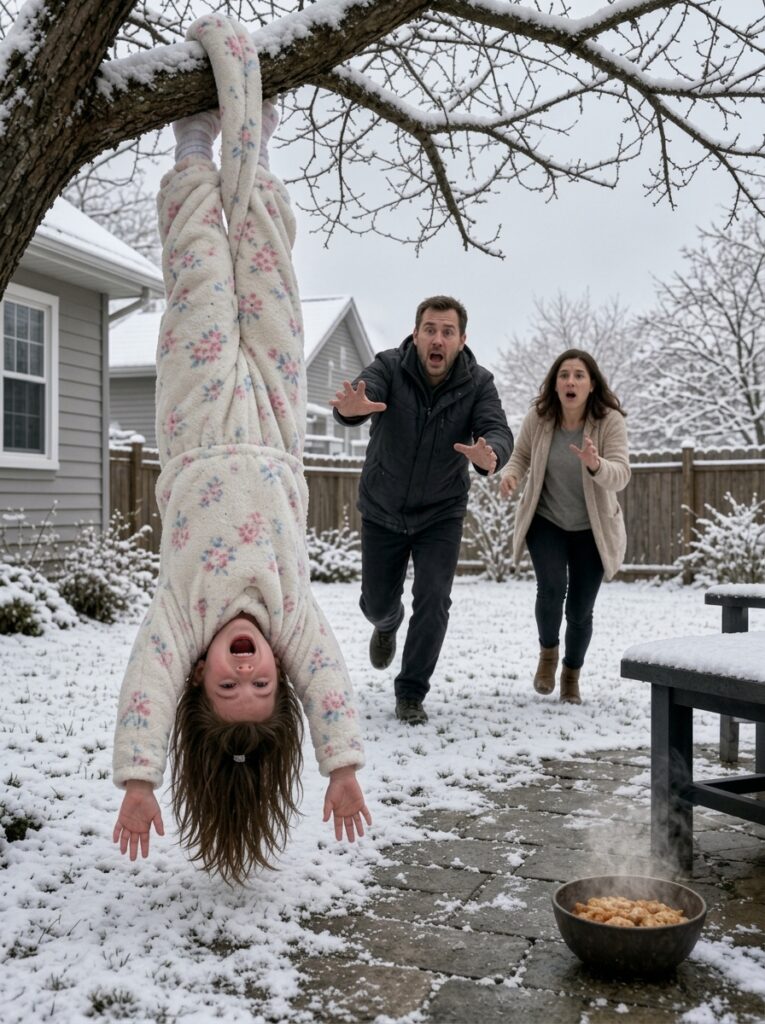
My Wife Hurt Our Feverish Daughter Over Spilled Food — The Moment I Got Home, I Put the Signed Divorce Papers in Front of Her
I had barely closed the front door when I heard our daughter crying outside. It wasn’t the angry cry of a child throwing a tantrum.
It was thin, frightened, and broken by little gasps.
I dropped my briefcase and ran through the kitchen.
The back door was wide open.
Freezing air poured through the doorway, carrying little specks of snow across our kitchen floor.
“Emily?”
The crying came again.
I ran outside without even grabbing my coat.
What I found in our backyard changed my marriage forever.
My seven-year-old daughter was outside in the bitter cold despite having been sick with a fever since the previous evening.
She was terrified, shivering, and clearly hurt.
For several seconds, my mind refused to understand what I was seeing.
Then I heard my wife behind me.
“She needed to learn.”
I turned around.
Laura stood inside the doorway with her arms crossed.
There was no panic on her face.
No concern.
No urgency.
Only irritation.
I rushed to Emily and brought her inside as quickly and carefully as I could.
Her skin was cold.
Her breathing sounded wrong.
She clung to me and whispered the same sentence repeatedly.
“I’m sorry, Daddy.”
Those words destroyed something inside me.
“Sorry for what?”
She wouldn’t answer.
She simply buried her face against me.
I looked toward Laura.
“What happened?”
“She spilled her dinner.”
For a moment, I genuinely thought I had misheard her.
“What?”
“She spilled food everywhere after I specifically told her to be careful.”
I stared at my wife.
Emily had been sick since yesterday.
That morning, her temperature had been high enough that I considered staying home from work.
Laura insisted she could handle things.
“She needs rest,” I had told her before leaving.
“I know how to take care of my own daughter,” Laura replied.
I believed her.
That mistake would haunt me.
Now our daughter was trembling in my arms, and Laura was talking about spilled food as though that explained anything.
“What did you do to her?”
Laura rolled her eyes.
“Don’t start being dramatic.”
I carried Emily into the living room.
When I tried setting her gently on the couch, she cried out.
That sound stopped me immediately.
“Where does it hurt?”
She pointed toward her side.
I carefully lifted the edge of her sweater.
What I saw made my stomach drop.
There were visible marks along her side.
I didn’t know exactly what had happened.
But I knew we needed a doctor immediately.
I grabbed my keys.
Laura stepped between me and the hallway.
“Where are you going?”
“The hospital.”
“She doesn’t need a hospital.”
“Move.”
“Michael, you always do this. You undermine me every time I try to discipline her.”
“Move away from the door.”
Something in my voice finally made Laura step aside.
I wrapped Emily in the warmest blanket I could find and carried her toward the car.
Laura followed us.
“You’re making me look like some kind of monster.”
I stopped.
For the first time since coming home, I looked directly into my wife’s eyes.
“This isn’t about how you look.”
Then I left.
The drive to the emergency department felt endless.
Emily sat bundled in the back seat while I kept speaking to her so she knew I was there.
Every few minutes, she apologized.
“Stop saying sorry, sweetheart.”
“But Mommy said—”
“You did nothing wrong.”
“She said I wasted food.”
“It was an accident.”
“She said food costs money.”
“I don’t care about the food.”
That was when Emily finally started crying harder.
Not loudly.
Quietly.
Like she had been trying not to cry for hours.
At the hospital, everything moved quickly once the medical staff examined her.
A nurse asked me what had happened.
“I don’t know,” I admitted.
It was one of the most painful sentences I had ever spoken.
I was her father.
I was supposed to know.
A doctor examined Emily and ordered imaging.
Then came questions.
Had she fallen?
Had she been in an accident?
Had anyone struck her?
I answered honestly.
“I came home and found her outside.”
The doctor stopped writing.
“Outside?”
“In the cold.”
“How long?”
“I don’t know.”
That answer felt even worse.
The examination revealed injuries serious enough that the medical team became immediately concerned, including multiple rib fractures that required further evaluation.
My hands started shaking.
I sat beside Emily’s hospital bed while she held two of my fingers.
Then she finally told me what happened.
She had been eating soup at the kitchen table.
Her hands were shaking because of the fever.
When she reached for her cup, she accidentally knocked her bowl onto the floor.
Laura became furious.
Emily tried apologizing.
It didn’t matter.
According to my daughter, Laura grabbed her.
What followed was something no child should experience, and I will not repeat every detail Emily had to explain that night.
The spilled soup was never the real issue.
The issue was an adult choosing cruelty over control.
Eventually, Emily told me Laura had forced her outside into the freezing weather as punishment.
I felt physically sick.
The doctor stepped outside with me.
“We need to report this.”
“Yes.”
I didn’t hesitate.
Not for one second.
Maybe some people imagine that moment differently.
Maybe they imagine a husband desperately trying to protect his wife.
Maybe they imagine denial.
I felt none.
My only concern was the little girl lying inside that room.
I called my brother.
“David, I need you.”
He heard my voice and stopped asking questions.
“Where?”
I gave him the hospital name.
He arrived forty minutes later.
When he saw Emily, his face changed.
Then he looked at me.
“What happened?”
“Laura.”
He went silent.
David had never liked my wife.
I used to accuse him of judging her too harshly.
Now I wondered how many things he had noticed that I had dismissed.
“You can’t take Emily back there,” he said.
“I know.”
“Stay at my place.”
“I will.”
Then I remembered something.
Six months earlier, Laura and I had nearly divorced.
Our marriage had been deteriorating for years.
She had become increasingly controlling, volatile, and angry.
We fought about money.
We fought about parenting.
We fought about my work schedule.
But the worst arguments always concerned Emily.
Laura believed children needed “absolute discipline.”
I believed our daughter needed boundaries without fear.
After one particularly ugly argument, I met with an attorney.
Divorce papers were prepared.
I signed them.
Then Laura begged me to reconsider.
She cried.
She promised counseling.
She promised she would change.
Most importantly, she promised Emily would never again be frightened by her temper.
So I put the papers away.
I never filed them.
They remained inside a locked drawer in my office.
Sitting beside Emily’s hospital bed that night, I suddenly knew exactly what I was going to do with them.
But first, I stayed with my daughter.
Authorities were contacted.
Statements were taken.
Medical staff documented what they observed.
Emily was frightened by all the unfamiliar adults.
I remained beside her.
Whenever she looked overwhelmed, I reminded her:
“You’re not in trouble.”
That became my sentence for the night.
“You’re not in trouble.”
Because she kept behaving like she expected punishment.
That terrified me almost as much as the injuries.
How long had she been afraid?
How many things had happened when I wasn’t home?
How many times had she hidden something because she thought adults wouldn’t believe her?
Around midnight, Emily finally fell asleep.
David sat across from me.
“You’re blaming yourself.”
I looked at him.
“I left her there.”
“You went to work.”
“I knew Laura had a temper.”
“You didn’t know this.”
“I should have.”
David didn’t argue.
Maybe he knew there was nothing he could say that would make me forgive myself that night.
The following morning, I went home accompanied by someone I trusted while Emily remained safely with family after receiving medical care.
Laura was there.
She had apparently spent the night sending messages.
I hadn’t answered them.
When I entered, she immediately started talking.
“Michael, you need to listen.”
I walked past her.
“Michael!”
I went directly to my office.
The drawer was locked.
My hands shook slightly as I opened it.
The envelope was exactly where I had left it.
Inside were the divorce documents.
My signature was already there.
I carried them downstairs.
Laura was standing in the living room.
“What are you doing?”
I put the papers directly in front of her.
For once, she stopped talking.
She stared at them.
Then at me.
“You can’t be serious.”
“I’ve never been more serious.”
“It was an accident.”
“No.”
“She was misbehaving.”
“No.”
“You weren’t here!”
That sentence nearly made me lose control.
But I refused.
Emily had already experienced enough anger.
I would not become another screaming adult in her story.
“You’re right,” I said.
“I wasn’t here.”
Laura seemed surprised by my calmness.
“And that is something I’m going to have to live with.”
Her expression changed.
“You’re choosing her over your wife?”
I couldn’t believe the question.
“She’s our daughter.”
“I’m your wife.”
“Not for much longer.”
Laura started crying.
Months earlier, her tears might have changed something.
Not anymore.
She said she was stressed.
She said Emily had been difficult.
She said she had lost control.
Then she said something that permanently erased whatever remained of our marriage.
“You know how frustrating she can be.”
I stared at her.
Emily was seven.
She was sick.
She had spilled food.
That was the entire “provocation.”
“No,” I said quietly.
“This conversation is over.”
Laura reached for the documents.
Then she looked at me again.
“What did Emily tell them?”
Everything suddenly became clear.
She wasn’t asking whether Emily was okay.
She wanted to know what Emily had said.
What doctors knew.
What authorities knew.
What I knew.
I stepped backward.
“You need an attorney.”
Her face went pale.
“Michael.”
“I’m leaving.”
“You’re destroying this family.”
I stopped at the front door.
“No.”
I looked around the house.
Family photographs covered the walls.
Christmas pictures.
Birthday photographs.
A picture of Laura holding newborn Emily.
Once, those images represented everything I believed I had built.
Now they felt like evidence of how appearances could deceive.
“I’m protecting what’s left of it.”
Then I walked out.
The weeks that followed were exhausting.
There were legal proceedings, medical follow-ups, interviews, paperwork, and difficult conversations with professionals whose job was to protect children.
I cooperated with everything.
So did Emily.
I never told her what to say.
I never asked her to exaggerate.
I told her only one thing.
“Tell the truth.”
She did.
The truth was enough.
Laura’s version changed repeatedly.
At first, she denied hurting Emily.
Then she described the incident as discipline.
Then she suggested Emily had fallen.
But medical documentation and Emily’s account raised serious questions that could not simply be explained away.
The divorce moved forward.
My priority was keeping Emily safe.
People sometimes asked whether I still loved Laura.
That question felt almost meaningless.
Love cannot erase responsibility.
Marriage cannot require a parent to ignore danger.
And loyalty to a spouse cannot come before protecting a child from harm.
Emily’s physical recovery took time.
Her emotional recovery took longer.
For weeks, spilled food terrified her.
One morning, she knocked a glass of orange juice from the breakfast table.
The glass hit the floor.
Emily froze.
Her face went white.
“I’m sorry.”
I grabbed a towel.
“It’s okay.”
She stared at me.
“But I spilled it.”
“I can see that.”
“Aren’t you mad?”
“No.”
She looked genuinely confused.
“It was an accident,” I told her.
Then something happened that broke my heart.
She started crying.
Not because of the spilled juice.
Because nobody punished her.
I sat on the kitchen floor beside her.
“Listen to me, Emily.”
She wiped her eyes.
“You are allowed to make mistakes.”
She nodded uncertainly.
“You are allowed to spill things.”
Another nod.
“You are allowed to be sick.”
Her lip trembled.
“And you are allowed to tell me when someone scares you.”
That time, she hugged me.
We stayed on the kitchen floor until the orange juice became sticky beneath our knees.
I didn’t care.
Months passed.
We moved into a smaller house.
Emily chose a pale yellow bedroom.
She covered one wall with drawings.
Our life became quieter.
Not perfect.
But safe.
Sometimes she still asked difficult questions.
“Does Mommy love me?”
I never wanted my anger toward Laura to become Emily’s burden.
So I answered carefully.
“Adults can have feelings for someone and still make choices that are harmful.”
“Is she bad?”
“That’s not something you need to decide.”
“Was I bad?”
That question hurt the most.
“No.”
I knelt beside her.
“You were never responsible for what happened.”
She needed to hear that repeatedly.
Children have a frightening ability to turn an adult’s cruelty inward.
They search for explanations.
Maybe I cried too loudly.
Maybe I made a mess.
Maybe I was difficult.
Maybe I deserved it.
No child deserves it.
I began learning that protecting Emily meant more than removing her from immediate danger.
It meant rebuilding her understanding of home.
Home was where accidents could happen.
Home was where illness brought blankets, medicine, and concern.
Home was where crying brought someone closer instead of making someone dangerous.
And home was where spilled food required a mop.
Nothing more.
I also had to confront my own mistakes.
There had been warning signs before that winter afternoon.
Laura’s anger.
Her obsession with obedience.
Emily becoming unusually quiet whenever her mother entered the room.
I had explanations for everything.
Work stress.
Parenting differences.
Exhaustion.
Marriage problems.
I had mistaken explanations for excuses.
They are not the same thing.
Someone can be stressed and still be responsible for their choices.
Someone can be angry and still be responsible for controlling their behavior.
And someone can be your spouse while still being unsafe around your child.
I wish I had understood that sooner.
I cannot change the afternoon when I opened our front door and heard Emily crying outside.
I cannot erase what happened before I reached her.
But I can decide what happens afterward.
The signed divorce papers became symbolic to me.
Months earlier, I had prepared them because I knew our marriage was unhealthy.
Then fear, hope, guilt, and promises convinced me to stay.
That second chance nearly cost far more than a failed marriage.
So when I finally placed those papers in front of Laura, I wasn’t celebrating revenge.
There was nothing satisfying about it.
My marriage was ending.
My daughter had been hurt.
Our family would never look the same.
But some endings are necessary because continuing would be worse.
Today, Emily laughs loudly again.
That might sound insignificant.
It isn’t.
For months, she seemed to monitor every sound she made.
Now she sings while brushing her teeth.
She leaves toys across the living-room floor.
Sometimes she spills cereal.
Sometimes she gets frustrated.
Sometimes she cries.
And every ordinary childhood mistake feels like evidence that fear is slowly losing its hold on her.
I still remember that freezing afternoon.
The open back door.
The cold air rushing through the kitchen.
My daughter’s frightened crying.
And Laura standing there insisting that punishment justified what I had found.
But another memory has gradually become stronger.
Emily spilling orange juice months later.
Her frightened expression.
My towel landing on the floor.
And the moment she finally understood that nobody was going to hurt her over a mistake.
That is the home I should have protected from the beginning.
It is the home I am building now.
If there is one thing I learned, it is that protecting your child sometimes requires accepting a truth you desperately wanted to deny.
A marriage certificate does not make someone safe.
An apology does not erase a pattern.
A promise to change does not matter unless behavior actually changes.
And when a child is being harmed, protecting the family’s appearance cannot become more important than protecting the child.
The day I came home early, I thought I was walking into another ordinary evening.
Instead, I discovered something that ended my marriage.
But it also ended my denial.
I could not undo what had happened.
I could only make certain it would never happen again.
So I chose Emily.
I chose safety.
I chose truth.
And when I finally walked away from that house, the divorce papers were no longer simply documents ending a marriage.
They represented a promise to my daughter:
She would never again have to earn the right to feel safe inside her own home.