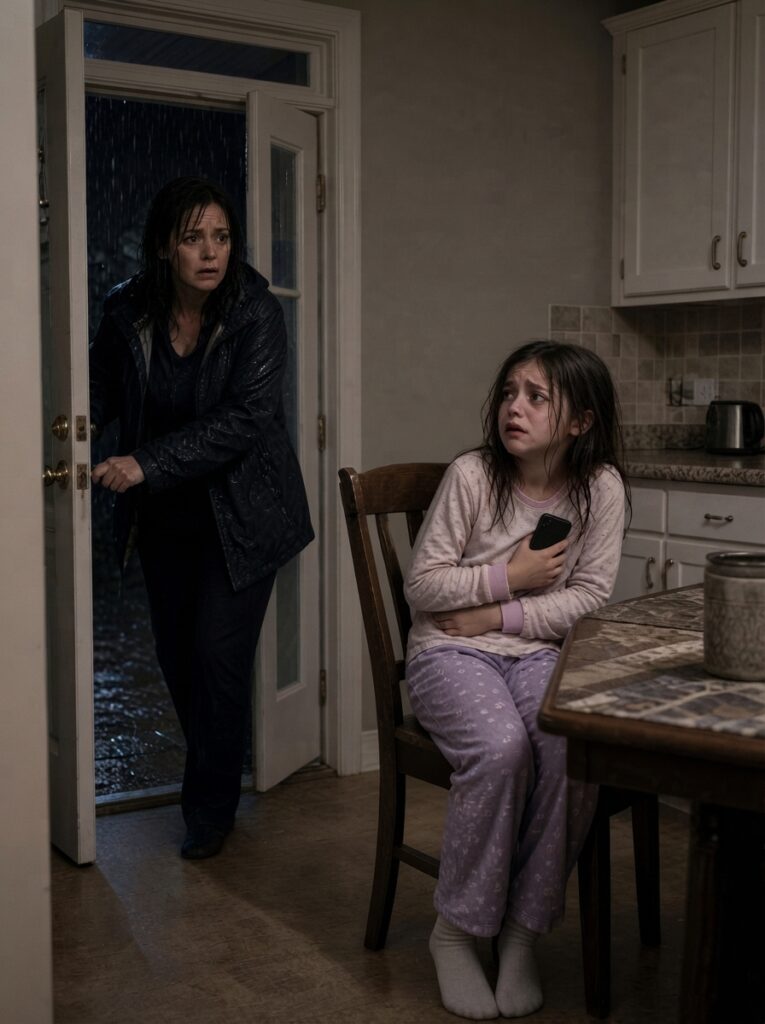
White light slid across the upstairs wallpaper. A vehicle had turned into the driveway. I froze with the chair braced against my shoulder.
Below me, the front door opened.
Mom’s voice carried into the dark house. “Why is the kitchen window open?”
Lily made a frightened sound behind the locked bedroom door.
That decided it for me.
I swung the chair again.
The wooden frame cracked around the metal latch. I hit it once more, and the screws tore free with a sharp snap. The padlock stayed closed, still attached to the broken piece of trim, but the door swung inward.
Lily stood three feet away in oversized pajamas and socks.
For one terrible second, neither of us moved.
She looked smaller than I remembered. Her hair was tangled. Her lips were dry, and she was clutching an empty plastic cup against her chest as if someone might take it from her.
Then she ran into me.
I dropped the chair and caught her.
“Don’t let Grandma put me back,” she whispered.
Footsteps hit the stairs.
Mom appeared first, rain shining on the shoulders of her coat. Dad came up behind her.
Mom stopped when she saw the broken doorway.
Her face changed, but not in the way I expected. She didn’t look ashamed.
She looked furious that I had seen it.
“What have you done?”
I tightened my arms around Lily.
“What have I done?” I repeated. “She called me because she was locked in here without food.”
Dad pushed past Mom and stared at the splintered frame. “Emily, you broke into our house.”
“You left an eight-year-old alone.”
Mom lifted both hands as if I were the unreasonable one. “She was safe.”
Lily pressed her face against my side.
I stared at my mother. “There was a padlock on the outside of her bedroom.”
“She wanders at night.”
Lily’s fingers tightened around my shirt.
“No, I don’t,” she said.
Mom’s eyes snapped toward her.
Lily flinched so hard I felt it through my wet clothes.
That tiny movement told me more than anything Mom could have said.
I took my phone from my pocket.
Dad stepped closer. “Put that away. We can talk about this as a family.”
“We’re past that.”
Mom’s voice dropped. “Emily, think carefully. You are emotional. You have been emotional since Jenna died.”
Six months earlier, that sentence might have stopped me.
They had used my grief like a fence. Every time I asked to see Lily, they reminded me that I was grieving. Every time I questioned a decision, Dad said I was making things harder. Every time Mom canceled a visit, she acted as if she were protecting Lily from me.
Now Lily was standing beside a broken door that had been locked from the hallway.
I called 911.
Mom moved toward me.
Lily spoke before I could.
“Please don’t let her take my phone.”
Everyone went still.
I looked down. “What phone?”
“The little one Jenna gave me.”
Mom’s mouth tightened.
Lily pointed toward the bed. Under the edge of the mattress, I found an old phone with a cracked corner and almost no battery left.
“That’s what you called me from?”
She nodded.
“Grandma took my regular tablet. She didn’t know I had Mommy’s old phone.”
Mom immediately said, “That phone was supposed to be gone.”
I looked at her.
She seemed to realize too late what she had admitted.
The emergency dispatcher stayed with me until officers and paramedics arrived. Dad spent most of that time insisting there had been a misunderstanding. Mom kept saying Lily had eaten before they left.
Then Lily quietly asked me whether there was anything downstairs besides crackers.
One of the paramedics heard her.
Within minutes, the house no longer belonged to my parents’ version of events.
The empty refrigerator was photographed. So were the cabinets, the broken bedroom latch, the padlock and the room itself. I showed an officer the pictures I had taken before touching anything downstairs.
At first, Officer Hayes looked at the shattered door and asked whether Lily had been locked in temporarily because of a dangerous behavioral episode.
Lily stared at him.
“I wasn’t dangerous,” she said.
He looked at the padlock again, then at her.
“You’re right,” he said. “I’m sorry I asked it that way.”
It was the only time that night I saw an adult correct himself immediately after Lily told him he was wrong.
Mom never did.
Dad never did either.
When the paramedic asked Lily when she had last eaten a full meal, she hesitated before answering.
“Yesterday morning, I think.”
Mom interrupted. “That is not true.”
Lily shrank against me again.
The paramedic held up a hand. “I asked her.”
That was when Dad changed tactics.
He stopped defending the lock and started attacking me.
He told the officers I had always resented my parents for taking over after Jenna died. He said I had been unstable. He said I had broken into the house because I wanted Lily for myself.
Then he pointed at the envelopes still on the hallway floor.
“And now she’s stealing our mail.”
I hadn’t opened a single one.
I had only carried them upstairs after photographing where I found them.
An officer picked them up with gloved hands and looked over the fronts.
Several had Lily’s name printed beneath my parents’ address. One came from the school district. Another came from an agency handling survivor benefits. A third had been sent by the administrator of a custodial account connected to Jenna’s estate.
All were unopened.
Mom suddenly wanted them back.
The officer didn’t give them to her.
Lily was taken to the hospital to be checked. I rode with her while my parents remained behind answering questions.
The rain was easing by then, but Lily kept watching the ambulance windows as though she expected my mother’s SUV to appear beside us.
“You’re not going back there tonight,” I told her.
She studied my face carefully.
“Even if Grandma gets mad?”
“Even then.”
She nodded, but she didn’t look relieved yet.
Children who have been frightened long enough do not trust a promise simply because it is kind.
At the hospital, they gave her water, soup, toast and fruit. She ate slowly at first. Halfway through the soup, she stopped and asked whether she was allowed to finish it.
I had to turn my face away for a second.
“Lily, you never have to ask me permission to finish your dinner.”
She looked down at the bowl.
“Grandma said food costs money.”
That sentence opened the next door.
Over the following hours, with a child welfare worker present, Lily explained that the stormy night had not been the first time my parents had gone away and left her alone.
Usually it was only for several hours.
Sometimes they locked her bedroom. Sometimes they simply told her she was not allowed downstairs. If she complained about being hungry, Mom told her she had already eaten enough. If she asked to call me, she was told I was too busy and did not want to deal with her grief.
I felt sick hearing that.
Because at the same time, my parents had been telling me Lily did not want to see me.
They had isolated both of us using opposite lies.
Lily looked at me from the hospital bed.
“Did you stop calling because I cried too much after Mommy died?”
“No.”
“Grandma said you did.”
“I called. I came to the house. I sent things.”
Her forehead wrinkled.
“What things?”
That was the moment the anger inside me changed.
Until then, I had been angry about what I had physically seen: the padlock, the empty kitchen, Lily’s fear.
Now I understood there was a system behind it.
My parents had not simply neglected her while overwhelmed by grief.
They had controlled information.
They had kept me away deliberately.
Two days later, Lily was released into temporary kinship care with me while the investigation continued.
The first morning in my apartment, I made pancakes.
She ate one and then sat with her fork resting beside the plate.
“Can I have another?”
“You can have ten if your stomach can handle it.”
She almost smiled.
I gave her a second pancake and left the plate in the center of the table so she could take more without asking.
That week was strangely ordinary.
We bought shampoo. We found pajamas that actually fit her. I drove her to school. She chose strawberry toothpaste instead of mint. One afternoon she spent twenty minutes deciding where to put a stuffed rabbit on the bed in my guest room.
Those small decisions mattered because almost every choice had been made for her for six months.
But at night, she still checked the bedroom door.
The door had an ordinary lock on the inside.
Nothing on the outside.
She tested it twice before sleeping.
Meanwhile, the envelopes from my parents’ house began answering questions I had not known to ask.
The school district had been requesting meetings about Lily’s repeated absences and sudden decline in class participation. My parents had ignored several notices.
The survivor-benefit paperwork showed that money had been arriving regularly for Lily’s care.
The custodial-account correspondence was more troubling. Jenna had left a modest amount for her daughter, and my parents, as the adults controlling Lily’s daily care, had been given limited authority to manage approved expenses for her benefit.
Records later obtained during the case showed withdrawals that did not match Lily’s needs.
There were payments for my parents’ personal bills, travel and purchases with no connection to her care.
The amount mattered, but the pattern mattered more.
Mom had been telling an eight-year-old that food was too expensive while using money intended for that child elsewhere.
Dad had been telling me I was interfering while signing forms describing their home as stable and adequately supplied.
Then investigators reviewed Jenna’s old folder.
That was the folder I had handed my parents after her death because I could barely get through a day without crying.
Inside were the documents I remembered: death certificates, insurance information, school records, medical forms.
But there was also a sealed envelope I had never seen.
My name was written on the front in Jenna’s handwriting.
I opened it with Lily’s advocate present.
It was not a formal will. It was not a secret fortune. It was something much simpler and, to me, much worse.
Jenna had written it during one of her final hospital stays.
She said she knew Mom and Dad would want to help with Lily. She appreciated that.
Then she wrote that if Lily ever became frightened, withdrawn or difficult to reach, I was the person who understood her best after Jenna herself.
The last line said: “Please keep Emily close to her, even if everyone is grieving differently.”
My parents had possessed that letter for six months.
They had done the opposite.
For several minutes, I could not speak.
Lily’s advocate asked whether I wanted a break.
I shook my head.
I had already lost too much time because my parents had convinced me that backing away was the loving thing to do.
I was not backing away again.
My parents fought the temporary placement.
Their attorney argued that the storm had turned one unfortunate night into something that looked worse than it was. Mom claimed the lock was a recent safety measure. Dad described the financial withdrawals as reimbursements for household expenses.
For a while, I was terrified that the whole case would collapse into competing stories from adults.
Then Lily was interviewed again without any of us in the room.
Afterward, she came out holding her stuffed rabbit and climbed into the chair beside me.
She did not tell me what she had said.
I did not ask.
The next development came from my parents themselves.
They produced a box of Lily’s belongings that they said she had left behind.
Clothes. School notebooks. A winter coat. Jenna’s framed photograph.
And beneath those things, wedged against the cardboard bottom, were three unopened birthday cards and two small packages addressed to Lily in my handwriting.
I recognized them immediately.
I had mailed every one after Mom told me Lily was too upset to see me.
Dad stared at the box as if he had never seen the cards before.
Mom said she had been waiting for “the right time” to give them to Lily.
Lily looked at her.
“My birthday was four months ago.”
Mom had no answer.
That discovery did not create the case against them. The padlock, abandonment, food conditions, school records and financial documents had already done that.
But it destroyed the story they had told Lily about me.
For the first time since the storm, I watched something in my niece loosen.
She picked up one of the unopened cards and ran her thumb under her name.
“You really sent these?”
“Every one.”
She leaned against me without saying anything else.
The final custody hearing came months later.
By then, Lily was eating normally, attending school regularly and seeing a counselor. She still hated thunderstorms. She still woke some nights to make sure the hallway was empty.
But she laughed again.
My parents’ guardianship was terminated.
They were ordered to account for and repay money improperly taken from funds meant for Lily. The financial findings were referred for further review, and any future contact with Lily would depend on conditions set for her safety rather than on what my parents demanded.
I was granted permanent guardianship.
Mom cried when the decision was announced.
Dad stared straight ahead.
Neither apologized to Lily.
That hurt her more than the ruling helped her at first.
She had spent months believing that eventually Grandma would explain everything in a way that made sense.
There was no explanation that could make locking a hungry child behind a bedroom door acceptable.
There was only consequence.
On the anniversary of Jenna’s death, Lily and I went through the documents from the case together.
Not all of them. She was still a child, and she did not need every ugly detail.
But I showed her Jenna’s letter.
She read the final sentence twice.
Then she asked if she could keep it someday.
“It was written about you,” I said. “I think it should belong to you.”
We put it in a new folder with Jenna’s photograph, Lily’s school certificates, a few drawings and the birthday cards my parents had hidden.
The old folder had once been something adults passed between themselves while making decisions over Lily’s head.
This one sat on her bookshelf.
It was hers.
A few weeks later, we moved into a two-bedroom place so she could have a room that was truly her own.
The first night, I showed her the lock.
It worked only from inside the bedroom.
I put the small brass key in her palm.
“No one else keeps a copy for the hallway,” I told her. “If you want the door open, it stays open. If you want privacy, you lock it from your side. You decide.”
She closed her fingers around the key and looked at the room Jenna’s daughter finally controlled for herself.
Then Lily smiled and said, “Then I’m keeping it.”