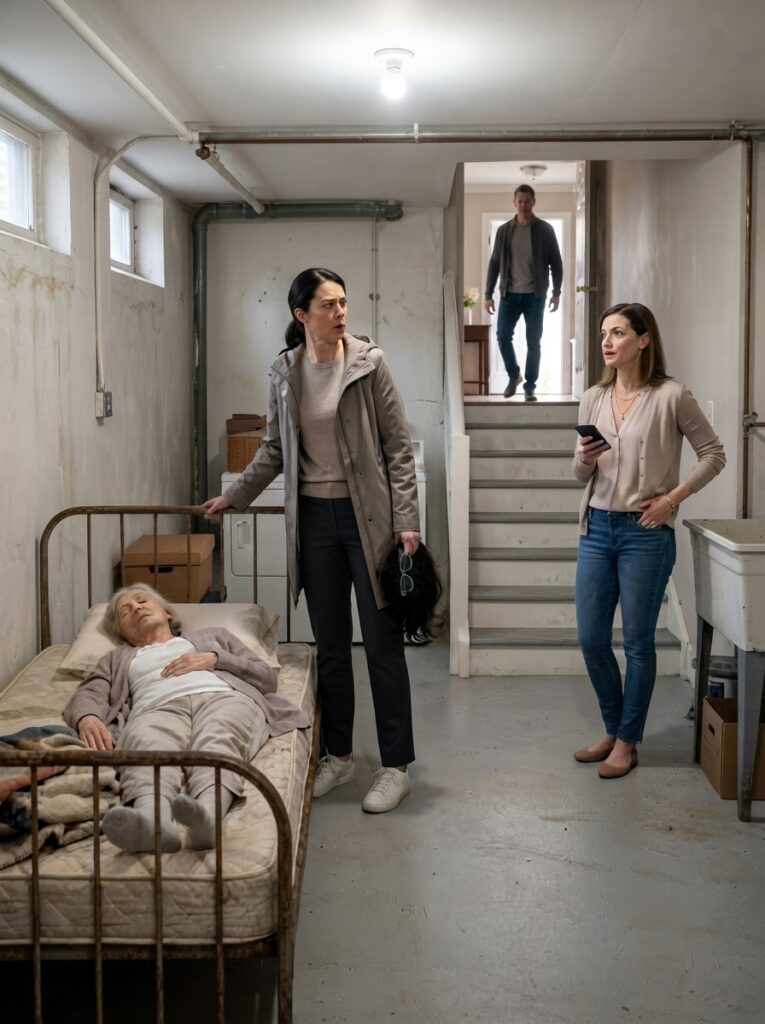
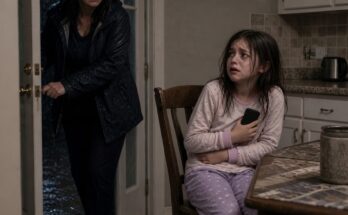
The folder stayed under my hand.
For a moment, nobody moved.
Then the crash upstairs came again.
This time it sounded like something heavy hitting the floor.
Valerie flinched before she could hide it.
I saw the scarred man’s eyes move toward her. Whatever arrangement existed between them, they were both suddenly aware that I had noticed the same thing.
I tightened my grip on the deed.
“Who is upstairs?” I asked.
Valerie folded her arms. “One of the tenants.”
“No.”
The tenant who had recognized the company name shook his head.
“I know everyone renting rooms here,” he said. “Nobody is supposed to be upstairs tonight.”
The scarred man stepped toward me.
“Give me the folder.”
I held it against my chest.
“You walked into my mother’s house carrying a document transferring her property. You aren’t getting it back until I know exactly what it is.”
His jaw tightened.
“It isn’t your mother’s house anymore.”
“Then why was my mother signing documents five months ago while she was supposedly suffering from dementia?”
He didn’t answer.
That was the first crack.
I turned toward the tenants.
“Everyone stay here.”
Valerie laughed once, but there was no humor in it.
“You think you’re in charge because you flew home from Singapore with a laptop?”
“No,” I said. “I think I’m in charge of what happens next because you’re the one who keeps reacting every time I ask a simple question.”
The tenant beside the window looked between us.
“What’s upstairs?” he asked.
Valerie’s expression hardened.
“Nothing.”
Another sound came from above.
A muffled knock.
Then silence.
My stomach dropped.
I ran for the stairs.
The scarred man caught my arm before I reached the first step.
His grip was strong enough to hurt.
“Don’t.”
I looked down at his hand.
Then at his face.
“You’re not a landlord.”
He released me.
I climbed anyway.
Valerie followed, swearing under her breath.
The hallway looked different from the last time I had seen it during one of those carefully controlled video calls. A bedroom door that had once been painted white was now locked. Another room had a keypad installed on the outside.
I tried the first handle.
Locked.
“Chloe,” Valerie said behind me, “walk away.”
I turned.
“You’ve been telling me for six months that Mom couldn’t walk around the house. You told me she couldn’t remember my name. You told me she needed medication to keep her calm.”
I pointed at the locked doors.
“Yet you’ve turned her home into a rental operation.”
Valerie stared at me.
“You don’t understand what was happening here.”
“Then explain it.”
She didn’t.
The tenant who had followed us upstairs pointed toward the keypad room.
“I’ve never seen anyone enter that room.”
The scarred man appeared at the end of the hallway.
“Everybody downstairs.”
Nobody moved.
Then the keypad door clicked.
All of us froze.
The door opened from the inside.
An older woman stepped out.
She wore a gray cardigan over pajamas, and one hand gripped the wall for balance.
My breath stopped.
“Mom?”
She looked at me.
For one terrible second, I wondered if Valerie had been telling the truth after all.
Then Mom’s eyes filled with tears.
“Chloe?”
I crossed the hallway so quickly that I nearly stumbled.
Mom reached for me.
I caught her.
She was thinner than I remembered, but she was awake.
And she was terrified.
“I knew you’d come,” she whispered.
Valerie stepped forward.
“Mom, you’re confused.”
My mother looked past me at Valerie.
“No.”
It was the first firm word I had heard from her since I arrived.
“No, I’m not.”
Valerie stopped.
Mom looked at me again.
“She told me you were dead.”
My heart seemed to stop.
“What?”
Mom swallowed.
“She said your plane had crashed. Then she said you had decided you didn’t want me anymore.”
I looked at Valerie.
She shook her head.
“She’s confused.”
Mom’s fingers tightened around mine.
“She made me sign things.”
The scarred man immediately stepped forward.
“That isn’t what happened.”
Mom looked at him.
“You were there.”
He went still.
“You held my hand down.”
The tenants behind us fell silent.
I felt something inside me go cold.
I pulled Mom toward the stairs.
“No more.”
The scarred man blocked the hallway.
“I said everybody stays downstairs.”
I reached into my bag and pulled out my phone.
“I’ve already sent copies of the deed and the rental listing to someone outside this house.”
That wasn’t entirely true.
But I had taken screenshots before coming upstairs and scheduled them to send to my attorney if I didn’t cancel the message.
The man looked at my phone.
For the first time, he looked uncertain.
Then my mother said something that made him step back.
“Your name isn’t on the deed.”
I looked at her.
Mom nodded toward him.
“He told me his name was Daniel Mercer.”
The man said nothing.
Mom continued.
“But the man who came with Valerie was never Daniel.”
Valerie’s face changed.
I looked at the deed again.
The signature belonged to my mother.
The company was real.
The notarization looked legitimate.
But the name beneath the transfer didn’t match the man standing in front of me.
“Who are you?” I asked.
He didn’t answer.
So I called the number on the notary seal.
The phone rang once.
Twice.
Then a woman answered.
I put her on speaker.
“I’m looking at a quitclaim deed signed by Evelyn Parker five months ago,” I said. “Can you confirm that your office notarized it?”
A pause.
“What’s the document number?”
I read it aloud.
The woman went silent.
Then she said, “That document number does not belong to a real estate transfer.”
Valerie’s eyes widened.
The scarred man lunged for my phone.
I stepped back.
One of the tenants grabbed a chair and put it between us.
“Don’t touch her,” he said.
The room changed instantly.
A few minutes earlier, everyone had been afraid of the man with the scar.
Now they were watching him.
The notary remained on speaker.
“I’m sorry,” she said. “If you’re holding a copy of the document, do not alter it. Keep the original secure. That stamp appears to have been copied.”
I stared at the seal.
The signature could have been genuine.
The stamp was not.
That meant Mom had signed something.
But not necessarily that thing.
I looked at her.
“What did you sign?”
Mom’s eyes dropped.
“A stack of papers.”
“Why?”
“Valerie told me they were medical forms.”
Valerie shook her head.
“I was helping you.”
Mom’s voice trembled.
“You took my glasses.”
Silence.
“You said I would misunderstand the papers if I read them.”
I felt sick.
Mom continued.
“Then you told me Chloe had stopped paying for the house.”
I looked at Valerie.
“She said that?”
Mom nodded.
“She told me you wanted to sell it.”
Valerie’s face had gone pale.
I remembered every mortgage payment.
Every transfer.
Every message I had sent from Singapore asking whether Mom needed anything.
Every short video call where Valerie had positioned the camera so I could see only Mom’s face.
She hadn’t just been hiding the basement.
She had been controlling what my mother believed about me.
But there was still one question.
Why?
I turned to the scarred man.
“You weren’t trying to steal the house from me.”
His eyes narrowed.
“You were trying to move it somewhere else.”
He said nothing.
“The company isn’t Valerie’s.”
Still nothing.
“You aren’t the owner.”
His expression hardened.
“And whatever you’re doing here, you’re not doing it alone.”
That was when Valerie finally broke.
“You don’t know what it cost me!” she shouted.
Mom recoiled.
Valerie immediately lowered her voice.
“I was the one here. I was the one taking care of her. You were halfway around the world.”
I stared at her.
“You could have asked me for help.”
“You would’ve taken everything away.”
“What?”
She looked toward the scarred man.
He shook his head once.
Too late.
I had seen enough.
“What were you promised?”
Valerie’s lips parted.
No answer.
Then one of the tenants spoke.
“She collected all our deposits.”
Another tenant nodded.
“She told us the property was being renovated and the company handled the lease.”
A third tenant pulled out his phone.
“She made us pay into three different accounts.”
The scarred man turned toward him.
“Put that phone away.”
“No.”
For the first time, the man sounded afraid rather than angry.
The tenant opened his banking app.
“I’ve got every transfer.”
I looked at Valerie.
“How long?”
She said nothing.
“How long have you been renting rooms in Mom’s house?”
“Six months.”
“And how much did you collect?”
Her silence answered for her.
I didn’t need another confession.
I called the police.
This time I didn’t hesitate.
While we waited, Mom sat at the kitchen table wrapped in a blanket. I made tea with shaking hands because I needed something ordinary to do.
She watched me.
“I thought you didn’t want to come home.”
I sat beside her.
“I never stopped wanting to come home.”
She touched my hand.
“Why didn’t you tell me you bought this house?”
I smiled through the tears.
“Because Dad said it should feel like yours. Not like a gift you owed me for.”
Mom looked toward the hallway.
“He would’ve hated this.”
“I know.”
The police arrived before midnight.
What followed wasn’t dramatic.
There was no movie-style confession.
There were questions, photographs, copies of documents, statements from tenants, and the slow realization that the house contained evidence of a scheme much larger than the rental payments.
The deed was taken for examination.
The unfamiliar pill bottles were documented.
Mom was taken for a medical evaluation.
Valerie was questioned separately.
The scarred man gave a different name than the one on the deed.
That mattered.
So did the fact that several of the tenants had copies of payments leading to accounts that weren’t connected to the company named in the document.
But the biggest break came two days later.
My attorney called me early in the morning.
“We found the original filing,” she said.
I sat up.
“What does it say?”
“The property was never transferred out of your mother’s name.”
I closed my eyes.
“Then the deed was fake.”
“Not exactly.”
I waited.
“Your mother signed a legitimate power-of-attorney document. Valerie used it to obtain copies of her records. Someone then created a fraudulent transfer document using that information.”
I felt the pieces connect.
The house hadn’t been legally stolen yet.
Someone had been preparing to steal it.
The rental operation had been generating money while they built a paper trail that was supposed to make the transfer look legitimate.
And Mom had been kept isolated because she was the one person who could say the signature had been obtained under false pretenses.
My attorney continued.
“There is one more thing.”
“What?”
“The company on the fake deed isn’t random.”
She gave me the name.
I recognized it immediately.
It was connected to the same company that had appeared on several of the rental payment records.
Valerie hadn’t owned the house.
But she hadn’t been acting alone.
The scarred man hadn’t been trying to frighten me away from a completed theft.
He had been trying to stop me from discovering the paperwork before the theft was finished.
Months later, Mom came home.
Not to the basement.
Not to a locked bedroom.
To her own bedroom, with the curtains she liked and Dad’s old photograph on the dresser.
The tenants moved out after their deposits were documented and returned where possible.
The locks were changed.
The basement was emptied.
And the rusted cot disappeared from the house.
Valerie faced criminal charges related to the fraudulent documents, the rental scheme, and the treatment of Mom. The investigation into the people behind the company continued separately.
I never learned everything that happened before I came home.
Maybe I never will.
But I learned something more important.
For six years, I thought distance was the thing that had kept me from protecting my mother.
It wasn’t distance.
It was the story Valerie had built around it.
She made every short video call look normal.
She made every unanswered question sound reasonable.
She made my mother’s confusion look like dementia.
And she made me feel guilty for being thousands of miles away.
The first night Mom slept in her own room again, I sat beside her until she fell asleep.
She opened her eyes once.
“Chloe?”
“I’m here.”
She smiled.
“I knew you would come.”
I squeezed her hand.
“I should’ve come sooner.”
Mom shook her head.
“No.”
She looked toward the window.
“You came when you knew.”
That was the part I carried with me.
Not the fake identity.
Not the deed.
Not the man with the scar.
The moment my mother finally understood that the person she had been told abandoned her had actually been trying to reach her all along.
And the moment I understood that sometimes the most dangerous lie in a family isn’t the lie someone tells you.
It’s the lie that keeps you from asking one more question.