My lawyer reached for the final divider inside the blue folder, then stopped.
“Daniela,” she said quietly, “there’s something here your parents clearly believed you hadn’t found yet.”
I stared at her from the hospital bed.
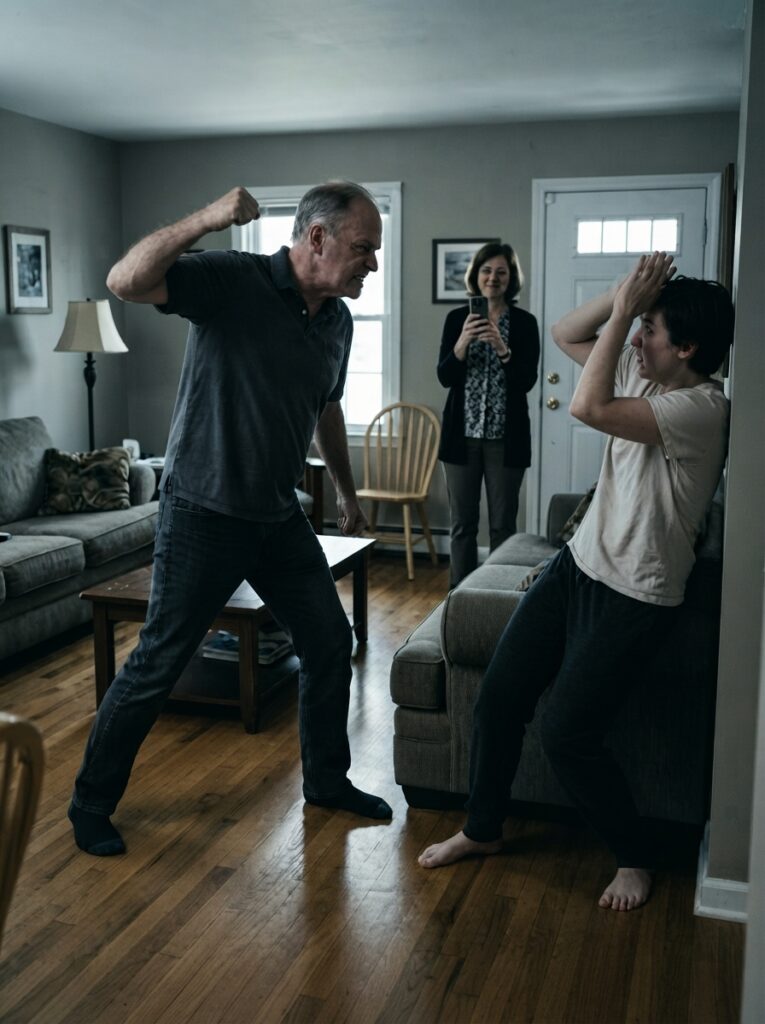
For four days, I had been trying to understand how my life had gone from arguing over family finances to waking up behind a grocery store with three broken ribs. I knew what my parents had done to me. I knew my mother had filmed it. I knew she had laughed while I struggled to breathe.
But I still didn’t know why they had been so desperate to stop me from looking at those trust records.
My lawyer slid the final divider toward herself.
The detectives leaned closer.
Then she pulled out a series of documents I had never seen before.
They were not ordinary trust statements.
They were copies of correspondence between the trust’s financial administrators and several outside entities. Dates, account references, authorization records, and internal notes connected transactions that had looked unrelated when I first reviewed the beneficiary statements.
My lawyer placed the pages beside the two versions of the trust records.
The same destination entities appeared again and again.
Different descriptions.
Different paperwork.
Different explanations.
But the money kept moving toward the same network.
One detective pointed to a transfer date.
“This was before you started asking questions?”
“Yes.”
“And this one?”
“Before.”
He looked at another page.
“And this?”
My lawyer answered for me.
“After Daniela sent her first written request for clarification.”
The room went quiet.
That detail mattered.
I had thought the transfers were the reason my father became angry when I confronted him. Now I could see something more precise. My questions had not merely threatened to expose old financial irregularities. They had arrived while someone was still moving money and trying to make the records look ordinary.
The detective picked up the copy of one of my emails.
My name was at the bottom.
So was the date.
I had asked for an explanation in writing.
That meant my parents had known exactly what I was examining before they attacked me.
The detective closed his notebook.
“Do not contact either of your parents,” he said.
“I wasn’t planning to.”
“Good. Don’t warn them. Don’t tell them what you found. And don’t discuss these records with anyone outside your lawyer.”
I nodded.
For the first time since waking up in that alley, I felt something other than fear.
Not relief.
Control.
Then someone knocked hard on my hospital-room door.
A security officer stepped inside holding a clear property bag.
Inside were my wallet, one torn piece of clothing, and the shoes I had been missing since the night my parents left me in Bridgeport.
“Ms. Rios,” he said, “a man downstairs just tried to leave these for you.”
My stomach tightened.
“Who?”
“He didn’t give a name.”
The detective immediately stood.
“Where is he?”
“Security stopped him at the entrance. He left before officers arrived.”
My lawyer looked at me.
I looked at the shoes.
My parents had taken my belongings when they dumped me on the street. They had taken my phone, wallet, identification, and purse. Whoever had returned the property knew exactly what had been missing.
And now someone knew I was awake.
The detective asked security to preserve every available camera recording from the entrance, parking area, and surrounding hallways.
My lawyer did something else.
She photographed the property bag without touching the contents.
Then she asked me a question.
“Did your father ever have someone who handled errands for him?”
I thought about it.
“Yes.”
“Who?”
“His driver, mostly. Sometimes a security contractor.”
“Names?”
I gave them both.
The detective wrote them down.
Then he looked at the shoes again.
“Did your parents know where you were taken?”
“No.”
“Are you sure?”
“I was unconscious. But the only people who knew I had been left there were the people who left me.”
Nobody answered.
That silence told me they were thinking the same thing I was.
The person who returned my belongings might not have been trying to help me.
He might have been checking whether I could still be frightened.
My lawyer closed the folder.
“We’re going to proceed carefully,” she said.
The detectives left with copies of the documents.
I remained in the hospital room staring at the blue folder.
For weeks, I had believed the folder contained the explanation.
Now I understood that it contained a map.
A map of where the money went.
A map of who had access to it.
And, most importantly, a record of when I had started asking questions.
My father had assumed that if he frightened me badly enough, I would stop.
He had been wrong.
But I still needed to know how wrong he was.
Two days later, my lawyer returned with another update.
The detectives had obtained additional financial records through formal requests. Some transactions matched the pattern in my folder. Others led to companies I had never heard of.
Then my lawyer put a single document on the table.
It was a corporate registration.
One of the entities receiving trust money had a manager whose name I recognized.
Not a family member.
Not a bank employee.
A man who had attended my father’s business dinners for years.
Someone my father had always introduced as a consultant.
I remembered seeing him in the background of family photographs. At holiday dinners. At charity events. At my grandparents’ anniversary celebration.
He had always been close enough to my father to hear private conversations.
I asked my lawyer whether the records proved he had done anything illegal.
“No,” she said. “Not by themselves. They prove a connection that needs to be investigated.”
That distinction mattered.
I didn’t want revenge.
I wanted the truth.
And I wanted every conclusion to be supported by evidence.
The next morning, my father called the hospital.
I didn’t answer.
The nurse told me he had asked to speak with me personally.
My lawyer was sitting beside the bed when the message came through.
She shook her head.
“Don’t return it.”
I didn’t.
An hour later, my mother called.
Then again.
Then again.
The calls stopped only after my lawyer sent a formal notice instructing them not to contact me directly.
That afternoon, my father finally sent a message through his attorney.
The message was short.
He claimed the assault had been “a private family dispute that became physical.”
He denied intentionally abandoning me.
He denied taking my belongings.
And he insisted that the trust records were being “misinterpreted.”
I read it twice.
Then I handed the phone to my lawyer.
She smiled without humor.
“They’re trying to separate the financial records from what happened in the study.”
“They can’t?” I asked.
“Not anymore.”
She tapped the blue folder.
“Your questions happened first. Your written requests happened before the assault. The financial pattern is documented. Then you were attacked immediately after confronting your father about it. Those facts can be examined together.”
I looked toward the hospital window.
Outside, traffic moved through the afternoon as if nothing had happened.
My father had spent years building a reputation around money, influence, and control.
I had spent years assuming that reputation meant he knew what he was doing.
Now I wondered how much of that reputation depended on everyone around him being too afraid to check the paperwork.
Three weeks after the assault, I was discharged from the hospital.
I could walk, but slowly.
My ribs still hurt when I breathed too deeply.
The bruising had begun to fade, though the broken cheekbone still showed in the mirror.
I went home to a temporary apartment arranged by my lawyer because I refused to return to my parents’ house.
The blue folder came with me.
So did copies of everything inside it.
I kept the original evidence sealed.
Then the investigation moved faster.
One financial institution produced records showing transfers that had never appeared on the statements given to beneficiaries.
Another record showed an authorization linked to an entity my father had claimed he knew nothing about.
A third document connected one of the receiving companies to the consultant I recognized from my father’s dinners.
But there was still a missing piece.
Who had actually authorized the movement of the money?
The answer came from a document nobody in my family had expected me to possess.
My lawyer called me late one evening.
“Daniela, I need you to sit down.”
I was already sitting.
“What happened?”
“We found the authorization trail.”
She sent me a copy.
I opened it.
There was my father’s name.
Below it was another signature.
My mother’s.
I stared at the page.
For weeks, I had imagined that Patricia had simply stood by while my father lost control.
I had remembered her phone in her hand.
Her laughter.
Her voice telling me I was pathetic.
Now I understood that she was not merely a witness to the destruction of my life that night.
Her signature was on the financial paperwork too.
I asked my lawyer whether that meant she had known everything.
“Not everything,” she said. “But it means we have evidence that she was involved in at least some of the transactions.”
That was enough to change the case again.
The following week, investigators interviewed people who had worked with the trust.
One former administrator admitted that she had questioned several transfers years earlier.
She had been told they were part of a restructuring.
When she asked for supporting documents, she was removed from the account.
Another employee remembered being instructed to use different descriptions for transactions involving the same receiving entities.
The pattern was becoming impossible to dismiss as bookkeeping mistakes.
But then something unexpected happened.
The consultant disappeared.
His office closed.
His listed phone number stopped working.
Investigators could not immediately locate him.
For the first time, I wondered whether the people around my father had realized what was coming.
Then my lawyer received a package.
There was no return address.
Inside was a single flash drive.
And a handwritten note.
The note contained only one sentence: “You were never supposed to see the second set of records.”
My lawyer did not open the drive on her own computer.
She gave it directly to investigators.
They found copies of internal trust records, correspondence, and transaction reports.
There was also a video file.
The video was not from my father’s house.
It was from the night I was attacked.
Security footage from the area behind the grocery store showed a vehicle arriving shortly before I was found.
The footage did not show everything clearly.
But it established something important.
A vehicle connected to my father’s financial consultant had been near the location that night.
The same consultant whose companies had received trust money.
The same man who had vanished after investigators began asking questions.
Suddenly, the returned shoes made sense in a different way.
Someone had known where I was.
Someone had known what had been taken from me.
And someone had been close enough to my parents’ operation to know exactly what might frighten me into silence.
The case was no longer simply about what happened inside my father’s study.
It was about everything that had happened before and after it.
My parents had believed violence would end the questions.
Instead, it created a record of the moment they became desperate.
The assault gave investigators a reason to examine the financial trail.
The financial trail gave them a reason to examine the people around my parents.
And those records led to documents my parents had spent years trying to keep separate.
Months later, the investigation resulted in formal legal action involving the trust and several people connected to its management.
I did not celebrate.
There was nothing to celebrate about discovering that the people who were supposed to protect a family inheritance had treated it as something they could control for themselves.
My relationship with my parents ended long before the paperwork did.
I never received an apology from my father.
My mother eventually sent one message through an attorney.
She said she had been afraid.
I believed she had been afraid.
But fear did not erase the fact that she had locked the door.
Fear did not erase the phone in her hand.
Fear did not erase her laughter.
And fear did not erase her signature from the financial records.
The blue folder remained with my lawyer throughout the investigation.
One afternoon, after everything had been formally documented, she returned it to me.
The edges were worn from being opened and handled so many times.
I held it in both hands.
For a moment, I remembered the night I placed it on my father’s mahogany desk.
I had walked into that room believing I was asking my family for an explanation.
I walked out of it broken, abandoned, and unable to defend myself.
But the folder had survived.
So had the paper trail.
And so had I.
I used to think the most important thing inside that folder was the money.
I was wrong.
The most important thing was the record of every question I had asked before anyone could tell me I was imagining things.
Every transfer had a date.
Every request had a timestamp.
Every document had a source.
Every contradiction had a place in the sequence.
My father thought he could make the truth disappear by making me afraid to look at it.
He never understood that the moment I stopped arguing with him and started documenting everything, the balance of power had already changed.
The blue folder did not destroy my family.
What it did was preserve the evidence of what my family had already chosen to become.
And that was enough.