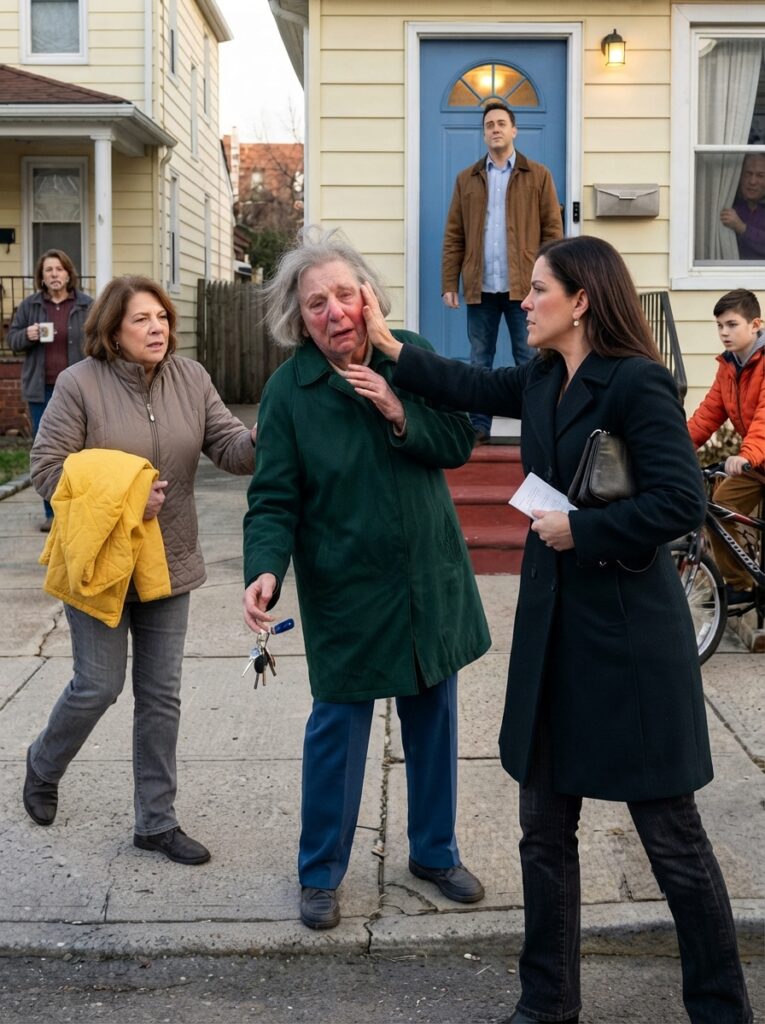
My daughter sold my house while I was in London and waited for me at the front door to tell me, “You don’t have a home anymore, Mom.” Her husband laughed as if he had just buried me alive. My keys no longer opened the house where I had given birth, become a widow, and grown old. But I smiled, because Daniela didn’t know that night she hadn’t sold a house. She had opened a grave with my family name on it.
My name is Margaret Holloway. I am sixty-eight years old, and until last October, I believed there were certain betrayals that simply did not happen in ordinary families. Children might argue with their parents. They might become selfish, distant, even cruel. But I never imagined my only daughter would stand on the porch of the home where I had raised her and tell me, with a smile on her face, that it no longer belonged to me.
I had spent three weeks in London visiting my younger sister, Helen. It was my first real vacation since my husband, Robert, died eleven years earlier. Daniela had practically pushed me onto the airplane. “Go enjoy yourself, Mom,” she told me. “You’ve spent your whole life worrying about everyone else.” Looking back, I should have wondered why she was suddenly so interested in getting me out of the country.
My flight landed shortly after four in the afternoon. I took a taxi home, exhausted but happy to see the familiar maple trees lining our street. Then I noticed a black SUV parked in my driveway. Daniela stood on the porch beside her husband, Marcus. Neither of them came down to help with my suitcase. Marcus had his arms folded across his chest, wearing the smug expression he usually saved for moments when he believed he had won an argument.
I climbed the steps and slipped my key into the front door. It wouldn’t turn. I tried again. Then another key. Nothing. “What happened to the lock?” I asked. Daniela looked at Marcus before answering. “Nothing happened to it, Mom. Those just aren’t your locks anymore.” I stared at her. She almost seemed to enjoy my confusion. Then she said the sentence I would remember for the rest of my life. “You don’t have a home anymore, Mom.”
Marcus laughed. Not loudly. Just a short, satisfied laugh. Somehow that made it worse. Daniela explained that the house had been sold while I was overseas. She claimed I had signed documents months earlier authorizing her to handle my property affairs. According to her, the sale was completely legal. A young investment company had purchased the house, and I had until the following morning to remove whatever personal belongings the new owners had agreed to release.
“You sold my house?” I whispered. “Our house?” Daniela rolled her eyes. “Mom, please don’t make this dramatic. You’re sixty-eight. That place is too big for you anyway. Marcus found an excellent buyer. We handled everything.” We. That word told me more than the rest of her explanation. I looked at my daughter and suddenly saw a stranger wearing the face of the baby I had once rocked to sleep in the upstairs bedroom.
I had given birth to Daniela in that house. Robert had carried me through that same front door after we returned from the hospital. We celebrated twenty-nine Christmases there. I buried my husband while living there. After his funeral, I slept on his side of the bed for six months because his pillow still smelled faintly like his shaving cream. Every wall contained a piece of my life, and my daughter had reduced all of it to a transaction.
Marcus stepped forward. “Look, Margaret, there’s no reason to make this ugly. Daniela arranged a nice apartment for you. First month is covered.” I looked at him and asked how much they had sold the house for. His expression changed for half a second. Daniela answered quickly. “That’s not important.” That was when I knew money had already moved somewhere it shouldn’t have.
I surprised both of them by smiling. “You’re right,” I said. “There’s no reason to make this ugly.” Daniela blinked. Marcus looked almost disappointed. They had expected tears. They had expected screaming, perhaps even begging. Instead, I picked up my suitcase and asked Daniela to text me the address of the apartment. She looked relieved. She believed I had surrendered.
What Daniela never understood was that her father had spent forty-two years as an estate attorney. Robert trusted people, but he trusted paperwork more. Three years before he died, after watching one of his clients lose a family property through a forged power of attorney, he came home and changed the structure of our estate. At the time, I thought he was being overly cautious. Eleven years later, his caution was about to become the most valuable inheritance he ever left me.
The house Daniela thought she had sold was not legally mine to sell by myself. It had been transferred years earlier into the Holloway Family Preservation Trust. I had lifetime occupancy rights and served as one trustee, but any permanent sale required authorization from two additional trustees: Robert’s younger brother, Thomas, and our longtime attorney, Samuel Reed. Neither man had authorized anything.
More importantly, Robert had inserted a clause specifically addressing fraudulent transfers. Any family beneficiary who knowingly attempted to sell, mortgage, or transfer trust property using forged authorization would immediately lose all future beneficial interest in the trust, subject to the trust’s terms and applicable law. Daniela was a beneficiary. The house was only one asset. She had no idea how much else was sitting behind that clause.
From my hotel room that evening, I called Samuel. He was seventy-three and supposedly semi-retired, but when I explained what had happened, his voice became sharper with every sentence. “Margaret,” he said, “do not contact Daniela again tonight. Send me photographs of the locks, every message she sent you, and your travel records. Then get some sleep.” I almost laughed. “Samuel, I don’t think I’m sleeping.” He paused. “Then make coffee. We have work to do.”
By eight the next morning, Samuel had discovered that a document carrying my supposed signature had been notarized twelve days earlier, while my passport and airline records placed me in London. The document claimed I had personally appeared before a local notary. Unless I had learned to be on two continents simultaneously, somebody had a serious problem.
The supposed buyer was an LLC created only six weeks earlier. Its registered mailing address led to a small office associated with one of Marcus’s former business partners. The sale price was nearly $180,000 below a recent independent valuation of the property. Even more interesting, a substantial portion of the proceeds had been directed toward an account connected to a company Marcus controlled.
At 10:17 that morning, Daniela called me. “Mom, why is some lawyer contacting the title company?” Her voice no longer sounded triumphant. I sat beside the hotel window and stirred my coffee. “I thought you said everything was legal.” Silence. Then she snapped, “It is legal. You gave me power of attorney.” “Did I?” I asked. “Then I’m sure you have nothing to worry about.”
She hung up.
For the next two days, the story Daniela and Marcus had constructed began collapsing piece by piece. The title insurer froze further activity related to the transaction while counsel reviewed the trust documents. Samuel sought emergency legal relief challenging the transfer. The purported buyer suddenly claimed it had relied entirely on documents supplied by Marcus and Daniela. The notary who supposedly witnessed my signature became remarkably difficult for them to explain.
Then Thomas arrived from Vermont. My brother-in-law had not spoken to Daniela in almost two years because he disliked Marcus, but Robert had trusted him completely. Thomas walked into Samuel’s office carrying the original trust documents in a battered leather briefcase. He placed them on the conference table and looked at me. “Robert always said this clause would make everyone angry one day.” I smiled sadly. “He was right.”
Daniela finally requested a family meeting. She arrived without Marcus. That alone told me something had changed. She looked exhausted. Her expensive coat was wrinkled, and the confidence she had worn on my porch was gone. “Mom,” she began, “Marcus told me the trust didn’t matter because you were the primary owner.” Samuel immediately corrected her. “Mrs. Holloway is not the sole owner. You were informed of the trust when your father’s estate was administered.”
Daniela started crying. I had spent my entire life responding to my daughter’s tears. When she fell off her bicycle at six, I carried her home. When her first boyfriend broke her heart, I stayed awake beside her until sunrise. When she lost her first job, Robert and I paid her rent for four months. Even after she married Marcus, I gave them money whenever they claimed they were struggling.
But those tears felt different. They were not tears over what she had done to me. They were tears over what might happen to her.
Samuel placed a copy of the trust on the table. Daniela’s face went pale as he explained the forfeiture provision. Under the trust’s terms, her conduct could jeopardize benefits she expected to receive after my death. Those benefits included investment accounts, income-producing commercial property, and other assets Robert had accumulated quietly over decades. The house she had tried to steal was worth a fraction of what she had put at risk.
“How much?” she whispered. Samuel looked at me, allowing me to decide whether to answer. “Enough,” I said, “that selling my house behind my back may become the most expensive decision you ever made.” Daniela stared at me as though I had slapped her. “Dad left all that?” “Your father left security for his family,” I replied. “He also left rules for anyone who tried to destroy it.”
That was when she blamed Marcus. She said he had debts I knew nothing about. His consulting business had been failing for nearly two years. He owed money to private lenders and had convinced her that selling my property would solve everything. He told her I would eventually forgive her because I always did. That sentence hurt more than the sale itself.
Because Marcus was right about one thing. I always had forgiven her.
I forgave Daniela when she borrowed $14,000 from me and took three years to admit she couldn’t repay it. I forgave her when she skipped my sixty-fifth birthday because Marcus had gotten tickets to a resort weekend. I forgave her when she sold Robert’s antique watch after promising she would keep it for her future child. Every time she crossed a line, I moved the line farther back because she was my daughter.
This time, I didn’t.
“I want my house restored,” I told her. “I want every dollar accounted for. I want full cooperation with Samuel and everyone investigating these documents. And I will not lie for you or Marcus.” Daniela stared at me through tears. “You’re choosing money over your daughter.” I shook my head. “No. You chose money over your mother. I’m simply refusing to pretend you didn’t.”
The weeks that followed were ugly. Lawyers became involved. Records were requested. Statements were taken. Marcus hired his own attorney and began distancing himself from Daniela’s decisions. Daniela, in turn, provided messages showing how aggressively he had pushed the plan. I learned things about their marriage I never wanted to know, but I also learned something about myself: being a mother did not require volunteering to be a victim.
Eventually, the disputed transfer was unwound through the legal process, and control of the property returned to the trust. The locks were changed again. This time, Samuel handed the keys directly to me. I stood on the porch for nearly five minutes before opening the door. Inside, most things were exactly where I had left them. Robert’s photograph still sat on the mantel.
I walked upstairs to Daniela’s childhood bedroom. Faded marks remained inside the closet doorway where Robert had measured her height every birthday. Age seven. Age nine. Age twelve. At sixteen, she had complained that we were embarrassing her by continuing the tradition. Robert had laughed and marked the wall anyway.
I touched the highest pencil line and cried for the first time since returning from London.
Not because I had nearly lost the house.
Because somewhere between that little girl standing barefoot against the wall and the woman waiting on my porch to announce that I was homeless, I had lost something far more important. Maybe Daniela had lost it too.
Months later, she came to see me alone. Marcus was no longer living with her. Their marriage was unraveling beneath the financial and legal consequences of what they had done. She stood outside the same front door where she had once humiliated me, but this time she did not enter until I invited her inside.
“I thought you would always forgive me,” she said.
I looked at her for a long time. “I can forgive you someday,” I answered. “But forgiveness doesn’t mean returning everything to the way it was.”
She nodded, crying quietly.
I still live in the house. Some evenings I sit on the back porch where Robert and I used to drink coffee and complain about the neighbors’ barking dog. The neighborhood has changed. I have changed too. Daniela and I speak occasionally, but trust is returning slowly, if it returns at all.
People sometimes ask why I smiled that first night when my daughter told me I had no home. They assume I already knew I would win. I didn’t. Legal battles are never that simple, and paperwork alone cannot erase betrayal.
I smiled because I suddenly remembered something Robert once told me after handling a terrible family estate dispute.
“Greedy people rarely read the document that protects them,” he said. “They only read the number they think they’re getting.”
Daniela had looked at my house and seen money.
Marcus had looked at an aging widow and seen someone easy to remove.
Neither of them had bothered to look beneath the surface.
So when my daughter changed the locks and told me, “You don’t have a home anymore, Mom,” she believed she had closed the final door on my life.
Instead, she opened one her father had locked years before.
And behind it was not simply a house, an inheritance, or a pile of legal documents.
It was the final lesson Robert left for our family:
A home can be stolen.
Money can disappear.
Even blood can betray you.
But the moment you stop confusing love with permission to destroy you, the people who counted on your silence discover something terrifying.
You were never as powerless as they needed you to believe.