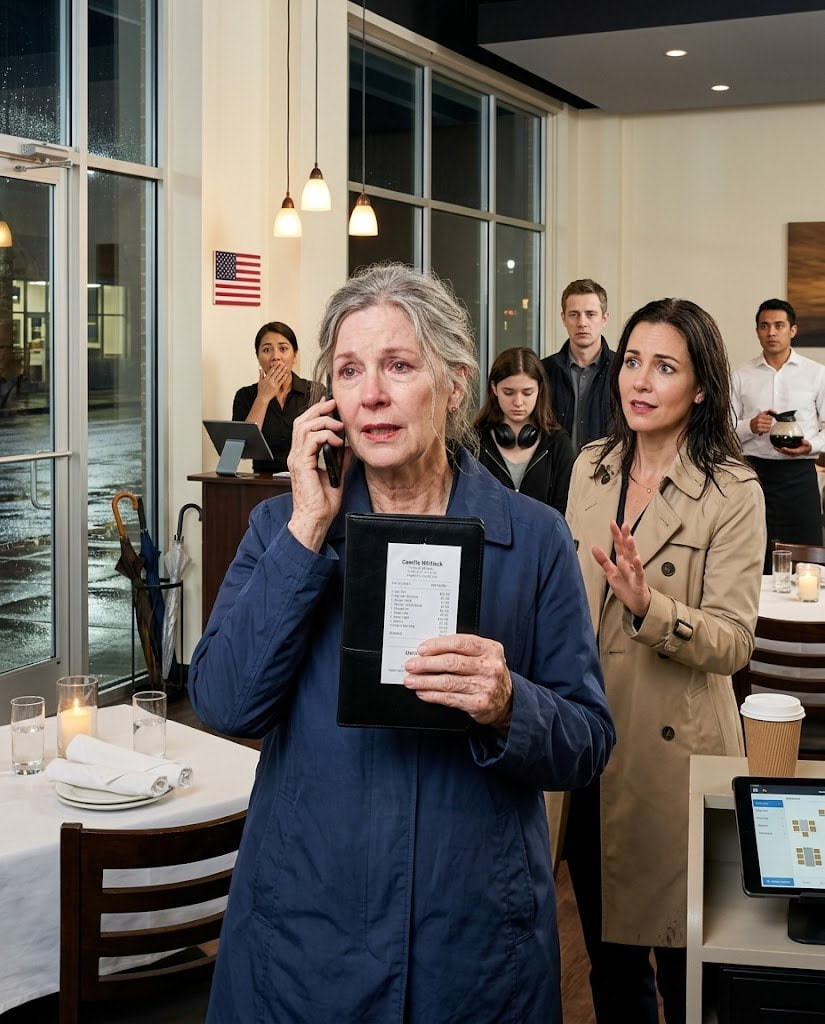
Camille Whitlock did not arrive at Callaway’s looking for a fight. She arrived with a birthday card in her purse, her navy coat buttoned wrong, and a bus transfer folded inside her glove.
The restaurant smelled like butter, coffee, and rain-wet wool from coats hung near the front. Candlelight flickered on polished glasses. It was the kind of place her husband Forest once saved for anniversaries.
Her daughter Sabine had texted at 4:12 that afternoon, saying Reagan had been promoted and they wanted to celebrate as a family. Camille read the message twice before answering yes.
Those words still had power over her. As a family. They reached places ordinary apologies could not reach, especially after two years of widowhood and too many quiet dinners alone.
When Camille gave the hostess her name, the young woman checked the tablet and hesitated. The reservation was under Whitlock, but it was listed as a party of three.
Camille looked across the room and saw Sabine already seated with Reagan and Iris. Sabine lifted one hand in recognition, cheerful enough to look innocent from a distance.
She did not stand. She did not point to an empty chair. She did not say, “Mom, over here.” That silence told Camille everything before the evening even began.
The hostess, Denise, offered to ask whether they wanted Camille added to the table. Camille almost said yes. Pride and hurt rose together, sharp as a swallow of hot coffee.
Instead, she said a small table would be fine. Denise led her to the window, where rain blurred the headlights outside and the candle made her hands look older than they were.
Camille ordered soup because it was the least embarrassing thing on the menu. She opened her paperback and read the same paragraph until the words stopped meaning anything.
At table fourteen, Reagan laughed too loudly. Sabine leaned toward him with the pleased expression she wore around men who made money sound like character. Iris kept her headphones around her neck.
Camille had helped raise Iris through fevers, school projects, and afternoons when Sabine worked late. That girl had once fallen asleep on Camille’s sofa under Forest’s old quilt.
Now Iris kept glancing at her grandmother as if she had been told not to look too long. Children know the shape of adult cruelty before they know what to call it.
Halfway through the meal, Marco the waiter brought Camille a slice of dark chocolate cake. He said her family had asked him to bring her a treat.
Camille looked over. Sabine lifted her glass from across the room. Reagan kept his attention on the server pouring wine. Iris touched the edge of her headphones and looked away.
The cake was rich, dark, and cold at the center. Camille took three bites because refusing it would have made Marco feel responsible for something he did not do.
For nearly two hours, she sat alone beside the window while the table across the room ordered as though money had stopped mattering. Caviar, wagyu, wine pairings, and the theatrical little desserts restaurants serve under silver lids.
Camille was not poor, but she had learned the difference between having assets and having cash. The house on Greer Street was valuable. Her monthly life was careful.
Forest had understood that difference. Before he died, he told her to hold the house, not because brick and shingles mattered, but because leverage mattered.
They bought the Greer Street ranch in 1979. It had two old oaks, a cracked driveway, a green mailbox, and a front porch Forest repainted every spring.
Sabine learned to ride a bike in that driveway. Iris planted marigolds by the porch. Forest came home from the hospital there for the last time.
After the funeral, Sabine’s concern arrived in helpful packages. She helped sort papers, carried boxes from Forest’s office, and offered to handle “the complicated stuff” when Camille looked overwhelmed.
That winter, Sabine held Forest’s old American Express card between two fingers and said Camille did not have to handle every little thing alone. Camille believed she meant kindness.
Grief makes some people generous. It makes others visible. Camille did not understand which one Sabine was until Callaway’s placed the black check folder beside her coffee cup.
At 8:33, Marco approached with the careful expression of a man carrying bad news on someone else’s behalf. The party at table fourteen had said Camille would settle the check.
Camille looked across the room. The table was empty. Three water glasses remained, along with a bread basket torn open and linen napkins folded into little white flags of escape.
The bill was $3,418. Near the bottom was the slice of chocolate cake sent to Camille’s lonely window table. Fourteen dollars, listed neatly with everything else.
They had included her on the bill. Not at the table. That sentence would stay with Camille longer than the number itself, because it named the whole evening.
She could have shouted. She could have walked out. She could have let the restaurant chase Sabine and Reagan, although that would have punished staff who had only done their jobs.
For one ugly heartbeat, Camille wanted the whole dining room to turn and see what her daughter had become. Then Forest’s voice came back, calm and stubborn.
Hold the house. Hold it tight.
Camille asked Marco for fresh black coffee and asked whether Denise could come over. Her voice stayed even, which made both employees listen more closely.
When Denise arrived, Camille explained that she would pay and that Marco would be tipped properly. Then she asked for the reservation details, including the booking name, time, and card on file.
Denise checked the tablet. The reservation had been made online at 3:47 p.m. by Sabine Whitlock Granger for a party of three.
The card on file ended in 7042. Camille recognized the digits before her mind finished forming the thought. Forest’s old American Express. Cancelled two years earlier.
Denise explained that the card had declined during pre-authorization. Sabine told them Camille was on her way and would settle in person. She made it sound arranged.
Not a misunderstanding. Not a rushed dinner. Not a daughter assuming too much. A plan with a timestamp, a declined card note, and an audience.
Camille paid the bill. She added a full tip because dignity should never be financed by humiliating someone else. Then she asked Denise to email the itemized receipt and reservation log.
At 8:47, the receipt reached Camille’s inbox. At 8:51, she forwarded it to herself and to Martha, the realtor handling Greer Street.
The house had not been officially listed yet. Sabine and Reagan had been trying to buy it first, below market, with a family-friendly closing timeline and a vague promise to “take care of Mom later.”
Camille had nearly agreed. Iris loved that house. Sabine said the school commute would be easier. Reagan said the promotion would make the payments manageable soon.
The offer packet was in Camille’s purse, folded beside the old county property record and the unsigned listing agreement. She had brought it to review after dinner.
That was the part Sabine did not know. Camille had come prepared to say yes. Not because the offer was fair, but because mothers are trained to confuse sacrifice with proof of love.
She stepped under the restaurant awning and called Martha. Rain tapped the sidewalk. Cars hissed past. Through the glass, Denise watched from the hostess stand.
“Martha,” Camille said, “take the Greer Street house off the table. Tonight.”
Martha did not argue. Good realtors hear decisions in the spaces between words. She only asked if Camille was certain.
Before Camille could answer, Sabine texted from the parking lot. Mom, don’t embarrass us over dinner when you know we’re about to be under contract.
That message was worse than anger. It revealed assumption. Sabine had not hoped for Camille’s help. She had already spent it in her mind.
Then Martha mentioned one more document. Reagan’s lender had attached a draft gift letter at 5:09 p.m., stating Camille intended to credit them money at closing as family assistance.
Camille closed her eyes. Her name was typed at the bottom. It was not signed or notarized, but it was there, placed like consent waiting to be harvested.
Denise had stepped closer by then, pretending to straighten menus. Marco stood near the coffee station with the pot in his hand. Both saw Camille’s face change.
The front doors opened. Sabine came in first, her hair damp from the rain. Reagan followed with Iris beside him, the girl’s face tight with the shame of being trapped between adults.
Sabine saw the phone. She saw the folder. Then she smiled, thin and controlled, the way she did when she wanted witnesses to think she was the reasonable one.
“Mom,” Sabine said, “please don’t make this ugly.”
Camille looked at her daughter and thought of Forest’s card, the cake, the declined pre-authorization, and the typed gift letter. Ugly had already been made. She had only discovered it.
Martha’s voice came through the phone. “Camille, tell me yes or no. Do I withdraw the Greer Street offer package?”
Camille kept her eyes on Sabine. “Yes,” she said. “Withdraw it.”
For a moment, nobody moved. The hostess tablet glowed on the stand. Rainwater dripped from Reagan’s sleeve. Iris stared at the floor as if the pattern in the tile could rescue her.
Sabine’s face changed first. Not fully. Just enough for Camille to see the fear beneath the polish. “You can’t do that,” she said.
“I can,” Camille replied. “It is still my house.”
Reagan finally spoke. His voice had lost its promotion-night shine. “Camille, this is a misunderstanding.”
Denise looked down at the tablet. Marco looked at the receipt in Camille’s hand. Even strangers understood what that word was trying to cover.
Camille did not argue in the doorway. She thanked Denise, asked that all documents be preserved, and walked to the curb to wait for a rideshare Martha insisted on calling.
Sabine followed her outside, whispering fast. She mentioned Iris, school, family, Forest, and how hard things had been since the promotion process began. Every word reached for a different handle.
Camille listened without offering one. When Sabine said, “Dad would have wanted us to have that house,” Camille finally turned.
“Your father wanted me protected,” she said. “That is different.”
Iris began crying then, silently, with her headphones still around her neck. Camille did not blame her. Children inherit the weather adults create.
Reagan and Sabine left before the rideshare arrived. Camille stood under the awning with Denise beside her until the car pulled up. Neither woman spoke for almost a full minute.
The next morning, Martha formally withdrew the family offer in writing. She documented the time, saved the lender attachment, and advised Camille to keep every message.
Camille did. She created a folder on her laptop labeled Greer Street. Receipt. Reservation log. Declined card note. Gift-letter draft. Text messages. Every piece had a date.
She also called the number on the back of Forest’s old statements and confirmed in writing that the card had been cancelled two years earlier. That confirmation went into the folder too.
Sabine called seventeen times that weekend. Reagan called four. Camille answered none of them until Monday, when she asked for all future discussions about the house to go through Martha.
That sentence broke something. It also saved something.
The house went on the open market three weeks later. Camille did not choose a buyer to punish Sabine. She chose the cleanest offer with verified funds, standard inspection terms, and no family pressure disguised as love.
At closing, Camille signed her name slowly. The title company employee slid each page across the table, and Camille read before signing because Forest had taught her that paper remembers what people deny.
Part of the proceeds went into a conservative account her financial adviser explained twice. Part paid for a smaller condo with no cracked driveway and no rooms that echoed quite so loudly.
She kept the green mailbox. The buyer let her take it after hearing Forest had painted it every spring. It now sits in Camille’s condo entryway, holding umbrellas.
Sabine did not attend the move. Iris did. She arrived with grocery-store flowers and a small apology she could barely get through.
“I didn’t know about the bill,” Iris said. “I knew they were mad you had your own table. I didn’t know they left it for you.”
Camille believed her. She hugged the girl longer than either expected and told her that loving someone never requires helping them lie.
Months later, Sabine sent a letter. It was not perfect. It contained excuses, embarrassment, and one line that sounded almost honest: I thought you would rather pay than make a scene.
Camille folded the letter and placed it in the Greer Street folder, not because she wanted evidence forever, but because she had learned not to let pain float around without a name.
She did not stop being Sabine’s mother. She stopped being Sabine’s emergency fund, silent witness, and convenient signature.
That was the real inheritance Forest left her. Not the brick ranch. Not the oak trees. Not even the rising value of a house bought decades earlier.
He left her the last clear warning of a man who knew the difference between family and leverage.
Years of motherhood had taught Camille to make room. That dinner taught her to draw a line. The cake, the bill, the old card, the typed gift letter—all of it pointed to the same truth.
They had included her on the bill. Not at the table.
So Camille built a new table. Smaller, quieter, steadier. And everyone who sat there after that understood one rule before the coffee was poured.
Kindness was welcome. Entitlement was not.