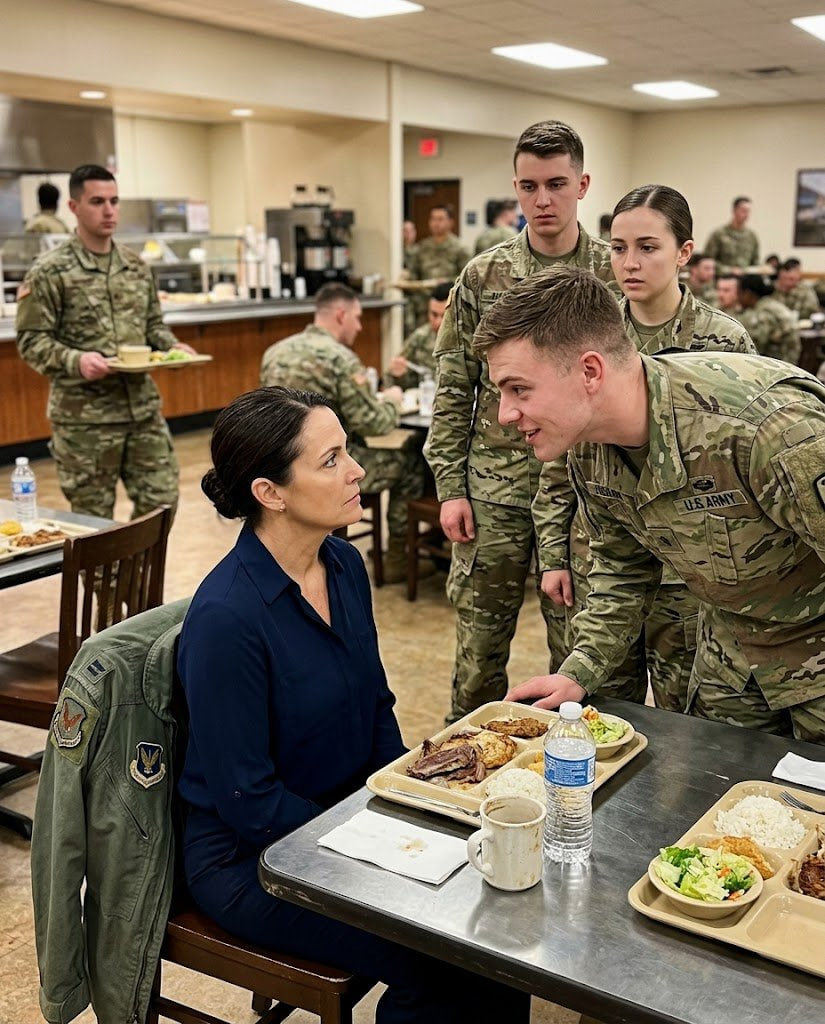
The dining hall carried the usual midday noise—trays sliding over rails, chairs dragging across polished floors, boots landing in hard, efficient rhythms, the sharp smell of coffee mixing with grilled meat and fresh bread.
It was the kind of lunch hour people forgot before the day was over.
That was what made the silence so noticeable when it came.
Captain Evan Davis noticed the woman long before he spoke to her.
In a room full of flight suits and pressed uniforms, she stood out in a deep-blue blouse, dark slacks, and the kind of calm posture that could read as confidence or defiance depending on who was looking.
Davis decided almost immediately which one he preferred.
She had taken her tray without hesitation, scanned the room once, and chosen a seat with her back angled toward the wall and a clear view of both exits.
To people who had spent time around operational crews, that choice meant something.
To Davis, it simply looked practiced enough to be annoying.
He was thirty-three, sharp-featured, articulate, and already being talked about as a future squadron commander.
He liked order.
He liked standards.
Most of all, he liked being the person who enforced them.
Around junior officers, that habit had hardened into performance.
He had learned that if he sounded certain enough, people often confused certainty with competence.
The woman gave him no opening except her presence.
That was enough.
Across the back of her chair hung a worn sage-green field jacket.
The patch on the chest was faded with age and use, showing a dark silhouette cut through by a broken line.
A black-stitched name tape sat beneath it.
Davis noticed none of that.
What he noticed was the blouse, the lack of visible rank, and the quiet way she seemed entirely unbothered by the room around her.
He gave her six minutes, then walked over with two junior officers trailing him.
He stopped at her table and smiled.
That was the first mistake.
The smile made the question sound casual when it wasn’t.
‘Ma’am, with all due respect… what was your call sign?’
She looked up from her lunch with the patience of someone interrupted often and impressed rarely.
‘Excuse me?’
His smile widened a little, encouraged by the attention beginning to shift toward them.
‘Your call sign,’ he repeated.
‘You’re sitting in a flight unit dining hall.
Everyone here has one.
Or are you just here to hear the stories?’
One junior officer let out a small laugh.
The other stared at his tray as if he already regretted being there.
The woman placed her fork down carefully.
‘I don’t believe we’ve met.’
‘Captain Davis.
Operations officer.
I track who comes and goes around here, and I don’t remember your name on today’s movement list.’
The words sounded procedural.
The tone did not.
This was not about security.
This was about making her explain herself publicly.
She glanced once at the jacket behind her, then back at him.
‘I’m not here for the briefing.’
That should have ended it.
Instead, Davis leaned in.
‘Then I’ll need to see credentials.’
Her identification was in the jacket.
She could have ended the exchange in two seconds.
But something in his tone—more than suspicion, less than outright contempt, exactly the kind of polished condescension
women in aviation learned to recognize before anyone else did—made her pause.
She had heard versions of it for years.
In training rooms.
In ready tents.
In briefing spaces where men mistook familiarity for authority.
It was rarely loud.
That was the problem.
Quiet arrogance survived longer than open hostility because it could always pretend to be professionalism.
‘My credentials are in my jacket,’ she said.
‘I’m trying to finish my lunch.’
To Davis, refusal to perform on command felt like challenge.
He pushed his chair back so sharply the legs scraped across the floor.
‘The jacket with that old patch?’ he asked.
‘I’m going to need you to come with me so we can verify who you are and what you’re doing here.’
One of the junior officers shifted.
‘Sir, maybe we should—’
‘Enough.’
The woman finally looked at him fully.
At the crisp uniform.
At the rigid posture.
At the confidence of someone who had not yet learned how dangerous it was to underestimate people in operational spaces.
‘Officer,’ she said, and her voice changed just enough that nearby tables felt it immediately, ‘you have two choices.
You can sit back down and finish your meal… or you can continue.’
Davis blinked.
She held his gaze.
‘If you choose to continue, this will not end well for your career.’
He laughed, but the sound came late and landed badly.
‘Is that a threat?’
She took a sip of water.
‘No.
It’s a prediction.’
At a nearby table, a silver-haired advisor named Tom Hale stopped eating.
He had noticed the woman when she entered, though not for the reasons Davis had.
He noticed how she moved, how she scanned, how she never once seemed unsure of the room.
Now his eyes dropped to the jacket, to the faded patch, to the broken line.
He went still.
Then he rose so fast his chair rocked backward and strode out of the dining hall without a word.
Davis mistook that, too.
He thought Hale was going to fetch support.
He folded his arms.
‘Last chance, ma’am.’
The woman glanced at her interrupted tray, then back at him.
‘Do you know the difference between a security check and a public display?’
His jaw tightened.
‘I know when someone avoids answering a direct question.’
‘No,’ she said quietly.
‘You know when someone refuses to hand you a stage.’
That line changed the air.
Even the junior officers felt it.
Davis did too, but pride had already taken over.
‘Fine.
Name.
Unit.
Call sign.’
She lifted the jacket from the chair and laid it across her lap.
In the brighter light, the faded patch came alive.
The broken line was not decoration.
It looked like a fracture through darkness.
The name tape beneath it read KNOX.
He saw the name and still did not understand what he was seeing.
She brushed one thumb along the edge of the patch.
‘People used to call me different things.
Some respectful.
Some not.’
A few older faces in the hall had already gone rigid.
Davis forced a thin smile.
‘Let’s hear the one that stuck.’
She met his eyes.
‘Valkyrie.’
The effect was instant.
A spoon hit the floor.
Someone at the far wall whispered, ‘No way.’ One of the junior officers beside Davis went pale.
Davis
knew the name.
Not from personal experience, but from case studies and training binders.
From one of those missions instructors always referenced when weather, fuel, bad intelligence, and impossible timing collided.
Valkyrie was not just a call sign.
Around that wing, it had become shorthand for impossible judgment under pressure.
He looked from the patch to her face and back again as the pieces locked together too late.
Sierra Knox.
The woman in the blue blouse.
The pilot behind the case study.
The officer whose decision-making had been dissected in classrooms by people who had never sat in her seat.
He opened his mouth.
Nothing came out.
Before he could recover, the dining hall doors swung open.
Hale returned with Wing Commander Colonel Nathan Mercer, Command Chief Elena Ruiz, and a civilian deputy from headquarters.
Mercer crossed the room fast, but the moment he saw Sierra Knox standing beside her table and Davis in front of her, he slowed.
He took in the untouched tray.
The field jacket.
The dead-silent room.
Then he straightened and said, very carefully, ‘Colonel Knox.
I was told you arrived early.’
A chair tipped over somewhere behind Davis.
Sierra stood.
She was not physically imposing, but the calm in her posture made everyone else look hurried.
‘I decided to eat first,’ she said.
‘It was informative.’
Nobody missed that word.
Davis tried to speak.
‘Sir, I was only—’
Sierra raised one hand and he stopped.
Not because she touched him.
Because in that moment even he understood the room no longer belonged to him.
She reached into the inner pocket of her jacket and removed a dark credential wallet.
Mercer opened it.
Inside, above a recent photo and official seals, were the words Davis should have feared far more than a famous call sign: Sierra Knox, Lead Evaluator, Joint Aviation Readiness Review.
She was not there as a guest.
She was there to judge the entire wing.
The formal meeting started twenty minutes later in the conference room Davis had expected her to enter from the beginning.
Mercer sat at the head of the table.
Ruiz sat to his right.
Hale remained by the wall, arms crossed.
Davis was invited in last.
Sierra Knox did not raise her voice.
That was one of the things that made her difficult to argue with.
Loud people created emotional cover for everyone else.
Calm people removed it.
‘Explain your rationale,’ she said.
Davis swallowed.
‘Unknown individual in a restricted environment.
No visible rank.
Nonstandard attire.
I believed intervention was appropriate.’
‘Intervention,’ she repeated.
‘Or performance?’
He hesitated.
‘I was following security protocol.’
Ruiz slid a folder across the table.
‘Security protocol required quiet verification through access control, front desk confirmation, or escort coordination.
Her clearance was already logged.
You did not check any of those before confronting her in a public space.’
Davis looked at the folder but did not reach for it.
Sierra leaned back slightly.
‘Why did you ignore the name tape?’
‘I didn’t see it.’
‘Why?’
He had no good answer.
Because the truthful one sounded worse than silence.
Because he saw the blouse first.
Because he saw a woman without visible rank and decided the rest of the evidence was unnecessary.
Mercer’s face had gone tight with embarrassment.
Sierra did not rescue him either.
‘Let me save you time,’ she said.
‘You ignored the patch, the name, and the possibility that someone might belong there in a form you didn’t expect.
Then you turned a routine verification into a public spectacle.
Real professionals verify quietly.
People who care about security do not turn it into theater.’
Davis tried one last defense.
‘I didn’t know who you were.’
Sierra nodded once.
‘Exactly.’
The room held that answer for a second.
Then she continued.
‘And that should not have changed the respect you showed me.’
Hale shifted against the wall.
‘He asked you for your call sign,’ he said, still sounding offended on her behalf.
Sierra gave the faintest shrug.
‘The call sign wasn’t the problem.’
She looked back at Davis.
‘The problem was that you needed an audience.’
That line stayed in the room longer than anything else.
Mercer rubbed a hand across his mouth.
‘We’ve had minor complaints,’ he admitted at last.
‘Nothing formal enough to trigger review action.
A few remarks from visiting engineers.
One woman pilot who said she was challenged more often than her peers.
I assumed it was isolated.’
Ruiz answered before Sierra could.
‘It’s never isolated when everyone else already knows how to go quiet around it.’
Over the next two days, Sierra conducted the review she had come to perform.
She met with pilots, maintainers, administrative staff, visiting contractors, and junior officers.
Patterns surfaced quickly.
A civilian avionics specialist had been mistaken for an assistant three separate times.
Lieutenant Mara Ellis, one of the unit’s strongest young pilots, admitted she had lost count of how often people asked whether she was in the wrong room before ever reading her badge.
None of it, standing alone, seemed catastrophic.
Together, it revealed a culture problem no metrics sheet had captured.
Davis was not the only source of it, but he amplified it.
He set a tone.
Younger officers watched him and learned what kind of behavior would be laughed off, excused, or mistaken for standards.
On the second afternoon, Hale finally told the younger officers why the patch had hit him the way it did.
Years earlier, he had been a crew chief on a rescue mission that went bad in mountain weather.
Another aircraft had gone down.
Visibility collapsed.
Fuel numbers were ugly.
Two crews had aborted.
Knox flew in anyway, not recklessly, not theatrically, but with the cold precision of someone who could feel fear and still think through it.
She brought the aircraft into a hover over broken terrain while everyone on the radios sounded one breath away from panic.
The call sign Valkyrie had stuck after that mission, not because she was fearless, but because she had sounded calmer than everyone else when calm was the only thing keeping people alive.
Davis had studied that mission during his training.
Like many younger officers, he had built a picture in his head of what that kind of person would look like.
He had imagined someone larger.
Louder.
More immediately recognizable.
More like the legends men preferred when they told each other stories.
He had never imagined a woman in a blue blouse eating lunch in peace.
When Sierra met with him privately on the last day of the review, he looked like a different man from the
one who had approached her table.
Not broken.
Not humbled enough to become noble overnight.
But stripped of his easy certainty.
‘I was trying to maintain standards,’ he said.
She held his gaze.
‘No.
You were trying to display them.’
He looked down.
She continued, not unkindly.
‘A proper security check is quiet, efficient, and boring.
You did not ask for support.
You did not verify through channels.
You did not read the evidence directly in front of you.
You wanted the room to see you control it.’
He exhaled slowly.
‘When you said Valkyrie, I knew the name.’
‘That should have been irrelevant.’
He flinched because she was right.
Sierra folded her hands on the table.
‘You were not wrong to verify an unknown person.
You were wrong in almost every choice you made after that thought entered your head.
Understand the difference.
It matters.’
He was quiet for several seconds before asking the question he had probably been holding since the dining hall.
‘Is my career over?’
She did not answer immediately.
‘That depends on whether this becomes the worst moment you learn from,’ she said, ‘or the first one you resent.’
The final review was blunt.
Davis was removed from supervisory duties for ninety days, given a formal letter of counseling, required to complete leadership remediation under Ruiz, and lost his recommendation for the promotion board that cycle.
Mercer accepted broader corrective actions across the wing: revised visitor and access procedures, culture review sessions, anonymous reporting channels, and direct climate follow-ups with female aircrew and civilian specialists.
Some thought Davis got off lightly.
Some thought Sierra had spared him only because she had seen too many talented people waste themselves out of pride.
Maybe both were true.
What was undeniable was that the room changed after that week.
Lieutenant Ellis later told Sierra that the most important part had not been Davis getting corrected.
It was hearing someone name the real issue out loud.
Not rank.
Not protocol.
Not a misunderstanding.
The hunger for a public stage.
Before Sierra left the base, Ellis caught her near the hangar and thanked her.
Sierra adjusted the strap of her bag and glanced toward the aircraft line, where crews were moving through late-day checks in gold light.
‘You shouldn’t need a legend to make people listen,’ Ellis said.
Sierra gave a tired half-smile.
‘No,’ she said.
‘But sometimes a legend is just a person who got tired of being interrupted and stayed in the room long enough to prove everybody wrong.’
Davis approached her once more that evening near the flight line.
No audience this time.
No junior officers.
No posture borrowed from performance.
‘I owe you an apology,’ he said.
‘Not because of your name.
Because of how I acted before I knew it.’
She studied him for a moment, deciding whether the words had weight.
Then she nodded.
‘That’s the first correct thing you’ve said to me.’
He accepted that.
After a second, she added, ‘The biggest problem wasn’t that you asked for credentials.
It was that you wanted witnesses.
The moment you need an audience for your authority, you’ve already lost part of it.’
He looked out at the runway lights beginning to glow in the distance.
‘I understand that now.’
She did not tell him he
was forgiven.
Some lessons had to survive without comfort.
Mercer met her at the car a few minutes later and asked the question he had been carrying since the review began.
‘Are we still eligible for the tasking?’
Sierra looked back once at the hangars, the crews, the movement of people who did real work whether leaders deserved them or not.
‘Yes,’ she said.
‘You have the skill.
Now make sure the culture deserves the mission too.’
Months later, people on base still remembered the lunch in the dining hall.
Some remembered the famous call sign.
Some remembered how fast Hale had moved when he saw the patch.
But the part that lingered longest was simpler than that.
A young officer had looked at a woman and decided he already knew what she was not.
Everything that followed came from that first bad assumption.
Whether Davis deserved forgiveness depended on what mattered more to a person: the apology he offered later, or the instinct he showed when he believed no one important was watching.
For some, the correction was enough.
For others, the red flag had been too clear to ignore.
But everyone agreed on one thing.
In aviation, the most dangerous arrogance is not always in the cockpit.
Sometimes it starts at a lunch table, in a room full of witnesses, the moment someone mistakes control for judgment and forgets that the sky has never cared who thinks they own it.