My sister used my house for her big career celebration while I was out of town. When I saw nearly a hundred strangers inside, I told her to shut it down immediately. She laughed and said, “This night isn’t about you.” I made one quiet call instead of arguing. And soon, everyone at that party was staring at her for a very different reason.
I was in Seattle for a three-day leadership conference, the kind of trip that looked polished from the outside and felt exhausting from the inside. I had spent the day in a ballroom with fluorescent lights, lukewarm coffee, and panelists using words like synergy and transformation as if anyone in the room still believed those words meant something. By the time I got back to my hotel that evening, all I wanted was a shower, silence, and maybe ten uninterrupted minutes where no one needed anything from me.
Instead, my phone started buzzing.
At first I ignored it. Then I looked down and saw a string of motion alerts from my front door camera in Austin. One alert was normal. Two was mildly annoying. Ten in less than five minutes made my stomach tighten.
I opened the app.
My street was full.
Cars were lined up bumper to bumper along both curbs. A rideshare dropped off two women in cocktail dresses carrying a wrapped gift and a bouquet. A man in a white shirt and vest walked up my path with a metal tub full of ice balanced against his hip. Someone else carried in three cases of sparkling water. Warm lights had been draped over my backyard fence. I watched a bartender unloading bottles beneath the oak tree my husband had planted the year we bought the house.
For a few seconds, my brain simply refused to process what I was seeing.
Then Madison stepped into view.
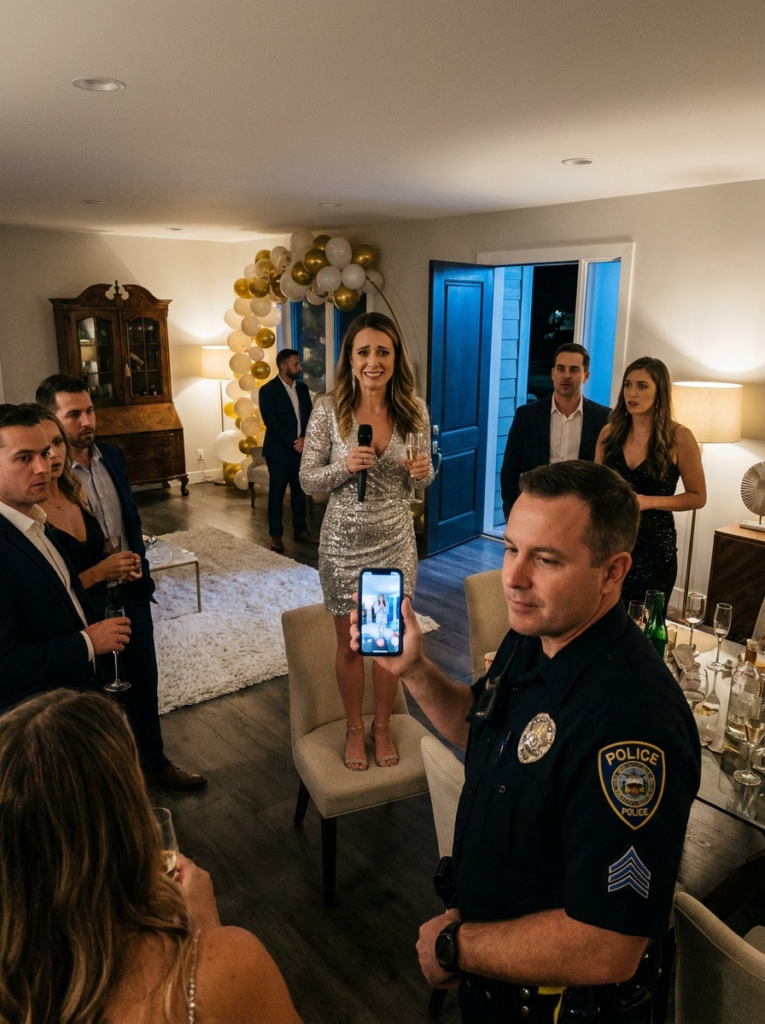
My younger sister was wearing a silver dress that caught the porch light every time she moved. She looked radiant, practiced, completely at home. She was laughing with a woman I didn’t know, holding a champagne flute in one hand while gesturing toward my front entry with the other. Behind her, tied between the columns of my porch, was a giant balloon arch in gold and white.
It read: Congratulations, Madison — Regional Director.
My mouth went dry.
I called her immediately.
She answered on the fourth ring, already laughing. Music pounded behind her.
“Ava, hey,” she said. “I was going to tell you.”
“Tell me what?” I asked. “That you’re in my house?”
She let out the sigh she always used when she wanted to cast herself as the reasonable one. “Don’t be dramatic. Mom gave me the spare key. My place is too small, and this is important. It’s one night.”
I stared at my own foyer on the screen while strangers I had never met crossed over the runner rug my husband and I had picked together after months of arguing over color. “My house is not available,” I said. “End it now.”
“This night isn’t about you,” Madison replied, bright and careless. “I’m not stopping for anyone.”
Then somebody in the background shouted, “Speech!”
I switched cameras and saw a man leaning his elbow against the antique cabinet my husband had restored by hand before he died. Another guest drifted through my living room carrying a red drink over my white rug. Two women stood at my piano taking selfies. Someone else had already put gift bags on the dining table my father built.
That was the moment something in me stopped shaking and went still.
I had spent years trying to explain Madison to people who only ever saw the polished version of her. To coworkers, she was magnetic. To acquaintances, she was ambitious and funny and a little blunt in a way people often mistook for confidence. To our mother, she was the child who reached. The one destined for bigger things. The one whose messes were always just temporary side effects of a successful personality.
To me, Madison was a person who had spent our entire lives treating my boundaries like decorative suggestions.
She borrowed clothes without asking and returned them stretched or stained. She borrowed money and forgot exact amounts. She once used my name on a volunteer list because, in her words, people trusted me more quickly and it helped open doors. When I complained, my mother rolled her eyes and said I needed thicker skin. Madison was intense, she said. Sensitive people always misunderstood confident ones.
When my husband Ben got sick, Madison showed up exactly twice. The first time, she cried harder than I did and somehow made me comfort her. The second time, she stood in my kitchen and asked whether I planned to keep the house if things got worse, because a property like mine would be “such a blessing” for family gatherings.
Ben heard her.
He said nothing until she left. Then he looked at me from his chair by the window and said quietly, “Your sister doesn’t enter rooms. She occupies them.”
He was right.
After he died, that house became the only place in my life where I felt like I could still hear the shape of our marriage. His books were still on the study shelves. The cabinet he restored stood in the living room. The oak tree he planted threw shade over the yard in the late afternoon exactly the way he said it would. Every repair I made, every room I painted, every object I kept was deliberate. It wasn’t a showroom. It was the one place I did not have to negotiate my grief.
And Madison had turned it into a stage.
I should say this clearly: she knew what the house meant to me. She knew better than anyone.
That was what made it unforgivable.
I thought about calling my mother. Then I imagined the conversation before it happened.
Don’t overreact.
It’s your sister.
It’s an important night for her.
Can’t you just let her have this one thing?
There was always one thing. One occasion. One reason her behavior had to be excused because confronting it would be less convenient than absorbing it.
So I didn’t call Mom.
I called my neighbor instead.
Graham Patel lived next door. He was an Austin police sergeant, though that night he was technically off duty. He had my emergency number because he’d watched my house more than once when I traveled for work. He was not a close friend in the sentimental sense, but he was dependable, observant, and one of the few people I trusted to take a problem seriously without turning it into theater.
He answered on the second ring.
“Patel.”
“Graham,” I said, forcing my voice level. “There are trespassers in my house.”
There was a short pause. “You’re not home?”
“Seattle. I’m watching the camera feed right now. My sister used a key without permission. There are close to a hundred people there. They’re inside, in the backyard, upstairs. I want them removed.”
His tone changed just enough to tell me he understood the difference between a family dispute and a legal problem. “Stay on your camera. Do not contact them again.”
I watched from my hotel room as he entered my front gate ten minutes later with two uniformed officers.
The shift in the party was immediate.
At first, only the guests near the entrance noticed. Then heads turned in a ripple through the living room and out into the backyard. Music kept playing for three awkward seconds before somebody cut it. Madison, who had climbed onto one of my dining chairs with a microphone for a toast, froze with her champagne glass midair.
Even from a silent camera feed, I could read her body language. The quick smile. The half shrug. The little lift of the chin that said she planned to charm her way through this.
She climbed down and walked toward Graham with the expression she used on waitstaff and receptionists when she wanted to imply she was above inconvenience.
I couldn’t hear every word through the app, but I heard enough when they moved closer to the hallway camera.
“This is a misunderstanding,” Madison said. “It’s my sister’s house. I have access.”
“Do you have permission to host this event here tonight?” Graham asked.
“I have family permission.”
“From the homeowner?”
Her pause was small, but deadly.
“She’s upset,” Madison said. “She overreacts.”
Graham held up his phone, showing the screen to one of the officers. I knew exactly what he was displaying: my live confirmation that I had not authorized anyone to be there. Madison’s face changed. Not dramatically. Just enough for the performance to slip.
A silver-haired man in a navy suit stepped forward from the crowd.
I recognized him immediately from Madison’s company posts. Harold Vance, division vice president. The man who had apparently flown in from Dallas to celebrate her promotion.
“Is there a problem?” he asked.
Madison moved toward him too quickly. “No, no. Tiny family issue. My sister is very emotional.”
The words hit me like ice water.
Very emotional.
I had heard that phrase my entire life. Whenever I objected, I was emotional. Whenever Madison lied, she was resourceful. Whenever I drew a line, I was difficult. Whenever she crossed one, she was driven.
One of the officers headed toward the backyard bar. Another looked at the staircase and told the guests upstairs to come down. People began collecting purses and jackets with the tight-faced urgency of those realizing they may have been invited into something illegal.
Then the officer by the entry table picked up a printed welcome sign.
I leaned closer to my phone.
It was one of those foam-board displays mounted on an easel. At the top, in scripted gold letters, it said: Welcome to Madison Lane’s Regional Director Celebration. Beneath that, in smaller print, were company logos.
And under those logos, one line that changed everything.
Hosted at the private residence of Senior Partner Ava Lane.
I stared.
Then I laughed once. A hard, disbelieving sound that startled even me.
She had used my name.
Not just socially. Not casually. She had used it to lend legitimacy to the event.
Harold Vance read the sign, then looked at Madison with a stillness that made the room feel colder even through a camera. “Senior Partner?” he said.
Madison smiled too fast. “That’s just family shorthand. Ava does consulting.”
I knew what he was hearing, because I knew the company she worked for. Madison sold regional commercial real estate services. I had done outside branding work for one of their competitors years earlier, enough to know they cared obsessively about optics, approval chains, and client perception. A vice president attending an event hosted at a supposed private residence of a supposed senior partner was not a small detail. It suggested corporate endorsement. It implied business relationships that did not exist.
The officer near the bar said something to the bartender, who immediately stopped pouring. He then asked for permits. The bartender looked at Madison. One of the servers near the kitchen went pale.
Madison began talking faster.
“I hired them. It’s fine. It’s all covered.”
“Covered by whom?” Graham asked.
She didn’t answer directly. Instead she tried to redirect, asking whether this really needed to happen in front of her guests. It was an old tactic. If she could turn accountability into embarrassment, she could usually push people into retreat.
It didn’t work on Graham.
“These guests were invited to a residence without the owner’s consent,” he said. “That’s the issue in front of your guests.”
The crowd was quiet enough now that half the room could hear him.
Harold Vance looked from the sign to the balloon arch to Madison. His expression had gone from confusion to calculation. “Did you tell people this was your residence?” he asked.
Madison swallowed. “I said it was family property.”
“Did you tell the event team your sister approved this?”
She hesitated.
That was answer enough.
One of the women near the staircase muttered, “Oh my God.”
A man in a blazer pulled his wife gently toward the door. Another guest took a photo down from her social media story the second she realized what was happening. The room didn’t feel festive anymore. It felt like a set after the lights failed.
Then my phone rang.
It was my mother.
Of course it was.
I answered.
“What have you done?” she whispered furiously. There was enough background noise for me to know she was already at the party or pulling up outside.
“What have I done?” I repeated.
“You called the police on your sister over a celebration?”
“I reported trespassers in my house,” I said. “Which is exactly what they are.”
“You’re humiliating her.”
I looked at my screen, where Madison was trying and failing to keep her smile in place while her boss questioned her in front of everyone who mattered to her. “No,” I said. “She did that herself.”
Mom changed tactics instantly, the way she always did when outrage failed. Her voice softened. “Ava, sweetheart, just tell them it’s fine. For me. Let her have this. We can sort the rest out later.”
That was the sentence that finally burned through whatever loyalty I had left to the family version of reality.
Later.
Always later. My feelings later. My house later. My marriage later. My grief later. My boundaries later. Madison now.
“No,” I said. “Not later. Not this time.”
I hung up.
A few minutes after that, Graham called me back and switched to audio. “I need your verbal statement on record,” he said.
I gave it. Calmly. Clearly. I stated that I was the sole owner of the property. That no one had my permission to enter or host an event. That the key used had been accessed without my consent. That I wanted every non-authorized person removed.
He thanked me and disconnected.
Through the camera, I watched the dismantling begin.
The bartender packed bottles into crates. Servers stacked trays with trembling hands. Guests filed out with the strained politeness people use when pretending they were never fully part of a disaster. The balloon arch sagged on one side after someone brushed against it. A woman carrying a gift asked where to leave it, and nobody answered.
Harold Vance remained.
He stepped aside with Madison near the front windows, where the porch camera caught enough of their expressions for me to understand the conversation even without every word. He asked sharp questions. She answered too quickly, then too slowly. At one point, she gestured toward my house as if the size of it alone justified what she had done. He looked unimpressed.
Finally he said something that made her face go white.
He left without taking the champagne gift basket someone had clearly prepared for him.
My mother arrived just in time to see the tail end of the collapse. She rushed in wearing slacks and a silk blouse, already furious, already prepared to defend Madison against whatever facts stood in the way. The hallway camera caught her grabbing Graham’s arm. He stepped back. She pointed toward the kitchen, toward the officers, toward Madison, who had begun crying in earnest now that there was no audience left to impress.
Then Mom spotted one of the foam-board signs and read it.
Even from the grainy camera image, I saw the exact second she understood Madison had used my name.
Her anger shifted.
Not away from me. She wasn’t generous enough for that. But sideways, into the frantic silence of someone who realized the lie had become too large to defend cleanly.
I got on the first flight back to Austin the next morning.
When I pulled into my driveway just after noon, the aftermath looked worse in daylight. Tire tracks scarred the lawn. Glitter clung to the porch boards. One of my potted plants had been knocked over. Inside, the damage spread in small insulting ways: wine rings on side tables, candle wax hardened on the patio, a chipped plate in the sink, mud on the upstairs runner, a scratch on the antique cabinet, and a faint sticky residue on the piano bench where somebody had clearly set down a drink.
Madison was sitting at my kitchen island when I walked in.
Not because I invited her. Because my mother had let her stay, assuming proximity would produce sympathy.
Madison looked wrung out. Mascara smudged. Hair pulled back. Promotion flowers wilted in a bucket beside her like mocking trophies.
Mom stood near the stove with her arms crossed. She looked as if I had arrived to answer for my crimes.
Before either of them could speak, I held up a folder.
Inside were printed screenshots from my security cameras, a copy of the incident number Graham had texted me, and estimates for the visible damage. I laid them on the counter one by one.
“You have two choices,” I said to Madison. “You reimburse me for every cost connected to last night, including cleaning, repairs, and rekeying this house, or I move forward legally.”
Mom inhaled sharply. “Ava.”
I didn’t look at her. “This is between me and the person who entered my home without permission and misrepresented my name for a business event.”
Madison gave a brittle laugh. “You can’t be serious.”
“I have never been more serious in my life.”
She stood. “Do you know what you did to me?”
The audacity of that question almost stole my breath.
“Do you know what you did to yourself?” I asked.
She stared at me, and for once there was no easy confidence in her face. Only rage, humiliation, and the dawning fear that consequences were not going to be gently redirected this time.
“Harold put me on administrative leave,” she said. “They’re reviewing everything. Everything. He thinks I misrepresented my position, the event, all of it.”
“Did you?”
Her silence answered.
Mom stepped in then, desperate. “She made a mistake.”
I turned to her. “No. A mistake is knocking over a glass. This was planning. She hired staff. She printed signs. She used my name. She brought people into the one place she knew mattered to me and acted like I owed her gratitude for the honor.”
Madison’s voice cracked. “I worked for that promotion.”
“Then why wasn’t your own success enough?” I asked. “Why did it need my house? My name? My life to make it look bigger?”
For a second, nobody spoke.
Then Madison sat down hard on the stool and started crying in a way I had never seen from her before. Not theatrical tears. Not offended tears. These came from somewhere rawer, somewhere closer to the truth.
“Because it never feels real,” she whispered.
That stopped me.
She pressed the heels of her hands into her eyes. “Every time I get something, there’s always someone better, someone richer, someone more polished. And with you…” She looked around my kitchen, at the light through the back windows, at the neat shelves, at the ordinary peace of the house. “With you everything always looked solid. Ben loved you. People trust you. You don’t even try, and people trust you. I thought if I did it here, just once, it would feel like I’d finally arrived.”
It was the closest thing to honesty I had ever heard from her.
It did not excuse a single thing.
But it explained more than I wanted it to.
Mom opened her mouth to rescue her. I lifted a hand and she stopped.
“I am sorry you feel empty,” I said to Madison. “I am not responsible for filling it.”
She lowered her gaze.
I slid the estimates toward her. “You will pay for the damages. You will pay to change every lock. You will send a written statement to your employer clarifying that I had no involvement in that event and never authorized the use of my name. And after today, you do not enter this house again. Not for holidays. Not for emergencies. Not because Mom thinks family should ignore boundaries. Never again.”
Mom said my name in warning.
I met her eyes. “And if you ever give out a key to my house again, I will change those locks too, and you will not get the new one.”
That landed harder than anything else I had said. My mother went silent.
In the weeks that followed, Madison’s company completed its review. She kept her job, but the promotion was revoked. Officially, they cited misrepresentation and poor judgment. Unofficially, one of her coworkers told a mutual acquaintance that no one trusted her version of events anymore. Harold Vance never attended another one of her team celebrations.
Madison paid for the cleaning, the repairs, the new locks, and the damaged cabinet restoration after I sent everything through an attorney instead of trusting verbal promises. She sent the statement to her employer exactly as I required. It was brief, professional, and so stripped of her usual sparkle that I almost didn’t recognize her in it.
My mother didn’t speak to me for twelve days.
When she finally did, she framed it as concern. She said she hoped I was happy now that I had made my point. I told her this had never been about a point. It had been about a door she kept helping Madison open into my life. That door was closed.
The surprising part came from Graham.
A few days after the new locks were installed, he brought over a small envelope containing the spare key I had once let him keep for emergencies. “You should decide who gets access from here,” he said.
I looked at the key in his palm and then back at him. “You can keep yours.”
He smiled, just slightly. “Good.”
For the first time in a long time, my house felt fully mine again.
Not because the damage was gone. Some of it wasn’t. The cabinet had a repaired corner you could still see if the afternoon light hit it a certain way. The rug never came completely clean. And every now and then, when motion alerts hit my phone unexpectedly, my chest still tightened before I checked them.
But the deeper damage had been named.
Madison had spent years acting as though love entitled her to access. My mother had spent years insisting peace mattered more than truth. That night finally exposed both things under bright enough light that nobody could call them misunderstandings anymore.
I still think about Madison standing in my living room in that silver dress, smiling as if my life were just another accessory she could borrow to complete her image. And I still think about the exact moment that smile disappeared when she realized someone had been watching all along.
Sometimes the real shock is not that a person will cross a line.
It’s how offended they are when the line finally holds.
I don’t know whether Madison learned anything lasting from what happened. Maybe humiliation changed her. Maybe it only made her more careful about where she stages herself next. I do know this: the biggest red flag was never her ambition. It was how naturally everyone around her was expected to pay for it.
And if I had given in one more time, I already know how the story would have been told. She would have called it family support. My mother would have called it grace. Everybody else would have called it a beautiful celebration.
Only I would have known the truth of what it cost.