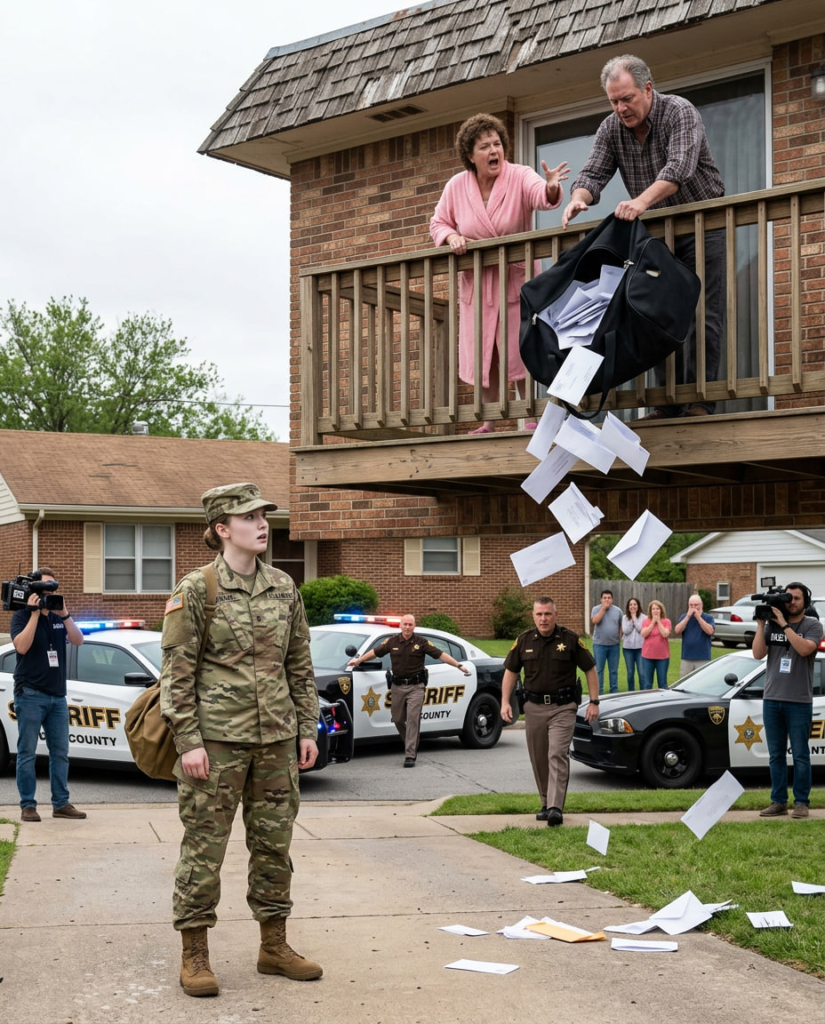
PART 1: The Daughter They Buried While She Was Still Alive
The first thing Mr. Bennett said when he locked the truck doors was so absurd I honestly thought I misunderstood him.
“Your mother just called the police,” he whispered nervously. “She told them there’s an escaped convict standing in her yard.”
I sat frozen in the passenger seat staring through the windshield at the small Virginia house I had spent four years dreaming about while deployed overseas. The cracked driveway still curved past the mailbox exactly the same way it had when I was sixteen. Grandma Rose’s stone fountain still leaned slightly to the left. The curtains in the living room twitched constantly like someone inside was watching me while trying not to be seen.
And somewhere beyond those locked doors were my parents.
Hiding from me like I was dangerous.
I still wore my Army uniform. Dust from overseas probably clung to my boots. My duffel bag rested beside me with my discharge papers folded carefully inside. For years I imagined this moment differently—Mom crying at the doorway, Dad awkwardly hugging me after pretending not to get emotional, neighbors welcoming me home after deployment.
Instead, sheriff’s cruisers screamed down the street.
Then came church members.
Old teachers.
Neighbors.
And finally a local news van.
I turned slowly toward Mr. Bennett.
“What exactly did my mother tell them?”
The old mailman swallowed hard before answering.
“She told dispatch you got released from prison early. Said the military uniform was fake. Said you were unstable.”
Every ounce of warmth left my body instantly.
Then the front door creaked open.
My mother stepped outside first wearing a pale gray sweater and an expression so carefully arranged it looked rehearsed. One hand pressed dramatically against her chest while she stared toward the police like she was the victim in some terrible situation.
My father hovered behind her gripping the brass chain lock tightly.
“Emily,” my mother called loudly enough for everyone nearby to hear, “please don’t make this worse.”
Cameras turned toward me immediately.
Sheriff Dawson approached carefully.
“Everybody stay calm,” he instructed.
I stepped slowly from the truck.
“Sheriff, I’m Staff Sergeant Emily Carter. I just came home from military deployment overseas.”
A ripple moved through the crowd instantly.
Mrs. Harper—my old seventh-grade teacher—covered her mouth in shock.
Pastor Reed suddenly looked pale.
Then my mother pointed directly at me.
“That uniform is part of her manipulation,” she announced coldly.
I reached slowly into my jacket pocket.
“I have my military ID right here—”
But before I could finish, my father shouted from the doorway:
“Don’t touch anything she hands you!”
The entire neighborhood fell silent.
Then Mr. Bennett finally stepped forward beside me.
His voice shook slightly.
“That girl wrote home every month. I forwarded the letters myself after her parents started refusing delivery.”
For just a split second, my mother’s expression cracked.
Not fear.
Anger.
Pure fury.
Then my father slammed the front door shut.
One lock clicked.
Then another.
Then a third.
From inside the house he shouted:
“If she wants everyone hearing the truth so badly, then show them what she hid!”
An upstairs window burst open.
Seconds later, a black duffel bag crashed onto the front porch.
My name was stitched across the side.
At first I thought they were planting fake evidence against me.
Then Sheriff Dawson unzipped the bag.
No weapons.
No drugs.
No criminal evidence.
Only letters.
Hundreds of them.
Letters I mailed from Kuwait.
Germany.
Afghanistan.
Some envelopes still carried military postal stamps. Others were ripped open and taped back together. A few had giant red markings stamped across the front:
RETURN TO SENDER.
I stared toward the locked front door in disbelief.
“You rejected my mail?”
No answer came.
Then the sheriff pulled another document from the bag.
His face changed immediately.
“This is a power of attorney.”
My stomach dropped.
A forged version of my signature sat neatly across the bottom. Underneath were loan documents, bank papers, and property transfer forms connected to Grandma Rose’s little yellow house—the house she left to me before I enlisted.
Dad cracked the front door open slightly.
“She gave permission,” he barked.
“No, I didn’t.”
My mother’s voice sliced through the doorway instantly.
“You abandoned this family!”
I almost laughed from disbelief.
“I joined the Army.”
Then she screamed the sentence that finally explained everything:
“You left us drowning in debt!”
A strange murmur moved through the crowd.
Pastor Reed slowly stepped backward looking horrified.
Sheriff Dawson noticed immediately.
“Pastor?”
The pastor lowered his eyes.
“Carol told the church Emily had fallen into addiction,” he admitted quietly. “She said the family needed help paying legal expenses.”
I stared at him.
“How much money?”
His voice barely worked.
“Almost seventy thousand dollars.”
My knees nearly gave out beneath me.
Then an old pickup truck rolled slowly toward the curb.
The second my father saw it, he disappeared from the doorway completely.
A heavyset man climbed from the driver’s seat wearing a wrinkled blazer and carrying a thick folder under one arm.
I recognized him instantly from old financial paperwork.
Frank Mercer.
The mortgage broker.
He looked at me standing there in uniform and grimaced uneasily.
Then muttered the sentence that froze the entire street:
“Well… looks like the dead daughter came back after all.”
Everything inside me stopped.
“Dead?” I whispered.
Sheriff Dawson turned sharply toward him.
“What does that mean?”
Frank shifted nervously.
“Her parents filed documents over a year ago declaring her missing and presumed dead overseas.”
The world tilted sideways around me.
That was how they stole Grandma Rose’s house.
That was how they erased me.
Not while I was dead—
while I was still alive.
PART 2: The Lie That Fed an Entire Town
For several seconds after Frank Mercer spoke, nobody on the street moved.
The sheriff stared at him.
The reporters froze.
Even the cameraman lowered his equipment slightly like his brain needed time to process what he’d just heard.
Meanwhile, I stood in the middle of my parents’ front yard trying to understand how two people could erase their own daughter while she was still alive.
Sheriff Dawson stepped toward Frank slowly.
“Explain exactly what you mean by ‘dead daughter.’”
Frank looked toward the house nervously.
Then sighed.
“Her parents filed paperwork saying Emily disappeared overseas and was presumed dead.”
My stomach twisted violently.
“That’s impossible,” I snapped. “The Army contacts family directly during casualties.”
Frank rubbed one hand across his face uneasily.
“They never involved the military. They used forged legal documents instead.”
The crowd erupted instantly.
People started whispering loudly.
Questions flew across the lawn.
Mrs. Harper looked physically sick beside the curb while Pastor Reed stared toward my parents’ house like he no longer recognized it.
Then I saw movement through the front window.
My mother stood inside with a phone pressed tightly against her ear.
And even through the glass, I could read her lips clearly.
Burn the garage.
The words hit me like ice water.
I turned immediately toward the detached garage behind the house.
Thin smoke curled beneath the side door.
Sheriff Dawson saw it one second later.
Then everything exploded into chaos.
I ran before anyone could stop me—not because I was brave, but because military training hardwires certain instincts into your body. When people panic around fire, you move first and think later.
By the time I reached the garage, my father stumbled through the side entrance coughing violently while clutching a red gasoline can.
Sheriff Dawson tackled him straight into the grass.
At the same moment, my mother burst through the front door screaming:
“Richard, no! You promised!”
Honestly, it was the first truthful thing either of them said all day.
Neighbors dragged hoses across the lawn while firefighters arrived within minutes. Thankfully the flames remained mostly trapped inside a metal burn barrel near the back workbench.
Inside the barrel sat burned photographs.
Half-charred folders.
Melted plastic binders.
And blackened paperwork with my name still visible beneath the ash.
One deputy grabbed my arm before I could move closer.
That’s when I noticed the cardboard box beside the barrel.
Two words were written across the front in my mother’s handwriting:
EMILY PROBLEM.
The air left my lungs completely.
By midnight, the sheriff’s office looked like an evidence room from a true-crime documentary. Folding tables overflowed with pieces of my life.
Deployment photos.
Birthday cards I mailed home.
Letters begging my parents to tell people I was okay.
Military commendations.
Returned envelopes.
Every single thing they tried to erase.
That was when the full story finally surfaced.
During my first year overseas, Mom secretly opened and read every letter I sent home. During the second year, she started refusing delivery entirely. Mr. Bennett became suspicious because he’d known me since childhood, so he quietly forwarded the returned mail to my military forwarding address whenever he could.
I thought my parents stopped responding because they were hurt.
In reality, they were building a lie.
They told neighbors I went to prison.
They told old teachers I developed addiction problems.
They told church members I was mentally unstable and too ashamed to come home.
And because people felt sorry for them, sympathy turned into money.
The church raised nearly seventy thousand dollars for my so-called legal bills, rehabilitation, and “family hardship.”
Not one dollar reached me.
The money paid debts connected to Grandma Rose’s house.
The forged power of attorney gave my parents access to my inheritance.
A fake psychiatric evaluation labeled me unstable.
And the falsified “missing and presumed dead” paperwork gave them legal leverage to seize property that never belonged to them.
Frank Mercer handled the mortgage transfers.
His sister notarized forged documents.
My parents created the story.
And Pastor Reed unknowingly repeated it to the entire congregation.
When Sheriff Dawson handed him one of my deployment letters that read:
Please tell everyone at church I miss them,
the pastor sat down and cried openly in front of everyone.
My mother never cried once.
Inside the interrogation room, she folded her arms calmly and said:
“Emily always thought she was better than us.”
Dad lasted longer before finally breaking.
He admitted Grandma Rose should’ve left the house to him instead of me.
He admitted they expected me to fail in the military and come home desperate.
But when I started getting promoted, sending photographs in uniform, and building a life they couldn’t control anymore—
Mom became furious.
The first lie happened almost accidentally.
A neighbor asked why I never visited home.
Mom vaguely answered:
“Emily’s away because of bad choices.”
The neighbor assumed prison.
Mom realized pity brought attention.
Attention brought donations.
And once enough people believed I was ruined, stealing from me became easier.
By sunrise, both of my parents were under arrest for fraud, forgery, filing false reports, and attempted arson.
Frank Mercer tried fleeing town before daylight, but Mr. Bennett recognized his truck at a gas station and alerted deputies immediately. Officers later discovered another folder filled with forged documents in Frank’s vehicle—every single page carrying fake versions of my signature.
The whole town woke up to scandal headlines before breakfast.
And suddenly the daughter they buried for four years—
came home alive carrying the truth with her.
PART 3: The Daughter Who Came Back Alive
For weeks after my parents’ arrest, the entire town treated my life like a scandal people couldn’t stop talking about.
Every grocery store checkout line.
Every church parking lot.
Every diner conversation.
Some people looked at me with sympathy. Others looked embarrassed because they realized they helped spread lies about me for years without ever asking whether they were true.
At first, I hated all of it.
I hated hearing myself described as “the soldier whose parents pretended she was dead.”
I hated cameras outside the courthouse.
I hated strangers whispering while I walked past.
But underneath the humiliation sat something far heavier:
grief.
Not because I lost my parents.
Because I finally understood I never truly had them the way other children did.
The investigation uncovered everything.
The forged signatures.
The fake psychiatric report claiming I was unstable.
The falsified “missing and presumed dead” affidavit.
The church donations.
The mortgage fraud connected to Grandma Rose’s yellow house.
Even worse, detectives discovered my mother kept detailed folders documenting which neighbors believed which lies.
One folder labeled CHURCH included notes beside congregation members’ names:
LIKELY TO DONATE.
ASK AGAIN BEFORE CHRISTMAS.
TRUSTS CAROL COMPLETELY.
I stared at those papers for nearly ten straight minutes unable to breathe normally.
To my mother, the town wasn’t a community.
It was a resource.
Pastor Reed visited me personally three days later.
He looked ten years older than I remembered.
The moment I opened Grandma Rose’s front door, he removed his hat immediately.
“Emily… I need you to know I’m sorry.”
His voice cracked badly.
“I should’ve checked the truth before repeating any of it.”
For a second, I almost comforted him automatically.
Military training teaches you how to steady other people during emotional collapse.
But then I remembered sitting alone overseas rereading unanswered letters wondering why my family stopped loving me.
So instead, I answered honestly.
“People don’t destroy lives only by lying,” I told him quietly.
“Sometimes they destroy lives by believing lies because it feels easier than asking questions.”
The pastor cried openly after that.
Honestly, part of me did too.
Meanwhile, my mother never apologized once.
Not during interrogation.
Not during arraignment.
Not even when investigators showed her the unopened deployment letters she hid for years.
She simply folded her arms and repeated:
“Emily always thought she was better than us.”
Dad eventually broke emotionally before trial.
He admitted Grandma Rose should have left him the house instead of me. He admitted they expected me to fail in the military and come home financially desperate enough to depend on them again.
But when I kept succeeding—
Mom became furious.
The sentencing hearing happened almost four months later.
The courtroom overflowed with reporters, church members, and neighbors who once believed I was either a criminal or dead. I wore my dress uniform because for years my parents used shame to erase my identity, and I refused to hide any part of myself anymore.
Mom looked directly at me only once during the hearing.
For one brief second, I thought maybe remorse finally reached her.
Then she whispered bitterly:
“You enjoyed humiliating us.”
Something inside me went completely still hearing that.
I looked at the woman who spent four years burying me alive inside other people’s minds.
Then answered quietly:
“No.”
My voice barely rose above a whisper.
“I survived you.”
Dad stared silently at the defense table afterward.
Mom looked away first.
Both of them received prison sentences for fraud, forgery, attempted arson, and filing false reports. Frank Mercer was sentenced separately after deputies found additional forged property records inside his truck.
Honestly, none of the prison time felt long enough.
But eventually I realized punishment wasn’t what healed me.
Truth did.
Over the next several months, the town slowly changed around me.
Mrs. Harper mailed me the scholarship recommendation letter she wrote years earlier before believing I had “thrown my life away.”
Neighbors volunteered statements helping prosecutors recover stolen church donations.
The congregation voted unanimously to repay every dollar raised in my name.
I used part of the recovered money to restore Grandma Rose’s little yellow house on Willow Creek Road.
Fresh paint.
New porch rails.
A repaired roof.
The first night I slept there alone, Mr. Bennett quietly placed my mail into the mailbox and tapped the porch railing with one weathered hand.
“Welcome home, Sergeant Carter.”
The second he walked away, I sat on those porch steps crying harder than I had during deployment.
Because for the first time in years—
I finally understood the difference between returning somewhere and actually being welcomed home.
That Memorial Day, the town invited me to speak outside the courthouse.
At first I refused.
I didn’t want my life becoming some inspirational story people used to feel better about themselves.
Then I saw Mr. Bennett standing quietly near the back of the crowd holding one of my old letters.
And Pastor Reed beside him looking ashamed but sincere.
So I stepped to the microphone.
The crowd fell completely silent.
I looked across the same town that once believed I was dangerous, unstable, imprisoned, addicted, or dead.
Then I told them the truth.
“I was never in prison,” I said quietly.
“But I was trapped inside a lie.”
Nobody moved.
Nobody interrupted.
So I continued.
“And every time we repeat a story without checking whether it’s true, we help build prisons around innocent people.”
Nobody clapped immediately afterward.
Honestly, that silence meant more to me than applause.
People were finally listening instead of assuming.
As the crowd slowly dispersed later that afternoon, a little girl approached me shyly while holding her mother’s hand.
She looked up at my uniform nervously.
“Can girls become soldiers too?”
I knelt down until we were eye level.
Then smiled softly.
“Yes,” I told her.
“And they can come home too… even when somebody tries to lock them out.”
That evening, I returned to Grandma Rose’s house, opened every window wide, and unpacked my duffel bag for the final time.
At the very bottom sat an old folded letter I never mailed.
Dear Mom and Dad, I hope you’re proud of me.
I read it once.
Folded it carefully again.
And placed it back inside the drawer.
Not because I was hiding anymore.
But because some versions of myself deserved peace instead of answers.
And for the first time in four years—
nobody in town was telling my story except me.
THE END