Chapter 1: The Architect in the Shadows
Every family has a designated role for its members, a script written long before you are old enough to understand the words. In my family, my younger sister, Chloe, was the glittering protagonist, the golden child whose every mediocre achievement was celebrated with the fervor of a coronation. My mother, Eleanor, was the fierce, obsessive director, meticulously curating a lifestyle of old-money elegance on a desperately hollow budget.
And I, Clara, was the wallpaper. The invisible, dependable, entirely unglamorous stagehand required to keep the set from collapsing.
I sat at the edge of my mother’s suffocatingly over-decorated living room, nursing a cup of lukewarm black coffee. The house buzzed with the chaotic, hysterical energy of Chloe’s impending wedding—a $100,000 spectacle designed entirely to impress people who did not care about us. I wore a simple, well-worn gray cashmere sweater and dark denim jeans. I wore no makeup, and my hair was tied back in a plain clasp.
To my family, I was a mid-level data entry clerk who lived in a boring apartment, a woman who had tragically missed out on the family’s “superior” genetics and social grace. They loved that narrative. It made Chloe, who was marrying a supposedly wealthy—but heavily leveraged—finance executive named Julian, look like royalty by comparison. My plainness was the necessary shadow that made Chloe’s artificial light shine brighter.
What they did not know, what I had spent ten agonizingly careful years keeping a complete secret, was that I was the founder and CEO of Vanguard Property Group.
My family was blinded by labels; they only respected wealth that screamed. They didn’t understand the quiet, labyrinthine world of commercial real estate acquisition, shell companies, and massive, silent capital. I drove a modest sedan and kept my address private precisely because I knew my mother and sister. If they knew I was a billionaire, they would not love me more. They would simply view me as an endless, uncomplaining ATM to fund their terrifying vanity. I had already spent years quietly bailing them out of secret credit card debts through anonymous “gifts” from distant, fictional relatives, simply to keep a roof over their heads.
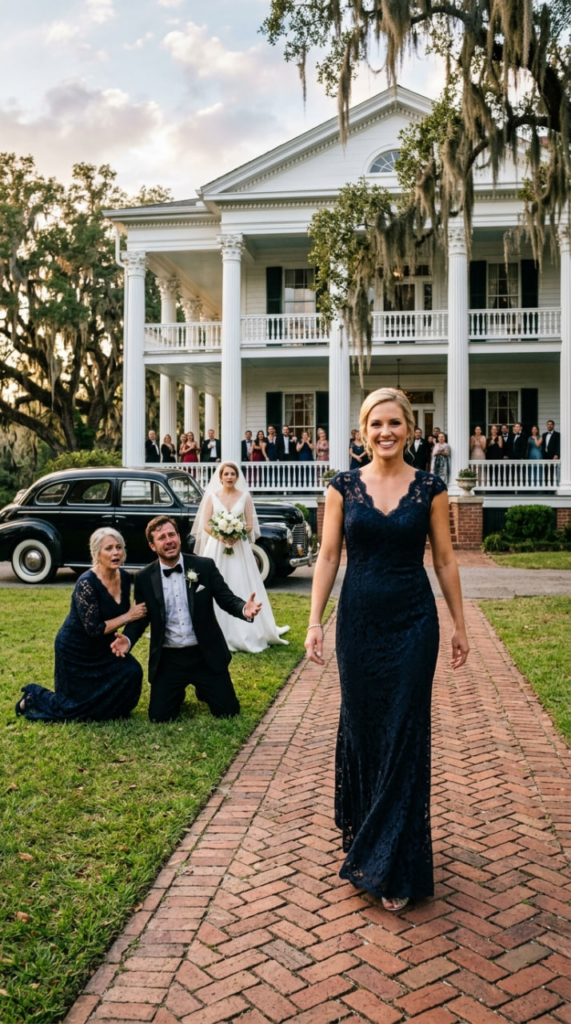
More importantly, as I watched my mother frantically steam the train of Chloe’s massive silk gown, they had absolutely no idea that the venue for tomorrow’s wedding—the historic, breathtaking Vane Manor estate—was not rented from a faceless luxury corporation.
It was owned by me.
I had purchased the fifty-acre estate two years ago. When Chloe became engaged and sobbed hysterically that Julian’s family would judge her if she didn’t secure the city’s most exclusive venue, I had quietly intervened. Through a web of corporate emails, I had my property management team offer Chloe a “promotional lottery discount.” I absorbed the entire astronomical rental cost, generating a zero-dollar invoice for her. I did it because, beneath the layers of their toxicity, I still harbored the pathetic, enduring hope of a daughter and a sister. I simply wanted Chloe to have a beautiful day.
But as I watched Eleanor adjust Chloe’s diamond-encrusted veil in the floor-to-length antique mirror, the atmosphere in the room shifted. The giggling bridesmaids were dispatched to the kitchen for mimosas. The room grew unnervingly quiet.
Eleanor turned away from the mirror, her eyes landing on me. The fabricated warmth she used for the wedding planner vanished, replaced by a familiar, chilling disdain. She marched across the thick Persian rug, her heels clicking sharply against the hardwood, stopping directly in front of my chair.
“Clara,” my mother said, her voice dropping into a register of pure, calculated malice. “We need to have a serious conversation about tomorrow.”
I set my coffee mug down on the coaster, the ceramic clinking softly against the wood. I looked up at her, completely unprepared for the words that were about to sever my ties to this bloodline forever.
Chapter 2: The Shredded Invitation
The silence in the living room felt heavy, suffocating, like the air right before a thunderstorm. Chloe turned slowly from the mirror, a smug, self-satisfied smile playing on her lips.
“It would be better if you don’t show up tomorrow,” Eleanor said, folding her arms across her chest, a cold, hard smile fixed on her face.
I blinked, the words taking a moment to penetrate my brain. “Excuse me?”
“Don’t play dumb, Clara. You know exactly what I mean,” Eleanor sighed, rolling her eyes as if explaining a basic concept to a slow child. “You’ll spoil my family’s image. Chloe’s new in-laws, Julian’s parents, they are very important people. They move in circles you can’t even comprehend. You don’t fit in with this crowd. Your clothes, your car, your whole… demeanor. You’ll just make everyone uncomfortable. We can’t have you sitting in the front row looking like the hired help.”
A cold numbness began to spread from my chest outward, freezing the blood in my veins. I stared at the woman who had given birth to me. She was not asking me to change my outfit. She was actively banishing me from my only sister’s wedding because my lack of ostentatious wealth offended her fragile ego.
Chloe strutted over, her silk robe trailing behind her. In her manicured hand, she held the thick, gold-embossed wedding invitation I had received in the mail six months ago—the very invitation I had secretly paid the printing costs for.
She didn’t hesitate. With a sharp, theatrical motion, Chloe tore the heavy, expensive cardstock perfectly in half. The sound of the ripping paper echoed violently in the quiet room. She let the pieces flutter to the floor, landing directly between my worn boots.
“Your pathetic vibe doesn’t belong at my wedding, Clara,” Chloe sneered, admiring her three-carat engagement ring in the light. “I’m sorry, but it’s my special day. And I don’t want to spend my reception explaining to Julian’s wealthy friends why my older sister looks like a depressed librarian who got lost on the way to a book club.”
“We’ll send you some photos, sweetie,” Eleanor added, her tone dripping with fake, condescending pity. “It’s really for the best. You’d just be miserable watching people who are actually successful anyway.”
In that suspended moment, time seemed to stop. I looked at the torn pieces of gold foil on the rug. The agonizing hope I had carried my entire life—the hope that if I just gave enough, protected them enough, faded far enough into the background, they might eventually love me—evaporated.
It was replaced by a profound, breathtaking clarity.
For ten years, I had funded their fake high-society life from the shadows. I had paid the mortgage on the very house we were standing in when my father’s “investments” failed. I had secured the venue for tomorrow’s spectacle. I had built the stage they were currently standing on to look down at me.
I finally understood that I wasn’t their family. I was their secret embarrassment, an ugly utility they tolerated only out of habit.
I didn’t flush red. I didn’t cry. I didn’t scream about how ungrateful they were, or reveal my billions in a fit of passionate rage. That would have given them an emotion to feed on. Instead, I absorbed the humiliation, my shock hardening into a cold, terrifying, architectural precision. They cared only about their image. They cared only about the facade.
I slowly lifted my gaze from the torn paper, looking past Eleanor, locking eyes with my sister.
“You’re right,” I said, my voice eerily calm, devoid of any inflection. “I don’t belong at your wedding. You shouldn’t have to worry about my pathetic vibe on your special day. I’ll stay home.”
Eleanor let out a sharp, dramatic sigh of relief, instantly dismissing me as she turned back to Chloe’s veil. “Thank God you’re finally being reasonable,” my mother muttered, already entirely unconcerned with my existence. “Now, Chloe, tilt your head up. We need to check the lighting on those cheekbones.”
I stood up slowly. I left my coffee mug on the table. I walked to the front door, grabbed my simple wool coat, and walked out into the crisp autumn air without looking back.
As I got into the driver’s seat of my sedan, I didn’t turn the key. I pulled my phone from my pocket and dialed the encrypted number for the property manager of Vane Manor.
He answered on the first ring. “Good afternoon, Ms. Vance.”
“Marcus,” I said, my voice smooth, cold, and absolute. “Cancel the catering for tomorrow. Send the floral staff home. Terminate the valet service.”
“Ma’am?” Marcus asked, slightly startled. “But the wedding—”
“There is no wedding, Marcus. And I need you to go to the hardware store,” I instructed, starting the engine. “Buy the thickest, heaviest industrial steel chain and padlock you can find. We are locking down the estate.”
Chapter 3: The Iron Gates
Revenge, I discovered that evening, is not a fire. It is ice. It is the meticulous, mathematical dismantling of an illusion.
I spent the evening in my penthouse apartment downtown—a sprawling, glass-walled sanctuary that Eleanor and Chloe did not know existed. I sat on my white leather sofa, sipping a glass of $4,000 vintage Bordeaux, watching the digital security feed for Vane Manor on my massive television screen.
The estate was a masterpiece of 19th-century architecture, surrounded by fifty acres of pristine, manicured forests and rolling lawns. At the edge of the property line, bordering the main road, stood the grand entrance: two towering pillars of solid granite holding massive, ornate wrought-iron gates.
On the screen, I watched Marcus and two of my private security contractors work under the glow of the halogen security lights. Marcus took a massive, industrial-grade steel chain—the kind used to secure shipping containers—and threaded it tightly through the iron bars of the two main gates. With a heavy, satisfying metallic clank that I could hear through the audio feed, he snapped an enormous brass padlock shut.
He then took a step back, holding a large, professionally printed aluminum sign. He used thick zip-ties to secure it directly at eye level, right over the seam of the chained gates. The high-definition camera zoomed in on the bold, red lettering:
VENUE CLOSED.
PRIVATE PROPERTY. NO TRESPASSING.
VIOLATORS WILL BE PROSECUTED TO THE FULLEST EXTENT OF THE LAW.
Because the “lottery discount” I had arranged for Chloe was actually just a zero-dollar invoice generated through my shell company, there was no exchange of funds. Under state law, there was no legally binding financial contract protecting Chloe as a renter. She was, legally speaking, a guest with a revoked invitation. I didn’t even have to breach a contract; I simply exercised my absolute right as the owner to close my own property.
By 9:00 PM, the trap was fully set. Marcus had called the catering company—which I also owned a controlling stake in—and redirected the hundreds of pounds of gourmet food to three local soup kitchens. The florists were paid in full and told to take the thousands of white roses home to their families. The massive estate was entirely emptied, plunged into a serene, beautiful darkness, guarded only by the iron gates and the cameras.
Saturday morning dawned bright, crisp, and entirely cloudless. It was the absolute perfect day for a high-society wedding.
I woke up feeling profoundly rested. I took a long, hot shower, dressed in a comfortable silk lounge set, and made a fresh pot of pour-over coffee. I opened my laptop, set it on the kitchen island, and pulled up the live, multi-angle feed from the gate cameras at Vane Manor.
I watched the empty, leaf-strewn road leading to the estate. I felt no guilt. I felt no anxiety. I felt only the terrifying, unshakeable peace of a woman who had finally stopped apologizing for her own existence.
I waited for the princess to arrive at her castle.
At exactly 10:00 AM, the first vehicle appeared on the security feed. It wasn’t a guest; the invitations stated the ceremony began at 1:00 PM.
It was a massive, pristine white stretch limousine. It was carrying the bride, the mother of the bride, and a flock of bridesmaids, arriving three hours early for the crucial, meticulously planned “pre-wedding bridal photoshoot” on the estate grounds.
The limo turned off the main road, its tires crunching onto the long, sweeping gravel driveway of the estate. It rolled smoothly toward the grand entrance.
I leaned closer to the laptop screen, taking a sip of my coffee. I watched the limo’s bright red brake lights suddenly flare. The massive vehicle jerked to a halt about ten feet from the entrance, the driver realizing the majestic gates were blocked by a terrifying wall of iron, chain, and a glaring red sign.
The show had officially begun.
Chapter 4: The Meltdown at the Manor
For three long minutes, the white limousine sat idling in front of the chained gates. Through the tinted windows, I could practically sense the confusion mutating into toxic entitlement. In Chloe and Eleanor’s world, obstacles were things that happened to poor people.
Finally, the rear door of the limousine swung open.
Chloe stepped out. She looked absurdly out of place on the rural driveway in her massive, $15,000 custom white silk gown. The train pooled in the autumn dust. Her hair was perfectly sculpted, her makeup flawless, but her face was already twisted into a mask of furious indignation. Eleanor followed right behind her, wearing an aggressively tailored champagne-colored mother-of-the-bride dress, looking like a furious wasp.
Eleanor marched directly up to the iron gates, grabbing the heavy steel chain and rattling it violently. The heavy metal barely budged.
“What is the meaning of this?!” Eleanor shrieked at the empty driveway, her voice captured perfectly by the hidden security microphones. “Hello?! Open the gates! We have a wedding today! We are VIPs!”
Chloe pulled out her iPhone, her long acrylic nails frantically tapping the screen as she dialed the number for the venue coordinator—a number that now routed directly to a dead voicemail box.
I watched from my laptop as Marcus, dressed in a sharp black suit, stepped out from the small, stone security guardhouse hidden just inside the gates. He walked calmly toward the iron bars, holding a two-way radio.
“Excuse me!” Chloe yelled through the bars, her voice pitching up into a hysterical screech. “I am Chloe Vance! I have this entire estate booked for the weekend! I won the promotional package! Cut this chain right now, or my fiancé, Julian, will sue this property into absolute oblivion!”
Marcus stopped two feet from the gate. He didn’t flinch. He looked at them with the calm, detached pity of a zoo employee looking at angry monkeys behind glass.
“I’m very sorry, Ms. Vance,” Marcus said, his voice even and professional. “But the owner of the property contacted me late last night and officially revoked your access permit. The venue is permanently closed to your party. You are trespassing. I must ask you to return to your vehicle.”
Eleanor’s jaw dropped. The champagne dress seemed to lose its luster. “The owner?!” she screamed, gripping the iron bars. “That is impossible! We have a legal right to be here! We sent out three hundred invitations! Get the owner on the phone right now! I want to speak to the manager!”
Sitting in my penthouse, I set my coffee down. I picked up my cell phone, dialed the private extension for the guardhouse, and entered a four-digit passcode. This patched my audio directly into the external Public Address system mounted on the stone pillars of the gates.
I cleared my throat.
“You don’t need to call the owner, Mom,” my voice boomed across the driveway, the high-fidelity speakers carrying the sound perfectly, echoing off the iron gates and the surrounding trees. “I’m already here.”
Chloe froze. The phone slipped from her hand, clattering onto the gravel. She looked up at the intercom speaker mounted on the stone pillar, then back at her mother. The blood drained completely from her face, leaving her looking like a ghost haunting her own wedding dress.
Eleanor stumbled backward, her hand flying to her chest.
“Clara?” Chloe gasped, her voice cracking, barely a whisper. “Clara… what is this? Are you… you work here?”
“No, Chloe,” I replied smoothly through the speaker, my voice resonating with absolute, crushing authority. “I don’t work here. I own Vane Manor. I own the ground you are standing on. I am the CEO of Vanguard Property Group.”
The silence that followed was the most beautiful sound I had ever heard. It was the sound of a paradigm shifting, of an entire worldview collapsing under the weight of reality.
“You… you own it?” Eleanor stammered, her mind entirely incapable of processing the information. The scapegoat, the failure, the invisible daughter in the gray sweater, was the billionaire landlord holding the keys to their kingdom.
“I do,” I said. “I bought it two years ago. I was the one who authorized your zero-dollar ‘lottery discount.’ I funded your entire day, Chloe. Because despite everything, I wanted to be a good sister.”
I paused, letting the cold autumn wind howl through the microphone for a second.
“But yesterday,” I continued, “you made it perfectly clear that my pathetic vibe doesn’t belong at your wedding. And since I am the legal owner of this property, I decided my real estate didn’t belong at your wedding either. Have a beautiful day, Chloe. I hear the municipal park down the street is completely free.”
Chapter 5: The Stranded Bride
For a moment, the only sound on the audio feed was the rustling of dry leaves against the white silk of Chloe’s gown. Then, the reality of the situation crashed down upon them with the force of a falling anvil.
The arrogance, the high-society posturing, the condescension—it all evaporated instantly. Faced with absolute, insurmountable financial power, the parasites reverted to their true nature.
“Clara! No, Clara, please!” Chloe shrieked, throwing herself against the iron bars. The pristine white silk of her dress caught on the rusted iron, tearing a jagged hole near her knee. She didn’t care. She pressed her face between the bars, weeping hysterically. “You can’t do this! Julian’s family will be here in an hour! They are flying in from New York! Open the gates! I’m sorry! I was just stressed! I’m so sorry!”
“You’re not sorry, Chloe,” I said, my voice projecting coldly across the void. “You’re just embarrassed. You told me I’d spoil your image. Well, consider your image preserved. No one will see you getting married today.”
“Clara, you psychotic, jealous bitch!” Eleanor screamed, the mask fully off, her true, venomous nature exposed for the cameras. She kicked the iron gate, scuffing her expensive heels. “You planned this! You waited until the morning of to destroy us! You stole our day!”
“I didn’t steal it, Mom,” I replied calmly. “I funded it. And then I defunded it. It is my property. And I am asking you to leave.”
“We are not leaving!” Eleanor roared. “We will stand right here!”
That, as it turned out, was the worst possible decision she could have made.
Because at 11:30 AM, behind the idling white limousine, the first wave of guest vehicles began to arrive.
The road leading to Vane Manor was a narrow, two-lane country road bordered by deep ditches. As the first few cars—sleek black Mercedes, silver Porsches, and rented town cars—pulled up behind the limo, they realized there was nowhere to go. The gates were locked.
Within twenty minutes, a massive, honking traffic jam of the city’s most elite socialites had formed on the rural road. They could not move forward, and the road was too narrow to turn around.
Wealthy, confused guests in tailored suits and expensive fascinators began stepping out of their idling vehicles. They walked up the gravel driveway, murmuring to one another, only to witness the horrifying spectacle unfolding at the front.
There was the beautiful, perfect Chloe Vance, her dress torn and covered in dust, her mascara running down her face in thick black rivers, violently shaking the chained gates of a closed venue, screaming obscenities at a metal speaker. Beside her, Eleanor was weeping, her makeup smeared, begging the confused guests to help her break the chain.
The image was shattered. The facade was completely, irreparably annihilated. They looked like absolute lunatics.
And then, the final blow was struck.
At 12:15 PM, a sleek, matte-black Aston Martin maneuvered onto the grassy shoulder, bypassing the line of trapped cars. It was Julian, the groom.
I watched closely on the zoomed-in camera feed. Julian, wearing a custom Tom Ford tuxedo, stepped out of his car. He took one look at the chained gates, the giant red “NO TRESPASSING” sign, his screaming mother-in-law, and his sobbing bride rolling in the dirt in front of three hundred horrified, whispering socialites.
Julian was a finance bro. He understood optics. He understood leverage. And he instantly understood that the Vance family, who had sold themselves as wealthy elites, were absolute frauds who couldn’t even secure a venue or pay a rental fee.
According to the security feed, Julian didn’t even speak to Chloe. He didn’t walk up to comfort her. He stood by his car for exactly thirty seconds, evaluating the catastrophic damage to his own social standing.
He pulled out his phone, made a single, brief phone call—likely to his parents trapped in a car further back—and then calmly got back into his Aston Martin.
“Julian!” Chloe screamed, noticing his car. She abandoned the gate and began running down the driveway toward him, her ruined dress heavy with dirt. “Julian, wait! It’s a mistake! My crazy sister—”
Julian didn’t look at her. He put his car in reverse, expertly navigated backward down the shoulder of the road, and drove away. He was not marrying a woman who was currently the laughingstock of his entire social circle.
“Please! I have nothing!” Chloe screamed into the air as Julian’s taillights disappeared around the bend, collapsing onto the gravel in a heap of dirty white silk.
I watched her for a moment longer. I felt no triumph. I felt no sadness. I felt the profound, cleansing emptiness of a surgically removed tumor.
“Goodbye, Eleanor. Goodbye, Chloe,” I whispered into the microphone.
I turned off the PA system. I closed my laptop, the screen going black. I picked up my phone, opened my contacts, and permanently blocked both of their numbers.
The wedding was officially over. And so was my lifelong sentence as the family scapegoat.
Chapter 6: The Open Estate
A year later, the disastrous non-wedding of Chloe Vance remained legendary gossip in the city’s high-society circles. It was a cautionary tale whispered over overpriced martinis at the country club.
Chloe’s life had unraveled with astonishing speed. Dumped by Julian—who, I read in a financial magazine, had quickly moved on to marry a shipping heiress whose family actually owned their assets—Chloe had spiraled. Without my secret financial bailouts, reality hit her hard. She was currently working as a mid-level retail manager at a suburban mall, forced to sell the diamond ring to pay off the massive credit card debt she had accrued buying her trousseau.
Eleanor and my father were social pariahs. The very people they had sacrificed their souls to impress now viewed them as toxic frauds. Completely alienated from the country club set, they had been forced to downsize to a small, two-bedroom apartment.
In a desperate, flailing attempt at vengeance, Eleanor had tried to sue me for “intentional infliction of emotional distress” and “breach of verbal contract.” My corporate legal team—a group of ruthlessly efficient lawyers who charged thousands of dollars an hour—had the case thrown out of a judge’s chambers with a laugh in under five minutes. The judge had explicitly reminded Eleanor that you cannot sue a landlord for refusing to let you use their property for free.
I had not spoken a single word to any of them since the day I turned off the microphone.
I stood on the grand, sweeping stone balcony of the master suite at Vane Manor, looking out over the fifty acres of rolling hills. The late afternoon sun painted the sky in brilliant strokes of gold and violet.
The iron gates at the end of the driveway were wide open today.
There was no chain. There was no padlock. Instead, a steady stream of vehicles was rolling up the drive. I was hosting a massive, fully catered charity gala for a foundation that provided micro-loans to women entrepreneurs in developing nations. The estate was filled with the sound of a string quartet, the clinking of crystal glasses, and the genuine laughter of colleagues, innovators, and true friends—people who respected my mind, my work ethic, and my character, regardless of what I chose to wear.
I looked down at my outfit. I was wearing a stunning, custom-tailored emerald green evening gown. It was quietly, devastatingly expensive. I didn’t wear it to show off; I wore it because I liked the way the silk felt against my skin.
I took a sip of vintage champagne from my crystal flute, feeling the warm, fragrant evening breeze brush past my face.
My family had looked at my simple sweaters and my quiet demeanor and decided I did not belong in their beautiful, fake world. They believed that worth was dictated by the labels on your clothing and the loudness of your arrogance.
They didn’t understand that true power doesn’t need to scream for attention. True power doesn’t need to wear a fifteen-thousand-dollar dress to prove it exists, and it certainly doesn’t need to tear up an invitation to make itself feel tall.
True power is quiet. It is the architect in the shadows. It is building the castle with your own two hands, holding the absolute legal right to the keys, and having the unshakable, terrifying peace of knowing exactly when to lock the iron gates.
I smiled, raising my glass to the horizon, enjoying the flawless, beautiful reality of my perfectly curated, completely authentic life.
If you want more stories like this, or if you’d like to share your thoughts about what you would have done in my situation, I’d love to hear from you. Your perspective helps these stories reach more people, so don’t be shy about commenting or sharing.