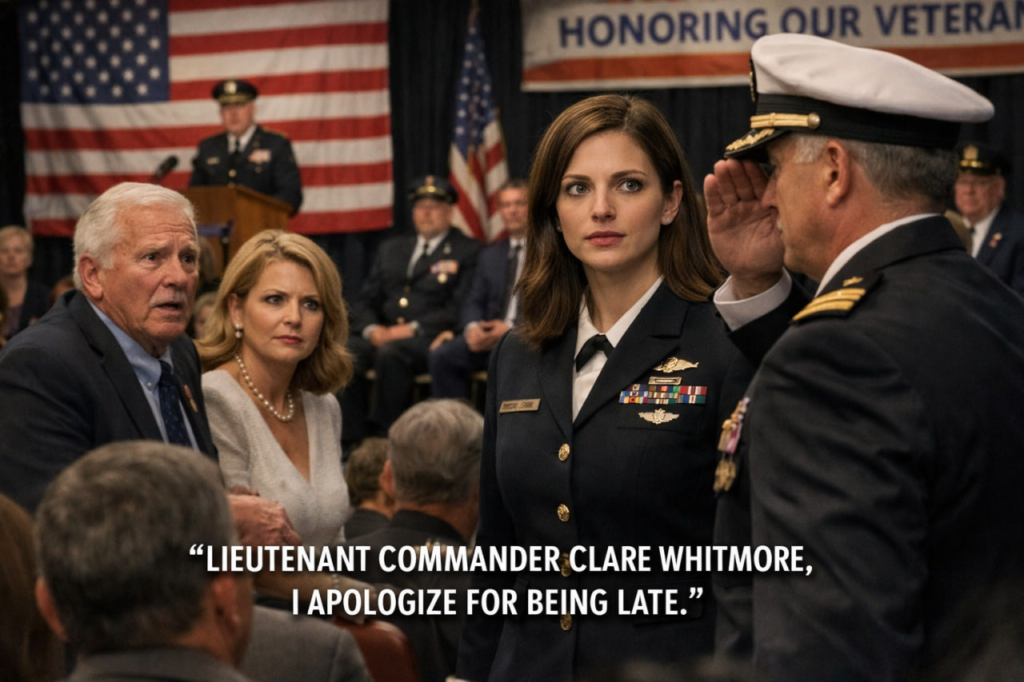
PART 1: The Daughter in the Last Row
Clare Whitmore never intended to return home as a hero.
During the long drive through rural Virginia, past pine forests and familiar roads, she kept telling herself the same thing: she was only coming back as a daughter attending her father’s ceremony. Nothing more. Her father, Richard Whitmore, was being honored at the county veterans hall that evening, and despite everything between them, she still came because promises mattered to her.
Richard had always been complicated.
He taught Clare discipline before affection, duty before comfort. He taught her to stand straight, finish what she started, and never treat promises as decoration. But somewhere over the years, the same man who once taught honor had become someone who listened too easily when other people told him who his daughter was.
Much of that change carried Evelyn Whitmore’s fingerprints.
Richard’s second wife preferred polished homes, curated memories, and stories she could control. Their house always smelled of lemon cleaner and cinnamon, every military photo perfectly placed for visitors, every patriotic decoration positioned where guests would admire it. Evelyn loved appearances because appearances could be managed.
Six months earlier, Clare’s life had changed in ways nobody in that house knew.
Orders arrived.
Documents were signed.
Briefings disappeared into restricted channels. The language on the papers was clinical and cold: temporary reassignment, communication restrictions, advisory review, limited family disclosure. Clare accepted all of it because the assignment demanded silence.
Evelyn translated that silence differently.
To her, absence became failure.
By the time Clare returned to town, people already believed she had left the Navy. The rumor had grown legs and moved through coffee shops, church circles, and polite conversations spoken softly enough to sound kind.
At a roadside café, the woman behind the counter looked at Clare with gentle pity.
Two men nearby whispered that military life must have been too difficult for her. Clare drank half her coffee, said nothing, and drove on. Years in uniform had taught her that silence often survived longer than arguments.
The front door of Richard’s house stood open when she arrived.
Evelyn greeted her before she reached the hallway. Her eyes moved over Clare’s jeans, dusty boots, and plain sweater with obvious disappointment.
“That’s what you’re wearing?” she asked.
“I came straight from the road,” Clare answered quietly.
Evelyn stepped closer.
“Tonight matters. Donors will be there. The councilman. Church leaders.”
Then came the real point.
“I heard you left the Navy.”
Clare stayed silent.
Not because she was ashamed.
Because she wasn’t allowed to explain.
Evelyn smiled anyway.
“Such a shame. At least when you served, it sounded respectable.”
In the kitchen, Richard stood over seating charts and printed programs.
He looked older than she remembered—gray near his temples, shoulders slightly lower, eyes carrying fatigue he tried to hide behind paperwork.
“You made it,” he said.
“I told you I would.”
For a moment, something almost softened between them.
Then Evelyn entered again.
“She’ll sit quietly in the back,” she announced before anyone could say anything else.
Clare simply nodded.
“I’ll be there.”
Later that afternoon, Richard received a phone call.
His posture changed immediately.
His voice warmed.
“Yes, sir… we’re honored… absolutely, we’ll be ready.”
After he hung up, Evelyn asked only one question.
“Is he coming?”
Richard nodded.
Nobody explained who “he” was. Clare noticed that immediately. She had spent too much of her life recognizing the moments families quietly decided daughters did not need information.
By six o’clock the veterans hall was full.
Flags lined every wall. Flower arrangements sat beside framed service photographs. Politicians, donors, veterans, and local families filled the polished room. Evelyn floated through the crowd gracefully, introducing people to “our family’s military legacy.”
She never introduced Clare.
Instead Clare sat where Evelyn placed her.
Last row.
Far right corner.
Half hidden behind a fake potted fern and a support pillar.
She accepted it quietly.
Not because she agreed.
Because she came for her father.
Then Evelyn noticed her across the room.
Standing with local society women and a banker’s wife, she lifted her voice just enough.
“That’s Richard’s daughter.”
Pause.
“The one who already left the Navy.”
The women turned.
One smiled with pity.
Another asked softly, “Was military life too much for her?”
Evelyn sighed dramatically.
“Some people simply aren’t built for service.”
Small laughs followed.
The polite kind.
The dangerous kind.
Clare sat perfectly still.
Stillness had become one of her sharpest skills. People expected tears, excuses, explanations. Silence unsettled them more.
The ceremony began.
Anthem.
Prayer.
Prepared speeches about sacrifice and honor. Richard received warm applause as he walked toward the stage. Clare applauded too because despite everything, parts of him still deserved respect.
Then the room changed.
The doors opened.
A man in dress whites entered.
He ignored the mayor.
Ignored the councilman.
Ignored the stage.
Instead he walked directly toward the last row.
Clare recognized him instantly.
Captain Rowan Blake.
Her commanding officer.
Richard’s face lost color.
Evelyn stopped smiling.
Captain Blake reached Clare, stood straight—
and raised his hand in a formal salute.
“Lieutenant Commander Clare Whitmore,” he said clearly.
“I apologize for arriving late.”
The hall went silent.
PART 2: The Salute That Broke the Lie
The silence after Captain Blake’s words felt unreal.
Programs slipped from people’s hands. A photographer lowered his camera without taking the picture. Across the hall, Evelyn stood frozen beside her circle of guests while the smile she had worn all evening slowly disappeared.
Richard reacted first.
He stepped down from the stage too quickly, forcing a smile that already looked broken.
“Captain,” he said carefully, “I think there’s some confusion. My daughter isn’t serving anymore.”
Captain Blake turned toward him.
His expression never changed.
“With respect, sir,” he replied, “your daughter never left the Navy.”
The room inhaled all at once.
Someone dropped a program.
Forks stopped halfway to plates.
The rumor everyone accepted without question began collapsing right in front of them.
Evelyn laughed sharply.
Too quickly.
Too loudly.
“Then where has she been?” she asked.
Clare closed her eyes briefly.
There it was.
The question she had avoided for six months.
The lie she allowed because the truth never belonged entirely to her.
Captain Blake turned back to her and held out a sealed folder marked with a red stripe. Clipped beneath it was a second envelope carrying a Norfolk operations code and official Department markings. The timestamp on the cover sheet read 18:07.
Clare’s stomach tightened instantly.
This wasn’t about defending her reputation.
Captain Blake had not crossed a crowded veterans hall for that.
Something had happened.
Richard noticed the change in her face immediately.
For the first time that night, he forgot the audience.
“Clare…” His voice cracked. “What’s going on?”
Captain Blake answered before she could.
“The Department requested that Lieutenant Commander Whitmore’s attendance tonight remain undisturbed if possible.”
He paused.
“Unfortunately, that is no longer possible.”
The hall became still again.
Evelyn looked from the folder to Clare and back toward the women standing beside her as if someone else would rescue the story she had built.
Nobody moved.
Clare opened the packet.
The red stripe alone was enough.
She recognized it immediately.
Emergency routing.
Restricted handling.
Priority movement authorization.
Six months earlier she had joined a classified advisory review tied to a naval logistics breach. The details remained sealed, but the reality was simple: people were in danger, and Clare had helped identify the channel causing it. Her assignment required communication restrictions and limited contact, which meant family only received absence without explanation.
Evelyn turned absence into failure.
The town turned silence into proof.
Now the investigation had escalated.
A former teammate was connected to a casualty risk serious enough to trigger immediate recall to Norfolk. Not confirmed death. Not final. But dangerous enough that the Navy broke the silence she requested.
Captain Blake kept his explanation short for the civilians present.
“Lieutenant Commander Whitmore has remained under temporary communication restrictions related to an active matter.”
He looked toward Richard.
“She never left service.”
Richard stared at his daughter.
“You were still serving?”
Clare nodded.
“I was.”
The words carried no pride.
Only exhaustion.
An entire room had accepted her humiliation because it was easier than defending her.
Evelyn whispered weakly:
“You could have told us.”
Clare looked directly at her.
“No.”
The room stayed silent.
“You didn’t want truth.”
“You wanted the rumor because it sounded better.”
Nobody laughed now.
Councilman Pierce suddenly became fascinated by his printed notes. The women who had laughed earlier looked at the floor. Even the banker’s wife avoided eye contact.
Richard stepped closer.
“Clare… I didn’t know.”
It was the first completely honest sentence he had spoken all evening.
And somehow it still hurt.
“No,” she answered quietly.
“You didn’t.”
Captain Blake handed her the second envelope.
“We have transport outside.”
“You have ten minutes.”
Ten minutes.
After six months of silence.
Ten minutes was all the room would get.
Clare opened the final packet.
Inside were copies of her signed orders, communication restrictions, and emergency contact authorization forms.
At the top—
Richard Whitmore. Primary family contact.
Richard saw his own name.
His face changed completely.
“You listed me?”
Clare held his gaze.
“You were my father.”
PART 3: The Daughter He Almost Lost
The room stayed silent after Clare spoke.
Nobody moved. Nobody whispered. The same people who had watched her humiliation an hour earlier now stood trapped inside their own discomfort. Evelyn remained beside the decorated tables and patriotic banners she arranged so carefully, but for the first time that evening, she looked like someone who no longer understood the story.
Richard stared at the papers in Clare’s hands.
Emergency orders.
Communication restrictions.
His own name listed as primary family contact.
“You trusted me with this?” he asked quietly.
Clare folded the papers back into the envelope.
“I trusted who you used to be.”
The answer landed harder than anger.
Richard lowered his eyes.
He looked suddenly older—not like the respected veteran standing beneath flags and applause earlier, but like a father realizing he missed the most important part of his daughter’s life while protecting someone else’s version of her.
Evelyn finally stepped forward.
“Clare, things got misunderstood.”
Her voice sounded smaller now.
“I heard people talking. I assumed…”
“No,” Clare interrupted gently.
“You enjoyed it.”
The room froze again.
Because everyone knew she was right.
“You repeated it at church.”
“At the house.”
“Tonight.”
Clare looked toward the women standing near the back wall.
“You introduced me as the daughter who failed.”
Evelyn opened her mouth.
Nothing came out.
Captain Blake checked his watch quietly.
The vehicle outside was waiting.
Norfolk was waiting.
Real problems were waiting.
Richard took a step forward.
“Clare…”
His voice broke.
“I’m sorry.”
This time there were no witnesses left to impress.
No podium.
No applause.
Just a father and daughter standing in the ruins of a lie.
Clare wanted it to fix something.
She wanted one sentence to return all the years she spent being quietly erased.
But apologies offered after proof carry a different weight.
“I know,” she answered softly.
She picked up her coat.
No one stopped her.
No one repeated the rumor.
No one looked at her with pity anymore.
Outside, Virginia air cut cold through the parking lot.
A government vehicle waited near the curb with its lights dimmed. Captain Blake opened the rear door, then paused before she entered.
“You didn’t deserve what happened in there,” he said.
Clare looked back toward the veterans hall.
Through the windows she could still see shadows moving.
Her father standing alone.
Evelyn surrounded by the people who had laughed.
The fake fern beside her chair still visible in the corner.
“No,” Clare answered.
“But now they know.”
The Norfolk assignment lasted through the night.
Debriefings followed.
The investigation expanded.
The teammate connected to the casualty alert survived, though the operation remained active. Clare returned to work because that was what service demanded.
Weeks later Richard called.
Not Evelyn.
Richard.
He didn’t ask questions he had no right to know.
He didn’t ask for classified details.
He only asked if she would meet him for coffee next time she passed through Virginia.
This time he listened more than he spoke.
Trust didn’t return immediately.
It rarely does.
Evelyn sent one message later.
Something about misunderstandings.
Pressure.
Things getting out of hand.
Clare never answered.
Some silences are weakness.
Others are boundaries.
Months later, when she thought back to that ceremony, she didn’t remember the applause first.
She remembered the last row.
The fake fern.
The moment the doors opened.
And Captain Rowan Blake walking through the hall in dress whites like the truth itself had arrived.
Because she never left the Navy.
She simply stopped explaining her service to people who only respected it when it looked convenient.