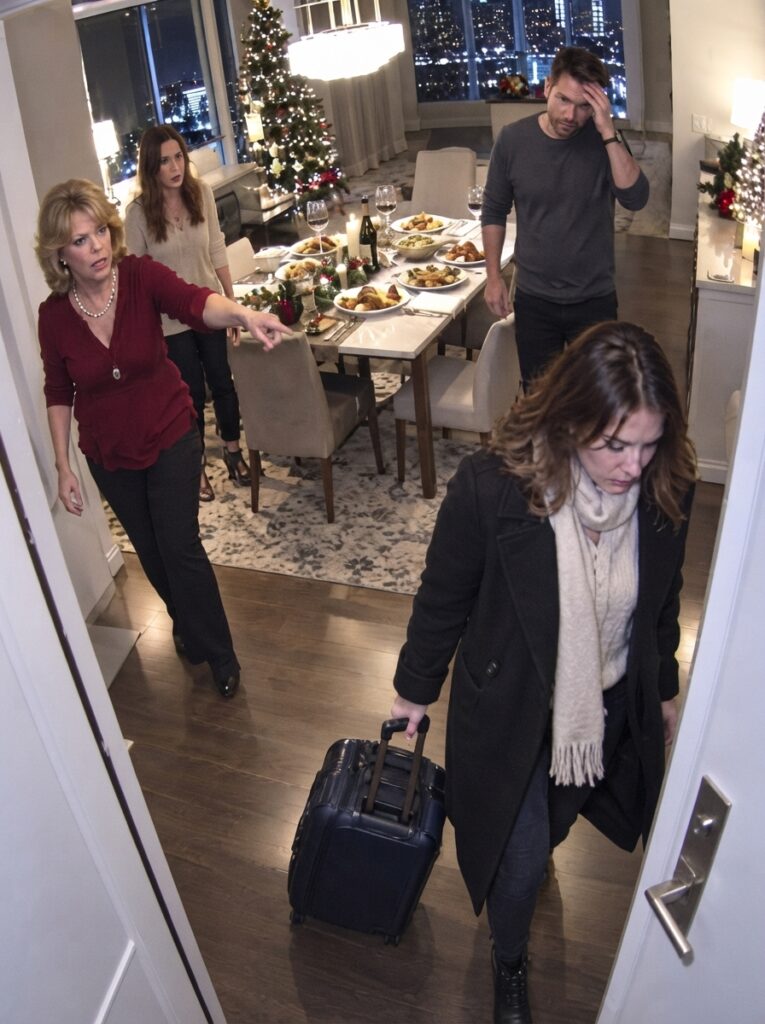
“My Mother-in-Law Threw Me Out Into the Snow on New Year’s Eve — She Didn’t Know Her Son Was Already Planning to Follow Me the Moment He Learned the Truth”
My Mother-in-Law Ordered Me Out on New Year’s Eve. At Midnight, My Husband Discovered the Secret That Would Destroy Our Marriage.
The night my mother-in-law threw me out of my own home, I didn’t scream, cry, or beg my husband to defend me.
I simply packed a suitcase and left.
Six hours later, my husband called in a panic.
“Ellie, why did you turn off the heat? Everyone’s freezing!”
I was sitting in my parents’ warm apartment, holding a mug of tea.
I listened to him complain for almost a minute.
Then I asked one question.
**”Why is that suddenly my responsibility?”**
The silence that followed was the first real silence Arthur had given me in three years.
But what happened next had nothing to do with the temperature.
Because hidden among the household documents in our home office was evidence of something much colder than a winter night.
And the person responsible wasn’t the one I initially suspected.
***
My name is Eleanor Bennett. I was thirty-five that New Year’s Eve, and I had been married to Arthur for three years.
We lived in a comfortable condo about twenty minutes from downtown, where I worked in finance.
It wasn’t a mansion.
It was a two-bedroom apartment with a converted den, hardwood floors, large windows, and a kitchen I had renovated myself.
I had purchased it before our marriage using eight years of savings and a modest inheritance from my aunt.
**The deed was in my name. The mortgage was in my name.**
Arthur knew this when we married.
He had even signed paperwork acknowledging that the property belonged to me before our wedding.
Back then, it hadn’t mattered.
We were in love.
Or at least I believed we were.
Arthur was funny, affectionate, and surprisingly thoughtful during our first year together.
He remembered little things.
How I liked my coffee.
Which flowers made me smile.
How much I loved cooking when I wasn’t exhausted.
He once told me that being married to me felt like coming home.
I held on to those words long after they stopped matching our life.
The trouble began when his mother, Deborah, moved in.
Deborah was sixty-four, with a carefully maintained silver-blonde bob and an impressive ability to turn any conversation into a criticism.
She said her townhouse needed extensive repairs.
Arthur asked whether she could stay for a few months.
“Of course,” I said.
I even helped convert our den into a comfortable bedroom.
Then Arthur’s younger sister, Chloe, needed somewhere to stay while she decided on a career.
Chloe was twenty-nine.
She promised she would find an apartment once she figured out her next move.
That was nearly two years earlier.
And somehow, our home had become a place where three people lived comfortably while I carried nearly every responsibility.
***
I should have recognized the warning signs.
Deborah never asked whether I needed help cooking.
She asked what time dinner would be ready.
Chloe never offered to pay for groceries.
She complained when her favorite snacks ran out.
Arthur rarely noticed either problem.
When I raised concerns, he always had an explanation.
“Mom’s getting older.”
“Chloe’s trying to figure things out.”
“You’re better at organizing things than I am.”
The final excuse irritated me most.
Being capable had somehow become a punishment.
The more efficiently I handled our lives, the less anyone felt responsible for helping.
I worked long hours downtown.
Yet groceries appeared every week, utility payments cleared, laundry got folded, and meals were prepared.
I handled the HOA correspondence and scheduled repairs.
I even maintained the smart-home system because nobody else could be bothered to learn how it worked.
Arthur occasionally thanked me.
Deborah rarely did.
Instead, she compared me with other women.
Especially Susan, our downstairs neighbor.
“Now there’s a woman who knows how to make people feel welcome,” Deborah would say.
Susan served on the condo association board and worked full-time herself.
I liked her.
But I didn’t particularly enjoy being measured against her every other week.
Whenever I complained to Arthur, he kissed my forehead.
“Don’t let Mom get to you, Ellie.”
Then he went back to whatever he was doing.
**He never asked why his mother was allowed to get to me in the first place.**
***
On December 30, the day before everything happened, I came home to find Chloe using the scanner in our home office.
She quickly closed a folder on the computer.
“Just scanning some paperwork,” she said.
“For what?”
“Something related to property management. I might have found a business opportunity.”
I was genuinely pleased.
“That’s great, Chloe.”
She smiled, though she looked strangely nervous.
Arthur appeared in the doorway and asked whether I had seen the latest building notice.
I said I had checked the HOA messages that morning but hadn’t read every attachment.
“Probably just the annual paperwork,” he said.
At the time, those two moments seemed completely ordinary.
Later, I would replay them over and over.
Especially **the way Arthur and Chloe exchanged a look when they thought I wasn’t watching.**
***
On New Year’s Eve, I woke before everyone else.
I picked up groceries, answered a work call, cleaned the kitchen, changed the guest-room sheets, and started preparing dinner.
By five o’clock, the condo smelled wonderful.
Roasted herbs.
Fresh bread.
Lemon.
Mushroom sauce.
Snow was collecting along the sidewalks outside.
Silver garland decorated the lobby, and holiday music floated through the hallway.
I wanted one peaceful evening.
That was all.
Deborah arrived at the dinner table wearing a burgundy cardigan and an expression suggesting she had already found something disappointing.
She tasted the salmon.
“It needs something.”
“There’s lemon and fresh dill,” I replied.
She tilted her head.
“I mean warmth, Eleanor. A holiday dinner should feel special.”
I glanced at the table.
Flowers.
Candles.
Homemade bread.
Three carefully prepared dishes.
Two desserts.
I smiled politely.
“Okay.”
Chloe barely looked up from her phone.
“Mom always says you can tell when somebody really enjoys cooking.”
I reached for my water.
Arthur sat quietly across from me.
Deborah tasted the roasted pork.
“Too much seasoning.”
Then she turned toward my husband.
“Arthur, you really should help Eleanor understand how our family celebrates holidays.”
Our family.
Those two words hurt more than the criticism.
After three years of marriage, I was still being treated like an outsider.
Arthur finally muttered, “Mom, dinner’s fine.”
“Fine isn’t the point.”
Deborah looked directly at me.
“You work so much, Eleanor. You’re always organizing things, but a home needs more than organization.”
I felt a familiar pressure building behind my ribs.
Chloe put down her phone.
“She just means you should relax more.”
I nearly laughed.
Relax?
That morning, while I had been shopping and cooking, Chloe had slept until nearly noon.
Arthur had watched football.
Deborah had sat on the couch commenting on the menu.
And apparently I was the one who needed to understand how a home should operate.
“Look at Susan downstairs,” Deborah continued. “She has a career, but she’s always cheerful.”
Arthur shifted.
“Mom.”
“I’m simply making an observation.”
Then came her usual speech.
Marriage was about sacrifice.
A husband needed peace.
A wife should naturally want to make her home comfortable.
I stared at Arthur.
He studied his dinner plate.
Something inside me finally gave way.
Not dramatically.
It felt more like a door quietly closing.
I put down my fork.
“I’m finished.”
Deborah frowned.
“You barely touched your food.”
“I’m not hungry.”
I stood.
“Eleanor, sit down. We’re having a family dinner.”
“I need some space.”
“I’m speaking to you.”
“I heard you.”
“Then why are you walking away?”
I didn’t answer.
I headed toward the bedroom.
Behind me, Deborah raised her voice.
“If being here makes you so uncomfortable, perhaps you should spend New Year’s with your parents.”
I stopped.
The room fell silent.
I turned toward Arthur.
This was his moment.
All he needed to say was, “Mom, you cannot throw my wife out of her own home.”
Instead, he rubbed his forehead.
“Can everyone just calm down?”
Deborah folded her arms.
“I’m perfectly calm. Frankly, a few days away might be good for everybody.”
I watched Arthur.
He said nothing.
**That was the moment I stopped waiting for my husband to choose me.**
“Okay,” I replied.
Deborah blinked.
“What?”
“I’ll go.”
***
Arthur followed me into our bedroom.
I pulled my suitcase from the closet and began folding sweaters.
“Ellie, come on.”
I kept packing.
“You know Mom didn’t mean it literally.”
“She told me to leave.”
“She was frustrated.”
“And you?”
He looked confused.
“What about me?”
“You were sitting right there.”
Arthur exhaled.
“What did you want me to do in front of everybody?”
I slowly turned toward him.
“For once, Arthur, I wanted you to remember that I’m your family too.”
He looked away.
“Let’s talk tomorrow.”
“No.”
“You’re seriously making a permanent decision over one dinner?”
I almost laughed.
One dinner.
Three years of carrying everyone else’s burdens.
Three years of swallowing insults.
Three years of promises that things would change.
And he called it one dinner.
I zipped my suitcase.
In the foyer, Deborah stood watching me.
“You’re actually leaving?”
“You suggested it.”
“I thought you’d take some time to calm down and apologize.”
“I am calm.”
Chloe looked at my suitcase.
“So you’re really going to your parents?”
“Yes.”
Then I took out my phone.
For years, the household’s automated services had been tied to accounts I personally managed.
I paused the recurring grocery deliveries.
I removed my personal holiday settings from the smart-home system.
That included the temporary temperature override I had activated for dinner.
The thermostat would return to its ordinary sixty-degree energy-saving setting. The heat itself would remain available, with manual controls anyone could use.
I wasn’t going to risk frozen pipes or anyone’s safety.
**I was simply no longer volunteering to manage everyone’s comfort from another address.**
Chloe noticed me using the phone.
“What are you doing?”
“Taking care of something.”
Arthur appeared behind her.
“Ellie, don’t make this worse.”
I slipped my phone into my pocket.
“Happy New Year.”
Then I walked out.
***
My father picked me up twenty minutes later.
He didn’t ask for details.
He simply turned up the car heater and said, “Your mother made soup.”
That sentence nearly broke me.
At my parents’ apartment, nobody demanded anything.
My mother hugged me.
My father carried my suitcase.
Someone put a warm mug of tea in my hands.
I sat on their couch and realized I had spent years feeling like a guest in a home I owned.
Around midnight, fireworks lit the snowy sky.
Then my phone rang.
Arthur.
I ignored it.
He called again.
And again.
Finally, I answered.
“Hello?”
“Ellie! Something’s wrong at the condo!”
“What happened?”
“Mom’s freezing. Chloe’s wearing two blankets. The thermostat isn’t working!”
“Did you check the controls?”
“Why would I need to? You always handle that!”
I stared at the fireworks outside.
Then Arthur snapped.
“Why did you turn off the heat? Everyone’s freezing!”
I took a sip of tea.
**”Why is that suddenly my responsibility?”**
He went silent.
Then he exploded.
“Because you live here!”
“Not tonight, apparently.”
“Ellie, this isn’t funny!”
“I’m not laughing.”
I explained the thermostat’s energy-saving setting and told him how to raise the temperature manually.
He demanded that I come back.
I refused.
Then I remembered the blue folder in our home office.
“Arthur, go to the bottom drawer of the desk.”
“What?”
“There’s a blue folder. Open it.”
I heard him walking.
Paper rustled.
“These are property documents.”
“Exactly.”
He turned several pages.
“Ellie, the deed is still only in your name?”
“It always has been.”
“But Mom said—”
“Your mother doesn’t own this condo, Arthur.”
A long silence followed.
Then he found the agreement we had signed when Deborah originally moved in.
It described her stay as temporary and required us to agree on any extension.
Arthur had signed it.
He had simply stopped treating it as important.
Then he said something unexpected.
“Wait. There’s another document in here.”
“What document?”
“An HOA application.”
“For what?”
His voice became uneasy.
“It says you’re authorizing somebody to lease part of the condo.”
My fingers tightened around the mug.
“I never authorized a lease.”
“Ellie…”
He swallowed.
“Then why does this application have your signature?”
***
I didn’t sleep much that night.
Arthur sent me photographs of the pages.
The application described a proposed six-month rental of the condo’s primary bedroom, beginning January 15.
There was a proposed monthly payment of $2,800.
A property coordinator was listed.
**Chloe Bennett.**
And at the bottom was a signature that looked almost exactly like mine.
Almost.
I had a distinctive way of writing the capital E in Eleanor.
The signature on the application had the same unusual curve.
But the final stroke was too smooth.
It looked copied.
My father examined the photographs.
“Did you sign this?”
“No.”
“Then don’t argue with them about it tonight.”
He placed the phone on the table.
“Save everything. Call a lawyer.”
My mother sat beside me.
For several minutes, neither of us spoke.
Then she said softly, “Sweetheart, do you understand what this means?”
I did.
Someone had apparently tried to arrange for a stranger to move into my bedroom.
Without telling me.
And somehow, the plan involved a signature I hadn’t written.
***
On New Year’s Day, Susan from downstairs called.
She sounded uncomfortable.
“Eleanor, I’m sorry to bother you on a holiday.”
“What’s wrong?”
“I’m calling about an occupancy application we received.”
My heart started pounding.
Susan explained that Chloe had submitted paperwork requesting approval for a non-family occupant.
The application claimed I would be away for an extended period.
It identified Chloe as the person coordinating the arrangement.
“The board hasn’t approved it,” Susan said. “We needed to verify your authorization.”
I closed my eyes.
“Did Chloe tell you where I was going?”
There was a pause.
“She said you’d be staying with family for a while.”
I felt cold.
“Did she say when?”
“Beginning around New Year’s.”
I looked toward my mother, who was sitting across from me.
**The application had been prepared before Deborah ordered me out.**
This wasn’t a spontaneous family argument followed by someone taking advantage of my absence.
At least part of the plan had already existed.
I asked Susan to send me the documents and preserve the original submission.
“Of course,” she replied.
Then she hesitated.
“Eleanor, I thought you should know something else.”
“What?”
“Chloe had been asking questions about rental rules for several weeks.”
Several weeks.
While I had been coming home exhausted and cooking dinner.
While Arthur promised we would eventually discuss boundaries.
While Deborah criticized everything I did.
Someone had been working out how to make money from my home.
***
Arthur called later that morning.
His tone was different.
Quieter.
“Ellie, Mom says Chloe was just exploring options.”
“Options for what?”
“To help with expenses.”
“By renting out my bedroom?”
He didn’t answer.
I continued.
“Arthur, someone copied my signature.”
“I know.”
“Do you understand how serious that is?”
“Chloe says she thought you wouldn’t mind.”
I nearly dropped the phone.
“She thought I wouldn’t mind a stranger moving into my bedroom?”
“She’s been under financial pressure.”
I stared at the wall.
“Financial pressure?”
“She started a small business. It’s not going as well as she hoped.”
I breathed slowly.
“Why didn’t anyone tell me?”
Arthur sighed.
“Because you already have so much on your plate.”
The absurdity of that explanation stunned me.
They had concealed a business problem because I had too much to do.
Then they had apparently tried to solve it using property I owned.
“Arthur, you need to tell Chloe not to contact any prospective tenant.”
“Can’t we discuss this at home?”
“No.”
“Ellie—”
“Have you turned up the thermostat?”
“Yes.”
“Good. You’ve learned something.”
I ended the call.
***
On January 2, I met with a real-estate attorney named Paula Brooks.
She was practical, direct, and uninterested in family drama.
She reviewed the deed, our premarital documents, the temporary occupancy agreement, and the application.
Then she looked at me.
“First, we’re going to protect your property and document what happened.”
I felt my shoulders relax.
She explained that the condo’s ownership records strongly supported my position, though any separation and occupancy arrangements still had to be handled properly.
I couldn’t simply change the locks or disregard anyone’s lawful occupancy rights.
But neither could my husband’s relatives create a valid lease by copying my signature.
“Do you believe they intended to rent your bedroom?”
“I don’t know what else to believe.”
Paula turned the application toward me.
“Then let’s find out.”
She sent formal notices disputing the authorization and asking that the proposed rental be suspended.
We also requested copies of the communications surrounding the application.
I secured my personal financial accounts and reviewed the household payments.
What I discovered was embarrassing.
Not because I had done anything wrong.
Because I had allowed myself to stop looking closely at what everyone else was doing.
Over the previous year, I had paid nearly all the groceries, utilities, HOA dues, and maintenance costs.
Arthur contributed irregularly to shared expenses.
Chloe contributed nothing.
Deborah occasionally bought milk or paper towels, then reminded everyone about it for days.
I had been financing a household that treated me like an inconvenience.
And I had called it keeping the peace.
***
Three days later, Paula obtained additional paperwork associated with the proposed rental.
The prospective tenant was a traveling nurse named Olivia Price.
She had responded to an online listing for a furnished primary suite.
The advertisement described the condo as spacious, comfortable, and professionally managed.
It included photographs of my bedroom.
My bed.
My dresser.
Even the framed picture of my parents on the nightstand.
I sat staring at the screen.
Those photographs had been taken while I was still living there.
One showed the cream quilt I had put on the bed only two weeks earlier.
Olivia had already paid Chloe a $900 holding deposit.
She believed she was negotiating with someone authorized to rent the space.
She had no idea the actual owner hadn’t agreed.
Through Paula, we explained what had happened.
Olivia was furious.
Not with me.
With Chloe.
She forwarded the listing and all her correspondence, requested her deposit back, and agreed to cooperate if necessary.
I felt terrible for her.
She was relocating for work and needed housing.
Chloe had turned my home into a business opportunity and pulled an innocent stranger into it.
The holding deposit was eventually returned.
But the paperwork revealed another disturbing detail.
The listing stated that **the owner would be living elsewhere for at least six months.**
I read that sentence several times.
Six months.
Deborah had told me to go to my parents for a few days.
The rental plan required me to be gone much longer.
***
I met Arthur at a coffee shop that weekend.
He looked exhausted.
His eyes were red, and he wore the navy sweater I had bought him for Christmas.
“Ellie,” he said when I sat down. “I’m sorry.”
I waited.
He rubbed his hands together.
“Mom crossed a line.”
I nodded.
“She did.”
“And Chloe made a terrible mistake.”
“She did.”
He looked relieved.
As though we were finally agreeing.
Then I asked, “What about you?”
His face changed.
“What about me?”
“Why didn’t you defend me?”
“Because I didn’t want a fight.”
“Why didn’t you tell me Chloe was arranging a rental?”
“I didn’t know the details.”
“Did you know she was planning to rent a room?”
He hesitated.
“I knew she had talked about making some extra money.”
“In my home?”
“I thought she meant eventually, if everyone agreed.”
I studied him.
Arthur looked genuinely miserable.
For a moment, I wanted to believe him.
Then I remembered the way he had watched me leave.
The way he’d said his mother didn’t mean it literally.
The way he’d asked me not to make things worse.
“Arthur,” I said quietly, “someone submitted a document with my forged signature.”
He stared into his coffee.
“I know.”
“And I still don’t understand why.”
He didn’t answer.
Instead, he whispered, “Can’t you just come home?”
I felt a familiar ache.
I loved parts of this man.
I loved our memories.
I loved the version of him who had once carried me through our apartment after our honeymoon because I had twisted my ankle.
But I no longer recognized the husband sitting across from me.
“I won’t come back to the same life,” I said.
He nodded.
“Then I’ll change.”
I wanted to believe him.
That was the hardest part.
***
Over the next several weeks, the truth emerged in pieces.
First, I learned Deborah’s townhouse had never required the extended repairs she had described.
Public property records confirmed she still owned it.
A rental listing showed that tenants had occupied it for much of the time she had been staying with us.
When confronted, Deborah admitted she’d been collecting rent.
She claimed it was necessary to maintain her financial security.
I understood wanting financial security.
What I didn’t understand was why she had used mine to provide it.
Then I learned about Chloe’s business.
She had registered a small property-management venture months earlier.
Arthur had helped finance it with a personal loan.
The company was struggling, and the monthly loan payments were becoming difficult.
The proposed rental income from my primary bedroom would have covered those payments and more.
Suddenly, their behavior looked different.
Chloe hadn’t simply been trying to figure out what to do with her life.
She had been trying to rescue a failing venture.
Deborah hadn’t been staying with us because she had nowhere else to go.
She had been saving money by living rent-free.
And Arthur had concealed financial problems while allowing me to pay most of our household costs.
But I still believed one thing.
I believed Arthur had been passive.
Weak.
Afraid to confront his mother.
I thought his greatest failure was remaining silent while other people took advantage of me.
**I had no idea how wrong I was.**
***
With Paula’s help, we arranged an orderly separation.
Arthur agreed to move out.
Deborah and Chloe were given a proper timetable for leaving, with the arrangements documented rather than handled through a confrontation.
There were angry phone calls.
Deborah accused me of destroying the family.
Chloe said I was ruining her future.
Arthur begged me to reconsider.
But I had finally learned the difference between guilt and responsibility.
Their problems were real.
That didn’t make them mine to solve.
My parents helped me sort through the years of accumulated household expenses.
My father listened patiently while I talked through the marriage.
One evening, he said something I will never forget.
“Ellie, you’ve spent so long keeping everybody warm that nobody noticed you were standing outside in the cold.”
I cried.
Not because he had said something cruel.
Because he had seen what I hadn’t allowed myself to admit.
***
By the beginning of March, Deborah and Chloe had left.
Deborah returned to her townhouse after making arrangements concerning the tenants.
Chloe found another place to stay while she dealt with her business problems.
Arthur moved into a rented apartment.
I returned to the condo.
The first evening alone felt strange.
There were no complaints from the kitchen.
No television blaring from the den.
No one asking what was for dinner.
I stood in the hallway listening to the silence.
Then I walked into the kitchen and made myself a bowl of pasta.
Just one serving.
I ate at the counter.
Nobody criticized it.
Nobody asked for anything.
For the first time in years, I could hear myself think.
Arthur continued trying to reconcile.
He sent flowers.
He wrote long emails.
He told me he had finally confronted his mother.
“I should have defended you,” he said during one phone call.
“Yes,” I replied.
“I should have made Chloe leave months ago.”
“Yes.”
“I didn’t realize how much you were doing.”
That one made me pause.
Because I suspected he had realized.
He had simply benefited from pretending otherwise.
Still, part of me wondered whether we could eventually rebuild something.
Until Paula called with the final batch of documents.
***
“There’s something I need you to see,” she said.
Her tone was unusually serious.
“What is it?”
“Correspondence from Chloe’s business.”
I went to Paula’s office the next morning.
She had been requesting records related to the unauthorized rental application.
After receiving a formal demand concerning the copied signature and the prospective tenant’s deposit, Chloe had provided additional correspondence through her attorney.
Paula placed several printed pages in front of me.
They contained messages exchanged between Chloe, Deborah, and Arthur during the days leading up to New Year’s Eve.
I read the first page.
Then the second.
At first, it was ordinary planning.
Rental pricing.
Approval questions.
The potential tenant’s move-in date.
Then I reached a message sent on December 30.
It was from Arthur.
My husband.
The man who had supposedly known nothing about the plan.
**”We need Ellie out of the condo for a while before Olivia comes to look at the room.”**
I stopped breathing.
Below it, Chloe had replied:
**”How are you going to convince her to leave?”**
Arthur’s response appeared beneath the question.
**”Mom can handle that. Ellie won’t want a scene. If Mom tells her to spend some time with her parents, she’ll probably go.”**
My hands began shaking.
There was another message.
Deborah had written:
“Are you sure she’ll leave?”
Arthur answered:
**”I’ll stay out of it at dinner. She always gets upset when nobody backs her up. This time, she might actually go.”**
I stared at the page.
I remembered Arthur studying his plate.
I remembered him rubbing his forehead.
I remembered waiting for him to defend me.
And suddenly, every moment had a different meaning.
**His silence hadn’t been weakness.**
It had been part of the plan.
***
I continued reading.
There were more messages.
Arthur had suggested using New Year’s Eve because he knew I would already be exhausted from preparing dinner.
He believed I would be more likely to leave rather than argue.
He planned to tell me we needed space afterward.
Then, while I stayed with my parents, Chloe could show the bedroom to Olivia and finalize the rental arrangement.
If I objected, Arthur intended to persuade me that allowing a temporary tenant would help his family financially.
One message made me physically sick.
**”Once the room is occupied, she’ll be more willing to work something out instead of making everybody move.”**
He had calculated my exhaustion.
My reluctance to create conflict.
My attachment to our marriage.
And my habit of solving problems.
He had planned to use all of it.
Then I reached the final page.
There was a scanned image attached to one of Arthur’s messages.
It was my signature from the original family occupancy agreement.
Underneath, he had written:
**”Use this for the draft. It should be enough to get the paperwork started.”**
I looked up at Paula.
“He sent them my signature?”
She nodded.
“The correspondence strongly indicates that.”
“But he told me he didn’t know.”
“I know.”
“He told me Chloe was responsible.”
Paula let me finish.
Then she said, “Eleanor, Chloe didn’t invent this plan by herself.”
My husband had been involved from the beginning.
And he had lied to my face afterward.
***
I drove home without turning on the radio.
I parked in the garage and sat behind the wheel for almost twenty minutes.
For months, I had been telling myself that Arthur was someone who loved me but didn’t know how to stand up to his family.
The messages destroyed that explanation.
He knew exactly what his mother was doing.
He had encouraged her.
He had chosen the timing.
He had helped arrange the paperwork.
**He hadn’t failed to protect me from his family. He had used his family to push me out.**
My phone buzzed.
A message from Arthur.
“Thinking about you today. I really hope we can talk about starting over.”
I stared at the words.
Then I called him.
He answered immediately.
“Ellie?”
“Did you plan the New Year’s Eve argument?”
Silence.
“What?”
“Did you tell your mother to make me leave?”
“Ellie, where is this coming from?”
“I’ve seen the messages, Arthur.”
He stopped talking.
I waited.
Finally, he whispered, “It wasn’t supposed to happen like that.”
I closed my eyes.
“So you did plan it.”
“We were desperate.”
“Who was desperate?”
“Chloe needed money. Mom was worried. I thought if we rented the room for six months—”
“You thought you’d throw me out of my bedroom?”
“No! I thought once you had some time away, we could talk.”
“About what? Letting a stranger live in my home?”
He began speaking faster.
“I didn’t think you’d actually leave that night. I thought you’d be upset, maybe stay with your parents for a couple of days, and then we could figure things out.”
“Then why did you tell Chloe I’d be gone long enough for the rental?”
Another silence.
He had no answer.
I continued.
“And my signature?”
“Chloe said the form was preliminary.”
“You sent her a copy of my signature.”
“I never thought she’d actually submit it.”
I felt something settle inside me.
For months, I had been waiting for an explanation that would make the betrayal smaller.
There wasn’t one.
“Arthur,” I said, “you didn’t just let your mother push me out.”
His breathing became uneven.
“You helped her.”
“Ellie, please—”
“And when I left, you didn’t call because you were worried about me.”
“That’s not fair.”
“You called because the house was cold.”
He started crying.
“I’m sorry.”
I believed he was sorry.
But I no longer confused regret with honesty.
“Arthur, I’m filing for divorce.”
He begged me not to hang up.
I listened for a moment.
Then I said the words I had needed to say months earlier.
**”You don’t get to make me responsible for repairing something you deliberately destroyed.”**
And I ended the call.
***
The legal process wasn’t quick or painless.
There were questions about finances, occupancy, and the unauthorized paperwork.
Paula helped me preserve the evidence and determine which issues required formal action.
Arthur eventually acknowledged his involvement in the attempted rental arrangement.
Chloe cooperated in resolving the disputed application.
No tenant ever moved into my bedroom.
The property remained mine, and the divorce arrangements were finalized months later.
Arthur continued apologizing.
Sometimes I wondered whether he genuinely understood what he had done.
Then I remembered the messages.
He had watched me spend an entire day preparing a holiday dinner.
He had sat across from me while his mother criticized my food.
He had looked down while I searched his face for support.
And all the while, he knew what he wanted the argument to accomplish.
That knowledge ended my uncertainty.
I didn’t need to hate Arthur.
I simply couldn’t trust him with my life again.
***
The following New Year’s Eve, I hosted dinner at the condo.
But this time, the guest list was small.
My parents.
Susan from downstairs.
And two close friends.
I cooked roasted salmon with lemon and dill.
Fresh bread.
And the mushroom sauce I had once made because Arthur loved it.
This time, I made it because I did.
My mother helped set the table.
My father brought dessert.
Susan arrived carrying flowers and a bottle of sparkling cider.
Nobody criticized the food.
Nobody complained about the temperature.
Nobody suggested I wasn’t doing enough.
When midnight approached, we moved toward the windows.
Fireworks began filling the sky.
My father stood beside me.
“How are you doing, sweetheart?”
I looked around the room.
The den had become my home office again.
Chloe’s former bedroom was now a comfortable guest room.
The household bills were organized.
The thermostat was set exactly where I wanted it.
And the quiet no longer frightened me.
“I’m good, Dad.”
He smiled.
“Really?”
I nodded.
“Really.”
Then I remembered the previous New Year’s Eve.
The suitcase.
The cold hallway.
The frightened phone call.
And the question that had changed everything.
**”Why is that suddenly my responsibility?”**
For three years, I had believed love meant proving how much I could carry.
I had confused being needed with being valued.
I had mistaken someone’s dependence on me for devotion.
And I had allowed people to convince me that keeping a family together required making myself smaller.
Now I understood something I wished I had learned sooner.
**A home isn’t built by one person carrying everyone else’s responsibilities. It’s built by people who respect one another enough to share them.**
My father reached for my hand.
Behind us, my mother called everyone to the table.
For the first time in years, I wasn’t wondering who would criticize me next.
I wasn’t waiting for permission to feel comfortable.
I wasn’t hoping someone would finally defend me.
I didn’t need anyone to tell me I belonged.
I already knew.
And the most surprising part of the whole story wasn’t that my mother-in-law had told me to leave.
It wasn’t even that my husband had helped plan it.
It was that they had spent years convincing me I couldn’t possibly manage without them.
**Yet the moment they were gone, my home finally felt like home again.**
I looked out at the fireworks and smiled.
Happy New Year.
This time, I meant it.