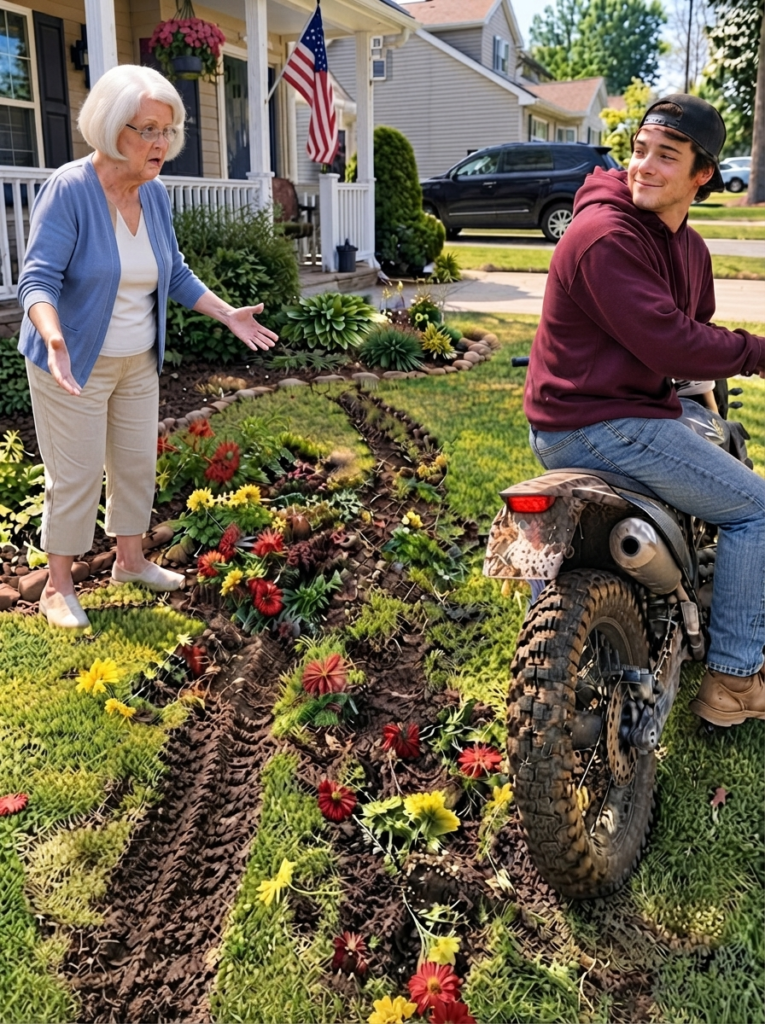
Then I had gone inside.
I hadn’t watched him discover it.
I didn’t need to.
I already knew what it contained.
He finally crouched down.
He picked up the envelope.
It was plain white.
No name.
No return address.
Just three words written across the front in black ink:
LOOK INSIDE.
He glanced toward the houses around him.
Nobody came outside.
The street was unusually quiet.
Then he opened the envelope.
His eyes moved across the first page.
I watched his expression change.
First confusion.
Then disbelief.
Then something I hadn’t seen on his face before.
Fear.
He pulled out the photograph inside.
It was an old picture of my husband standing beside the garden.
The picture had been taken almost twenty-nine years earlier.
He was younger then.
His hair was still dark.
He was kneeling in the dirt with a shovel in his hand, smiling at the camera.
Behind him were the first flowers he had planted.
Red.
Yellow.
The exact same colors I had replanted every spring since.
The young man stared at the photograph for a long time.
Then he turned it over.
There was another message written on the back.
THIS IS WHAT YOU DESTROYED.
He swallowed.
I could see him looking toward my house again.
But this time, he didn’t have that arrogant expression.
He looked confused.
As though he couldn’t understand why a few flowers had suddenly become something much larger.
He pulled another sheet from the envelope.
This one contained a photocopy of an old newspaper clipping.
I had found it years ago.
My husband had been interviewed by the local newspaper when he helped organize the neighborhood’s first community garden project.
There was a photograph of him standing beside several neighbors.
The young man’s eyes stopped on one particular name.
His father.
The boy stared at the clipping.
Then he looked toward his own house.
For the first time, I saw him realize something.
This wasn’t simply about my garden.
His father knew about it.
His family had known about it for decades.
And perhaps that was why the young man suddenly looked so uneasy.
He turned the page over.
There was one final sentence.
ASK YOUR FATHER WHY HE REMEMBERS THIS GARDEN.
The young man stood there for nearly a minute.
Then he shoved everything back into the envelope.
He didn’t start his motorcycle.
Instead, he walked toward his house.
He went inside.
I stepped away from the window.
My hands were trembling.
Not because I regretted what I had done.
Because I knew what was coming next.
I had kept one promise to myself for almost thirty years.
I had never allowed anyone to turn my husband’s memory into something ordinary.
And there was something else the young man didn’t know.
Something I had deliberately left out of the envelope.
Something his father had forgotten.
Or perhaps had simply hoped I had forgotten too.
Twenty minutes later, I heard shouting from across the street.
Not loud enough to make out every word.
But loud enough to know there was an argument.
The young man’s voice came first.
Then his father’s.
Then silence.
A few minutes later, the front door opened.
His father stepped outside.
He was holding the photograph.
He looked across the street.
Straight at my house.
Our eyes met through the distance.
He didn’t look angry.
He looked ashamed.
He crossed the street slowly.
When he reached my gate, he stopped.
For several seconds, neither of us spoke.
Finally, he said,
“Where did you get that picture?”
I looked at him.
“You know where.”
He lowered his eyes.
“That was a long time ago.”
“Yes.”
He nodded.
Then he looked toward the damaged flower bed.
“I didn’t know he did that.”
“You knew what kind of young man he was.”
He didn’t answer.
Instead, he whispered,
“My son doesn’t know what this place meant.”
“No,” I said.
“He doesn’t.”
The man looked back at the photograph.
Then he said something that I hadn’t expected.
“My father helped your husband build that garden.”
I felt my breath catch.
For years, I had believed my husband had created it entirely by himself.
He had always told me it was my anniversary gift.
He had never mentioned that anyone helped him.
But apparently, there was more to the story.
His father had helped carry the stones.
He had helped dig the first beds.
And on the afternoon my husband planted the first flowers, the two men had made a promise.
They had promised that as long as either family lived on that street, the garden would never be forgotten.
I stared at him.
“Why didn’t you ever tell me?”
He looked down.
“Because after your husband died, I thought bringing it up would only make things harder.”
He paused.
Then he looked toward his son’s motorcycle.
“I was wrong.”
I didn’t say anything.
He continued.
“My father died three years ago. Before he died, he asked me to make sure my son understood something.”
“What?”
He looked directly at me.
“He said, ‘That garden isn’t hers alone. It’s part of the history of this street.’”
My throat tightened.
The young man had apparently heard enough.
The front door across the street opened.
He stepped outside.
His helmet was gone.
His hands were empty.
He walked toward us.
Slowly.
For once, there was no engine roaring behind him.
No smug smile.
No careless confidence.
He stopped several feet away.
Then he looked at the garden.
“I didn’t know,” he said.
His voice was barely audible.
I looked at him.
“That’s true.”
He swallowed.
“But not knowing doesn’t make what you did disappear.”
“I know.”
It was the first time I had heard him say those words.
I know.
Not I didn’t mean to.
Not they’re just flowers.
Not I’ll pay for it.
Just:
“I know.”
He looked at the photograph in his father’s hand.
Then at me.
“I want to fix it.”
I shook my head.
“You can’t fix yesterday.”
His face fell.
“But you can decide what you do tomorrow.”
He nodded.
And then he did something I never expected.
He walked to the damaged flower bed.
He knelt down in the mud.
And with his bare hands, he carefully lifted one of the broken plants that was still alive.
He looked at its roots.
Then he looked at me.
“Where does this go?”
I pointed.
He began digging.
And for the first time since he had arrived home from college, the motorcycle stayed silent.
But there was still one thing I hadn’t told him.
One thing that had nothing to do with his father.
One thing that had been sitting inside my house for twenty-nine years.
And before that day was over, he was going to see it.
Because the photograph had only been the beginning.Part 3 — What He Finally Understood
Part 3 — What He Finally Understood
He worked for almost three hours.
At first, he didn’t know what he was doing.
He placed one plant too deep.
Another too close to the edge.
He stepped on a small patch of soil he had just prepared and had to start again.
I corrected him several times.
He listened every time.
No arguing.
No attitude.
No excuses.
His father eventually brought out a pair of gardening gloves.
The young man shook his head.
“I’ll use these.”
He held up his muddy hands.
“I think I should feel what I’m fixing.”
His father looked at me.
I could tell that sentence meant more to him than it sounded.
So I let them work.
By noon, the garden didn’t look beautiful.
Not yet.
There were empty spaces everywhere.
Broken stems.
Exposed roots.
Patches of disturbed soil.
But something had changed.
It was no longer a garden someone had destroyed.
It was a garden someone was trying to rebuild.
That afternoon, the young man came to my front door.
He stood there awkwardly.
“I need to ask you something.”
“What?”
“Why did you leave the photograph for me?”
I smiled faintly.
“Because yelling at you wouldn’t have taught you anything.”
He looked down.
“And the message?”
“Which one?”
“The one saying I should ask my father why he remembered the garden.”
I looked at him carefully.
“Because I wanted you to understand that what you destroyed existed before you.”
He didn’t answer.
I continued.
“That’s something people your age sometimes forget.”
He looked embarrassed.
“You’re right.”
“I wasn’t trying to frighten you.”
He nodded.
“I know.”
“I wanted you to stop and think.”
He took a breath.
“Well…”
He looked toward the garden.
“It worked.”
For the first time, I smiled.
Then I walked back into the house.
“Come with me.”
He followed.
I took him into the hallway.
There was a small wooden cabinet there.
My husband had built it himself.
I opened the bottom drawer.
Inside was a box.
The young man looked at it.
“What’s that?”
“Something I should have shown you yesterday.”
I lifted the box onto the table.
It was old.
The edges were worn.
The lid had faded over the years.
I opened it.
Inside were dozens of photographs.
Letters.
Receipts.
Old gardening notes.
And one small envelope.
The young man picked up a photograph.
It showed my husband standing in the garden on the very first day.
Beside him was his father.
They were both covered in dirt.
Both laughing.
The young man stared at the photograph.
“My dad?”
“Yes.”
He looked at another.
Then another.
His eyes became glassy.
“He never told me.”
“No.”
“Why?”
“Maybe he forgot.”
He shook his head.
“No.”
He looked at the photograph again.
“I don’t think he forgot.”
I waited.
He continued quietly.
“I think he didn’t want me to know.”
“Why?”
“Because he’d been trying to teach me to respect things I didn’t understand.”
He looked ashamed.
“And I wasn’t listening.”
I said nothing.
Sometimes people need silence more than advice.
He opened the little envelope.
Inside was a handwritten note.
The handwriting was my husband’s.
I recognized it immediately.
The young man read it silently.
Then he looked at me.
“What does this mean?”
I took the note.
I hadn’t read it in years.
My husband’s words were simple.
He had written them on the day the garden was completed.
Some things grow slowly.
You don’t notice them changing every day.
Then one morning you look back and realize you’ve spent years building something that matters.
Take care of the things that matter.
I felt tears gather in my eyes.
The young man looked at the words again.
Then he said,
“I think I finally understand.”
I closed the box.
“You don’t have to understand everything.”
He nodded.
“But you do have to learn to respect what isn’t yours.”
“I will.”
He stood there for another moment.
Then he asked,
“Can I ask one more thing?”
“Of course.”
“Would you let me rebuild the whole garden?”
I looked at him.
“Why?”
“Because replacing a few flowers isn’t enough.”
He glanced toward the window.
“I destroyed something you spent years protecting.”
His voice cracked slightly.
“I can’t undo that.”
“No.”
“But maybe I can help make sure it’s still here twenty years from now.”
That sentence stayed with me.
So I nodded.
“All right.”
For the next several weeks, something strange happened on our street.
The motorcycle became quieter.
The young man stopped cutting across lawns.
He started parking properly.
He apologized to the neighbors whose property he had disturbed.
Some accepted his apology immediately.
Others didn’t.
And I understood that.
An apology isn’t a magic eraser.
Sometimes people need time.
Every morning, before he went anywhere, he came across the street and checked the garden.
He watered it.
Removed weeds.
Replaced the plants that couldn’t survive.
He even researched the flowers my husband had originally planted.
One Saturday, he knocked on my door carrying a small paper bag.
“I found these.”
He opened it.
Inside were seeds.
Red and yellow.
The exact colors.
“I thought you might want them.”
I took the bag from him.
For a moment, I couldn’t speak.
Then I said,
“My husband would have liked that.”
He smiled.
“I think I would have liked him.”
“You probably would have.”
There was one final thing I needed to do.
Late that summer, when the garden had begun blooming again, I called him outside.
He stood beside me.
The red flowers were opening along the edge.
The yellow ones filled the center.
It wasn’t exactly the same arrangement.
It couldn’t be.
Too much had happened.
But somehow, it felt right.
He looked at the garden.
“Is it the same?”
I shook my head.
“No.”
He seemed disappointed.
Then I smiled.
“But maybe it isn’t supposed to be.”
He looked at me.
I pointed toward the flowers.
“Your mistake changed it.”
He lowered his head.
“But so did what you did afterward.”
He looked at the garden again.
“And that’s okay?”
“No.”
I paused.
“It’s not okay that you destroyed it.”
He nodded.
“But it’s okay that you learned from it.”
For a moment, neither of us spoke.
Then he said,
“Can I tell you something?”
“Yes.”
“I used to think people like you cared too much about little things.”
I laughed softly.
“I know.”
He smiled.
“But I don’t think they’re little anymore.”
I looked at the flowers.
“They never were.”
That evening, he left his motorcycle parked in his own driveway.
He didn’t ride it.
Instead, he sat on the curb across from my house and watched the garden move gently in the evening breeze.
His father came outside and stood beside him.
Neither spoke.
After a while, the young man said,
“Do you think she’d ever forgive me?”
His father looked toward me through the window.
Then he said,
“She already started.”
I heard them.
But I pretended I hadn’t.
Because forgiveness isn’t always a sentence you say out loud.
Sometimes it’s a flower you decide to plant again.
Sometimes it’s allowing someone who hurt you to help repair what they broke.
And sometimes, after losing someone you loved, you discover that their memory can survive in ways you never expected.
My husband planted that garden for me almost thirty years ago.
I thought I was the only person who remembered.
I was wrong.
The old photograph had survived.
The promise had survived.
The garden had survived.
And, somehow, even after being driven through by someone who thought it was nothing more than flowers and grass…
the meaning had survived too.
A few months later, the garden was blooming again.
Not exactly as it had before.
Something about it was different.
There were a few flowers he had chosen himself.
Red and yellow, just like the originals.
But in the corner, he planted one small white flower.
I asked him why.
He smiled.
“Because your husband planted the first garden.”
He looked at the flower.
“I thought this one should represent what happened after.”
I smiled.
“What does it represent?”
He shrugged.
“Second chances.”
I looked at the garden.
Then at the young man.
And for the first time, I realized something.
The little surprise beside his motorcycle had never been meant to frighten him.
It wasn’t revenge.
It wasn’t punishment.
It was simply a reminder.
A reminder that every careless action leaves something behind.
Sometimes it’s broken flowers.
Sometimes it’s a damaged relationship.
And sometimes…
if you’re lucky enough to recognize it…
it’s the beginning of becoming someone better than the person you were yesterday.
I never replaced the original garden.
I didn’t need to.
Instead, I kept the old photographs in the wooden box.
I kept my husband’s note.
And every spring, I planted the same red and yellow flowers.
Only now, I wasn’t the only one caring for them.
The boy who once said,
“They’re just flowers. They’ll grow back,”
eventually became the person who arrived every spring with a shovel in his hand.
And whenever he planted the first red flower of the season, he always paused for a moment.
Then he would look at me and say,
“These aren’t just flowers.”
And I would smile.
Because now he understood.
They never had been.