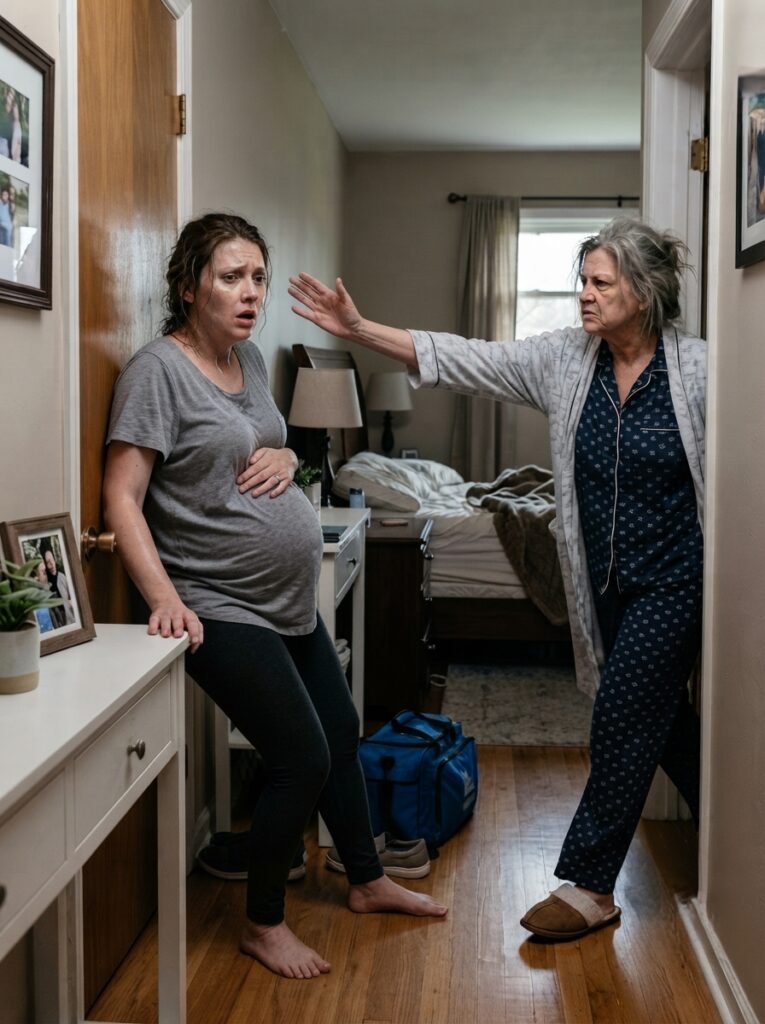
The second responder stepped into the hallway and told my mother-in-law to move away from the bathroom door. She immediately protested that it was her house and that I was too exhausted to know what I was saying.
The first responder never moved from between her and my daughter.
“She stays with her mother,” he said.
For the first time that morning, my mother-in-law had no control over what happened next.
They brought medical equipment into the bathroom. They checked my baby. They examined my wrist. They asked me questions directly, and for the first time since the contractions began, nobody was allowing another person to answer for me.
My mother-in-law tried anyway.
“She panicked,” she said. “She was confused. She had just given birth.”
One of the responders looked at her.
“Ma’am, we need to hear from her.”
My mother-in-law opened her mouth again, but the responder’s attention had already returned to me.
That small change felt bigger than it should have.
For hours, I had been told what was happening to me. I had been told I was dramatic. I had been told the hospital could wait. I had been told to stop making everything an emergency.
Now someone was asking me what I needed.
My daughter was still pressed against my chest, wrapped in the folded towel I had grabbed when I found myself on that bathroom floor. Her cries had weakened into small, uneven sounds, and every time she moved, I instinctively tightened my arms around her.
The responder checked her breathing and color, then looked at me.
“Has she been feeding?”
“No.”
“Any trouble breathing?”
“No.”
“Any bleeding that seems heavier than it should be?”
I hesitated.
The truth was that I barely knew what was normal anymore. My entire body hurt. My lip was split. My wrist was swelling. I had delivered a baby on a bathroom floor because the person who should have helped me had locked me inside.
“I don’t know,” I said.
“That’s okay,” he answered. “We’re going to check.”
My mother-in-law shifted behind him.
“I told her I would take her to the hospital,” she said. “She just refused to listen.”
I looked toward the bathroom doorway.
She was standing there in the same clothes she had worn before sunrise. Her hair was still slightly flattened from sleep. Her expression was irritated rather than frightened, as though the biggest inconvenience that morning was that emergency responders had interrupted her routine.
She had slapped me when I tried to get past her.
She had told me the hospital could wait until she finished sleeping.
She had watched me struggle through contractions.
She had gone back to bed.
And when I crawled into the bathroom because I could no longer stand, she had locked the door.
None of those facts had changed just because she was now speaking calmly.
The dispatcher was still on the line through my phone.
One responder picked it up from the floor.
“Can you give us a summary of what you heard?” he asked.
The dispatcher’s voice came through clearly.
She described the call. She described hearing my newborn cry. She described hearing the bathroom door lock while I was inside alone with the baby. She described hearing my mother-in-law say everything was fine.
My mother-in-law’s face tightened.
“That’s not what happened.”
The responder didn’t argue.
He simply listened to the dispatcher finish.
When the call ended, the bathroom seemed strangely quiet.
My mother-in-law folded her arms.
“She was emotional,” she said. “Anyone would be after giving birth.”
The responder looked at my split lip.
Then at my wrist.
Then at the door.
“What happened to your face?” he asked me.
“My mother-in-law slapped me.”
My mother-in-law immediately stepped forward.
“I barely touched her.”
The responder raised a hand.
“Please let her answer.”
I swallowed.
“She slapped me because I tried to leave the room.”
“Why were you trying to leave?”
“Because I was having contractions and I wanted to go to the hospital.”
My mother-in-law gave a short, frustrated laugh.
“She wasn’t in active labor when she first said it. She always panics.”
I looked at her.
“You told me the hospital could wait.”
“You were overreacting.”
“You hit me.”
“I was trying to calm you down.”
“You locked me in the bathroom.”
Her expression changed.
Only slightly.
But the responder saw it.
“I locked the door because I didn’t want her wandering around the house,” she said. “She was confused.”
The responder looked at the bathroom lock.
Then at me.
Then back at her.
“She had a newborn with her.”
“I didn’t know the baby was going to arrive that quickly.”
“But you knew she was in labor.”
My mother-in-law stopped answering.
The silence did more than an argument could have.
A few minutes later, they helped me stand.
My legs shook beneath me.
One responder steadied my shoulder while another carefully supported my baby. I refused to let go for long. Even though my arms were exhausted, I needed to feel her against me.
“She stays with me,” I said.
“She will,” the responder told me.
My mother-in-law heard him.
“I’m her grandmother.”
No one answered.
She tried again.
“I have every right to be involved.”
The responder turned toward her.
“Right now, our priority is the mother and newborn.”
My mother-in-law’s jaw tightened.
I had never seen anyone speak to her that way.
Not in her house.
Not at family gatherings.
Not when she criticized how I cooked, how I dressed, how I handled pregnancy, or how often I called my own family.
She had always spoken as if being older meant being unquestionable.
That morning, it suddenly meant nothing.
They moved me toward the front of the house.
I could hear the ambulance equipment outside. Doors opened and closed. Footsteps crossed the porch. Voices spoke quickly but calmly.
My mother-in-law followed.
“You don’t understand,” she said. “She needs family.”
I stopped.
For a second, I almost turned around.
Then I remembered crawling across that freezing tile with my daughter beside me.
I remembered whispering into the phone because I was afraid she would hear me.
I remembered the dispatcher asking whether my baby was crying.
I remembered answering yes while wondering whether either of us would be okay.
I kept walking.
At the ambulance, a responder helped me sit.
He checked my wrist again and gently examined the swelling.
“It needs to be evaluated,” he said.
I nodded.
My baby was placed safely beside me while another responder continued checking her.
Then the first responder asked a question that made me realize the situation was about to change again.
“Is there someone you trust who can meet you at the hospital?”
I thought immediately of one person.
My sister.
She lived close enough to get there quickly, and unlike my mother-in-law, she would never tell me that pain was an inconvenience.
I gave him her name.
My mother-in-law heard it.
“You called her?”
I shook my head.
“I didn’t.”
The responder already had my phone.
He made the call.
It rang twice.
Then my sister answered.
Her voice came through the speaker.
“What happened?”
The responder briefly explained that I had delivered a baby unexpectedly at home and that I was being taken to the hospital for evaluation.
My sister went silent.
Then she asked, “Is she safe?”
“She and the baby are conscious and being evaluated.”
“And who is with her?”
The responder glanced toward me.
“I’m with her. Another responder is with us.”
My sister asked one more question.
“Is her mother-in-law there?”
I closed my eyes.
The responder looked toward the porch.
“Yes.”
My sister’s voice changed.
“Tell her not to leave that house before I get there.”
My mother-in-law heard every word.
For the first time that morning, she looked genuinely unsettled.
She stepped toward the ambulance.
“You have no right to tell me what to do.”
My sister answered through the phone.
“I wasn’t talking to you.”
My mother-in-law froze.
The responder looked at me.
“You want her to come to the hospital?”
“Yes.”
“Then we’ll make sure she knows where you are.”
My mother-in-law stared at me.
“You’re really doing this?”
I didn’t understand the question.
Doing what?
Going to the hospital after giving birth?
Getting my wrist examined?
Letting someone know I had been hit?
Making sure my newborn was safe?
I looked down at my daughter.
She had finally gone quiet.
Her tiny hand had curled around one of my fingers.
“No,” I said softly. “You did this.”
My mother-in-law’s face hardened.
“You’re going to destroy this family over one mistake.”
The responder immediately stepped closer.
“Ma’am.”
She stopped.
“This isn’t the time.”
The ambulance doors closed.
For the first time since the contractions began, there was a barrier between my mother-in-law and me.
I sat there holding my daughter, listening to the engine start.
I should have felt relieved.
Instead, I felt something more complicated.
I felt afraid.
Because leaving the house meant leaving the place where she had controlled the story.
At the hospital, there would be nurses. Doctors. Records. Questions. People who hadn’t spent years listening to her version of everything.
And once I answered those questions honestly, there would be no way to put the morning back the way it had been.
My sister arrived before the ambulance reached the emergency entrance.
She was waiting near the doors when we pulled in.
The moment she saw me, her face changed.
She looked at my lip.
Then my wrist.
Then the baby.
She didn’t ask whether I was sure.
She didn’t ask whether I had misunderstood.
She simply walked beside me.
“I’m here,” she said.
Those three words nearly broke me.
Inside, the hospital staff took over.
They examined my baby first, then me. They checked my wrist, documented the visible injury to my lip, and asked how the delivery had happened.
I told them.
Every time I started to soften a detail, my sister reminded me gently to keep going.
“Tell them exactly what happened.”
So I did.
I told them about the contractions.
I told them I wanted to leave.
I told them my mother-in-law slapped me.
I told them my wrist began swelling.
I told them I crawled into the bathroom.
I told them my daughter was born there.
I told them the door locked.
And I told them my mother-in-law had gone back to bed.
The nurse writing everything down never once looked shocked enough to make me feel ashamed.
She just kept documenting.
That mattered.
Because until that morning, I had thought documentation was something that happened to other people. People in television dramas. People with complicated lives. People who had already decided they were going to fight.
I hadn’t decided anything.
I had only wanted to get to a hospital.
But sometimes a person doesn’t choose the moment when the truth becomes unavoidable.
The moment chooses them.
Later, my sister told me what happened at the house.
My mother-in-law had tried to explain everything before anyone could question her.
She said the delivery had been unexpected.
She said I was emotional.
She said the slap was nothing.
She said the locked bathroom door was for my own safety.
But this time, there were other people listening.
There was the emergency call.
There was the dispatcher.
There were responders who had seen the condition I was in.
There was my injury.
There was the newborn.
And there was the fact that she had been given every opportunity to help me before the responders arrived.
Instead, she had chosen to minimize what was happening.
My sister told me that my mother-in-law eventually stopped talking.
She sat in the living room waiting.
Not because she had suddenly understood everything.
Not because she had apologized.
But because, for the first time, she couldn’t control who knew what she had done.
That was the first consequence.
Not revenge.
Not a dramatic confrontation.
Just the loss of privacy she had relied on to make her version of events sound like the only version.
That evening, after the doctors had finished evaluating me and my daughter, I finally had a quiet moment.
My wrist was supported.
My lip had been treated.
My baby was sleeping beside me.
My sister sat in the chair near the window.
I stared at my daughter’s face for a long time.
She had entered the world in a bathroom, wrapped in a towel, while I was terrified and alone.
But that wasn’t going to be the story I gave her.
Her first moments did not belong to the person who had hurt me.
They belonged to her.
And they belonged to me.
The next morning, my sister brought my phone into the room.
There were messages waiting.
Some were from relatives who had heard something had happened.
Some were from people asking if the baby was okay.
And one was from my mother-in-law.
It said she wanted to talk.
I looked at the screen.
My sister watched me.
“You don’t have to answer.”
I knew that.
For the first time, I actually knew it.
I put the phone face down.
A few minutes later, another message appeared.
Then another.
The tone changed from concern to accusation.
I was embarrassing the family.
I was exaggerating.
I was making a private family matter public.
I was letting strangers turn one bad morning into something bigger.
I read each message without responding.
Then my sister noticed something I hadn’t.
“The dispatcher was still connected when they arrived,” she said.
I nodded.
“That means she heard it.”
“Yes.”
“And the responders saw you.”
“Yes.”
My sister took a breath.
“Then you don’t have to convince anyone who matters.”
I looked at my daughter.
That sentence stayed with me.
I had spent so much time thinking I needed to prove what had happened that I hadn’t realized the most important thing had already happened.
Someone had heard me.
Someone had come.
Someone had seen me.
And when my mother-in-law reached for my baby, someone had stepped between us and said no.
That was the moment the balance changed.
Not because I became stronger overnight.
Not because I suddenly stopped being afraid.
But because the door that had been locked from the outside was no longer the only door in my life.
There were people on the other side now.
People who believed what they heard and saw.
People who could help.
People who would ask questions my mother-in-law could not answer for me.
And there was my daughter, sleeping peacefully after entering the world in the middle of a crisis she would never remember.
I held her hand.
Then I finally answered the question I had been too afraid to ask myself all morning.
What happens now?
I didn’t know everything yet.
But I knew one thing.
I was not going back into that bathroom.
And I was not going to let anyone lock the door again.