The officer held his phone between us and asked me to verify the timestamp before he played anything else. The date was from three days before the choking. He watched the first few seconds himself, his face tightening, then angled the screen toward me.
“Watch what she does after you leave,” he said.
The clip began with me standing beside our son’s high chair.
I remembered the morning immediately. I had been late for work. My wife was cutting breakfast into small pieces while I kissed our son on the head and hurried toward the kitchen door.
On the video, I disappeared from view.
My wife waited.
Not long. Maybe ten seconds.
Then she put down the spoon she had been using and grabbed our son’s jaw.
My stomach turned.
It wasn’t as violent as what I had walked in on that night. That almost made it worse. There was no sudden loss of control, no chaotic emergency, no moment that could be explained as panic.
She looked calm.
Our son twisted his face away from the food. She pulled him back by the chin, pressed his cheeks between her fingers, and pushed another bite into his mouth while he cried.
When he spit some of it onto his bib, she immediately forced another bite between his lips.
I reached for the phone without thinking.
The officer pulled it slightly back.
“There’s more,” he said.
I didn’t want there to be more.
He played another clip from the same morning. My son was crying hard enough that his shoulders shook. My wife kept one hand around his jaw while she wiped the tray with the other. Then she leaned close and said something the camera microphone barely caught.
The officer raised the volume.
“You are going to eat,” she told him.
My hands went cold.
I remembered coming home that evening and noticing a red mark under his chin.
She had blamed his bib.
The child-protection worker stood beside me without interrupting. When the clip ended, she asked the officer whether the home team had found anything from other days.
He nodded.
“They’re downloading the available recordings now.”
Available recordings.
The phrase landed harder than I expected because it meant this was no longer one terrible night and one disturbing clip.
It meant there might be a record.
My wife had been moved to another treatment area because of the injury to her head. I could hear voices beyond the hallway, but I couldn’t see her.
For a few minutes, nobody said anything to me.
Then the pediatrician returned.
He had reviewed the video with the child-protection worker. He explained that the varying colors and tenderness around our son’s jaw were consistent with injuries occurring at different times. He wouldn’t tell me exactly when every mark had been made. He didn’t need to.
The recordings were beginning to answer that question for him.
I sat beside my son’s hospital crib and watched him sleep.
His mouth was slightly open. Every few breaths, his fingers curled and relaxed against the blanket.
I kept seeing all the moments that had seemed harmless when they happened.
The vomiting.
The sudden terror at the high chair.
The marks beneath his chin.
My wife’s complaints that he was becoming “difficult” about food.
I had treated each thing like a separate problem because she had handed me a separate explanation for each one.
The camera was putting them back together.
An hour later, a detective came to the hospital.
He told me they had recovered several clips worth reviewing. He also told me something I already knew but had been trying not to think about.
The same camera that recorded my wife had recorded me.
It had captured the pan.
For the first time that night, I felt afraid for myself.
Not because I regretted stopping her.
Because video doesn’t feel fear. It doesn’t know what you thought someone was about to do. It only shows bodies moving.
The detective asked whether I wanted an attorney before giving another statement.
I told him I would answer what I could, but I wanted to see the recording first.
He agreed.
The home camera had captured the breakfast nook from above and slightly behind the high chair.
I watched myself enter the frame.
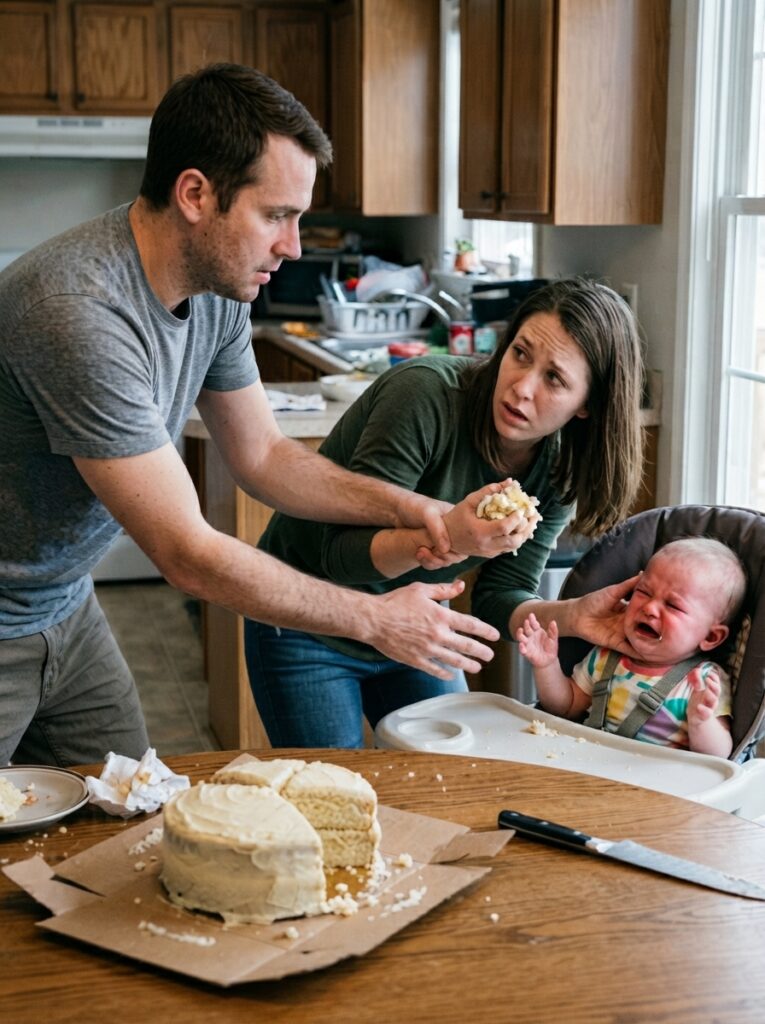
My wife had our son’s face trapped between her fingers. His head was pushed backward. A chunk of cake was already in his mouth, and she was forcing another piece toward him while he struggled.
Then I appeared.
I froze for less than a second.
I grabbed the pan.
I struck her once.
She dropped away from the chair.
I threw the pan down immediately, pulled our son free, and put my finger into his mouth.
The detective stopped the video there.
“Why did you use the pan?”
“Because her hand was on him and he couldn’t breathe.”
“Did you consider pulling her away?”
“No.”
That answer seemed to surprise him.
“Why not?”
“Because I wasn’t thinking about her. I was looking at his face.”
He let the silence sit for a moment.
Then he resumed the recording.
The blockage came out. I pulled our son against me. My wife moved on the floor. I grabbed my phone.
There was no second strike.
I never moved toward her again.
The detective watched the entire sequence twice.
Then he asked for the recording from several minutes earlier.
That was the first reversal I hadn’t expected.
The worst evidence against my wife wasn’t what happened after I came through the door.
It was what happened before.
The camera showed her feeding our son normally at first. He accepted two bites. On the third, he turned away.
She tried again.
He turned farther.
She gripped his chin.
He started crying.
She pushed food into his mouth anyway.
There was no confusion about whether he was refusing. No sudden choking that caused her to panic and grab him. The sequence moved in the opposite direction.
He resisted first.
She became rougher after he resisted.
By the time I walked in, the situation I had interrupted had been building for several minutes.
The detective didn’t tell me what that meant legally.
He simply wrote something down.
Later that night, the officers reviewing the cloud recordings found four more feeding incidents over the previous two weeks.
Not every one involved visible bruising. In one clip, my wife stopped when our son began coughing and lifted him out of the chair. For a few seconds, watching that made me want to believe there was still some boundary she hadn’t crossed.
Then the next clip played.
She waited until he stopped coughing, put him back into the chair, and started again.
In another recording, he turned his head when she approached with a spoon. She gripped the back of his neck to hold him still.
Then something changed at the edge of the frame.
I walked into the kitchen.
Her hand released him instantly.
Her entire posture changed.
She wiped his face, smiled at me, and lifted him from the chair.
The audio caught my voice asking why he was upset.
“He’s tired,” she answered.
I remembered believing her.
That was the moment the child-protection worker stopped watching the screen and looked at me instead.
“Did you ever see her hold him like that?”
“No.”
“Did she ever tell you she was doing it?”
“No.”
“Did she ever ask you for help because feeding was making her angry?”
“No.”
Every answer felt like an accusation even though the worker wasn’t accusing me.
I had lived in the same house.
I had eaten at the same table.
I had installed the camera myself.
And somehow my son had learned to be afraid of a chair before I learned why.
Near midnight, my wife’s mother arrived.
She had spoken to my wife first.
She came toward me furious, demanding to know how badly I had injured her daughter. An officer stepped between us before the argument could become anything more.
“She said you lost control,” her mother told me. “She said you’ve been angry for months.”
I didn’t answer.
The detective did.
He asked her whether my wife had ever talked to her about feeding problems.
Her expression changed.
“Every baby is difficult about food.”
“That wasn’t my question.”
She hesitated.
Then she said my wife had complained that our son embarrassed her by refusing meals, especially when other family members were around. She had told her mother she felt judged because he wasn’t eating as much as other babies she knew.
Her mother immediately tried to soften it.
“She was worried about him. That’s all.”
For several hours, I believed that might become my wife’s defense—that everything she had done would be reframed as desperate concern.
Then the pediatrician asked for her claim about our son’s eating to be checked against his medical record.
There was no instruction telling us to force food into him.
There was no warning that he was failing to grow.
There was no treatment plan requiring the behavior on those recordings.
The pediatrician had documented ordinary feeding guidance and told us to follow our son’s cues.
My wife had turned her own fear and frustration into a rule the rest of us had never been told existed.
By morning, I thought the camera evidence had settled the only question that mattered.
I was wrong.
The child-protection worker came back with a supervisor and told me our son would not automatically be released home with me.
I stared at her.
“You saw the video.”
“I did.”
“Then you know what happened.”
“I know what the video shows. I also know there was serious violence between two adults in the home, and the investigation isn’t finished.”
For the first time since my son had started breathing again, I felt the floor disappear under me.
I had spent the entire night believing that if I told the truth completely, the truth would lead in a straight line.
It didn’t.
They needed a safe discharge plan.
My wife couldn’t take him.
I wasn’t being told I had lost custody, but I also wasn’t being promised that I could simply carry him through our front door.
I called my older sister.
She lived forty minutes away. She had met the worker before sunrise, answered questions, opened her home for an emergency safety check, and agreed without hesitation that our son could stay with her if necessary.
I hated asking.
She didn’t let me apologize.
“Get him safe,” she said. “We sort out the rest after.”
That became the plan for the next few days.
It felt like losing even though I understood why they were doing it.
My wife was eventually moved from medical care into a separate interview with investigators.
At first, she kept the same story.
She had only been trying to feed him.
I had misunderstood.
The bruises could have come from normal play.
The cake had been an accident.
Then the detective showed her the older clips.
Her explanation shifted.
She said she had become frustrated.
She said she had been exhausted.
She said I didn’t understand what it was like being alone with a baby who refused to cooperate.
The detective kept bringing her back to one question.
If she believed what she was doing was ordinary feeding, why did she stop the instant I entered the room?
She had no answer they considered convincing.
Then investigators found one clip that nearly hadn’t been noticed.
It wasn’t dramatic.
There was no screaming.
Our son wasn’t even in the high chair yet.
My wife walked into the breakfast nook alone, looked directly toward the camera, reached up, and rotated it several inches toward the kitchen wall.
Most of the high chair remained visible, but the area where she normally stood beside it was partially blocked.
Hours later, she turned the camera back.
The detective asked her why.
She said she had been cleaning.
He showed her another date.
Same movement.
Another feeding session.
Another adjustment afterward.
That was the false ending I had been waiting for without realizing it. Until then, part of me had still been searching for some version of events where my wife had become overwhelmed and crossed a line she hadn’t understood.
The camera adjustments destroyed that version.
She had understood enough to hide where she stood.
The final break came that afternoon.
The detective played the incident from three days earlier again. He paused at the moment my wife heard the kitchen door opening.
Her fingers were still around our son’s jaw.
Then she heard me.
Her hand vanished.
She wiped his face before I entered.
The detective asked her one last time why she concealed the behavior from me.
For a long while, she said nothing.
Then, according to the statement later summarized for me, she stopped calling it normal feeding.
“Because he would have made me stop,” she said.
That sentence changed everything for me.
Not because it was louder or crueler than anything on the recordings.
Because it answered the question underneath all of them.
She knew I would object.
She knew she needed me not to see.
And she kept doing it anyway.
The medical findings, the videos, and her changing statements were turned over to investigators and prosecutors. A court order prevented her from having unsupervised contact with our son while the case moved forward.
My use of the pan was reviewed separately.
For several weeks, I didn’t know whether that single strike would become a criminal charge against me. I had meant what I told the first officer: saving my son didn’t give me permission to pretend I hadn’t hit someone.
Eventually, I was notified that no charge would be filed against me based on the full recording, the medical evidence, and the circumstances shown on video.
That decision didn’t make the night feel cleaner.
Nothing did.
My son stayed with my sister briefly while the safety plan was completed. I spent every hour I was allowed with him. I learned how quickly he tensed when a spoon came toward him and how much patience it took before he stopped watching every adult hand near his face.
We followed the pediatrician’s feeding plan exactly.
If he turned away, the food stopped.
If he cried, we comforted him instead of treating the crying like disobedience.
Weeks passed before he could sit in the high chair without immediately reaching for someone to pick him up.
The first time he stayed there calmly through an entire meal, nobody celebrated loudly.
My sister and I just looked at each other across the table.
He picked up a soft piece of food by himself, inspected it with enormous seriousness, and dropped it on the floor.
I laughed before I could stop myself.
So did my sister.
Months later, after his doctor had cleared the foods we were giving him and mealtimes had become ordinary again, there was cake at a family gathering.
For a second, seeing it on the table took me straight back to that night—to the purple in his face, the piece in my palm, the silence before he breathed.
Then my son reached toward the plate.
I broke off a tiny soft piece and set it on his tray.
I didn’t put it into his mouth.
I didn’t coax him.
I didn’t tell him to finish it.
He touched it with one finger, crushed it into crumbs, tasted one, and decided most of the rest belonged on his shirt.
This time, the cake was just cake.
And the choice of whether to eat it belonged to him.