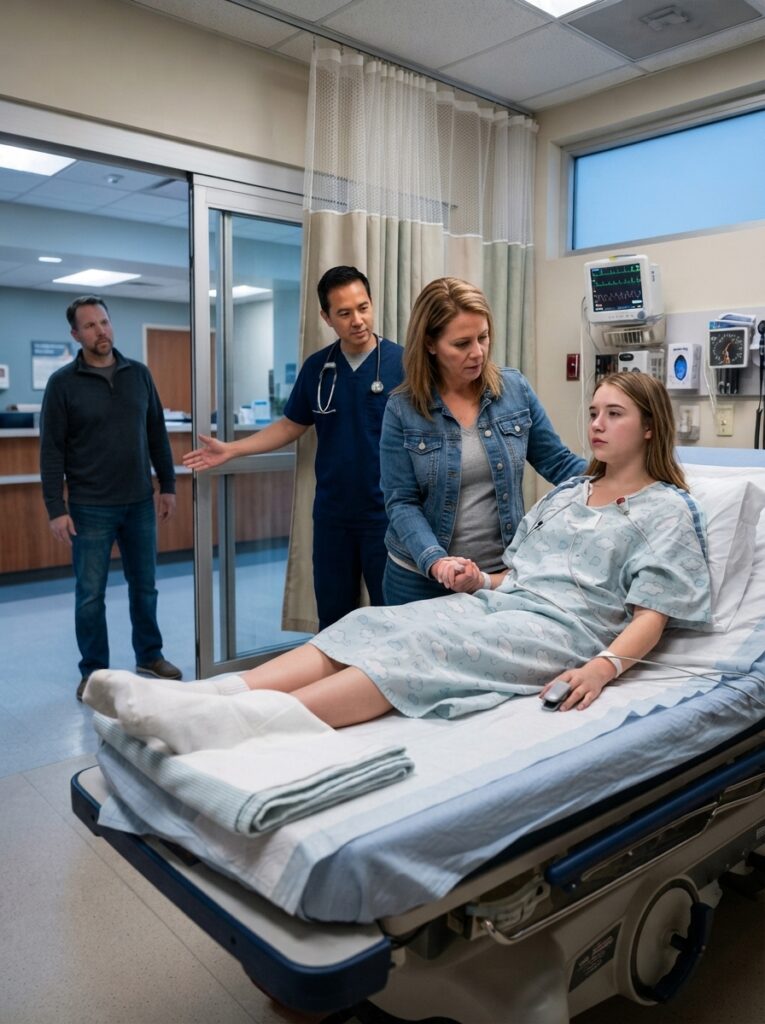
As the operating-room doors closed around Emily’s bed, I could still hear Michael at the far end of the corridor insisting that her cracked phone belonged to him.
A security officer stepped between us. Michael kept his voice controlled, the way he always did when strangers were watching.
“That’s my daughter’s property,” he said. “My wife is upset. She doesn’t understand what she’s doing.”
For years, that tone had worked on me. It made me search my own memory for whatever mistake I must have made.
That morning, it only made me hold Emily’s phone tighter.
The screen was still awake. Before the surgical team had taken her, Emily had pressed it into my hand and whispered that there was something on it because she thought nobody would believe her.
Now her father was more interested in getting the phone than following the daughter who had just been rushed into emergency surgery.
I looked at the officer.
“Please don’t give this to him.”
Michael’s expression changed for half a second.
Not anger.
Fear.
Then it was gone.
“Sarah,” he said, “you’re making a scene.”
The officer asked him to step away from the surgical area. Michael refused once, then twice, until another security employee joined them. He finally backed toward the elevators, pointing at me as though I were the dangerous one.
“When she wakes up,” he said, “she’s going to tell you she made a mistake.”
I watched the elevator doors close on him.
Then I sat down beneath fluorescent lights and opened my daughter’s phone.
There was a folder inside her photo app labeled CHEM NOTES.
It contained no chemistry.
The first image was a photograph of a school health-office form dated two days earlier. Emily had taken the picture at an angle, probably while the paper rested on her lap.
Her temperature had been recorded above 102. The notes mentioned repeated vomiting and worsening pain on the lower right side of her abdomen. At the bottom was a recommendation that she receive prompt medical evaluation.
Beside the pickup line was Michael Bennett’s name.
He had signed her out of school.
My stomach tightened.
I kept scrolling.
The next item was an audio recording made inside our car that afternoon.
At first there was only road noise.
Then Emily’s voice.
“Dad, the nurse said I need to go somewhere.”
Michael answered immediately.
“The nurse doesn’t pay our bills.”
“It really hurts.”
“You were walking when I picked you up. You’re fine.”
“Can you tell Mom?”
There was a pause.
Then his voice became quieter.
“No. And neither will you. She’ll panic, waste money, and turn this into another crisis. Go home, lie down, and stop feeding it.”
Emily started crying.
“What if it gets worse?”
“Then maybe you’ll learn the difference between discomfort and an emergency.”
The recording ended less than a minute later.
I stared at the phone until the letters on the screen blurred.
He had known.
Not vaguely. Not because he had watched her vomit at home. He had picked her up from the school health office after being told that she needed medical attention.
Then he had come home and told me she was pretending because she had a test.
A hospital social worker named Dana sat beside me after security reported what had happened at the entrance. I showed her the photograph and played the recording once.
She didn’t tell me what to feel. She didn’t ask why I had stayed with Michael or why I had believed him for so long.
She simply said, “Don’t delete anything.”
A police officer arrived to document Michael’s threatening text and the confrontation at the hospital. He asked me to send copies where they could be preserved, but told me to keep the original phone unchanged.
While he was speaking, my own phone vibrated.
It wasn’t Michael.
It was an alert from our bank.
A large transfer had been made from the savings account where both of our paychecks had accumulated for years.
I opened the banking app.
My password no longer worked.
Michael had spent years checking grocery receipts, questioning cash withdrawals, and telling me that letting him manage the accounts was simply more efficient. Even the emergency money hidden between the towels existed because I had started taking ten or twenty dollars back from my own paycheck whenever I thought he wouldn’t notice.
Now, while Emily was in surgery, he was doing exactly what he had always taught me he could do.
He was closing his fist.
Dana saw my face change.
“What happened?”
I showed her the alert.
“He moved the money.”
Saying it aloud should have terrified me.
Instead, something settled inside me.
The threat wasn’t abstract anymore. Neither was the pattern.
Michael had dismissed Emily’s pain, hidden the school warning from me, threatened me for taking her to the hospital, demanded the phone containing evidence, and begun moving money the moment hospital staff stopped him from controlling the room.
For the first time, I could see the whole shape of our life instead of examining each incident separately and asking whether I was overreacting.
A surgeon came through the double doors before sunrise.
I stood so fast the forgotten cup of vending-machine tea beside my chair tipped against the wall.
“Emily is out of surgery,” he said.
My knees weakened.
“Is she okay?”
“She’s stable.”
I heard only that word at first.
Then he continued.
Her appendix had perforated. The infection was more extensive than they had hoped, and she would need strong antibiotics and close observation. He said the delay had made a dangerous situation significantly worse.
“But she’s here,” he told me. “We were able to treat her.”
I covered my mouth with both hands.
Three days.
Three days of vomiting, fever, and pain while the man in our house told us she was dramatic.
The surgeon walked away, and I sat down again because my legs could no longer hold me.
A few minutes later, my phone rang from an unfamiliar local number.
It was Emily’s school nurse.
She had learned from an attendance notification that Emily had been hospitalized and wanted to know what had happened.
When I told her about the surgery, she went silent.
Then she said, “I told her father she needed to be evaluated that day.”
“I know. Emily took a picture of the form.”
The nurse exhaled sharply.
She explained that Emily had arrived at her office pale, feverish, and hunched over. Michael had come to collect her. The nurse had urged him to take Emily directly for medical evaluation.
He had assured her that he would.
“I believed him,” she said. “I shouldn’t have assumed.”
It was the only mistake she had made, but it mattered.
She sent the school record to the appropriate hospital contact and later provided the same information when investigators asked for it.
That record changed something important.
Michael could no longer claim he had merely misunderstood a teenager complaining about a stomachache.
There was a dated warning.
His signature was attached to it.
And Emily’s recording captured what he did after receiving it.
By midmorning, security told me Michael had left hospital property. Dana helped me speak with a domestic-violence advocate from a local service organization. I hated the phrase when she first said it.
Domestic violence.
Part of me still wanted another word. Something smaller. Something that would let me keep the architecture of my old life standing.
But I thought of Emily whispering, “Don’t tell Dad,” while barely conscious on our bathroom floor.
I stopped arguing with the words.
When Emily woke later that afternoon, I was sitting beside her bed.
Her face was swollen with exhaustion, and several monitors blinked quietly beside her. She moved one hand beneath the blanket, searching.
I took it.
Her eyes opened.
“Is he here?”
“No.”
She watched me carefully.
“Did he get my phone?”
“No. I have it.”
Her shoulders loosened against the pillow.
I wanted to ask a hundred questions, but I forced myself to wait until she was fully awake and the medical staff said she was able to talk.
Later, with a nurse nearby, I asked the one question that had been burning through me since the emergency room.
“Emily, when you said he knew why it hurt, what did you mean?”
She stared at the blanket for several seconds.
Then she looked at me.
“I wasn’t saying he made me sick.”
Her voice was weak but clear.
“I was saying he knew I was sick.”
I said nothing.
“The school nurse told him something could be seriously wrong. I begged him to take me somewhere. He said if I told you, you’d make everything worse.”
She swallowed.
“Then when you asked what was wrong with me, he kept answering before I could.”
I remembered every one of those moments.
Michael saying she was stressed.
Michael saying she wanted to avoid a test.
Michael saying I made her weak by babying her.
He hadn’t just ignored Emily.
He had stood between us and translated her pain until I stopped hearing her directly.
“Why did you record him?” I asked.
Emily looked toward the cracked phone on the bedside table.
“Because he always says things didn’t happen the way I remember them.”
That sentence broke something open in me.
Michael had done the same thing to me for years.
A receipt wasn’t evidence that I had bought groceries. It was evidence that I spent too much.
A question wasn’t a question. It was disrespect.
His shouting wasn’t shouting. I was sensitive.
His control of my paycheck wasn’t control. He was better with money.
And whenever I remembered something differently, he could keep talking until I became less certain than he was.
Emily had started making recordings because she needed somewhere her memories couldn’t be argued with.
I squeezed her hand.
“I believe you.”
Her eyes filled immediately.
“Even if there’s stuff on there about you?”
I froze.
“What stuff?”
She told me to open the folder again.
Below the hospital recording were several shorter clips. In one, Michael mocked me after I had questioned a charge on our account. In another, he warned Emily never to “take my side” because I couldn’t manage anything without him.
There were screenshots of messages he had sent Emily after arguments between us.
Don’t encourage her.
She gets confused when she’s emotional.
Tell me if she tries to move money again.
My fifteen-year-old daughter had been turned into an observer inside her own home.
Michael wasn’t simply controlling each of us separately.
He had been teaching us to monitor one another for him.
That was the moment I stopped wondering whether I could somehow repair the marriage if he apologized enough.
There was nothing left to negotiate.
The next few days were not a clean victory.
Emily developed another fever after surgery, and for several frightening hours the doctors worried that the infection was not responding quickly enough. Her antibiotics were adjusted, and we waited through a long night while I watched the numbers on the monitor instead of sleeping.
At dawn, her temperature finally began to fall.
She opened her eyes and found me sitting in the same chair.
“You stayed,” she whispered.
“I’m staying.”
That promise meant more than staying beside a hospital bed.
While Emily recovered, I changed the direct deposit for my future paychecks. I opened an account in my own name. With help from an advocate and an attorney, I began the process of separating our finances and seeking protection for Emily and myself.
Michael sent messages from unfamiliar numbers.
Some were angry.
Some were apologetic.
Some sounded almost reasonable.
He said the hospital had frightened everyone. He said he had been trying to keep us calm. He said moving the money was necessary because I was “not thinking clearly.”
I saved every message and stopped answering.
The temporary court restrictions that followed were not based on one dramatic sentence in an emergency room. They were supported by the threat Michael sent me, the hospital incident, Emily’s recordings, the school health record, and our statements about what had been happening inside the house.
When Michael later claimed he had never understood how sick Emily was, the school record remained there with his signature.
When he claimed Emily had invented the conversation because she was angry with him, the audio remained there with his voice.
When he claimed I had suddenly turned our daughter against him, the dates showed that Emily had been collecting evidence before I even understood what she was afraid of.
The cracked phone did what Emily had hoped it would do.
It made denial harder.
But the phone wasn’t what saved her.
Emily saved herself when she recorded what was happening. The school nurse’s documentation helped. The doctor who noticed her fear helped. The hospital staff who refused to let Michael control the room helped.
And eventually, I did what I should have done much sooner.
I listened to my daughter without asking Michael to explain her to me.
Emily remained in the hospital for more than a week. Her recovery continued at home afterward, although “home” was no longer the house Michael controlled.
For a while, we stayed with my sister. Emily slept in the small guest room beneath a quilt she had owned since childhood, and I slept on the couch outside because the first few nights she woke whenever a car door closed on the street.
Gradually, that stopped.
She returned to school part-time before going back to a full schedule. She met regularly with a counselor. I started seeing one too.
I filed for divorce.
There was no satisfying moment where Michael suddenly admitted everything and apologized in exactly the right words.
People who spend years controlling the story rarely surrender it because someone finally proves them wrong.
He continued to describe himself as the responsible parent and me as unstable.
The difference was that I no longer needed his version of me to make sense.
Months later, Emily and I moved into a small apartment of our own.
The first week, I caught myself saving grocery receipts in a neat stack on the kitchen counter.
Nobody had asked for them.
Nobody was going to inspect them.
I threw them away.
One Saturday morning, Emily came out of her room holding the old cracked phone.
By then the evidence investigators needed had been preserved, and she had transferred her photographs and contacts to a replacement device.
She turned the old phone over in her hands.
“Do we still need this?”
“Not for everyday life,” I said. “Why?”
She looked at the fracture running across the screen.
For months, she had guarded that phone while she was sick, while she was frightened, and even while she was collapsing beside the shower. I had once thought she was protecting a teenager’s private messages.
Now I understood that she had been protecting the only witness she believed couldn’t be intimidated.
I asked if she wanted me to store it with the rest of the records.
Emily shook her head and placed it in my hand.
“Keep whatever they still need,” she said. “I don’t need it to remember the truth anymore.”