My Cruel Parents Treated My Battle Scar Like A Disease And Rejected Front-Row Seats To My Pentagon Ceremony . They Expected Me To Suffer In Humiliated Heartbreak… Until A Four-Star General Awarded Me The Silver Star And Those Empty Chairs Sparked A Consequence To Expose Their Betrayal And Unleash Their Devastating Downfall!
Part 2
“When was the last time any of them asked what you needed?”
I did not answer because the honest answer embarrassed me. They asked whether I was safe, but only after discussing a payment. They asked when I was coming home, but usually because Victor needed help with a project or Diane wanted me present for a family photograph.
Naomi did not tell me what to do. She simply sat beside me until the night air turned cold. Before leaving, she tapped the pocket where I kept Ruth’s note.
“You already know what love looks like,” she said. “That is why the other thing hurts.”
During my second deployment, the demands became automatic. I established monthly transfers to my parents because handling individual emergencies from a combat zone became exhausting. The amount began at $800 and eventually climbed to $2,500.
Victor called it my contribution to the family. Diane said successful children did not abandon the people who raised them. Brielle stopped saying thank you because she had come to view the money as part of her own income.
I told myself it was temporary. I told myself Brielle would find stable work, Victor would recover his business, and my mother would eventually become embarrassed by taking money from a deployed daughter. I told myself many things because the truth was harder to carry than my medical pack.
The truth was that my family had turned my longing for approval into an income stream.
That truth finally reached me inside a medical tent in eastern Syria. Our convoy had been hit by a roadside blast earlier that afternoon, followed by rifle fire from a ruined building. I had climbed from the armored vehicle to reach a wounded communications specialist when a piece of metal sliced through my upper arm.
The wound was deep enough to damage muscle but not the artery. I packed it, finished treating the specialist, and refused evacuation until everyone else was stable. By sunset, another medic had me seated under harsh white lights while he irrigated sand and fabric fibers from the torn flesh.
My phone vibrated inside my vest.
I ignored the first call. It rang again, then a third time. Seeing my father’s name, I assumed Ruth might be sick or something terrible had happened at home.
I answered with my uninjured hand.
“Evelyn, I need you to transfer two thousand today,” Victor said. “Not tomorrow. Today.”
I stared at the blood running toward my elbow while the medic prepared another injection of anesthetic. “What happened?”
“Brielle has a fashion event in New York. She needs the deposit for the hotel and a stylist.”
For a moment, I believed I had misheard him. Explosions still rolled in the distance, and the canvas walls trembled whenever helicopters passed overhead. A tray beside me held bloody gauze and a jagged piece of metal that had been removed from my body.
“I’m injured,” I said. “I was hit this afternoon.”
There was a pause, but not the kind I had hoped for. Victor sounded irritated when he spoke again.
“How bad?”
“I need stitches and rehabilitation. They think I may lose some movement in my arm.”
“But you are talking.”
The medic looked at me. His expression changed from professional concentration to disbelief.
“Yes,” I said quietly. “I’m talking.”
“Then handle the transfer. Brielle cannot miss this event because you are having a difficult day.”
I closed my eyes. Something inside me had begun to crack, but the final break came when my mother took the phone.
“Evelyn, your father has enough stress,” Diane said. “Do not make everything about you.”
“I have shrapnel in my arm.”
“Your work is filthy and dangerous because you chose it. Brielle has a real future, and opportunities like this do not come twice.”
The medic stopped stitching. Around us, soldiers moved between cots, carrying plasma, instruments, and folded blankets. Every person in that tent had more urgent work than my family, yet several of them had paused because my mother’s voice carried clearly through the phone.
I heard Brielle laughing in the background.
“Send the money,” Diane said. “Then you can rest.”
I looked down at my uniform. It was stiff with another soldier’s blood, my blood, and the brown dust that covered everything in that country. The medic waiting beside me had dark circles beneath his eyes because he had worked for fourteen hours without sleep.
“My rehabilitation will cost money,” I said.
“You have military insurance.”
“I will still need savings when I come home.”
“Your sister needs you now.”
“No,” I said.
The word barely rose above a whisper, but it changed the temperature of the tent.
My mother laughed sharply. “What did you say?”
“I said no.”
Victor came back on the line. He began shouting about sacrifice, loyalty, and the money they had spent raising me. For the first time, his anger did not make me feel six years old.
It made me tired.
I ended the call.
The medic tied off the final stitch and placed a bandage around my arm. No one spoke for several seconds.
Naomi entered carrying a chart. She had heard enough to understand.
“Come with me,” she said.
She took me to the administrative bunker, where a young finance specialist helped me access my accounts through a secure terminal. The concrete room was cold enough that my teeth chattered, though part of that came from shock.
I canceled the automatic transfers. I removed my parents from the emergency account they had convinced me to create. I changed the beneficiary on my military life insurance from Victor and Diane to Aunt Ruth.
Next, I froze my credit and changed every password connected to my finances. I discovered two failed login attempts on my savings account from an address near my parents’ home.
Whether Victor had tried entering the account himself or merely guessed at my information, I did not care.
The finance specialist helped me set alerts on everything.
Before the system finished processing, my phone began vibrating. Brielle texted first.
What did you do?
Then Diane.
The rent transfer disappeared. Fix this immediately.
Victor called six times in four minutes. When I finally answered, he did not ask about my wound.
“You canceled the allotment,” he said.
“Yes.”
“Turn it back on.”
“No.”
“We have obligations based on that money.”
“They are your obligations.”
“Brielle’s rent is due.”
“Then Brielle should pay it.”
He called me selfish, ungrateful, and unstable. He said combat had damaged my mind and threatened to contact my commanding officer. When that failed, he said my mother was crying.
I had spent my entire life reacting to the possibility that Diane might cry. Her tears had excused forgotten birthdays, cruel comparisons, and every dollar taken from me. That night, they sounded like another invoice I had no intention of paying.
“I hope you find a solution,” I said.
“You are destroying this family.”
“No, Dad. I am resigning from the job you gave me.”
“What job?”
“Being your bank.”
I ended the call, turned off the phone, and placed it at the bottom of my pack. The sudden silence felt unnatural. I waited for guilt to crush me, but beneath the guilt was a smaller, stronger feeling.
Relief.
Ten minutes later, the alarm sounded.
Our operations center received reports that a patrol had been trapped inside a walled compound several miles away. The attackers had blocked the main exit and were firing from two elevated positions. Multiple soldiers were wounded, and the first evacuation team had been forced back.
My arm should have removed me from duty. The stitches were fresh, and any heavy movement risked reopening the wound. I knew that, Naomi knew it, and the physician who examined me knew it.
Then we learned that the trapped patrol included Specialist Aaron Bell, the communications soldier I had treated earlier. He had returned to duty after insisting his injuries were minor. Now he was inside the compound with a collapsed lung and no medic able to reach him.
“I’m going,” I said.
Naomi stepped in front of me. “You are injured.”
“I can still use my hand.”
“You could lose the arm.”
“If Bell does not get a chest seal and decompression, he will die.”
Naomi held my gaze. She understood that I was not trying to prove anything to my parents, my command, or myself. I simply knew what had to be done.
She tightened the straps on my vest. “Then I am going with you.”
Our vehicles stopped behind a partially collapsed wall several hundred yards from the compound. Gunfire struck the road before we opened the doors. Dust flooded the cabin, turning the air into something we had to chew before breathing.
Naomi and I moved with an infantry team through an alley littered with broken concrete. My arm burned beneath the bandage, each pulse of pain sharp enough to blur the edge of my vision. I kept moving because Bell and eleven other wounded soldiers were waiting.
The compound gate had been destroyed. We entered through a breach while rounds cracked against the outer wall. Inside, men were shouting from three directions, and the ground was slick with water from a ruptured pipe.
Bell lay behind a stone planter with blood bubbling at his lips. I crawled to him, pressed a seal over the wound in his chest, and inserted a needle to release the trapped pressure. His breathing improved within seconds.
“There you are,” he whispered.
“I told you to stay out of trouble.”
“You left early.”
“So did you.”
He tried to laugh and coughed instead.
Two soldiers carried Bell toward the evacuation point while I moved to the next casualty. One man had lost part of his lower leg. Another had a bullet wound near his shoulder. A third was unconscious after a section of wall collapsed.
There was no time to think about the stitches opening in my arm. I applied tourniquets, packed wounds, cleared airways, and marked treatment times across uniforms with a black pen. Naomi worked beside me, directing litter teams and managing the dwindling medical supplies.
A round struck the planter inches from my head. Someone shouted for me to move, but the soldier beneath my hands had stopped breathing.
I repositioned his airway and began ventilation.
My injured arm failed on the third compression. Pain tore from my shoulder to my wrist, and warm blood spread beneath the bandage. I switched position, braced myself against the ground, and kept going.
The soldier gasped.
The sound was small, wet, and beautiful.
By the time supporting forces secured the compound, we had treated twelve critical casualties. Every one of them reached the evacuation helicopters alive. As the final aircraft lifted into the gray dawn, I sat against the wall and discovered that my sleeve was soaked red.
Naomi crouched in front of me.
“You stubborn fool,” she said, her voice breaking.
“Did we get everyone?”
“Yes.”
“All alive?”
“Yes.”
Only then did I allow myself to close my eyes.
I woke two days later in a military hospital. My arm had required surgery, and the surgeon warned that nerve damage might prevent full recovery. Naomi sat beside my bed with a cup of coffee and Ruth’s latest care package at her feet.
My phone had accumulated more than one hundred messages.
None came from my parents asking whether I had survived an ambush. They had seen a routine military notification about my injury, but their messages focused on the canceled transfers. Victor claimed the mortgage payment might fail. Diane said Brielle’s landlord had threatened late fees.
Brielle sent a photograph of the dress she had planned to wear in New York. Her caption said, You ruined this for me.
I showed the message to Naomi.
She read it twice, then handed the phone back. “Some people are so empty that they believe everyone else exists to fill them.”
“What if cutting them off makes me like them?”
“It does not.”
“How do you know?”
“Because you are lying in a hospital bed worrying about whether protecting yourself might hurt the people who used you.”
I deleted every message without responding.
Recovery took months. I returned to the United States with a long scar across my upper arm and reduced grip strength in my left hand. Ruth met me at the airport wearing the same blue coat she had owned for fifteen years.
She did not ask why I had stopped supporting my parents. She did not tell me to forgive them or remind me that they were family. She wrapped both arms around me carefully, pressed her cheek against my hair, and whispered the words from her note.
“Come home whole.”
“I’m not whole,” I said.
Ruth leaned back and looked at my scar. “Whole does not mean unbroken. It means nothing essential was left behind.”
My parents did not meet me at the airport. Diane said the timing conflicted with a dinner Brielle had arranged for potential sponsors. Victor told me to take a rideshare and promised that we could discuss the money after I settled in.
I spent my first week home at Ruth’s townhouse outside Alexandria. She helped me with physical therapy exercises and made soup when the medication upset my stomach. Naomi visited twice, once with groceries and once with no excuse at all.
The Army began investigating the events at the compound. I gave statements, reviewed maps, and described each casualty treatment. I assumed the process was routine until my commanding officer informed me that I had been recommended for the Silver Star.
I did not feel heroic. I remembered shaking hands, dust in my mouth, and the fear that I had arrived too late. I remembered the soldiers who carried the wounded while bullets struck the walls.
Naomi told me that courage rarely felt heroic from the inside.
“It usually feels like being terrified and useful at the same time,” she said.
The award recommendation moved through levels of command while I continued rehabilitation. My parents learned about it through an Army public affairs officer who contacted them for background information.
Victor called me that evening.
“You should have told us,” he said.
“I just learned the approval is final.”
“This could help repair the damage you caused.”
“The damage I caused?”
“Your mother and I have been under tremendous pressure. Brielle lost her apartment.”
“She can rent something she can afford.”
“She also lost access to the club.”
“That is not an emergency.”
“She was building a career.”
“With my money.”
He exhaled heavily. “This ceremony will attract media. Brielle could attend and meet people.”
I should have been surprised. Instead, I felt the cold clarity that had entered me inside the bunker.
“The ceremony is not a networking event.”
“Do not be small-minded. Success should help the entire family.”
“The invitations are for guests who supported me during my service.”
“We raised you.”
“You financed eighteen years of my life. I financed the next seven months of yours, plus Brielle’s rent, car, trips, clothes, and club membership.”
“That is what family does.”
“No. That is what I did.”
He hung up.
The formal invitation arrived two weeks later in a heavy gold envelope. The ceremony would be held in a secure auditorium at the Pentagon, with General Marcus Hale presenting the decoration. I received two reserved guest seats and permission to request additional general seating.
I wanted Ruth and Naomi in the front row. Part of me still hoped my parents might attend and witness the moment from somewhere farther back. That hope embarrassed me, but healing had not erased the child inside me who wanted her mother to look proud.
I requested two additional invitations.
Then I drove to Richmond.
My parents had moved from financial panic into aggressive denial. Their house still looked immaculate from the street, but a foreclosure notice lay beneath several envelopes on the entry table. The imported SUV was gone, replaced by Victor’s old pickup.
Brielle sat in the living room wearing designer sunglasses even though it was raining outside. She had returned home after losing her apartment and spent most of her time posting old photographs to make followers believe she was traveling.
My mother looked at my uniform with immediate irritation.
“You could have changed before coming here.”
“I drove from base.”
“The neighbors will think something happened.”
“Something did.”
I placed the gold envelope on the table.
Victor opened it. His eyes moved across the embossed seal, the ceremony date, and the guest instructions. For perhaps three seconds, I saw something that resembled pride.
Then Brielle took the invitation from him.
“Will there be reporters?”
“Yes.”
“National reporters?”
“Possibly.”
She lowered her sunglasses. “I could wear the cream suit.”
“This is not about your clothes.”
“I know that. I am just saying the family should look coordinated.”
I turned to my parents. “I have two seats available in the general family section. Ruth and Naomi will sit in the reserved front row.”
Diane’s face hardened. “Your aunt gets the front row before your mother?”
“She supported me through every deployment.”
“I gave birth to you.”
“Ruth called after every attack reported on the news. She sent care packages every month. She came to the hospital.”
“You did not tell us the surgery was serious.”
“The Army contacted you.”
“We were dealing with Brielle’s eviction.”
Brielle waved one hand dismissively. “Can we focus on the ceremony?”
Victor looked at the date again. “That Saturday will not work.”
My stomach tightened. “Why?”
“We have dinner reservations.”
“You can change them.”
Diane folded her arms. “Brielle is being recognized by a handbag company.”
Brielle smiled. “It is a sponsored dinner. They sent me a bag from their new collection.”
“Are they paying you?”
“Not yet.”
“So you are attending a dinner because a company gave you a handbag.”
“It could lead to something.”
I looked at the invitation between Victor’s hands. “I am receiving the Silver Star.”
“We understand,” Diane said, as though speaking to an unreasonable child. “But your work has already taken years from this family. We cannot rearrange everything whenever the Army gives you another certificate.”
“It is not a certificate.”
Victor set the invitation down. “Do not become arrogant.”
I felt my scar tightening beneath my sleeve.
“General Hale is presenting it at the Pentagon. The citation is for treating twelve wounded soldiers under direct fire.”
Brielle glanced at her phone. “That sounds intense.”
Diane’s gaze moved over my uniform, my polished shoes, and the edge of the scar visible near my cuff. Her upper lip tightened.
“You smell like smoke,” she said.
I had showered before leaving base. My uniform had been professionally cleaned. Still, I lifted my wrist, wondering whether some trace of the motor pool or rehabilitation clinic clung to me.
Diane continued.
“Smoke, blood, and sweat. That is what follows you into every room.”
“Mom.”
“We cannot stand beside that in front of cameras. Brielle represents beauty and possibility. You represent violence.”
I looked at Victor, waiting for him to defend me.
He avoided my eyes.
“We will never stand beside you,” Diane said. “You embarrass us.”
No explosion I had survived sounded as loud as those words.
Brielle shifted on the couch. For once, she seemed uncomfortable. She could have spoken, but she chose silence.
I picked up the invitation. The paper did not tremble in my hand.
“Understood,” I said.
Victor frowned. He had expected tears, perhaps an argument he could use to accuse me of instability. “There is no reason to be dramatic.”
“I agree.”
“You should still send us the details. We may finish dinner early.”
“The seats will not remain available.”
Diane laughed. “You would give away your parents’ seats?”
“You just told me you would never stand beside me.”
“That does not mean you should insult us.”
I slid the invitation back into its envelope. “I am not insulting you. I am believing you.”
I left without raising my voice.
At sunrise the next morning, I called Ruth. She answered on the second ring, sounding alarmed.
“Are you hurt?”
“No.”
“Then why are you calling before six?”
“I need you in Washington on Saturday.”
She became quiet.
“I’m receiving the Silver Star,” I said. “I want you in the front row.”
Ruth inhaled sharply. “Evelyn.”
“Will you come?”
“I only need to see you standing.”
I called Naomi next. She tried to argue that the seat should belong to a relative until I reminded her that she had carried me after my arm failed at the compound.
“You carried half my weight for two deployments,” I said. “You are sitting beside Ruth.”
“Do I have to wear a dress?”
“No.”
“Then I accept.”
On the morning of the ceremony, Ruth arrived in a pale blue suit she had purchased fifteen years earlier for her retirement dinner. Naomi wore her dress uniform, every ribbon aligned with the precision she brought to an aid station.
I met them at the security entrance. Ruth touched the medal ribbon already fixed to my uniform and began crying before anyone had pinned anything to it.
“Not yet,” I said, smiling.
“I waited through five deployments. I can cry whenever I want.”
The auditorium glowed beneath bright white lights. Senior officers, medical personnel, veterans, and reporters filled the seats. Two placards marked the reserved places in the front row.
RUTH MERCER.
SERGEANT FIRST CLASS NAOMI PEREZ.
For several seconds, I imagined my parents’ names printed there. The old pain returned, but it no longer controlled the room. Ruth and Naomi took their seats, and the thought passed.
General Marcus Hale entered to formal applause. He was a tall man with silver hair, a deliberate voice, and the authority of someone who had spent decades making decisions that could not be reversed.
After the national anthem, he approached the podium.
He began by speaking about combat medicine. He described medics as soldiers who ran toward the consequences of war while everyone else was trained to seek cover. Then he told the story of the compound.
His account was more brutal than the version I had given Ruth. He described the ambush, the blocked evacuation route, and the rounds striking within feet of the casualty collection point. He said I had entered with a freshly sutured wound and remained until all twelve casualties were evacuated.
“In the course of treating others,” he said, “Staff Sergeant Evelyn Mercer suffered further injury and significant blood loss. She declined evacuation until the last wounded soldier was airborne.”
I could hear Ruth crying.
General Hale read the names of the twelve soldiers. Five were present in the auditorium, including Aaron Bell, who stood with one hand pressed over the scar on his chest.
“Every one of those soldiers survived,” General Hale said. “They survived because one medic understood that courage is not the absence of fear. Courage is the refusal to let fear decide who receives your help.”
He called me forward.
My legs felt less steady than they had under gunfire. I marched to the stage, stopped before him, and saluted.
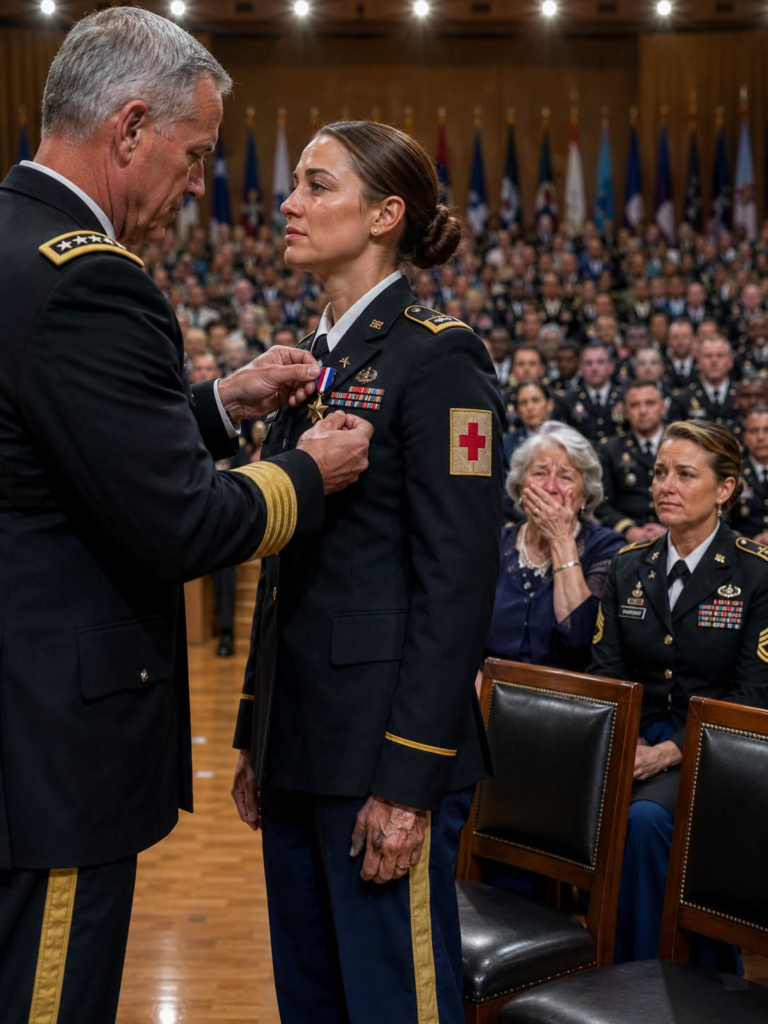
The citation was read. General Hale lifted the medal, attached it above my left breast pocket, and stepped back.
The entire auditorium rose.
Applause struck me from every direction. Aaron Bell saluted. Naomi stood with tears shining on her face, and Ruth pressed both hands against her heart.
I had spent years believing recognition from my parents would make me real. Standing beneath those lights, I finally understood that their refusal had never reduced the value of what I had done. It had only revealed the limits of what they were capable of seeing.
General Hale asked me to remain onstage.
“We have one additional recognition,” he said.
A screen behind us displayed photographs of care packages being assembled in Ruth’s dining room. There were boxes filled with socks, hygiene supplies, homemade cookies, letters, and knitted scarves. I recognized deployments by the handwriting on the labels.
Ruth stared at the screen.
General Hale explained that a coalition of veterans’ charities had created the Homefront Valor Initiative. The program would honor civilians whose consistent support had protected the mental health and morale of deployed service members.
“The first recipient sent more than three hundred care packages over twenty years,” he said. “She volunteered thousands of hours at veterans’ hospitals and personally supported soldiers who had no family waiting at home.”
Ruth covered her mouth.
“Mrs. Ruth Mercer, please join us.”
The cameras turned toward her. Naomi helped her stand, but Ruth paused beside the empty space where my parents might have sat.
Then she walked onto the stage.
General Hale presented her with a framed citation. A representative from the Homefront Valor Foundation joined us carrying a second frame.
“The foundation’s donors have also provided Mrs. Mercer with a fully paid lakefront residence near Annapolis,” he announced. “Property taxes, insurance, and essential maintenance will be covered for life. She will receive comprehensive supplemental medical coverage and a first-class trip to Europe, where she once served as a volunteer nurse but never had the opportunity to travel as a guest.”
The audience erupted again.
Ruth looked at the framed deed, then at me.
“This is not mine,” she whispered.
“It is now.”
“I only sent cookies.”
“You sent home,” I said.
She placed one hand against my cheek. Every camera in the room captured the moment, but neither of us noticed.
After the ceremony, reporters surrounded Ruth. She answered questions with awkward honesty, insisting that wool socks were more useful than medals and that young people serving overseas should not have to beg their families for kindness.
One reporter asked why she had occupied a seat normally reserved for a parent.
Ruth looked toward me, uncertain.
I stepped beside her. “The seat was reserved for family.”
The answer aired nationally.
By the time we reached the parking garage, my phone showed forty-nine missed calls. Victor had called seventeen times. Diane had called fourteen, and Brielle had sent messages in rapid succession.
Why did nobody tell us about the house?
That should have gone to Mom.
Call the general before they finalize anything.
The ceremony made it look like Aunt Ruth raised you.
People are attacking me online.
You need to fix this.
Ruth read one message over my shoulder and looked stricken. “I do not want to cause trouble.”
“You did not.”
“They are still your parents.”
“Yes.”
“You loved them.”
“I still may. That does not give them permission to use me.”
Naomi took the phone from my hand and switched it off.
“We are eating dinner,” she said. “The people who missed the ceremony can survive one evening without managing the rewards.”
We celebrated at a small restaurant near the Potomac. Ruth ordered chicken, Naomi ordered steak, and I could barely taste anything because the emotions of the day had left me exhausted.
Nobody asked for money.
Nobody suggested using the media attention to build a brand. Nobody complained that my medal made them look less important.
Ruth raised her water glass.
“To coming home whole.”
Naomi lifted hers. “And learning who home is.”
When I returned to my apartment shortly after ten, my parents and Brielle were waiting in the hallway. Victor stood directly in front of my door. Diane had been crying, and Brielle was holding the handbag that had supposedly required all three of them to miss my ceremony.
Not one congratulated me.
Brielle stepped forward. “You need to call the Pentagon.”
“No.”
“I have not told you what to say.”
“I know what you want.”
“The house was awarded because of your ceremony. That makes it a family asset.”
“It was awarded to Ruth.”
“She already has a house.”
“She owns a townhouse with a thirty-year-old furnace and a leaking roof.”
“She does not need lakefront property.”
“Neither do you.”
Brielle’s eyes filled with tears so quickly that I knew she had practiced the expression. “My sponsorship is falling apart because people think we abandoned a war hero.”
“You did.”
“We had a commitment.”
“You had dinner with a handbag.”
Diane moved between us. “Enough. Call General Hale tomorrow and explain that Ruth wishes to transfer the house to Brielle.”
“Ruth does not wish that.”
“She will if you ask.”
“I will not ask.”
Victor stepped closer. His face had turned the color it usually reached just before he punched a cabinet or threw something against a wall.
“You owe your family,” he growled.
“I have paid more than eighty thousand dollars toward this family in five years.”
“That does not erase what we did for you.”
“You provided food, shelter, and clothing to a child you chose to have. Those were responsibilities, not loans.”
His fist struck the wall beside my door. Diane screamed, though she had seen him do the same thing many times before.
Brielle began sobbing about the comments under her social media posts. Viewers had found photographs from the handbag dinner posted at the exact time I received the Silver Star. One image showed my parents smiling beneath gold balloons while the Pentagon ceremony played on a television behind the restaurant bar.
“You humiliated me,” she said.
“I did not post the photograph.”
“You put Aunt Ruth in Mom’s seat.”
“Mom refused the seat.”
Diane grabbed my injured arm.
Pain shot through the healing nerves. My body reacted before my thoughts did. I twisted free, stepped back, and raised my hand between us.
“Do not touch me again.”
Diane stared at me as if I had attacked her.
“I am your mother.”
“And this is my injured arm.”
“I barely touched you.”
“You knew exactly where to grab.”
Her face collapsed into tears. “How can you speak to me this way after everything?”
I looked at the three of them. My father had struck a wall because he could not seize someone else’s house. My mother had grabbed the injury she once dismissed as an inconvenience. My sister cared more about strangers criticizing her than twelve soldiers surviving an ambush.
For the first time, I saw them without the filter of hope.
“You called me disgraceful when I had nothing left to give you,” I said. “Now you see a house, cameras, and public attention, and suddenly I am family again.”
Victor pointed toward my medal. “Do not let that piece of metal make you believe you are better than us.”
“It does not.”
“Then act like a daughter.”
“I am acting like a person who finally understands what you wanted from her.”
Diane shook her head. “We wanted you to remember your family.”
“My money is gone. Your access is closed. Ruth’s property belongs to Ruth, and none of you will contact her about transferring it.”
“You cannot order us around,” Victor said.
“I can order you away from my apartment.”
He laughed. “You would call the police on your own father?”
I opened my door, stepped inside, and faced them from the threshold.
“If you are still here in sixty seconds, we will find out.”
Brielle called me cruel. Diane called me damaged. Victor promised that I would regret choosing strangers over blood.
I closed the door and turned the lock.
My legs gave way before I reached the couch. I sat on the floor with my back against the door, listening as they argued in the hallway. Their voices eventually moved toward the elevator and disappeared.
Then the silence arrived.
It was not the frightened silence of the bunker after I canceled the transfers. It was clean and complete. For the first time, I did not imagine chasing them, apologizing, or reopening the door.
I slept for eleven hours.
The following morning, I documented the confrontation and informed the apartment manager. A military legal assistance attorney helped me prepare a formal notice instructing my parents and sister not to contact me or Ruth regarding money or property.
Ruth received seventeen calls before noon. She answered the first because she still believed Diane might apologize.
Instead, my mother accused her of stealing a daughter’s place.
Ruth listened quietly. Then Diane said the lake house should remain within the immediate family.
“I am your immediate family,” Ruth replied.
Diane told her that sisters did not count.
Ruth ended the call, blocked all three numbers, and placed her phone face down beside the framed deed.
“I spent sixty-eight years believing patience could turn some people kind,” she told me later. “It cannot. It only gives unkind people more time.”
The foundation arranged a tour of Ruth’s new home. It stood on a quiet inlet near Annapolis, with a cedar deck overlooking water that shone silver in the morning. The house had two bedrooms, wide doors, and a ground-floor suite designed for aging in place.
Ruth walked through every room as if afraid someone would explain that a mistake had been made. In the kitchen, she opened and closed the cabinets. On the deck, she touched the railing and looked toward the distant sailboats.
“I could send packages from here,” she said.
“You are retired.”
“That is not the same as being useless.”
“You have never been useless.”
She looked at me. “Neither have you.”
My parents’ financial collapse began within weeks. Without my monthly transfers, the mortgage payment failed. Their home equity line had already reached its limit, and Victor had borrowed against the house to cover Brielle’s lifestyle.
Brielle’s SUV was repossessed outside a restaurant. One of her friends filmed the tow truck while she argued with the driver. The video spread faster than any sponsored content she had ever posted.
The handbag company ended its informal partnership. Its public statement said the company honored service members and did not support individuals who trivialized military sacrifice.
Brielle blamed me.
She created a video claiming that the Pentagon ceremony had been manipulated to make her family look cruel. She said I had always been jealous of her beauty and that combat trauma had made me vindictive.
The video lasted twelve minutes. Viewers responded with clips from the ceremony, photographs of Ruth’s care packages, and Brielle’s own posts from the expensive dinner. Aaron Bell commented from his verified account.
Staff Sergeant Mercer kept me alive while wounded. Her aunt wrote to our unit every month. Leave them alone.
Brielle deleted the video.
Victor contacted several relatives and claimed I had abandoned my parents during a financial emergency. Most knew only fragments of the story, and several called me to encourage reconciliation.
I asked each person the same question.
“How much are you willing to send them every month?”
The calls stopped.
My parents sold their house before the bank could seize it. After satisfying the mortgage, equity loan, taxes, and sales costs, they had far less money than they expected. They moved into a two-bedroom rental forty miles away.
Brielle went with them because she had nowhere else to go.
Victor mailed me a handwritten letter. He said a good daughter would have warned them before cutting off the transfers, though I had warned them repeatedly that I could not continue. He wrote that I had chosen public admiration over private loyalty.
I did not respond.
Diane sent a birthday card containing no birthday message, only a list of expenses she claimed my parents had paid for me from birth through high school. The total included diapers, school lunches, Christmas gifts, and a portion of the electricity used in my childhood bedroom.
I gave the card to Naomi.
She framed it.
“You need evidence,” she said solemnly, “that some people can turn electricity into emotional blackmail.”
My rehabilitation continued. The damaged nerves recovered slowly, and I regained most of the strength in my hand. The scar remained raised and pale, a permanent line beneath the sleeve of my uniform.
I stopped hiding it.
The Army offered me a position training combat medics at Fort Sam Houston in Texas. Accepting meant leaving Virginia, Ruth, and the familiar structure of my old unit. It also meant beginning a life that was not organized around proximity to my parents.
Ruth encouraged me to go.
“Family should give you roots,” she said. “Not chains.”
Naomi had received orders to the same training command. When I learned that, I accused her of arranging it.
“I am powerful,” she said. “But not that powerful.”
We moved to San Antonio in early fall. I rented a small house near the base with a shaded porch and a kitchen designed for actual cooking rather than photographs. I bought secondhand furniture and paid cash for a reliable car.
The absence of debt felt like wealth.
As an instructor, I taught young medics how to apply tourniquets in darkness, manage multiple casualties, and make decisions while their hands were shaking. I also taught lessons that were not written in the official curriculum.
I told them courage did not require destroying themselves. I told them caring for others was honorable, but being useful did not make them public property. I taught them to protect their finances, update beneficiaries, and recognize when people at home were exploiting deployment pay.
Some instructors considered those subjects too personal. The medics did not.
After one class, a nineteen-year-old soldier waited until everyone else had left. His family had taken out loans using his information and expected him to surrender nearly his entire paycheck.
“I thought saying no made me disloyal,” he said.
“So did I.”
“What changed?”
“I learned that loyalty without limits becomes permission.”
We connected him with legal and financial assistance. Months later, he showed me his first savings statement.
That piece of paper meant more to me than any photograph of my medal.
Ruth transformed the lake house into a gathering place. She used one bedroom for visitors and the other for shelves of care-package supplies. Veterans from the foundation came for weekend dinners, and recovering service members sat on the cedar deck when hospitals and crowded cities became too loud.
She named the house Harbor Light.
A small brass plaque near the door contained the words from her original note.
COME HOME WHOLE.
The foundation’s European trip took us to France, Belgium, and Germany. Naomi joined us using her own leave and spent most of the flight pretending she was not excited about the first-class seat.
In France, Ruth visited the hospital where she had volunteered as a young nurse. The building had been renovated, but an elderly administrator found an archived photograph of Ruth standing beside a row of recovery beds.
She was twenty-three in the picture. Her hair was dark, her smile uncertain, and her hands already carried the calm strength I had depended on all my life.
“You were beautiful,” I said.
“I was exhausted.”
“You can be both.”
She laughed and slipped the photograph into her bag.
One evening in Paris, we sat outside a small café as sunlight turned the buildings gold. Ruth asked whether I missed my parents.
The honest answer surprised me.
“I miss the parents I kept expecting them to become.”
“That is a difficult person to bury.”
“They are still alive.”
“I know. Sometimes imaginary people require the longest funerals.”
I reached across the table and took her hand.
“I would have given them everything.”
“You nearly did.”
“I thought if I became valuable enough, they would love me.”
Ruth squeezed my fingers. “They knew you were valuable. That is why they kept sending invoices.”
Back in the United States, Victor attempted to contact my commanding officer. He claimed my refusal to support my parents demonstrated emotional instability and dishonorable conduct.
The complaint reached my desk because the command wanted me aware of it. Victor had attached bank statements showing years of transfers from my account to his.
He believed the statements proved abandonment.
Instead, they proved exploitation.
The legal office issued a brief response explaining that adult service members controlled their own finances. Victor was instructed not to contact the command again regarding a private family dispute.
He sent me one final email.
You have made strangers more important than your own blood.
I read the sentence several times. Years earlier, it would have pulled me into an apology. Now I understood the manipulation hidden inside it.
Naomi had not been a stranger when she entered a kill zone beside me. Aaron Bell had not been a stranger when his life depended on my hands. Ruth had never been a stranger when she filled cardboard boxes with warmth.
Blood was biology.
Family was behavior.
I deleted the email.
Two years after the ceremony, I was promoted to Sergeant First Class. Ruth and Naomi attended. We celebrated afterward with barbecue, iced tea, and a cake that leaned slightly to one side because Ruth had baked it herself.
The Silver Star remained inside a drawer in my bedroom. I did not display it because I did not need to see it every morning to remember what happened.
Above my desk hung Ruth’s first note.
Come home whole.
My parents never apologized. Brielle eventually found administrative work at a regional clothing distributor, though she continued telling people she was rebuilding her brand. Victor returned to small repair jobs, and Diane increased her hours at the furniture showroom.
From relatives, I heard that they still blamed me for losing the house.
Perhaps they always would.
I learned that closure did not require their agreement. It did not require an apology, a confession, or a dramatic moment when they finally understood my pain.
Closure was a door I could lock from the inside.
On the fifth anniversary of the ambush, all twelve surviving soldiers gathered at Harbor Light. Some arrived with spouses, and three brought children who would not have existed if their fathers had died inside that compound.
Aaron Bell brought his daughter, a serious little girl named Evelyn.
“You did not,” I said when he introduced her.
“My wife chose it.”
“You suggested it.”
“I may have mentioned the name once or thirty times.”
That evening, we ate on Ruth’s deck while the sun lowered across the water. The soldiers told stories that became funnier with distance, though certain silences remained when memory reached the parts none of us could reshape.
Aaron’s daughter climbed into my lap.
“Daddy says you saved him,” she said.
“A lot of people saved your father.”
“But you fixed his chest.”
“I helped.”
She touched the scar on my arm. “Did this hurt?”
“Yes.”
“Were you scared?”
“Very.”
Her forehead wrinkled. “Then why did you go?”
I looked across the table at Naomi, at Ruth, and at the men whose lives had continued into marriages, careers, arguments, bedtime stories, and ordinary mornings.
“Because being scared does not always mean you should leave,” I said. “Sometimes it means you understand why staying matters.”
Ruth lifted her glass.
“To the people who stay.”
Everyone joined the toast.
Later, after the guests departed, I remained on the deck with Ruth. The night air smelled of tea, fresh bread, and clean water.
She was older now. Her hair had become completely silver, and she moved carefully when rising from a chair. I knew no award, house, or medical policy could keep her with me forever.
That knowledge no longer made me desperate. Love was not valuable because it could be held permanently. It was valuable because it changed what we carried after someone’s hand was gone.
“Do you ever wish they had come?” Ruth asked.
She did not need to explain who she meant.
“To the ceremony?”
“Yes.”
I considered the two seats beneath the Pentagon lights. For years, I had imagined Victor and Diane sitting there, transformed by the citation, the applause, or the sight of my uniform.
“No,” I said.
Ruth looked surprised.
“I used to. But if they had come, they would have made the ceremony about themselves. They would have smiled for the cameras, taken credit for raising me, and asked about the house before we reached the parking garage.”
“That sounds possible.”
“They left the seats empty, and that hurt. But empty seats can be filled.”
Ruth rested her head against the chair.
“You filled them well.”
I looked through the glass doors at photographs covering the living room wall. Ruth stood with medics, wounded veterans, military families, and children carrying care packages. In the center was the image captured onstage after she received the deed.
Her hand was against my cheek.
My eyes were closed.
General Hale stood behind us, smiling.
The photograph did not show the people who refused to attend. It showed the people who had arrived.
I spent the first half of my life believing home was the place where blood relatives waited. I believed duty meant paying, tolerating, and forgiving without limit. I believed a daughter could purchase love by becoming useful enough.
The battlefield taught me how to stop bleeding.
Ruth taught me why.
Home is not a surname, an obligation, or a debt passed from parents to children. It is the person who sends warmth into your darkest winter, who sees your wounds without exploiting them, and who stands beside you before the rest of the world decides you are valuable.
My parents left two chairs empty.
I filled them with family.
The End