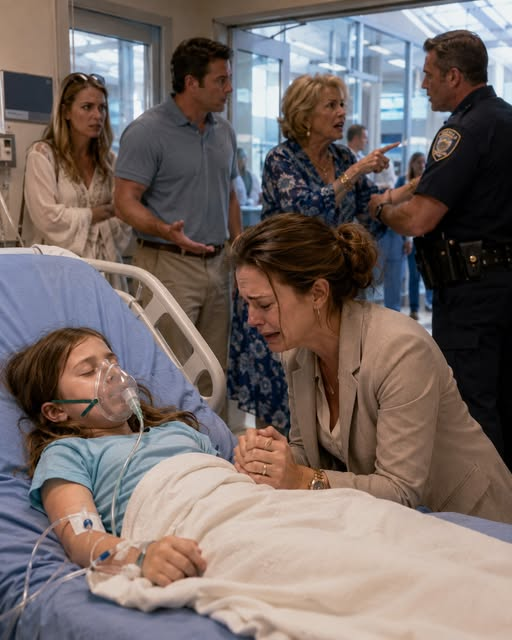
My Family Left My Allergic Daughter for a Luxury Lake Trip—By Nightfall, Their Lies Collapsed, and One Quiet Decision Changed Our Lives, Proving Real Family Matters More Than Blood
I answered Daniel’s call on the fourth ring.
For several seconds, neither of us spoke.
I could hear the wind moving across our front porch and the faint rattle of him trying his key again, as though the lock might eventually recognize him if he kept turning hard enough.
“Rachel,” he said finally.
“Why doesn’t my key work?”
I looked through the glass wall of Lily’s hospital room.
Her oxygen mask had been replaced with a smaller nasal tube.
The swelling around her face had begun to fade, but every few minutes, her fingers tightened around the blanket as if her body still remembered fighting for air.
“My attorney arranged an emergency protective order,” I said.
“A police officer will meet you tomorrow so you can collect clothes and personal items.”
Daniel went silent.
Then he laughed once, but there was no humor in it.
“You got a protective order against me?”
“I requested protection for Lily.”
“I’m her father.”
“You were her father when she needed an ambulance.”
The words landed between us.
He lowered his voice.
“I didn’t know how serious it was.”
“The school nurse called you twice.”
“My phone was in the locker.”
“She left a voicemail.”
“My mother said she had it under control.”
“And you believed her without checking on your child.”
His breathing changed.
For years, Daniel had relied on charm whenever responsibility became uncomfortable.
He apologized beautifully.
He explained gently.
He had a gift for making his failures sound like misunderstandings that had happened to him instead of choices he had made.
That gift did not work anymore.
“Rachel,” he whispered, “please don’t destroy our family over one terrible afternoon.”
I looked at Lily.
“Our family was almost destroyed because of one terrible afternoon.”
Then I ended the call.
A few minutes later, Officer Grant stepped into the hallway.
He was the same officer who had read Claire’s message earlier.
“The lake club gave us security footage,” he told me.
“It shows when they arrived, who was present, and when they received calls from the school.”
My stomach tightened.
“Was Daniel with them when the calls came in?”
Officer Grant did not answer immediately.
That was answer enough.
“He was standing beside his mother when she listened to one of the voicemails,” he said.
“The video has no sound, but the club manager remembers Patricia complaining that the school was trying to ruin the children’s day.”
I closed my eyes.
Daniel had not simply failed to understand.
He had known there was a warning.
He had chosen not to ask questions because asking questions might have interrupted lunch beside the water.
Officer Grant continued carefully.
“There are also photographs posted by your sister-in-law.
The timestamps matter.”
I had seen them before arriving at the hospital.
Claire smiling beneath a striped umbrella.
Patricia holding a tall glass of lemonade.
Daniel standing beside the boat dock with his sunglasses pushed into his hair.
Behind them, the other children held colorful water toys.
The caption read: Family days are the best days.
It had been posted fourteen minutes after paramedics found Lily turning blue on Mrs. DeLuca’s couch.
I did not cry when Officer Grant told me.
I had passed the point where tears could carry the weight.
“What happens next?” I asked.
“The investigation continues.
The prosecutor will decide what charges are appropriate.
For tonight, none of them are permitted to contact Lily directly.”
“Thank you.”
He hesitated before leaving.
“Mrs. Carter, your neighbor may have saved your daughter’s life.”
“I know.”
Mrs. DeLuca was sitting in the family waiting room with Lily’s backpack in her lap.
She was seventy-two years old, barely five feet tall, and still wore the pale blue gardening shirt she had been wearing when Patricia left Lily at her house.
When I approached, she stood so quickly that the backpack slid to the floor.
“I should have called sooner,” she said.
“You called as soon as you understood what was happening.”
“I thought Patricia had already given her the medicine.
She told me Lily only needed to rest.”
Mrs. DeLuca’s hands trembled.
“Then Lily started making that awful sound when she breathed.
She tried to tell me where the EpiPen was, but she couldn’t finish the sentence.”
I reached for her hands.
“You opened the backpack.
You found the emergency plan.
You stayed with her until the paramedics arrived.”
“She was so scared.”
“So were you.”
Mrs. DeLuca shook her head.
“Fear doesn’t matter when a child needs you.”
That sentence stayed with me.
Fear did not matter.
Reservations did not matter.
Embarrassment did not matter.
Being accused of overreacting did not matter.
When a child needed you, you showed up.
That was the entire definition of family.
Lily woke fully shortly after two in the morning.
Her eyes moved around the dim room before settling on me.
“Mom?”
“I’m here.”
Her voice was rough.
“Am I in trouble?”
The question broke something inside me.
I leaned over the rail.
“No, sweetheart.
You did nothing wrong.”
“Grandma said I ruined the trip.”
“No.”
“She said everybody was waiting because of me.”
I forced my voice to remain steady.
“You did not ruin anything.
You were sick, and the adults responsible for you made unsafe choices.”
Lily stared at the ceiling.
“I told her I couldn’t breathe.”
“I know.”
“She said if I kept panicking, it would get worse.”
I brushed the hair away from her forehead.
“Listen to me.
When your body tells you something is wrong, you speak up.
You call for help.
You never stay quiet to make another person comfortable.”
Her eyes filled with tears.
“Is Dad mad at me?”
“No.”
“Is he coming?”
I could have lied.
I could have said he was busy or that we would talk later.
But Lily had spent an entire day surrounded by adults who treated the truth like an inconvenience.
I would not become another one.
“Your father made a serious mistake,” I said.
“For now, he won’t be visiting until doctors and other adults decide it is safe.”
“Does he still love me?”
“I believe he loves you.
But loving someone is not only something you say.
It is also what you do when that person needs you.”
Lily was quiet for a long time.
Then she whispered, “Mrs. DeLuca helped me.”
“Yes, she did.”
“Can she come in?”
Mrs. DeLuca cried when Lily held out her hand.
By sunrise, the three of us were sitting together while pink light appeared between the hospital buildings.
For the first time since the school nurse called, I believed Lily was truly coming back to me.
But outside that room, the consequences had already begun.
The lake club suspended Patricia’s family membership after learning that police had removed them from the property during a child-safety investigation.
Claire’s employer placed her on administrative leave because she worked for a youth recreation organization and had posted photographs showing herself celebrating while a child in her care was being rushed to the hospital.
Patricia’s neighborhood committee asked her to resign as president.
None of those consequences came from me.
I did not call their employers.
I did not send photographs to their friends.
I did not write a single post online.
Their own messages, timestamps, photographs, and statements told the story.
All I did was stop protecting them from the truth.
Daniel came to the hospital the following afternoon with his attorney.
He was not allowed into Lily’s room.
I met him in a consultation office with my lawyer, Officer Grant, and a hospital social worker present.
Daniel looked as though he had not slept.
His clothes were wrinkled, his eyes red, and the confidence he normally wore like a tailored jacket was gone.
“I want to see her,” he said.
“The temporary order does not permit that,” my attorney replied.
Daniel looked at me.
“Rachel, please.”
I placed Claire’s printed text on the table.
We handled it.
Don’t make a scene.
Then I placed the school nurse’s call record beside it.
Then the club photographs.
Then a still image from the security footage showing Daniel standing beside Patricia while she held her phone.
“You told me you didn’t know,” I said.
He stared at the image.
“My mother said the nurse exaggerated.”
“You listened to a warning and decided not to check.”
“I thought Lily was with Claire.”
“Claire thought she was with Patricia.
Patricia left her with Mrs. DeLuca.
Everyone passed responsibility to someone else until no one was responsible.”
Daniel covered his face.
“I made the worst mistake of my life.”
“No,” I said quietly.
“A mistake is forgetting an appointment.
This was a series of decisions.”
His hands dropped.
“What do you want me to do?”
It was the first honest question he had asked.
“I want you to tell the complete truth to the police.
I want you to stop protecting your mother and sister.
I want you to accept every requirement the court sets without blaming me.
Parenting classes, counseling, supervised visits—whatever they decide.”
“And us?”
“There is no ‘us’ to discuss today.”
His face tightened.
“Are you divorcing me?”
“Yes.”
The room became completely still.
Daniel looked toward my attorney as though someone might correct what he had heard.
No one did.
“You already decided?”
“I decided when you said your mother thought Lily was improving.
You were still defending her while our daughter was on oxygen.”
He began to cry.
I felt pain watching him, but pain was not the same as doubt.
I had loved Daniel for thirteen years.
Love did not disappear in one moment.
Trust did.
And without trust, love could not safely hold a family together.
Daniel gave a full statement that afternoon.
He admitted that Patricia had played part of the nurse’s voicemail at the lake club.
He admitted hearing the words “EpiPen” and “call 911.” He admitted choosing to believe his mother because the boat reservation was nonrefundable and the other children were already changing into swimwear.
His honesty did not erase what happened.
But it prevented Patricia from rewriting it.
She had claimed the school never explained the severity of Lily’s condition.
The voicemail proved otherwise.
Claire had claimed she believed an ambulance was already coming.
Her text proved otherwise.
Daniel had claimed confusion.
The security footage and his own statement proved otherwise.
When Patricia learned that her son had stopped protecting her, she called me from an unfamiliar number.
I almost ignored it.
Then I answered and activated the recording function my attorney had recommended.
“You have turned Daniel against his own mother,” she said.
“No.
His choices brought him here.”
“You’re enjoying this.”
“My daughter is still in the hospital.”
“She recovered.”
“She nearly didn’t.”
Patricia exhaled sharply.
“You always make everything dramatic.”
There it was.
Even after the oxygen mask.
Even after the paramedics.
Even after the doctor said ten more minutes could have changed the outcome.
She still needed the problem to be my reaction instead of her behavior.
“You will not contact Lily,” I said.
“I am her grandmother.”
“A grandmother protects a child.
She does not leave that child struggling to breathe because a reservation is more important.”
Patricia’s voice hardened.
“Children need family.”
“Yes,” I replied.
“That is why I am building a safer one for her.”
I blocked the number.
Lily came home four days later.
Mrs. DeLuca decorated our front porch with paper stars.
The school nurse stood beside her holding a new insulated medical pouch containing two replacement EpiPens.
Several of Lily’s classmates had made cards.
None mentioned the lake trip.
They drew dogs, flowers, planets, and a purple dragon wearing a nurse’s hat.
Lily smiled for the first time since the hospital.
The weeks that followed were not easy.
She woke from nightmares believing her throat was closing.
She refused to let her backpack out of sight.
Whenever my phone rang, she watched my face carefully, afraid another adult had decided she was too difficult to protect.
We began seeing a child therapist who specialized in medical trauma.
I attended every session.
Mrs. DeLuca learned how to use the trainer EpiPen and kept one posted emergency plan on her refrigerator.
The school reviewed its release policy.
From then on, no student experiencing a documented medical emergency could be removed from campus by a relative who refused recommended emergency care.
Staff members were authorized to call 911 immediately.
The school nurse called the new procedure “Lily’s Rule.”
Lily did not like the name at first.
“I don’t want everyone remembering what happened,” she said.
I sat beside her on the porch swing.
“They won’t remember you as the girl who got sick,” I said.
“They’ll remember that because you survived, another child might get help faster.”
She considered that.
“Can we make the posters purple?”
“They can be any color you choose.”
“Then purple.”
Six months later, Lily stood in the school gym beside the nurse and demonstrated an allergy emergency kit to parents and teachers.
Her voice shook during the first sentence.
Then she saw Mrs. DeLuca in the front row wearing a purple sweater.
She straightened her shoulders and continued.
“If somebody says they cannot breathe,” Lily told the room, “you do not wait to see if they get worse.
You believe them, give the prescribed medicine, and call for help.”
The audience rose at the end.
Lily did not smile because of the applause.
She smiled because she had turned the worst afternoon of her life into protection for someone else.
The legal case ended without a public trial.
Patricia and Claire accepted responsibility under an agreement that required community service, child-safety education, compliance with protective orders, and formal acknowledgment of their actions.
They were prohibited from being alone with Lily.
Daniel received supervised visitation after completing parenting classes and individual counseling.
For nearly a year, he met Lily twice a month in a family center.
He never complained about the supervision in front of her.
He never asked her to forgive him.
He apologized once, clearly and without excuses.
“I chose what was convenient instead of checking whether you were safe,” he told her.
“That was wrong.
You did not cause it, and you did not deserve it.”
Lily listened.
Then she said, “I’m not ready to trust you.”
Daniel nodded.
“I understand.”
It was the first time I saw him accept a boundary without trying to negotiate it.
Our divorce became final the following spring.
There was no dramatic courtroom victory.
No shouting.
No crowd waiting outside.
Just signatures, a judge’s careful questions, and the quiet closing of a chapter I had once believed would last forever.
When I walked out of the courthouse, Mrs. DeLuca and Lily were waiting beside a small flower bed.
Lily ran toward me holding three purple tulips.
“One for you, one for me, and one for Mrs. DeLuca,” she explained.
Mrs. DeLuca smiled.
“Apparently, we’re a team.”
“No,” Lily said seriously.
“We’re a family.”
Two years after the lake trip, St.
Agnes Children’s Hospital invited Lily to speak at a community allergy-awareness event.
She stood on the same floor where she had once fought for every breath.
This time, she wore a purple dress and carried her emergency pouch proudly across her shoulder.
Before walking onto the stage, she squeezed my hand.
“Are you nervous?” I asked.
“A little.”
“We can leave.”
She shook her head.
“Fear doesn’t matter when a child needs you.”
I looked across the hallway at Mrs. DeLuca.
She covered her mouth, recognizing her own words.
Lily walked onto the stage.
She told parents to listen.
She told children their symptoms were never an inconvenience.
She told teachers that calling for help was not overreacting.
And she ended with a sentence she had written herself.
“Real family is not the group that looks perfect in photographs.
Real family is the person who stays when your life becomes difficult.”
The room became silent.
Then everyone stood.
I watched my daughter beneath the bright hospital lights, strong and smiling, and understood that our lives had not fallen apart that day.
They had been revealed.
The people who valued appearances more than Lily’s safety lost the privilege of controlling our home.
The man who failed her was required to face the truth before he could rebuild any relationship with her.
The elderly neighbor who had no obligation to help became the grandmother Lily chose.
And the frightened ten-year-old who once worried she had ruined everyone’s day became the reason children across our district would receive faster emergency care.
That night, the three of us returned home and ate pizza on the living-room floor.
Lily placed her head against my shoulder.
Mrs. DeLuca complained that the movie we selected made no sense, though she refused to let us change it.
Outside, rain tapped gently against the windows.
Inside, Lily laughed.
It was an ordinary sound.
Soft, bright, and completely alive.
I closed my eyes and listened.
For years, I had believed keeping a family together meant forgiving every insult, smoothing over every conflict, and making sure no one felt uncomfortable.
I know better now.
Sometimes protecting a family means closing a door.
Sometimes love means telling the truth even when the truth changes everything.
And sometimes the happiest ending does not come from getting your old life back.
It comes from building a new life where the people you love never have to beg to be believed, never have to apologize for needing help, and never have to wonder whether they are worth saving.
Lily never wondered again.