Chapter 1: The RSVP of Omission
My name is Tori Townsend. I am thirty-one years old, and a structural engineer by trade. I build frameworks designed to withstand immense pressure. Yet, absolutely nothing in my professional training prepared me for the sudden, catastrophic collapse of my own family structure.
Exactly two weeks prior to my wedding day, my mother called. She did not call to gush over floral arrangements or fret about the weather forecast. She called to casually inform me that she and my father would not be attending the ceremony.
They were boarding a first-class flight to Dubai to attend the grand opening of my younger brother’s boutique clothing store instead.
She delivered this devastating news with a breezy, terrifying calm, employing the exact same tone one might use when postponing a routine dental cleaning.
“Tori will absolutely understand,” she breezily assured my aunt later that same evening, completely oblivious to the fact that her words were being relayed to me. “She always does.”
What my mother fatally failed to realize as she packed her designer luggage was that my future father-in-law had already proudly purchased a brand-new, navy-blue silk tie specifically for the occasion. Furthermore, she was blissfully unaware that a highly skilled documentary crew was scheduled to capture every single, raw second of my wedding day.
What transpired during that ceremony, and what fourteen million complete strangers bore witness to in the aftermath, is the sole reason my mother now tearfully calls my voicemail every Sunday without fail.
But here is the unvarnished truth of what none of them comprehended when they gleefully boarded that transatlantic flight.
I was standing in the center of Janet Callaway’s cozy, sunlit living room when the axe fell. Janet is my fiancé’s mother. She is fifty-nine, a veteran pediatric nurse, and possesses the distinct aura of a woman who always has a comforting pot of something simmering on the back burner.
That specific Tuesday afternoon, we were attempting to finalize my bridal look. Janet was delicately pinning three vastly different tulle veils into my hair, stepping back to meticulously photograph each option on her iPad, when my cell phone vibrated violently against the coffee table.
I glanced at the illuminated screen. The contact name simply read: Mom.
I swiped to answer on the second ring. Some deeply ingrained, toxic habits require a lifetime to finally break.
“Tori, honey. I need to tell you something regarding the schedule,” she launched in, bypassing any semblance of a greeting. She didn’t bother to ask how the dress fitting went, or if I was drowning in seating charts.
“Your father and I have talked it over extensively, and we absolutely need to be physically present in Dubai for Derek’s store opening. It tragically falls on the exact same weekend as your event.”
I froze in the center of Janet’s living room. A heavy, antique lace veil was precariously pinned to my crown, yet I felt entirely stripped bare. I said absolutely nothing.
“You know exactly how critically important this launch is for your brother,” she continued smoothly, filling the silence with her rehearsed justifications. “He has been slaving over this boutique for two agonizing years. Major international investors are flying in from Singapore. He desperately needs his family’s support there on the ground.”
Four excruciating seconds of dead air ticked by. I neurotically counted them in my head. One. Two. Three. Four.
“What about my wedding?” I finally managed to croak out, my voice sounding incredibly small and brittle.
“Oh, Tori, please don’t be dramatic,” she scoffed lightly. “You have Liam’s massive family there! You will be completely surrounded by hundreds of people who absolutely adore you. And we will definitely celebrate properly when we get back stateside. We can do a nice, expensive dinner, just the core family.”
She delivered the rejection exactly the way one cancels a trivial lunch date. It was light, it was quick, and she was clearly already mentally moving on to reviewing her packing list.
“Okay,” I whispered. And I terminated the call.
Janet was still holding her iPad in mid-air. She took one long, agonizing look at my face and slowly set the device down on the mantelpiece. She didn’t bombard me with frantic questions. She didn’t offer hollow platitudes. She simply crossed the worn Persian rug, placed both of her warm, steady hands firmly onto my trembling shoulders, and held me there in the quiet room until my lungs remembered how to pull in oxygen.
This specific rejection was not the first time. It was not the fifth. It was not the tenth.
When I proudly graduated with honors from engineering school, my parents sauntered into the stadium two hours late. Derek had managed to snag a last-minute audition for a mid-tier modeling agency that very morning, and my mother had insisted on driving him across the city first. By the time they casually strolled through the auditorium doors, I had already crossed the stage and received my diploma. My father merely shrugged and offered a pathetic excuse: “We watched the live stream on my phone in the lobby, kiddo.”
When I was aggressively promoted to lead structural engineer at twenty-seven, I excitedly planned a celebratory dinner at the upscale Italian bistro my mother adored. She canceled via a hurried text message three hours before our reservation. Derek desperately needed a chauffeured ride to the airport; he was flying to Miami for a frat brother’s birthday weekend. She promised she would “make it up to me.” She never did.
When I underwent intensive reconstructive surgery on my rotator cuff the following year, my mother sent a generic group text: “Sending healing prayers, sweetheart! Please keep us all updated.” She did not visit the hospital. She did not call my room. Derek happened to be visiting home from Los Angeles, and she bluntly stated she didn’t want to “miss precious time” with her golden boy since his trip was so brief.
I stopped officially counting the betrayals after twenty-six. Twenty-six distinct, documented occasions where they actively chose Derek’s convenience over showing up for my life.
My Aunt Ruth had sat me down in her kitchen years ago, wrapping her hands around a mug of coffee that had gone completely cold between us.
“Your mother perceives you as the strong one, Tori,” Ruth had explained, her voice thick with sorrow. “She wrongly believes that your strength means you simply don’t need her.”
I vividly remember the taste of the black coffee that morning. It was incredibly bitter. Just like the toxic phrase that followed me like a shadow.
Tori will understand.
That was the lethal phrase. My mother wielded it like a master skeleton key, effortlessly unlocking her way out of every single maternal obligation to me. She deployed it to my aunt. She used it against my uncle. She weaponized it against my father whenever he displayed a fleeting microsecond of paternal hesitation.
And the absolute most devastating part? For thirty-one years, she was entirely correct.
I did understand. I intimately, painfully understood that I was a permanent second-place prize in my own family.
But the final, fatal mistake she made was assuming I would continue to understand on the day I promised my life to someone else.
I had issued one final plea. And the silence that followed was deafening.
Chapter 2: The Sealed Plea and the Surrogate Father
I still possess the exact pen I used. It was a heavy, navy-blue felt tip—the specific kind of ink that bleeds slightly at the edges if you press too aggressively against the paper.
I sat alone at my tiny kitchen table late into the night, hours after I had dropped the formal wedding invitations into the mail slot. I retrieved a piece of heavy, cream-colored cardstock and meticulously drafted a separate, desperate, handwritten note. I slid it carefully inside my parents’ official envelope before licking the seal shut.
Mom, Dad. This is undeniably the most important day of my entire life. I desperately need you there. Not for the posed photographs. Not for the sake of empty tradition. I need you there because I am desperately trying to still believe we can function as a family. Please, I am begging you, do not miss this one. Love, Tori.
I didn’t trust the postal service with this specific burden. I asked my Aunt Ruth to hand-deliver it.
Ruth dutifully drove forty minutes out of her way to my parents’ sprawling suburban house on a humid Tuesday afternoon. She recounted the interaction to me later, her voice tight with suppressed rage. She told me that my mother casually took the thick envelope from her hands, offered it a dismissive glance, and unceremoniously tossed it onto the granite kitchen counter, right next to a towering stack of glossy Pottery Barn catalogs.
“Did she even bother to open it while you were there?” I had asked Ruth, my stomach plummeting.
Ruth paused, the hesitation screaming volumes. “No, sweetheart. Not while I was standing there.”
I desperately lied to myself. I convinced my fractured heart that she would open it that evening in the quiet of the house. I hallucinated a scenario where the raw, bleeding truth of her daughter’s handwritten plea would finally penetrate her armor—that this time, the words would be powerful enough to physically prevent her from booking a luxury flight to the opposite side of the planet.
Two agonizing weeks later, Ruth stopped by my parents’ house to retrieve a borrowed Pyrex casserole dish.
She saw the cream envelope resting on the exact same spot on the granite counter. The exact same angle. It remained completely, unbrokenly sealed.
My mother never even bothered to slide a finger under the flap. She had callously abandoned my bleeding heart on her kitchen counter, wedged indifferently between expensive furniture catalogs and a stack of grocery coupons she possessed no intention of ever using.
And she officially booked the non-refundable flights to Dubai that very same week.
I know this for an absolute fact because Derek gleefully forwarded the airline confirmation email to our shared ‘Family Group Chat.’ Two massive, exorbitant, business-class seats.
I met Liam Callaway at a chaotic backyard barbecue exactly five years ago. He is currently thirty-three, a brilliant environmental engineer who spends his grueling weekdays meticulously testing contaminated soil samples, and his weekends constructing elaborate raised garden beds in our backyard that he perpetually forgets to finish. He is a profoundly quiet, incredibly steady man—the specific caliber of man who actively listens to you with his entire physical body.
But the specific individual who fundamentally altered the trajectory of my life was not Liam. It was his father.
Warren Callaway was a sturdy, sixty-two-year-old retired high school principal. He possessed a deep, resonant voice that sounded like warm, tumbling gravel, and large, calloused hands that had successfully repaired everything from leaky kitchen faucets to the shattered hearts of countless teenagers.
The very first time Liam nervously brought me home for a traditional Sunday family dinner, I stood frozen in the entryway, clutching an expensive bottle of Pinot Noir against my chest like it was a Kevlar shield. I was terrified of being evaluated and subsequently dismissed.
Warren bypassed the pleasantries, walked straight up to me, gently took the heavy bottle from my rigid grip, and looked me dead in the eye.
“You absolutely do not need to earn a seat at our table, Tori,” he stated warmly. “You have possessed one since the very first day Liam mentioned your name.”
I had to bite the inside of my cheek until it bled to keep from sobbing in his foyer. I firmly believe he instantly recognized the deep, gaping father-wound I was carrying.
Over the ensuing five years, Warren slowly, methodically evolved into the fiercely protective father I had spent my entire life desperately seeking. He initiated phone calls to my cell every single Sunday evening—not to perform a superficial check-in, but because he genuinely, deeply wanted to hear the mundane details of my week. He spent three hours in a sweltering driveway teaching me how to properly change the brake pads on my sedan. He remembered my birthday every single year, arriving with a card, without ever needing a calendar reminder.
He even physically showed up to a massive corporate presentation I was delivering. I had merely mentioned the event to him in passing weeks prior. When I walked to the podium, terrified out of my mind, I spotted him sitting proudly in the back row of a sterile conference room packed with ruthless engineers. He caught my eye and offered a subtle, encouraging thumbs-up.
My biological father had actively forgotten my birthday three years consecutively. He never bothered to learn the specific title of my engineering degree. The last time I attempted to explain complex structural load analysis to him, he offered a vacant nod and replied, “So, basically, you fix computer networks?”
Warren Callaway never confused my career with IT support. He intentionally read a dense article regarding fintech software simply so he could ask me a highly intelligent, relevant question over Sunday roast.
My father finally called my phone a full four days after my mother had dropped the Dubai bomb. I strongly suspect she aggressively badgered him into making the call to perform damage control.
His voice carried that specific, high-pitched strain it always adopts when he has been heavily coached on exactly what script to recite.
“Sweetheart, I know this is absolutely not the news you wanted to hear today,” he began haltingly.
“Then exactly why are you saying it, Dad?” I snapped back, exhaustion bleeding into my tone.
“We can only physically be in one place at a time, Tori,” he deflected. He paused, gathering his rehearsed ammunition. “Derek’s major investors are flying in directly from Singapore. This is his massive, life-altering break in the industry. If his parents are not physically present, it sends the entirely wrong message to the financial backers.”
“And what specific message does actively abandoning my wedding send to me?” I demanded.
He didn’t possess the spine to answer that question. Instead, he deployed the ultimate, patronizing deflection.
“You have Liam’s massive family there, Tori. You’ll be perfectly fine.”
I sat completely paralyzed with that horrific sentence echoing in my ears long after the line went dead.
You’ll be perfectly fine.
Not, “I desperately wish I could be there to walk you down the aisle.” Not, “I am so incredibly sorry we failed you.” Just the arrogant, toxic assumption that someone else would seamlessly pick up the heavy emotional slack they had so callously dropped. The arrogant assumption that Tori would understand.
Liam found me sitting alone on the darkened back porch later that evening. The sun had completely vanished behind the towering oak trees, and I was glaring at my silenced cell phone resting on the wooden railing as if it were a venomous snake that had just bitten me.
“What exactly did he say?” Liam asked quietly, stepping out into the cool air.
“He explicitly said, ‘I’ll be fine,’” I whispered.
Liam slowly sank into the Adirondack chair next to mine. He didn’t immediately reach out to touch me. He simply sat there in the heavy silence until the sky bled from dark orange into bruised purple.
Then, he leaned forward. “You absolutely will be fine, Tori. But it won’t be because of anything they did.”
I slowly picked up my phone and turned it face down on the wood. “I am completely, entirely done hoping,” I stated.
That very night, my brother Derek finally sent me a text message.
Hey, sis. Super sorry about the horrible timing of everything. I’ll totally make it up to you when I’m back.
There was no specific offer of restitution. There was no concrete plan to celebrate. There wasn’t a single follow-up question regarding the wedding logistics. Just fifteen hollow words casually tossed into the digital void, like tossing a cheap penny into a wishing well—a gesture that cost him absolutely nothing.
I did not reply.
I drove my car directly to Warren’s house on a humid Thursday evening. Janet was trapped pulling a grueling night shift at the pediatric ward. The yellow porch light was burning brightly, and through the mesh screen door, I could clearly see Warren sitting in his favorite armchair, intensely reading a thick biography, his reading glasses pushed halfway down his nose.
He glanced up the second my knuckles rapped against the wood frame.
“Tori, sweetheart. Come on in. I just brewed a fresh pot of decaf,” he called out warmly.
We migrated out to the back porch with our steaming mugs. The cicadas were screaming loudly in the tall grass that night. I gripped the hot ceramic with both trembling hands, staring intently at the steam curling off the dark surface, desperately hunting for the specific words I had spent the entire forty-minute drive over silently rehearsing in my car.
“My father officially chose Dubai,” I said, my voice barely audible over the insects.
Warren slowly, deliberately set his mug down onto the wooden railing. He didn’t interrupt.
“Would you… would you do me the absolute honor of walking me down the aisle, Warren?”
He did not utter a single syllable for ten excruciating seconds. He didn’t need to. His weathered face articulated every complex emotion his mouth currently could not form. The corners of his eyes reddened instantly. His strong jaw tightened visibly, and he aggressively pressed his lips together into a thin, white line—the specific, stubborn gesture men of his proud generation utilize when they are fighting a massive internal war against tears.
He cleared his throat roughly, a heavy, gravelly sound.
“I would be profoundly honored, Tori,” he rasped, his voice shaking. “More than you could ever possibly know.”
I heard a soft, muffled sound emanating from just behind the screen door. Janet had managed to leave her shift early. She was standing frozen just inside the darkened kitchen, desperately pressing a checkered dish towel against her mouth to stifle her sobs, heavy tears tracking rapidly down her cheeks.
Warren reached across the dark space separating our chairs and gripped my hand tightly. His grip was fiercely firm and incredibly steady.
“We are going to make it a profoundly beautiful day, kiddo,” he promised.
I inherently believed him. Not simply because he uttered the words, but because Warren Callaway had never, not once in five years, spoken a sentence to me that he did not back up with absolute, undeniable action.
My biological father had never purchased a new tie for me in his entire miserable life. Warren purchased a stunning, navy-blue silk tie the exact same afternoon I made the request. He tearfully confessed to me much later that it was the single most important garment he had ever purchased.
I had secured my father. Now, the universe was preparing to secure my audience.
Chapter 3: The Empty Chairs
Marcus Chen was Liam’s chaotic college roommate. They had shared a cramped, cinder-block dorm room featuring a miniature refrigerator that hummed so violently neither of them slept a full night during their freshman semester.
Marcus had eventually evolved into a highly respected, independent documentary filmmaker. He absolutely wasn’t producing highly stylized, fake-drama reality shows for streaming giants. He trafficked in raw, indie authenticity. He operated a rapidly growing YouTube channel boasting forty-eight thousand dedicated subscribers, specializing exclusively in short, emotional documentaries capturing modern, unscripted milestones. He filmed the gritty reality of first-generation college students navigating campus life, the exhausting struggles of immigrant small business owners, and couples who bravely eloped into the woods during the height of the pandemic.
Exactly six months prior to our wedding date, Marcus pitched Liam a compelling concept. He was launching a highly anticipated miniseries titled ‘Modern Ceremonies.’ The premise was aggressively simple: Real weddings. Real people. Absolutely zero scripting, and zero staged drama.
Liam loved the authentic concept and brought the proposal to me. I enthusiastically agreed.
Marcus was the epitome of professional respect. He never once pushed a boundary. He politely requested explicit permission before setting up every single shot, and he operated under one ironclad rule: If any guest at the event felt uncomfortable and requested him to stop filming, the lens was capped immediately, no questions asked.
What Marcus entirely lacked the capacity to know when he methodically packed his two high-definition RED cameras and his heavy carbon-fiber tripod into a rented cargo van, was that our supposedly ‘normal’ wedding was about to mutate into a narrative he could never have possibly storyboarded.
“I solely want to capture what is undeniably real,” he explained to us over plates of Thai takeout the week prior to the event. “Because the unvarnished reality is exactly what audiences desperately connect with.”
Liam nodded in agreement. I took a slow sip of my ice water.
I deliberately chose not to inform Marcus about the agonizing situation regarding my parents. I reasoned there was absolutely no narrative justification to do so. The documentary was intended to focus entirely on the joyous union, not the gaping, agonizing absence. It was meant to highlight the overwhelming love vibrating within the room, not focus on the physical chairs left glaringly empty by the exact people who possessed the biological duty to occupy them.
But as I was about to discover, ‘reality’ possesses a terrifying, autonomous habit of forcibly including the exact agonizing details you actively attempt to edit out of the script.
And when Marcus inevitably aimed his high-definition lens at two stark white folding chairs positioned in the absolute front row, bearing crisp paper signs that read ‘RESERVED’ with absolutely no human beings occupying them, he accidentally captured the singular, devastating truth I had never explicitly asked him to document.
If you have ever endured the soul-crushing experience of having someone actively choose their own superficial convenience over showing up for your most vulnerable, important day, you know the exact, suffocating weight I was carrying while standing in that grass.
Janet happily escorted me to my bridal dress fitting. So did my fiercely loyal best friend, Nora, and my soon-to-be cousin-in-law, Sarah. Four women tightly packed into a pristine, white-walled bridal boutique in downtown Hartford on a chaotic Saturday morning, fully armed with strong opinions and a surplus of tissues.
The exhausted bridal consultant lugged out five massive, heavy gowns. I methodically tried on three.
The third option was undeniable. It was an elegant A-line silhouette, featuring delicate, intricate lace sleeves, and a sweeping neckline that sat perfectly across my collarbones without appearing as though it were desperately trying too hard.
When I finally stepped out of the cramped fitting room and gazed at my reflection in the towering, gilded mirror, I felt something profound and heavy physically shift within my chest cavity.
I instinctively, foolishly turned my head to the left, desperately searching the room for my mother’s face.
Her designated chair was completely empty. It was a plush, cream-colored settee positioned perfectly near the bay window, adorned with a decorative throw pillow that cheerfully announced, ‘Here Comes the Bride.’
Absolutely no one was sitting in it.
Nora was perched nervously on the opposite velvet couch. Sarah was standing excitedly by the mirror. Janet was already positioned securely behind me, gently reaching for the delicate lace edge of the veil.
Janet instantly caught my eyes frantically searching the empty settee in the mirror’s reflection. She immediately stepped forward, expertly adjusting the intricate lace resting on my shoulder, and spoke softly directly to my reflection.
“You look like absolutely everything that is good and pure in this world, Tori.”
I blinked back the stinging tears rapidly twice, set my jaw, and locked eyes with my own reflection.
That very evening, I made the catastrophic, masochistic error of opening Instagram while lying in bed.
Pamela had proudly posted a massive photo dump. The location tag proudly declared: The Dubai Mall. The image featured floor-to-ceiling architectural glass, towering, imported palm trees in the background, and Derek standing center frame. He was wearing an overpriced, wrinkled linen shirt, grinning maniacally like a lottery winner. Pamela was clinging tightly to his arm, brandishing a massive, designer shopping bag.
The accompanying caption read: “So incredibly proud of my boy. Family supporting family. Always.”
I stared at those four agonizing words until the pixels blurred. Family supporting family.
I slowly turned my phone face down onto the wooden nightstand and clicked off the bedside lamp.
Liam rolled over in the darkness, sensing the shift in my breathing. “Are you okay?” he mumbled groggily.
“I will be,” I whispered into the dark.
I wasn’t entirely certain if I was lying to him yet, but I knew I was inching terrifyingly closer to the actual truth.
The wedding venue was a breathtaking, sprawling vineyard estate situated twenty minutes outside of Stamford. It boasted ancient, crumbling stone walls, hundreds of pristine white chairs arranged symmetrically on a manicured, emerald lawn, and a massive wooden arch heavily draped in cascading, fragrant wisteria.
We executed the final physical setup the agonizing day before the ceremony. I obsessively walked the grassy rows myself, meticulously checking the spacing of the chairs like a deranged architect.
I reached the absolute front row. The Bride’s side.
Two stark white chairs anchored the far-left end. Two crisp, white paper signs were resting squarely on the seats, held securely down against the gentle breeze by two small, smooth river stones.
RESERVED.
Nora walked up quietly beside me, holding a clipboard. “Do you want me to physically remove the signs, Tor?”
I stood there in the grass and stared intensely at those two specific chairs for what felt like an eternity. They were physically identical to every single other chair positioned on that massive lawn, but they emanated a suffocating, gravitational weight. It felt as though the crushing burden of thirty-one years of skipped childhood birthdays and half-hearted, dismissive phone calls had literally settled deep into the white-painted wood.
“Leave them,” I ordered, my voice hollow.
Nora hesitated, her pen hovering over the clipboard.
“They actively made their choice,” I stated firmly, not breaking my gaze. “The chairs should accurately reflect that reality.”
Marcus was silently filming the interaction from a discreet distance behind us. I had absolutely no idea he had captured that specific, agonizing micro-moment until weeks later, when the documentary was already live and streaming, and fourteen million people worldwide had witnessed me standing helplessly in front of two glaringly empty chairs, my arms crossed defensively over my chest, agonizingly deciding what to do with the massive, gaping void my parents had deliberately left behind.
Two white chairs. Two simple paper signs. Desperately reserved for the two people who should have fought a war to be there more than anyone else on Earth.
I finally turned my back on the void and marched toward the massive reception tent.
Liam was aggressively wrestling with the heavy speaker wire. Warren was balanced precariously on a ladder, happily stringing Edison lights along the edge of the canvas canopy. Janet was meticulously arranging the complex seating place cards with the terrifying, clinical precision only a veteran pediatric nurse could execute.
Ruth had arrived early that morning, pulling her sedan into the gravel driveway loaded down with a trunk full of homemade lemon pastries and a fierce, crushing hug that lasted a full, unbroken minute.
My real family was entirely present and accounted for. It just wasn’t the specific family I had been born into.
The pressure was mounting, but the true emotional detonation was waiting at the rehearsal dinner.
Chapter 4: The Vows of Presence
The frantic, desperate phone calls from my extended family commenced exactly three days prior to the ceremony.
Uncle Pete, my mother’s older brother, fired the first warning shot.
“Tori, sweetheart,” he began, adopting his best diplomatic tone. “Your mother is absolutely beside herself with grief about this whole unfortunate situation. Can’t you simply contact the venue and move the date? Even postponing it a single week would immensely help resolve this crisis.”
“The venue date was locked in with a non-refundable deposit eight months ago, Uncle Pete,” I replied, exhausted by the sheer audacity of the request.
“I know, kiddo, I know. But family is family. You only get one mother.”
I squeezed my eyes shut, rubbing my throbbing temples. “She only gets one daughter’s first wedding, too, Uncle Pete.”
He did not attempt to call me again.
Aunt Linda, my father’s fiercely conservative sister, opted for a lengthy, guilt-inducing text message. She rambled aggressively about the sacredness of tradition, about how a dutiful daughter is biblically commanded to honor her parents regardless of their earthly failings, and about how lavish weddings come and go, but the biological bond between parent and child is supposedly ‘eternal.’
She concluded the text with a dagger: “I sincerely pray you’ll reconsider your stubbornness and show some Christian grace.”
I read the toxic message twice, swallowed the bile rising in my throat, and deleted it without responding.
But then, Ruth called.
Ruth. The woman who had faithfully driven forty minutes out of her way to physically hand-deliver my desperate, handwritten invitation. Ruth, who had seen it abandoned, still sealed, on the granite counter weeks later. Ruth, who was the singular, terrifying force in my mother’s entire family who possessed the sheer courage to explicitly tell my mother she was dead wrong directly to her face.
“I am officially flying in on Thursday,” Ruth announced through the speaker, her voice brooking no argument. “I will absolutely be there for the rehearsal dinner. I will be there for the entire ceremony. And I will proudly be sitting dead center in the front row on your side of the aisle.”
“Ruth, please, you really don’t have to get dragged into the middle of this mess,” I protested weakly.
“Tori, listen to me very closely,” she commanded, her tone dropping into absolute steel. “Your mother is catastrophically wrong. I explicitly told her so to her face last Tuesday, and I will gleefully tell her again this Sunday. You deserve to have family fiercely present on your day. And I am your family.”
She paused, taking a heavy breath.
“I feel I need to formally tell you something. That beautiful invitation you wrote… it is still sitting on her counter. It is still sealed, Tori. She never even opened the envelope.”
I already knew the brutal truth, but hearing it spoken aloud by Ruth—hearing the vocal confirmation that my own mother never even bothered to read the desperate words I had poured my heart into—made the agonizing decision I had been cautiously circling for weeks feel suddenly, terrifyingly inevitable.
The rehearsal dinner was a boisterous, chaotic affair hosted in Warren’s sprawling, overgrown backyard.
Forty people crammed under thousands of twinkling string lights that Liam and his brother had spent the entire sweltering afternoon meticulously hanging from the oak branches. Long, rented folding tables were draped in cheap, cheerful checkered cloths. The air smelled heavenly of Janet’s famous slow-cooked pot roast and Ruth’s tart lemon pastries. Nora had smuggled in three cases of excellent wine and had commandeered a Bluetooth speaker, blasting a playlist she had spent two obsessive weeks curating.
It felt like family. Unvarnished, loud, authentic family. The specific kind of family that physically shows up when they say they will, and actually stays until the work is done.
As the meal concluded, Warren slowly stood up at the head of the table. He gripped a sweating glass of iced tea—he notoriously never consumed a drop of alcohol—and roughly cleared his throat. The chaotic yard instantly plunged into respectful silence.
“I want to say a few brief words tonight about the concept of family,” Warren began, his gravelly voice carrying clearly over the chirping crickets. “Family isn’t always strictly defined by the people who merely share your DNA. Very often, it’s the people who actively choose to show up for you. The people who drive forty inconvenient minutes just to deliver an envelope. The people who fly across the country simply because they gave you their word. The people who happily string up lights in a humid backyard because that is exactly what you do for the people you fiercely love.”
He turned his head and locked eyes directly with me.
“I didn’t receive a daughter the day Liam was born,” he said, his voice thickening with emotion. “I received one exactly five years ago, when Tori bravely walked through my front door clutching a bottle of wine, looking utterly terrified that we were going to reject her and send her back. We never will.”
I completely shattered.
I openly cried for the first time in two solid weeks. And they weren’t the bitter, angry tears I had been violently fighting back. These were entirely different. These tears were born of overwhelming, profound relief. They rushed up from somewhere deeply warm and secure inside my chest.
Marcus was silently filming the entire speech from a discreet, shadowed corner near the overgrown rose bushes.
I vaguely noticed his high-definition lens capturing the intimate close-ups. Warren’s massive, calloused hands gripping his tea glass. Ruth aggressively wiping her streaming eyes with a linen napkin. Liam watching me from across the table with an expression of absolute devotion.
I abstractly wondered what specific narrative story Marcus believed he was building in the editing bay. I did not know yet that the true, devastating story had already written itself. And I certainly did not know that the entire goddamn world was about to read the manuscript.
The agonizing night before my wedding, sleep violently eluded me.
I lay rigid in the center of the bed, staring blankly up at the spinning ceiling fan, neurotically counting the revolutions, desperately attempting to empty my racing head. It was a futile effort. So, like a masochist, I reached over and grabbed my glowing phone from the nightstand.
I absolutely should not have opened Instagram. I acknowledge that tactical error now.
Pamela had proudly posted again. The image featured a lavish, ultra-expensive rooftop restaurant, the glittering, futuristic Dubai skyline looming massively in the background. The table was set with obnoxious, gold-rimmed plates. Derek was seated across the table, sporting a tailored blazer, grinning and raising a crystal champagne flute toward the camera.
The caption read: “Celebrating our precious boy’s ultimate dream finally coming true tonight! Family first. Always.”
I stared at those three specific words until they completely ceased to resemble the English language. Family first. Always.
My father, Glenn, had not posted anything on his own accounts. He notoriously despised social media. However, he was visibly lingering in the background of Derek’s subsequent post—a blurry selfie featuring both of my parents smiling.
The hashtags read: #DubaiDreams #Family #Blessed.
My father possessed the exact same vacant expression he always wore in photographs. He was physically present in body, but utterly absent in spirit and emotional reality.
Derek had subsequently posted a separate, boastful ‘story’—a looping, slow-motion boomerang of expensive champagne glasses clinking together. He aggressively tagged my mother’s handle in the post.
He did not tag me.
He made absolutely no mention of the glaring fact that his only sister was getting married in less than twelve hours in a Connecticut vineyard, and that two white chairs were currently sitting empty in the front row.
He did, however, have the sheer audacity to send me a private direct message.
Wish you could be out here celebrating with us, sis. This city is totally insane.
There was zero mention of my impending wedding. Not a single, solitary syllable wishing me happiness on my day.
I slowly raised my thumb and took a deliberate screenshot of the message.
I didn’t capture the image for petty revenge. I didn’t capture it to build a legal evidence file. I captured it because my fractured mind desperately required something tangible—a digital anchor to remind me of reality when the guilt inevitably tried to creep back in.
I opened my secure notes app and typed six stark words underneath the saved image.
This is who they chose to be.
Then, I firmly set the phone face down on the wood, clicked off the bedside lamp, and stared blankly at the spinning fan blades until the pale morning sun finally breached the horizon.
Today, I was getting married. And for the absolute first time in thirty-one years, I genuinely, profoundly did not wish my parents were coming.
I was ready to walk into the light, but the ultimate betrayal was still waiting in the dark.
Chapter 5: The Walk and the Void
The frantic morning of my wedding, Ruth slipped quietly into the chaotic bridal suite just as I was lacing up my ivory heels.
She firmly closed the heavy wooden door behind her, shutting out the nervous chatter of the bridesmaids, and slowly sat down on the very edge of the plush bed. She was gripping her smartphone tightly in her hands.
“I wrestled with whether I was actually going to show you this,” Ruth began, her voice grave. “But you absolutely deserve to know the unvarnished truth.”
She rotated the glowing screen toward my face.
It was an active, family group text thread. The timestamps indicated the conversation was exactly three weeks old. The participants were Pamela, Glenn, Derek, Ruth, and Uncle Pete.
Pamela had fired off the initial message at exactly 9:47 a.m. on a Thursday morning.
Derek’s grand store opening is officially confirmed for June 14th. We absolutely need to be there for him.
Tori will understand. She always does.
Derek desperately needs us there on the ground. This is his massive moment to shine.
Glenn had dutifully replied a mere twelve minutes later.
She’ll be perfectly fine. Liam’s family will take care of the details.
Derek’s only contribution to the discussion was a lazy, singular ‘thumbs-up’ emoji. Nothing else. Not a single question regarding the logistics. Not a microsecond of hesitation. Just a casual thumb pointing upward, as if my wedding were merely a restaurant recommendation he was casually endorsing. He was simply acknowledging the sacrifice being made on his behalf.
Uncle Pete had nervously chimed in. Are you absolutely sure about this move, Pam?
Pamela’s response was swift and brutal.
Pete, do not start with me. Tori is the strong one in this family. She doesn’t require us constantly hovering over her. Derek does.
I read the agonizing thread twice. Then, a third time. I aggressively zoomed in on the harsh timestamps. I meticulously analyzed exactly who read what message, precisely when they read it, and how many minutes they callously waited before firing off a response.
They did not ‘accidentally forget’ my wedding. They actively, openly discussed it in a group forum, coldly weighed it against a boutique store opening in Dubai, and unilaterally decided I was simply not worth the price of a plane ticket.
It was absolutely not a tragic scheduling conflict. It was a vicious, premeditated choice, permanently documented in stark black and white pixels.
And the toxic, defining sentence I had heard weaponized my entire miserable life—the exact sentence that had relentlessly stalked me from childhood, through my college graduation, through every painful surgery and hard-won promotion they had ever skipped—was glaring right there on the screen, arrogantly typed out by my mother’s own thumbs.
Tori will understand. She always does.
Ruth reached out and firmly squeezed my trembling hand. “Now, I need you to dry your beautiful eyes. You have a magnificent wedding to attend to.”
I slowly handed her phone back. I turned and looked deeply at my reflection in the full-length mirror. I grabbed a soft tissue, carefully pressed it directly under each eye to catch the rogue tears, and firmly set my jaw.
She was right about one critical thing. I did understand.
Janet bustled over and expertly fastened the final, intricate pearl button on the back of my gown. Nora dropped to her knees, meticulously adjusting the delicate lace hemline. Ruth pinned the flowing veil perfectly into place with incredibly steady, practiced hands. Sarah happily held up a smaller hand mirror so I could inspect the back.
Marcus was silently filming the entire chaotic scene from a darkened corner of the suite, operating so quietly I had entirely forgotten he was even in the room.
I critically analyzed my reflection. The dress was flawlessly everything I had envisioned. Intricate lace sleeves, a sweeping A-line skirt, and a delicate neckline that beautifully framed my collarbones without appearing as though it were desperately screaming for attention. My hair was pinned into an elegant, low twist, with a few carefully curated, loose strands framing my temples. My makeup was intentionally light and natural. I wanted to look exactly like myself today, not a heavily contoured, fake version of myself designed solely to impress a couple who hadn’t even bothered to show up.
The terrified, desperate little girl who used to sob alone in her car after brutal Thanksgiving dinners was permanently gone. The fierce woman staring back at me in the mirror had already negotiated her peace treaty with the universe.
She was no longer pretending to be invincible. She was absolutely no longer performing exhausting resilience for an ungrateful audience. She was simply, unequivocally done desperately reaching out for people who had violently let go of her hands decades ago.
I switched my phone to silent mode and deliberately placed it face down on the vanity table.
“Ready?” Nora asked, her eyes shining with unshed tears.
I aggressively straightened my shoulders. “Yes.”
Janet reached out and squeezed my bare arm. “You look absolutely breathtaking, Tori.”
Ruth leaned in close, her lips brushing my ear, and whispered fiercely, “Your mother is a spectacular, colossal fool.”
I almost laughed out loud. Almost.
A sharp knock rapped against the heavy suite door. It was Liam’s voice filtering through the wood. “Hey, Dad is waiting outside. He said to tell you he’s been officially ready to roll since sunrise.”
I picked up my massive bouquet—stunning white peonies tightly bound with a silk ribbon Nora had painstakingly sewn by hand—and marched purposefully toward the door.
It was the absolute last time I would ever walk through a doorway before officially becoming someone’s wife. I did not cast a final, desperate glance back at my phone. I did not neurotically check for a last-minute, guilt-ridden text message from Pamela. I did not hold my breath waiting for Glenn to suddenly call with a miraculous change of heart.
I simply walked forward.
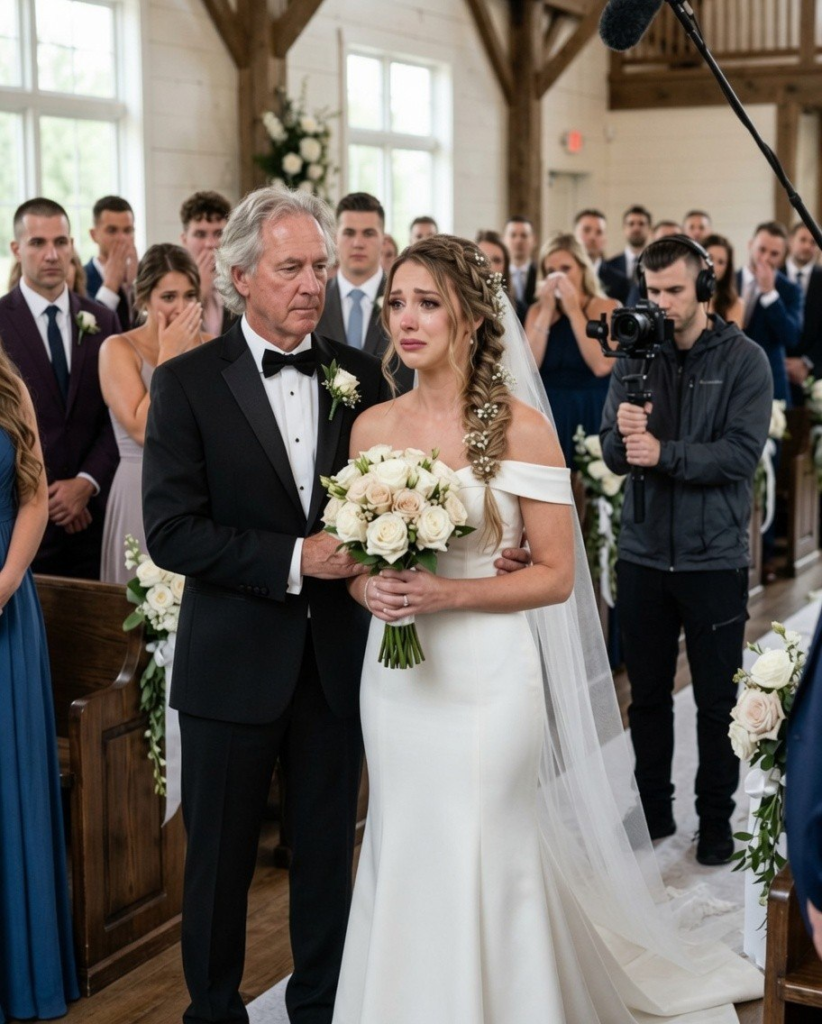
Warren was standing rigidly at the far end of the long hallway. He wore a razor-sharp navy suit and the brand-new silk tie. His expensive dress shoes were polished to such a high, mirror-like gleam that I could clearly see the overhead corridor lights reflecting perfectly in the dark leather.
He was holding his large hands tightly together in front of his waist, standing with the exact composed, upright posture he had likely utilized at every single chaotic high school assembly for thirty years. He was waiting patiently for his cue.
But as I drew closer, I noticed his massive hands were violently shaking.
Liam had pulled him aside twenty minutes earlier. “You holding up okay, Dad?”
Warren had aggressively straightened his pristine tie and replied, “Son, I have waited sixty-two agonizing years for the privilege of walking a daughter down the aisle. I think I can manage to hold it together for a few more minutes.”
When I finally stepped into the ambient light of the hallway, Warren’s breath audibly hitched in his chest. I watched his weathered face cycle rapidly through three distinct, overwhelming expressions in the span of two seconds.
First, profound surprise. Then, bursting pride. And finally, something infinitely deeper and significantly harder to label. It was the specific, crushing kind of emotion that only lives deep within the chest of a man who had dedicated his entire career to patiently teaching other people’s broken children, and who fiercely loved his son’s future wife as if she had always belonged to his own bloodline.
“You are unquestionably the most beautiful bride I have ever laid eyes on,” he stated. His gravelly voice violently cracked on the final word. He roughly cleared his throat and defensively straightened his suit jacket lapels.
“Thank you, Warren,” I whispered, fighting fresh tears. “For absolutely everything. Not just for today.”
He formally offered me his right arm. I took it, gripping the fabric tightly.
And for the absolute first time that entire exhausting day, I felt the suffocating weight of the morning—the vicious group text, the abandoned, sealed invitation, the obnoxious Dubai Instagram posts—physically lift off my shoulders and settle permanently into the dust behind me, exactly where it belonged.
Warren’s strong arm was incredibly steady. His walking pace was perfectly measured. I learned later that he had neurotically practiced the aisle walk three separate times in his living room the night before. Janet tearfully confessed she had watched him from the kitchen sink, obsessively counting his paces out loud, desperately ensuring his timing was flawless. He wanted the moment to be absolutely perfect for me.
And it was.
The hired string quartet began playing something hauntingly soft as the massive double doors swung open. I honestly do not remember the specific name of the classical piece. I only vividly remember the blinding sunlight.
It poured magnificently across the sprawling vineyard lawn in long, golden sheets, perfectly illuminating the tops of the pristine white chairs and the thousands of flower petals meticulously scattered along the grass aisle.
One hundred and twenty guests simultaneously stood up and turned toward us. I heard the collective rustle of expensive fabric, the quiet, appreciative gasps, and the undeniable sound of someone already openly sobbing in the third row.
Warren and I stepped forward together in perfect unison. His pace was a steady, rhythmic march. Mine flawlessly matched his. I gripped my heavy bouquet tightly with my left hand and anchored myself to his strong arm with my right. He gently placed his free, calloused hand securely over mine, and he kept it locked there for the entirety of the long walk.
I scanned the sea of faces blurring past me. Nora, already aggressively wiping her streaming eyes with a tissue. Sarah, beaming a massive, chaotic grin. Janet, standing proudly in the front row, pressing her hand hard over her heart as if trying to keep it from bursting. Liam, standing tall at the wisteria-draped altar, his jaw locked tight, his eyes shining with unshed tears.
And then, my eyes locked onto the two chairs.
Front row. Bride’s side. White paper signs loudly declaring RESERVED. Completely empty.
The two seats were positioned perfectly, utterly still, and glaringly vacant. They were two screaming rectangles of agonizing absence situated in a massive sea of people who had actively chosen to show up for me.
Marcus’s camera flawlessly captured the devastating moment.
He executed a slow, agonizingly steady pan. From the raw emotion on my face, directly down to the empty chairs, and slowly back up again. Five excruciating seconds of footage. There was zero dramatic voiceover. There was no manipulative musical sting added in post-production. It was just the devastating, raw image of a bride bravely walking past the exact physical space her parents should have been occupying, walking arm-in-arm with the surrogate father who actively chose to be there instead.
One hundred and twenty people watched the scene unfold in real-time. Some of them knew the ugly backstory; most of them did not. But every single soul who looked at those two glaringly empty chairs instantly understood the gravity of the betrayal.
Ruth sat entirely alone on the Bride’s family side, positioned exactly three seats away from the void. Tears streamed unchecked down her face, ruining her makeup. She made absolutely no effort to wipe them away.
When we reached the altar, Warren gently released my arm. He took my trembling hand, tenderly placed it into Liam’s strong grip, and leaned in close enough that only the three of us could hear his final words.
“She is undeniably the absolute best thing that has ever happened to our family,” Warren whispered fiercely to his son.
Liam nodded slowly, his eyes locked onto mine. “I know, Dad.”
Liam had painstakingly written his own vows. I had written mine as well. His were significantly shorter than mine, but they landed with the force of a sledgehammer.
“Tori,” he said, gripping both of my hands tightly in his. “I absolutely cannot promise you a flawless, perfect life. I cannot promise that we will never have stupid arguments about whose specific turn it is to unload the dishwasher. But I swear to you this one truth: I will always be in the one place that actually matters. I will always show up. And I will never, for as long as I draw breath on this earth, ever make you wonder whether you are enough.”
I completely lost trust in my own voice after that. I was forced to read my vows directly from a shaking, folded piece of paper, because I knew the moment I looked deeply into his eyes, my brain would entirely short-circuit.
The breathtaking ceremony concluded with a shattering kiss and a massive, roaring cheer from the crowd that loudly echoed off the ancient stone walls of the vineyard.
We walked back up the aisle together as husband and wife. We walked proudly past the two glaringly empty chairs. We walked past Ruth’s beautiful, tear-streaked face. We walked past one hundred and twenty people who would undoubtedly go home that night and recount the bizarre tale of the beautiful wedding that featured two blatantly empty chairs in the very front row.
Later, during the raucous reception inside the massive tent, Warren stood up to deliver the traditional toast.
He stood tall, clutching his signature glass of iced tea, and recounted a story to the hushed room that I had never heard before.
“The very first time Tori came to our house for Sunday dinner,” Warren boomed into the microphone, “she stood frozen in the entryway for a full thirty seconds before Liam finally had to physically nudge her inside. She was clutching a bottle of Pinot Noir against her chest like it was a Coast Guard life vest. And I looked at her, and I thought to myself: ‘This incredible woman has been desperately waiting her entire life for someone to finally tell her she belongs somewhere.’“
He proudly raised his glass high into the air.
“Tori. You belong here. You always have.”
Marcus’s camera silently captured every single raw reaction. The explosive laughter. The quiet, hidden tears. The musical clinking of crystal glasses. The jazz band enthusiastically starting up their set.
Marcus confided in me much later that evening, as his exhausted crew was breaking down the lighting equipment, that he had never, in his entire career, filmed anything quite as emotionally devastating.
His cameras officially stopped rolling at 11:00 p.m. that night.
But the true, world-altering story was only just getting started.
If you have ever wondered exactly what happens when the ugly truth finally escapes, not through a screaming, messy confrontation, but through the silent, undeniable truth of a camera lens, brace yourself. Because the fallout was about to reach millions.
Chapter 6: The 14 Million Witnesses
Exactly two weeks post-wedding, while Liam and I were still unpacking our lives, Marcus sent me a terse email containing a private hyperlink to the rough cut of the film.
It was twenty-two minutes long. He had simply titled it: Modern Ceremonies: Tori & Liam.
I watched it entirely alone the very first time. Liam was trapped at the engineering firm. The house was dead quiet.
It was an absolute masterpiece.
Marcus had masterfully woven together the chaotic energy of the rehearsal dinner, the profound intimacy of the ceremony, the raw emotion of the speeches, the clumsy joy of our first dance, and the chaotic beauty of the sparkler exit. He had exclusively utilized raw, natural audio—the sweeping swell of the string quartet, the rhythmic clink of champagne glasses, the booming, genuine laughter erupting during Warren’s toast. There was absolutely zero manipulative voiceover. No cheesy, dramatic music swelling to force an emotion. It was just the pure, unvarnished sounds of a real wedding, populated by real people.
But then, the footage reached the chairs.
Marcus did not add a single line of narration to explain the context. He didn’t need to. He simply held the agonizing shot for five excruciatingly long seconds. A slow, punishing, steady frame focused entirely on two stark white chairs situated in the front row. The crisp paper signs boldly declaring RESERVED. Completely, utterly empty. The golden afternoon sunlight falling tragically across the vacant seats.
You could clearly see the blurred, joyous shadows of the other guests moving excitedly in the background, but the chairs themselves remained terrifyingly still and silent.
It was undeniably the absolute quietest five seconds of the entire film. And it screamed louder than any monologue ever could.
I picked up the phone and called Marcus that exact evening.
“You have my full permission to publish it,” I stated firmly.
He paused on the other end, the hesitation evident. “Tori, are you absolutely certain about this? Once this footage hits the internet, you can never, ever take it back into the bottle.”
“It is the undeniable truth, Marcus,” I replied, my voice steady. “The chairs were empty. Your camera witnessed it. I am absolutely not ashamed of being the person who actually bothered to show up to her own wedding. The shame belongs to them.”
“You don’t want me to edit that specific part out?”
“Do not cut a single frame.”
He exhaled a long, heavy breath. “Okay. I will have it live on the channel by Friday morning.”
I hung up and sat silently in the fading light of the living room. Liam arrived home an hour later, exhausted, dropping his heavy work bag by the door. He found me staring blankly up at the ceiling fan.
“You good, babe?” he asked, walking over to kiss my forehead.
“I explicitly told Marcus to post the documentary,” I said.
“All of it?”
“Every single second of it.”
He slowly sat down on the sofa beside me, wrapping his arm around my shoulders. “Then whatever massive storm is about to hit, we handle the fallout together.”
Marcus officially uploaded the documentary to YouTube on a bright Friday morning.
The title remained aggressively simple: Modern Ceremonies: Tori & Liam. The chosen video thumbnail was a stark, unedited still frame extracted directly from the ceremony footage: Warren and I proudly walking down the grassy aisle, with the two glaringly empty chairs highly visible just behind our shoulders in the front row. There was absolutely no clickbait text overlay. No red arrows pointing to the drama. Just the raw, devastating image.
The first twenty-four hours performed entirely normally by Marcus’s indie-channel standards.
Twelve thousand views. His core, dedicated subscribers liked the aesthetic. The initial comments were overwhelmingly warm and supportive.
“What a breathtakingly beautiful wedding.”
“Warren is an absolute legend of a man.”
“That vineyard location is absolutely gorgeous.”
And then, inevitably, a sharp-eyed viewer asked the fatal question.
“Wait, hold up… are those two white chairs in the front row completely empty? Who on earth were those reserved for?”
Another user rapidly commented directly underneath: “I think those are traditionally the Bride’s parents’ designated seats.”
And then, the floodgates opened. “Where the hell are the bride’s parents?”
Marcus’s regular subscribers began aggressively responding to the thread. Some offered wild speculation, others demanded direct answers from the creator. Marcus maintained his strict professional silence. He never replied to comments. He firmly believed in letting his films speak entirely for themselves.
By hour thirty-six, the algorithm caught fire.
A highly influential, high-end wedding planner based in New Jersey discovered the video and shared the YouTube link directly into a private, highly active Facebook group boasting over twenty-two thousand industry members. Her accompanying caption was explosive:
“This is undeniably the most profoundly powerful, heartbreaking wedding film I have ever witnessed in my career. You must watch it to the very end.”
The view count violently skyrocketed.
Twelve thousand rapidly mutated into forty thousand. Then ninety thousand. Within a staggering forty-eight hours, the counter smashed past one hundred and eighty thousand views.
The fundamental tone of the comment section radically shifted. They ceased being superficial observations about the flowers and transformed into massive, deeply personal confessions.
“My mother callously skipped my college graduation to attend my brother’s meaningless baseball game. I have never admitted that to a single soul until now.”
“I openly wept when I saw those empty chairs. That was exactly my reality twenty years ago.”
“The father-in-law stepping up to walk her down the aisle completely destroyed me. I’m sobbing.”
“THAT is what actual, real family looks like. Blood means nothing.”
I sat in bed with the glowing screen illuminating my face, obsessively reading every single comment late into the night. Hundreds, then thousands of them. Complete strangers from across the globe actively healing their own trauma underneath the digital footprint of my wedding video.
I did not reply to a single comment. I simply bore witness. And for the absolute first time in my adult life, I did not feel isolated in my own tragic story.
Day Five: 1.2 Million Views.
A massively popular parenting and lifestyle blogger based in California penned a sprawling, emotional article titled: The Empty Chairs That Completely Broke the Internet. She embedded Marcus’s video directly into the post. Her article was aggressively shared over eleven thousand times across social media platforms in a mere two days.
Day Six. The story breached Reddit.
A viral thread materialized on a major subreddit. The blunt title read: This bride’s parents flew to Dubai for her brother’s boutique store opening instead of attending her wedding.
It violently rocketed to the front page of the internet within hours. Twelve thousand upvotes. Three thousand furious comments analyzing every frame of the video.
Day Eight: 4.7 Million Views.
A prominent regional news network in Connecticut ran a prime-time segment covering the viral phenomenon. They proudly utilized the agonizing still frame of the empty chairs as their backdrop. Mercifully, they did not name us on air; Marcus had intentionally omitted all last names from the documentary credits to protect our privacy.
Day Ten: 7 Million Views.
The tidal wave of media interview requests began pouring into Marcus’s inbox. A producer from a major national morning show. Two highly popular true-crime podcast hosts seeking a ‘betrayal’ angle. A senior editor from a women’s lifestyle magazine.
Marcus diligently forwarded every single inquiry directly to me. I firmly declined every last one of them.
“You absolutely do not owe a single one of these vultures your personal story,” Liam reminded me, handing me a cup of coffee.
“The video already told the only story that matters,” I replied quietly.
My personal cell phone buzzed incessantly for days. A relentless barrage of new friend requests, sprawling direct messages, and emotional emails from total strangers who simply wanted to desperately thank me for making them feel seen and validated in their own family trauma. I read a handful of them. I did not respond. I was entirely unprepared, and unwilling, to become a public figurehead for parental abandonment.
Nora called me late that week, her voice thick with panic. “Tori, this video is literally everywhere online. Are you holding up okay?”
“I think so,” I murmured.
“Are your parents actively watching this nuclear bomb detonate?”
I honestly hadn’t allowed myself to dwell on that terrifying specific thought. Or rather, I had been aggressively actively trying not to think about it.
Somewhere, thousands of miles across the ocean, lounging in a luxury Dubai hotel suite, or perhaps thousands of feet in the air on a return flight, or perhaps sitting in their pristine kitchen where my sealed invitation still gathered dust on the counter… my parents were about to violently discover what fourteen million complete strangers already intimately knew.
And there was absolutely nothing I could do to control the horrific fallout that was about to rain down upon them.
The internet had found the villains. And the internet is notoriously unforgiving.
Chapter 7: The Reckoning of Dubai
Derek was the very first casualty to discover the breach.
One of his sleazy, superficial business partners callously texted him a direct link to the viral video on a sweltering Tuesday afternoon in Dubai. The text arrived devoid of any contextual warning, bearing only the raw YouTube URL and a single, confused question mark.
Is this your sister?
Derek sat alone in his sterile, air-conditioned office situated directly above his newly minted boutique store—a store that had ironically opened to deeply underwhelming foot traffic, burdened with an exorbitant commercial lease payment that was already aggressively straining his limited cash flow.
He clicked the link. He watched the entire twenty-two minutes on his laptop screen.
He watched the intimate ceremony unfold without him. He watched Warren proudly walk his only sister down the aisle. He watched the merciless camera lens hold steady on the two stark white, empty chairs bearing the RESERVED signs.
He immediately picked up his phone and called my mother.
Pamela was already safely back home in Connecticut by then. They had returned stateside a mere four days after my wedding concluded. She eagerly answered Derek’s call on the absolute first ring. She always did.
“Mom. There is a video online,” Derek stammered, panic lacing his voice.
He texted her the link.
She sat on the plush sofa in her immaculate living room, the heavy curtains drawn tight against the afternoon sun, and watched it.
I know the precise, agonizing details of this moment because Ruth relayed them to me later. Ruth had been begrudgingly invited over for a post-trip lunch that very day. Ruth sat mutely at the kitchen island, drinking coffee, and actively listened to Pamela silently watch twenty-two devastating minutes of the daughter’s wedding she had callously chosen to skip.
Pamela was forced to look at the empty chairs. She was forced to witness Warren’s large, calloused hand protectively covering mine. She was forced to see one hundred and twenty guests serving as silent, damning witnesses to the gaping void she and my father had deliberately created.
Worse than the video itself, she saw the comment section.
Thousands upon thousands of furious comments from complete strangers globally branding her as utterly selfish, heartless, and morally unforgivable.
My father, Glenn, watched the video alone on his smartphone in the upstairs master bedroom. He did not emerge from that room for over an hour.
The digital siege had already commenced. Derek’s Instagram direct messages were rapidly overflowing with venom. Internet sleuths who had easily recognized his face from his boastful, public Dubai posts had quickly connected the dots.
“Isn’t this literally your sister’s wedding? Why the hell weren’t you there?”
“Your garbage parents picked your stupid store opening over her wedding day. You should all be deeply ashamed.”
Derek frantically turned off his public comments and notifications, but the digital onslaught was relentless.
The first panicked voicemail from my mother hit my phone at exactly 2:14 p.m.
“Tori, this is your mother,” her voice was shrill, completely devoid of apology. “I do not know what kind of sick game that filmmaker was attempting to play, but this video is absolutely not presenting the full story to people! You know we desperately wanted to be there with you. You know that! Call me back immediately to discuss this.”
The second voicemail arrived forty minutes later. The panic had mutated into furious indignation.
“This is completely humiliating, Tori! Absolutely everyone at the church has seen this trash! Carol from my private prayer group just texted me the link! You need to contact YouTube and have that video taken down this instant. This is a private family matter, not cheap entertainment for strangers to gawk at!”
The third voicemail arrived just before midnight. She was weeping now, wielding the ultimate weapon of maternal guilt.
“I am your mother, Tori! I carried you in my body! I raised you! And you maliciously allowed a camera crew to embarrass us in front of the entire internet? Call me, please.”
I sat on the cold tile of my kitchen floor the following morning, my back pressed firmly against the lower cabinets, and played all three voicemails sequentially.
I listened to them the exact same way you watch a violent storm tearing across a distant field—fully knowing the destruction cannot physically reach you, but still feeling the severe drop in barometric pressure deep within your chest.
Three frantic voicemails. Not a single, solitary apology contained within them. Just three vastly different methods of aggressively screaming: How dare you allow the world to see what we did to you?
Not, “I am so incredibly sorry I wasn’t there.” Not, “I made a catastrophic mistake.” Not even, “Can we please talk about what happened?”
It was pure, unadulterated damage control. It was desperate reputation management. It was the exact same toxic, narcissistic instinct that had brutally governed her parenting style for thirty-one years: Protect the pristine public image at all costs, and completely ignore the bleeding wound you inflicted.
I calmly set the phone onto the granite counter and proceeded to make breakfast. Eggs. Toast. Black coffee. I ate very slowly, savoring the quiet. Liam sat across the small table from me, silently scrolling through the news on his tablet, deliberately not asking the questions he already knew the answers to.
“Are you planning to call her back today?” he finally asked gently.
“No,” I replied firmly.
He offered a single nod, entirely validating my choice, and returned to his coffee.
By Day Fourteen, the video had smashed past 7.2 million views.
The comment section had evolved into something I could never have possibly anticipated. It was no longer simply an angry mob reacting to my specific narrative. It was a massive, digital support group where people were bravely unburdening their own souls. Thousands of them.
A heartbroken woman in Texas confessed her mother had skipped her college graduation to attend her golden-child brother’s meaningless high school baseball game. A man in Ohio revealed his parents had lavishly funded his sister’s wedding but flatly refused to attend his own because they deemed it “too informal.” A grandmother detailed how she had driven fourteen grueling hours to attend her young granddaughter’s dance recital because, as she wrote: “Someone in that little girl’s life absolutely needs to show up for her.”
Total strangers were finding profound healing underneath the digital footprint of my trauma. I honestly did not know how to process that responsibility.
The real-world consequences for my family were beginning to manifest.
Derek’s heavily hyped Dubai store started receiving an avalanche of devastating, negative online reviews. One-star ratings flooded Google and Yelp from furious individuals who had never even set foot in the Middle East.
“Owned by the narcissistic guy whose parents skipped his sister’s wedding to be here. Great family values. Check the viral YouTube video before shopping.”
I felt compelled to intervene. I posted a single, public statement on my personal, locked social media page—the first and absolute only public comment I ever made regarding the situation.
“Please, I am begging you, do not leave malicious negative reviews on my brother’s business pages. This is a deeply personal family matter. I do not want anyone’s livelihood harmed because of this documentary. Thank you for your understanding.”
Some of the digital vigilantes listened and deleted their reviews. Many did not. But I had officially said my peace. My conscience was clear.
The social isolation for my parents began rapidly.
Uncle Pete completely stopped calling to guilt-trip me. Aunt Linda, terrified of the digital backlash, abruptly deleted her entire Facebook account. Two of my mother’s closest friends from her elite church group quietly unfollowed her on Instagram.
They were small, seemingly petty things. But in a small, gossipy New England town, the small things are the exact weapons that cut the deepest.
Ruth texted me an update later that week.
“Your mother hasn’t physically left the house in three solid days, Tori. She is just sitting in the dark, obsessively reading the YouTube comments on a loop. Glenn finally had to confiscate the Wi-Fi router password from her to make her stop.”
I read that specific message three times over. I did not feel a rush of victorious satisfaction. I did not feel the sweet taste of revenge. I simply felt a quiet, hollow, profound ache—the specific tragedy of watching people realize, far too late, that their cruelest choices had millions of witnesses.
Day Twenty-One: 14 Million Views.
Marcus’s indie channel exploded from forty-eight thousand subscribers to a staggering three hundred and twenty thousand in three weeks. He possessed the profound integrity to absolutely refuse to monetize the video with ads. He confided in me later that he had aggressively turned down two highly lucrative corporate sponsorship offers. He refused to profit off my pain.
A single, devastating comment boasting forty-seven thousand ‘likes’ sat permanently pinned to the very top of the page.
It simply read: “Those two empty white chairs screamed louder than any speech ever could.”
I screenshotted and saved that specific comment to my phone. I honestly don’t know why. Perhaps because a complete stranger on the internet had managed to perfectly articulate in a single sentence what I had spent thirty-one agonizing years desperately trying to explain to my parents:
Your absence is not a neutral act. Your absence is a violent message.
I powered down my phone that evening and sat out on the back porch with Liam. The fireflies were blinking lazily in the humid air. The neighbor’s hound was barking distantly at something hidden in the tree line. It was profoundly quiet—the specific, thick, heavy quiet that only summer evenings in Connecticut can produce.
“I absolutely didn’t plan for any of this to happen,” I whispered into the dark.
“I know you didn’t,” Liam said, reaching out to hold my hand. “That is exactly why it is so powerfully real.”
Marcus called me the following afternoon. He gently asked if I would be interested in filming a brief, follow-up documentary. A ‘Where Are They Now?’ update for his massive new audience.
I declined immediately.
“No, Marcus,” I said firmly. “This is absolutely not a reality television franchise. It’s my actual family.”
He completely understood and respected the boundary.
I did not desire internet fame. I did not crave a platform as an influencer. I desperately did not want to become permanently known as ‘the tragic woman whose parents abandoned her at the altar.’
I simply wanted what I had always, pathetically wanted: to be fiercely loved by the two people who possessed the biological duty to love me first. And when that love failed to materialize, I simply wanted the terrifying freedom to stop pretending that the absence was acceptable.
Fourteen million strangers had witnessed my wedding day. But only the one hundred and twenty people physically present in that vineyard actually knew what it felt like to stand in the sun and survive it.
And for me, that was finally enough.
The world had moved on, but the wreckage in my family was just beginning to settle.
Chapter 7: The Unanswered Letters
The handwritten letter arrived in my mailbox on a gloomy Monday afternoon.
It was a stark, plain white envelope bearing absolutely no return address. However, I instantly recognized the severe penmanship. My father always wrote in harsh, block capitals—the specific, rigid style men who grew up in working-class, small-town New England were strictly taught in grade school. Every single letter was identical in height. No extravagant flourishes. Absolutely no wasted ink.
I sat alone at my kitchen table, a glass of ice water sweating onto the wood, and carefully sliced the envelope open.
TORI,
I WATCHED THE VIDEO. I SAW THOSE EMPTY CHAIRS. I POSSESS ABSOLUTELY NO EXCUSE.
I WAS A PATHETIC COWARD. I CHOSE THE PATH OF LEAST RESISTANCE EVERY SINGLE TIME YOUR MOTHER ASKED ME TO. AND I FOOLISHLY LIED TO MYSELF, SAYING I WAS JUST ‘KEEPING THE PEACE.’ BUT I WAS ONLY KEEPING THE PEACE FOR MYSELF, NOT FOR YOU.
I KNOW BEYOND A SHADOW OF A DOUBT THAT THIS LETTER CHANGES ABSOLUTELY NOTHING. I KNOW A CHEAP PIECE OF PAPER CANNOT POSSIBLY FIX THIRTY-ONE YEARS OF CHRONICALLY LETTING YOU DOWN.
BUT I DESPERATELY WANT YOU TO KNOW THIS: THE EXACT MOMENT I WATCHED WARREN TAKE YOUR ARM AND WALK YOU DOWN THAT AISLE, I FELT SOMETHING VITAL BREAK INSIDE OF ME THAT I DO NOT THINK WILL EVER HEAL. HE DID EXACTLY WHAT I SHOULD HAVE DONE, AND HE DID IT INFINITELY BETTER THAN I EVER COULD HAVE.
I AM SO INCREDIBLY SORRY, TORI. NOT JUST SORRY FOR SKIPPING THE WEDDING FOR DUBAI. I AM SORRY FOR EVERY SINGLE BETRAYAL BEFORE DUBAI THAT MADE DUBAI EVEN POSSIBLE.
DAD.
I read the block letters twice. I meticulously folded the paper along its original creases and slid it back into the white envelope.
Liam arrived home from the site an hour later. He immediately spotted the letter resting conspicuously on the kitchen table. He read it silently, not asking for permission, because I had deliberately left it there for him to find.
“What exactly are you going to do about this?” Liam asked softly, setting the paper down.
“Absolutely nothing,” I replied, staring out the window. “Not yet.”
“Is that okay?”
“It has to be.”
I did not draft a reply to my father’s confession. Not because I was maliciously attempting to punish him with silence. I withheld a response because I was no longer convinced that a letter—even a remarkably self-aware and seemingly genuine one—automatically earned a response after three solid decades of cowardly silence.
Sometimes, the absolute kindest, most protective action you can take for your own mental health is to allow someone’s desperate apology to sit in the void, entirely unanswered.
Pamela physically ambushed me on a humid Saturday morning in late August.
I was kneeling in the front garden, aggressively ripping stubborn weeds from the flowerbed bordering the brick walkway. I had dirt jammed under my fingernails, my hair was yanked back into a messy bun, and I was wearing sweatpants. I was absolutely not anticipating an audience.
A sleek, silver sedan aggressively pulled into my driveway. My mother slowly stepped out of the driver’s side.
The physical transformation was jarring. She had visibly lost a significant amount of weight. The skin around her eyes was swollen and red—not the fresh redness of crying that specific morning, but the deep, bruised redness born from weeks of relentless weeping. She was wearing a highly expensive, silk blouse I had never seen before, which immediately signaled to my brain that she had purposefully purchased a new outfit specifically for this confrontation.
She had dressed up for an apology tour.
“Tori. We desperately need to talk,” she announced, her voice trembling.
I slowly stood up, thoroughly brushing the damp soil from my knees. I did not move to invite her inside my home.
“That viral video has completely destroyed us, Tori,” she stated, her voice violently cracking on the pronunciation of my name. “My closest friends, my entire church group, your father’s professional colleagues… absolutely everyone in this town has seen it. Carol won’t even make eye contact with me at the grocery store.”
I stared at her, feeling an icy calm settle over my nervous system.
“You are only upset that people finally witnessed what you did, Mom,” I said flatly. “You are not actually upset that you did it.”
She physically flinched as if I had slapped her across the face. “That is incredibly unfair!”
“Neither was choosing Dubai.”
She aggressively pressed a manicured hand hard against her chest, deploying the theatrics. “I am sorry! I truly am! But you absolutely have to understand that Derek needed us there!”
“Derek always needed you,” I corrected her, keeping my voice terrifyingly even. “And I always quietly understood. That was our unspoken, toxic arrangement for my entire life.”
Her face radically shifted. The fragile, controlled composure she had undoubtedly practiced in her rearview mirror began to violently fracture.
“You are intentionally punishing me!” she accused, her voice rising to a shrill pitch. “You are maliciously punishing your own mother out of spite!”
“I am not punishing you at all, Mom,” I replied calmly. “I am simply refusing to pretend anymore.”
She stood frozen on my brick walkway, physically shaking. I did not raise my voice. I didn’t need to yell to be heard.
“You explicitly told Aunt Ruth, ‘Tori will understand. She always does,’” I recited, throwing her own poison back at her. “You typed it into a group text. You have been using that excuse my entire goddamn life. Every single birthday you skipped. Every celebratory dinner you canceled. Every single time you actively chose Derek simply because he was louder, and I was vastly easier to ignore.”
I paused, letting the silence hang heavy in the humid air.
“But you know what? You were absolutely right about one thing. I do understand now. I finally understand that I deserved infinitely better than you.”
She opened her mouth to argue, snapped it shut, and opened it again. Absolutely no words materialized. She was openly weeping now, standing awkwardly on my walkway, expensive mascara running in dark tracks down her cheeks, her brand-new silk blouse wrinkled where her fists had been desperately gripping the fabric.
“What exactly do you want from me, Tori?” she begged, her voice a pathetic whisper. “Tell me exactly what to do, and I will do it.”
“Nothing,” I said, offering her the ultimate rejection. “That is the entire point, Mom. I do not need a single thing from you anymore.”
The words landed heavily between us, echoing like a heavy vault door slamming shut. It wasn’t a violent slam. It was a terrifyingly quiet, permanent click.
I proceeded to outline my absolute, non-negotiable terms. I informed her that if she genuinely desired a relationship with me—an actual, authentic relationship, not the exhausting, theatrical performance she had been directing for three decades—she would be required to immediately enter intensive psychological therapy.
“Not performative therapy for my benefit,” I clarified coldly. “For yourself. Not as a grand, sweeping gesture, but as a grueling commitment.”
“I know that you tragically lost your sister when you were nineteen,” I continued, unearthing the family ghost. “I know that loss fundamentally broke something deep inside your psyche. I have watched that unhealed trauma shape every single erratic choice you have ever made. But you absolutely do not get the right to break me just to fill that gaping void.”
She looked at me as if I had suddenly begun speaking fluent Mandarin.
“You aggressively attached yourself to Derek because his chaotic energy reminded you of her,” I analyzed. “The constant need for attention, the desperate need to be kept close. I completely understand the psychology behind it. But that trauma is absolutely not my burden to carry for you. And it was never, ever my job to compete against a ghost for my mother’s love.”
She slapped a hand over her mouth, stifling a sob.
“Go home, Mom,” I ordered quietly. “Find a licensed therapist. Do the agonizing work. And if you ever decide to come back here, come back because you have fundamentally changed as a human being. Do not come back here simply because you desperately need me to forgive you so you can sleep better at night.”
I turned my back on her and walked toward my front door. I paused on the threshold, looking over my shoulder one final time.
“Warren Callaway was in the absolute only place on earth that mattered that day,” I said, twisting the knife. “Mom, you were in Dubai.”
I walked inside and firmly closed the heavy door.
Through the sheer curtains of the living room window, I watched her stand paralyzed on my walkway for two full, agonizing minutes. She finally turned, stumbled to her silver sedan, sat behind the steering wheel for another three minutes, and slowly drove away.
I did not raise my voice during the entire encounter. I did not need to. Thirty-one years of accumulated silence is infinitely louder than any scream.
I powered my cell phone back on later that evening. The illuminated screen instantly flooded with notifications. I had to count the terrifying number twice to ensure I wasn’t hallucinating.
93 Missed Calls.
Pamela: 31 attempts. Glenn: 17. Derek: 8. Uncle Pete: 12. Aunt Linda: 9. Completely unrecognized numbers: 16. Likely nosy neighbors, frantic church members, people who had scrounged my number from a friend of a friend desperately seeking the inside scoop on the viral drama.
Ninety-three frantic, desperate attempts to reach a woman who had spent thirty-one agonizing years desperately reaching out for them.
I held the glowing screen up for Liam to inspect as he walked into the kitchen.
“Ninety-three,” I announced flatly.
He stared at the staggering number, then looked directly into my eyes. “Exactly how many of those are you planning to return?”
“Zero.”
He offered a single, approving nod. Not because he blindly agreed with my anger, but because he implicitly, fiercely trusted my judgment.
I did not block a single one of their numbers. I did not dramatically change my phone plan. I simply chose not to call them back.
There is a profound psychological difference between angrily slamming a door shut and calmly locking a deadbolt. I intentionally left the door unlocked. But I completely ceased standing on the opposite side of the wood, desperately waiting for someone to finally walk through it.
That very same week, the karmic boomerang finally returned to Dubai.
Derek’s aggressively hyped boutique encountered its first catastrophic cash flow crisis. The initial foot traffic projections had been wildly, delusionally optimistic. The commercial lease was exorbitantly expensive. Two of his primary, ‘vital’ international investors abruptly pulled their funding following a massive supply chain failure.
These were basic, brutal business fundamentals at play. The collapse had absolutely nothing to do with the viral video, and absolutely nothing to do with me.
The tragedy was that Glenn had foolishly liquidated $80,000 of his personal savings to inject into Derek’s failing store. It was his retirement nest egg. The specific kind of reckless, desperate investment a weak father makes when his golden-child son promises it is a ‘sure thing,’ and his overbearing wife viciously insists that ‘family comes first.’
Eighty thousand dollars, sitting uselessly in a vacant storefront in a luxury Dubai shopping district where the rent was overdue and the customers were entirely non-existent.
I did not feel a rush of vindictive satisfaction when I heard the news. I merely felt the familiar, exhausting weight of watching reckless people make terrible choices, and then acting shocked when the floor inevitably collapses beneath their feet.
Three agonizing months later, Derek’s highly publicized store officially shuttered its doors.
Four miserable months of operation, catastrophically underfunded from the very beginning. The physical location had been entirely wrong—tucked away behind a noisy food court in a sprawling mall that exclusively catered to tourists seeking Instagram photos, not actual luxury purchases. The remaining investors formally pulled their capital in late September.
Derek signed the humiliating lease termination paperwork on a Tuesday, and slinked onto a commercial flight back to Connecticut on a Wednesday.
Glenn tragically lost the vast majority of the $80,000. Not the entirety of it, thankfully. The desperate liquidation sale managed to recover a fraction of the inventory value, but it was enough of a devastating financial blow that the comfortable retirement timeline he and Pamela had arrogantly mapped out was no longer a viable reality.
Pamela officially initiated therapy in late August.
Glenn relayed the information to Ruth, who subsequently relayed it to me. Twice a week. Tuesdays and Thursdays. She was seeing a highly recommended specialist in Fairfield who dealt specifically with complex family systems and narcissistic personality traits.
I did not inquire about what they discussed during those sessions. It was fundamentally no longer my business to manage her healing.
Her tight-knit circle of church friends remained cordial, but distinctly distant. Superficial conversations in the vestibule that used to drag on for twenty minutes were now abruptly terminated after three. People vividly remembered the documentary. They never brought it up to her face. They didn’t need to. The silence was punishment enough.
Derek quietly moved back into his childhood bedroom in Connecticut and secured a humiliating, entry-level retail management job at a mall in Stamford.
He finally texted me in late October. It consisted of exactly three sentences.
Tori, I am so incredibly sorry I took them away from you that day. I honestly didn’t think about what my demands cost you. I really should have.
It was the very first genuine, unprompted apology I had received from any of them. It wasn’t a panicked defense regarding the viral video. It wasn’t about his public embarrassment. It was a raw acknowledgment of the fact that he had selfishly consumed every available resource in our family—financial, emotional, and physical—and had never once bothered to look across the table to check if his sister was still surviving.
I read the text. I saved it to my phone. I did not reply. Not yet.
Six months post-wedding, this is exactly what my reality looks like.
Sunday dinners are hosted reliably at Warren and Janet’s house. The heavy oak dining table is designed to seat eight, but there are perpetually ten plates set because someone always drags along a stray friend or colleague. Liam expertly carves whatever massive cut of meat Janet has spent the afternoon roasting. Warren aggressively quizzes the entire table on obscure trivia he memorized from the Sunday paper.
Ruth faithfully makes the drive down from Hartford once a month. She always arrives bearing her signature lemon pastries, which, to be brutally honest, are never quite as spectacular as she firmly believes they are, but absolutely nobody possesses the heart to tell her.
Nora and I religiously hit the pavement for our three-mile run along the reservoir every Saturday morning. She complains about her exhausting toddlers. I complain about the raised garden bed I am desperately trying to coax a single, pathetic tomato out of.
We absolutely never discuss the viral video anymore. It has successfully transitioned from a chaotic event that was happening to me, into a static event that simply happened in the past.
Pamela and I have endured exactly two brief phone calls. Both were agonizingly short, and fiercely guarded at the surface level. How is work going? How is the humidity?
She does not dare mention the documentary. She absolutely does not utter the word ‘Dubai.’ She asks politely about Liam, and I can hear the desperate, agonizing strain in her voice. I can hear that she is genuinely trying. And trying, it turns out, looks vastly different than I had envisioned in my youth. It is significantly smaller, quieter, and entirely devoid of grand, dramatic gestures.
Glenn mailed me a physical birthday card in September. It was the first piece of mail I had received from him in nine years.
I let the envelope sit unopened on the kitchen counter for an entire week. When I finally summoned the courage to slice it open, it contained exactly five words written in his signature, block capitals.
I AM PROUD OF YOU. I SHOULD HAVE SAID IT DECADES SOONER.
I wept. Not because I still desperately required his paternal approval to survive. I wept because I realized, with a shocking sense of peace, that I finally no longer needed it. The tears were not mourning the loss of something; they were the physical release of a massive, crushing weight I had been dutifully carrying since I was a little girl—the pathetic, ingrained belief that if I just achieved enough, if I was just quiet enough, he would finally notice me.
He finally noticed. It required the outrage of fourteen million complete strangers and two stark white chairs to force him to open his eyes, but he finally noticed.
In late November, a small, padded envelope arrived in my mailbox.
It bore my mother’s unmistakable, looping handwriting. Inside, nestled in bubble wrap, was the original, cream-colored wedding invitation. The exact envelope Ruth had faithfully delivered. The one that had sat abandoned, sealed, and ignored on the granite counter for weeks.
It was sliced open now.
Tucked neatly inside the flap, attached to a yellow Post-It note bearing Pamela’s handwriting, were eight devastating words.
I finally read it. I am so profoundly sorry it took fourteen million strangers to make me pick it up.
I silently placed the invitation into a desk drawer. Perhaps, someday in the distant future, I would frame it. Perhaps someday it would symbolize something entirely different. But not today. Not yet.
I thought back to my mother’s toxic, defining refrain.
Tori will understand. She always does.
She was absolutely right about one thing. I do understand now. I understand, with a ferocity that terrifies me, that I deserved infinitely better.
Family is absolutely not a default title you inherit at birth. It is a grueling, daily promise that you actively choose to keep. And if the specific people who biologically gave you life completely lack the capacity to honor that promise, you are fully authorized to grab a hammer and build your own damn table where people actually bother to pull up a chair.
Warren Callaway taught me that invaluable lesson. Not through flowery speeches or empty promises. He taught me with a brand-new navy silk tie, a remarkably steady arm, and sixty-two years of consistently, quietly showing up for every single person who walked through his front door.
That is exactly what true family looks like. It is profoundly quiet. It is unshakeably steady. It is fiercely present.
That is my final cut. Two empty chairs, one viral documentary, and a surrogate father-in-law who never, not once in his life, had to be asked twice to show up.
If this story reminded you to pick up the phone and call the specific people who actually show up for you in the dark, please do it today. Drop a comment below, hit that subscribe button, and I will see you in the next chapter of the story.