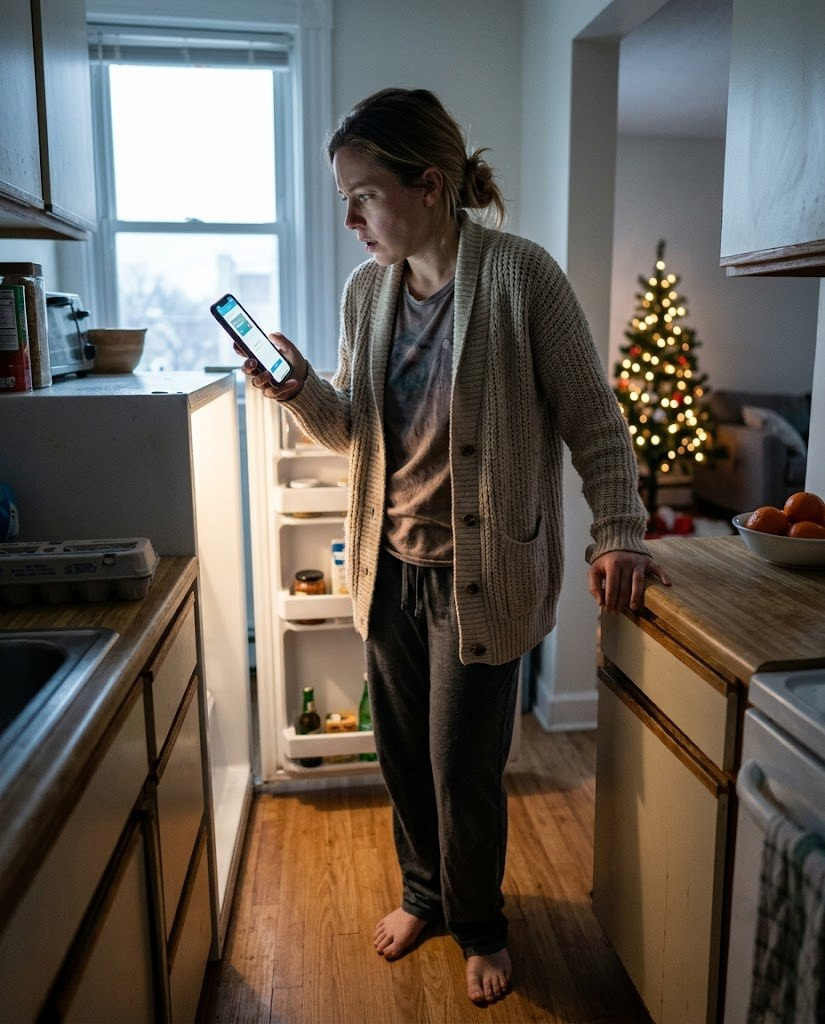
The text arrived while Nora Bell was standing in the checkout line at Granger’s Market, balancing a carton of eggs in one hand and a bag of clementines in the other.
The store smelled like cinnamon pinecones, wet coats, and pine cleaner so sharp it made every aisle feel scrubbed for judgment.
Her phone buzzed against her palm just as the cashier asked whether she wanted paper or plastic.
Nora glanced down.
Lily: Send me your card details.
Dad said you’re paying for our Christmas trip.
No hello.
No please.
No laughing emoji to soften the demand.
Just a command disguised as family planning.
Nora read it once, then again, waiting for her brain to find the joke.
Lily could be careless, entitled, even shameless, but there were still limits.
There had to be.
A person could not simply decide that her sister would fund a holiday vacation because their father had said so.
Except this was Lily, and Lily had spent most of her life stepping over lines everyone else pretended were not there.
When they were children, Lily had taken Nora’s clothes and said, You weren’t wearing it.
She had borrowed Nora’s school supplies, Nora’s headphones, Nora’s birthday money from Grandma, and each time the explanation was delivered with the same lazy confidence.
Nora could manage without it.
Nora always managed.
At seventeen, Lily had taken Nora’s little blue car without asking and brought it back with the gas light on and a melted milkshake cup wedged under the passenger seat.
Nora, fifteen and furious, had cried because she needed gas money to get to work.
Their mother had patted Nora’s shoulder and said, You know how Lily is.
That sentence had followed Nora for years.
You know how Lily is.
As if Lily were weather.
As if everyone else was responsible for umbrellas.
The cashier scanned the eggs.
Nora watched the total climb on the screen while her thumb hovered over the keyboard.
Her first instinct was to soften the answer.
Ask what this was about.
Offer to help with a smaller amount.
Make it clear she was not angry, not selfish, not the daughter who ruined Christmas.
Then she saw the words again.
Dad said you’re paying.
Not asked.
Not hoped.
Said.
A quiet, hard thing closed inside her.
Nora typed: That’s not happening.
She hit send before fear could dress itself up as politeness.
The typing bubble appeared immediately.
Vanished.
Appeared again.
Lily: Why are you being weird about this? Dad already looked at flights.
Nora paid for her groceries, carried the paper bag into the parking lot, and stepped into cold air so clean it stung.
A thin crust of frost covered her windshield.
She scraped at it harder than necessary, the plastic blade squealing against the glass.
It was not about flights.
It was not even about Christmas.
It was about being treated like a resource instead of a person.
She sat behind the wheel with the engine off, keys clenched in her hand, and remembered sophomore year of college.
Lily had called from her apartment sobbing because she had overdrawn her account and rent was due.
Nora’s scholarship refund had just arrived.
She wired the money before Lily even finished explaining.
She told herself it was a one-time thing.
A family emergency.
Love.
Then it was car insurance.
A phone bill.
A medical copay Lily never proved existed.
A security deposit.
A bachelorette weekend.
A birthday dinner where the check somehow slid toward Nora while everyone looked away.
Repayments came in pieces so small they felt insulting.
Twenty dollars with a heart emoji.
Fifty dollars three months late.
Promises that dissolved into silence.
Then a new emergency would appear, brighter and more urgent than the last, making the old debt feel petty and cruel to mention.
Her parents saw it.
Of course they saw it.
But they treated Nora’s usefulness like furniture that had always been in the room.
At thirty-two, Nora had worked hard to become harder to use.
She had an apartment she paid for alone.
A job in project management that she had earned after years of night classes and temp work.
A savings account that no longer felt like a miracle.
She checked her bank balances because survival had taught her to, but she no longer woke up every morning afraid of a declined card.
She had boundaries now.
Fragile, imperfect, but real.
Still, when her phone buzzed again on the kitchen counter, the old anxiety moved through her like a reflex.
Mom: Hey honey, you’re coming to Christmas, right? We’re finalizing plans.
Nora stared until the screen dimmed.
She typed: I’m working that week, but I’ll be there Christmas Day.
She did not mention Lily’s message.
Not yet.
She could already hear her mother’s sigh, that exhausted little sound that always made the conflict feel like Nora’s fault for noticing it.
Fifteen minutes later, her father called.
Nora let it ring until the fourth buzz, then answered.
He did not ask how she was.
He said, Your mother is upset.
Of course she was.
In their family, emotions traveled toward Nora like unpaid bills.
Did you tell Lily I was paying for a Christmas trip? Nora asked.
There was a pause.
Not confusion.
Calculation.
Her father, Martin, cleared his throat.
We thought it would be nice to do one big family thing.
Your mother has been under pressure.
Lily found a good package.
You’re the only one with a card that can handle the booking.
Nora pressed her palm flat against the kitchen counter.
I am not paying for anyone’s trip.
No one said you would pay forever.
We’d settle it later.
Later was where money went to disappear.
No, Nora said.
I’m not doing this.
Martin’s voice sharpened.
Don’t make this ugly.
It’s Christmas.
Nora looked at her small living room, at the secondhand table she had sanded and stained herself, at the tiny artificial tree glowing in the corner.
She had bought it because she wanted something beautiful that did not belong to anyone else.
It is already ugly, she said.
You just don’t like that I noticed.
He hung up.
By nightfall, her phone had become a courtroom.
Lily sent flight screenshots with red circles around prices.
Her mother, Elaine, sent a long paragraph about memories, sacrifice, and how families should want to be together while everyone was still healthy.
Aunt Paula wrote that Nora was breaking her mother’s heart over a financial misunderstanding.
A financial misunderstanding.
That was what they called spending someone else’s money.
Nora did not answer.
Instead, she opened every
banking and shopping app she had.
She lowered purchase limits, froze an old card, changed passwords, removed saved payment methods, and logged out of devices she did not recognize.
The process steadied her.
Each security change felt like sliding a lock into place.
By two in the morning, she finally slept.
At 6:12 a.m., her phone buzzed on the nightstand.
Mom: Don’t be dramatic.
I already booked everything on your card.
Nora sat up so fast the room tilted.
For a moment, there was no sound except her own blood rushing in her ears.
She opened her banking app with fingers that did not feel fully attached to her body.
There it was.
A pending charge from a travel agency she had never used.
Four flights.
Three nights at a mountain resort.
Holiday dining package.
Deposit protection.
The amount was so large it looked unreal, like someone had added an extra digit by accident.
Nora stared until the numbers blurred.
Then Lily texted.
Relax.
Mom found your old card info in the desk drawer.
Stop acting like we’re strangers.
The desk drawer.
At her parents’ house.
Nora’s stomach turned.
Two years earlier, after her divorce, she had left several boxes with her mother because she could not face sorting through them.
Tax forms.
old bills.
medical paperwork.
A canceled checkbook.
An expired driver’s license.
Her mother had hugged her in the hallway and said, Leave whatever you need here, honey.
I’ll keep it safe.
Safe.
Nora called the bank before she called anyone in her family.
The fraud agent’s voice was calm and practiced.
Did you authorize this charge?
No.
Did you provide your card information to the merchant?
No.
Do you know who may have made this transaction?
Nora closed her eyes.
Yes, she said.
My mother.
The silence after that was brief, but it felt like a door opening somewhere she had been afraid to enter.
The agent canceled the card, opened a dispute, and explained that the merchant might contact the person who made the booking.
If identity information had been used without permission, the matter could become serious.
Serious was a word Nora’s family reserved for inconvenience to themselves.
By eight o’clock, Elaine had called six times.
Lily had called four.
Martin sent one text.
What did you do?
Nora waited until the seventh call from her mother, then answered.
Elaine was crying already.
The travel company says the payment was flagged, she said.
They need the cardholder to confirm or they’ll cancel everything.
Your father is furious.
Lily is humiliated.
Why would you do this to us?
Nora leaned against the sink.
I did not do this to you.
You used my card without permission.
I am your mother.
The words hung between them.
For most of Nora’s life, they had been enough to silence her.
This time, they sounded smaller.
And I am your daughter, Nora said.
Not your bank.
Elaine’s crying changed.
It became quieter, more frightened.
Honey, you know how your father gets when plans fall apart.
Nora stilled.
What does that mean?
Nothing.
I’m just saying he had expectations.
In the background, Lily’s voice cut through, sharp with panic.
Mom, don’t tell her about the email.
Elaine stopped breathing for half a second.
Nora felt the air shift.
What email? she
asked.
It’s nothing.
What email, Mom?
Elaine lowered her voice.
The agency needed confirmation.
That’s all.
Nora’s laptop sat on the table.
She opened it with one hand while keeping the phone pressed to her ear.
Her inbox showed nothing.
Then a thought struck her so hard she almost dropped the phone.
The old family email account.
When Nora was sixteen, Martin had created an email address for her because he said children did not need private accounts.
She had not used it in years, but the password was one he had chosen: her first dog and her birth year.
She tried it.
It opened.
A new forwarded message sat at the top of the inbox.
Cardholder Authorization Required: Final Payment and Liability Agreement.
Nora clicked.
Her full legal name was listed as the billing party.
Her old address was there.
Her date of birth.
The last four digits of her Social Security number.
Beneath the agreement was a typed signature that looked nothing like hers and a scanned attachment of her expired driver’s license.
Her skin went cold.
Mom, she said carefully, why do they have my ID?
Elaine began crying harder.
Then Martin’s voice came onto the line, calm and flat.
Because you were supposed to keep your mouth shut and let your family have one nice thing.
Nora did not speak.
Martin continued.
Don’t make a federal case out of this.
We were going to pay you back.
You forged my authorization.
That word seemed to anger him more than the act itself.
Don’t use legal words with me, he snapped.
You always do this.
You get a little independence and forget who raised you.
Who raised me to think this was normal? Nora asked.
There was a brief silence.
Then Lily grabbed the phone.
Nora, please.
Just confirm the charge.
The room is nonrefundable if they cancel after today.
I already told Evan we were going.
His family thinks we’re staying at a luxury lodge.
Evan was Lily’s boyfriend of six months.
Nora almost laughed.
So this trip is for Evan?
It’s for everyone, Lily said.
You’re making it sound ugly.
It is ugly.
You have the money.
Nora felt something in her chest go still.
That had always been the real accusation.
Not that she had refused love.
That she had possessed anything they could not immediately claim.
I am calling the travel agency, Nora said.
Lily’s voice jumped.
Nora, don’t.
But Nora had already hung up.
The travel agency representative was named Marissa, and she sounded deeply tired by the time Nora reached her.
Yes, Marissa said, the booking had been flagged because the cardholder’s bank declined confirmation.
Yes, a digital authorization had been submitted.
Yes, there was a scanned ID attached.
I did not sign that, Nora said.
I did not authorize this transaction.
My identity was used without permission.
Marissa’s tone changed immediately.
She placed Nora on a brief hold, then returned with a supervisor.
The booking would be frozen.
The documents would be preserved.
No further charges would be attempted.
Because the reservation involved a disputed payment and questionable authorization, the cancellation penalty would not be charged to Nora’s card.
Can you send me copies of everything submitted? Nora asked.
We can send them to the email address on file once
we verify your identity.
Not the one they used, Nora said.
Mine.
By noon, Nora had a folder on her desktop labeled Evidence.
The word looked dramatic and necessary.
Inside were the forged authorization, the scanned license, the booking confirmation, her bank dispute number, and screenshots of every text.
She did not call the police immediately.
Some part of her still stood at the edge of that decision, shaking.
It was one thing to know your family had stolen from you.
It was another to become the person who wrote it down in official language.
Then Elaine sent a message.
Please don’t punish your father.
He only did this because you never help unless we beg.
Nora read it three times.
Never help.
She opened an old spreadsheet she had kept but never shown anyone.
Every unpaid loan.
Every emergency transfer.
Every bill she had covered.
Lily’s rent, $900.
Car insurance, $420.
Phone plan, $180.
Mom’s dental bill, $760.
Dad’s truck repair, $1,300.
Christmas gifts bought on Nora’s card and later called from everyone.
Wedding expenses Lily promised to split and never did.
The total sat at the bottom in bold.
$18,742.
Nora had made the spreadsheet years ago in anger, then hidden it from herself because seeing the number made her feel foolish.
Now it made her feel awake.
She sent the spreadsheet to the family group chat with the caption: This is what never helping looks like.
For seven minutes, no one replied.
Then Aunt Paula left the chat.
Lily wrote: Wow.
Keeping score is sick.
Nora answered: Forging my signature is worse.
Martin called immediately.
Nora let it go to voicemail.
His message was forty-three seconds long.
You listen to me, he said, his voice low and shaking with rage.
You are going to call that agency and fix this.
You are going to tell the bank it was a misunderstanding.
If you drag this family through humiliation over a vacation, don’t bother coming on Christmas.
Don’t bother calling yourself my daughter.
Nora played the message twice.
The second time, she did not cry.
She forwarded it to the fraud investigator.
That afternoon, she filed a police report.
The officer who took her statement did not gasp or act shocked.
He listened, asked clear questions, and gave her a case number.
The plainness of the process made it more real.
No lightning struck.
No one burst through the door to accuse her of betraying blood.
She simply described what happened, handed over proof, and watched the truth become paperwork.
Three days later, the travel booking was canceled.
The charge disappeared from Nora’s account.
Her bank issued a permanent credit.
The agency sent confirmation that the submitted authorization had been flagged as fraudulent.
Her family did not apologize.
Instead, they reorganized themselves around blame.
Elaine sent long messages about stress and misunderstanding.
Lily claimed she thought Mom had permission.
Martin sent nothing after the voicemail, which was almost a relief.
Aunt Paula eventually texted Nora privately: I didn’t know about the signature.
Your mother made it sound like you changed your mind after agreeing.
Nora wrote back: I never agreed.
Paula replied with a single sentence: I believe you.
It was not enough to heal anything, but it was something.
Christmas Day arrived gray and cold.
Nora woke
late, made coffee, and stared at the small stack of gifts she had already wrapped before everything happened.
A cookbook for Elaine.
Leather gloves for Martin.
A necklace for Lily that matched one she had admired months before.
For a while, Nora considered going to the family house anyway.
She imagined walking in with the gifts, letting everyone sit stiffly around ham and candles, pretending the air was not full of crime.
She imagined her mother crying into a napkin.
Her father refusing to look at her.
Lily whispering that Nora had ruined everything.
Then Nora looked at the tiny tree in her own apartment.
She turned off her phone.
She roasted a chicken.
She opened a bottle of wine.
Around five, her neighbor Mrs.
Alvarez knocked to bring her a plate of tamales and ended up staying for dinner.
They ate at Nora’s thrifted table and watched an old movie neither of them paid attention to.
For the first Christmas Nora could remember, no one asked her for money.
In January, Martin and Elaine received notices related to the fraud report.
Nora was not told every detail, and she did not ask for updates she was not entitled to receive.
She knew only that the matter frightened them enough to finally stop calling.
Lily broke the silence in February.
Her text was not an apology.
I hope you’re happy.
Mom cries all the time.
Nora typed several answers and deleted them all.
Finally, she wrote: I hope Mom learns that crying is not a receipt.
Lily did not respond.
Months passed.
The quiet was strange at first.
Nora kept expecting guilt to crash through the door, wearing her mother’s perfume and speaking in her father’s voice.
But quiet, she discovered, could become its own kind of family.
It lived in clean bank statements, in locked drawers, in evenings where her phone did not make her stomach drop.
In spring, Elaine sent a card.
Nora recognized her handwriting immediately and almost threw it away.
Instead, she opened it over the kitchen sink.
Inside was a short note.
I told myself it was okay because you always handled things.
I am beginning to understand that was not the same as consent.
I am sorry.
There was no demand attached.
No request.
No mention of Martin or Lily.
Just the sentence, trembling on the page.
Nora did not forgive her that day.
Forgiveness was not a switch, and an apology was not a refund.
But she put the card in a drawer, not the trash.
The following Christmas, Nora booked a cabin for herself in the mountains.
She paid with her own card, from her own account, for one guest: herself.
Snow fell all afternoon.
She made soup, read by the fire, and ignored the ache that came and went like an old injury in bad weather.
On Christmas morning, she woke to a message from Elaine.
Merry Christmas, honey.
I love you.
No need to answer.
Nora looked at it for a long time.
Then she set the phone down and watched snow gather on the balcony railing.
She still did not know whether her mother deserved forgiveness.
She did not know whether Lily would ever understand the difference between help and entitlement, or whether her father would rather lose a
daughter than admit he had treated her like an account to withdraw from.
But she knew this: the biggest red flag had not been the stolen card number.
It had been all the years before it, when everyone taught her that being easy to use was the same as being loved.
And for the first time in her life, Nora decided love would have to learn a new price.