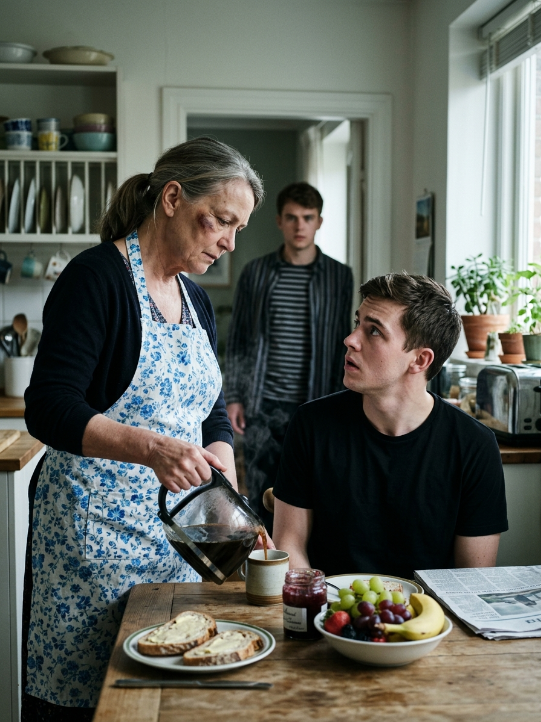
Last night my 23-year-old son raised his hand against me and I sat alone in that kitchen past midnight with a bruise on my skin and something finally breaking loose inside my chest, and I made a decision that would change both of our lives forever. For years I made every excuse in the book for Brandon. I blamed the divorce when his father Richard left. I blamed dropping out of college. I blamed losing job after job. I blamed a bad breakup. I cleaned up his messes, accepted apologies that meant nothing, ignored the
shouting and the insults and the holes punched in walls and the money that went missing and the dishes he shattered, because somewhere underneath all that rage I kept searching for the little boy who used to run through the backyard picking dandelions and hand them to me like they were the most precious things in the world. But that night when he looked me in the eye and said “if you tell me no one more time you’ll regret ever bringing me into this world,” and then did what he did, I stopped asking myself how to protect him from his consequences and started asking how to protect myself. So the next morning I woke up before the sun, pulled out the good tablecloth, the one I only use for holidays, and I cooked a full breakfast like it was a celebration. When Brandon came downstairs and saw that table set so beautifully he smiled, because he thought he had finally broken me. He said “so, you figured it out.” Then he looked at that table and froze, because I was not the only one waiting for him that morning, and the people sitting in those chairs had questions he could no longer run from.
Brandon stood frozen at the bottom of those stairs for what felt like an eternity. His eyes moved slowly around the table, taking in each face one by one, and I watched the confidence drain out of him like water through a cracked cup. Sitting at my dining table that morning were three people he had not expected to see. His Uncle Jerome, my older brother, who had driven four hours from Shreveport the moment I called him the night before. His Aunt Patricia, my closest sister, who had witnessed more of Brandon’s behavior than she had ever spoken about out loud. And Pastor David Okafor, who had known Brandon since he was seven years old and had baptized him with his own hands in a small church outside Dallas on a rainy Sunday afternoon that Brandon once told me was one of the best days of his life. None of them were smiling. None of them were there to comfort him. They were there because I had finally made a phone call I should have made years ago, the kind of phone call where you stop protecting someone’s image and start telling the truth about what is happening behind closed doors. Brandon opened his mouth to say something, then closed it again. For the first time in as long as I could remember, my son had nothing to say. I pulled out the chair across from them and sat down slowly, folded my hands on top of that good tablecloth, and looked at my son with eyes that were no longer apologizing for existing. “Sit down, Brandon,” I said quietly. And something in my voice must have sounded different, because he sat without a single argument. Uncle Jerome spoke first and his voice was low and steady the way it always gets when he means every single word. He told Brandon that he had driven through the night not because I had begged him to come but because when a man puts his hands on his mother, that is the moment the whole family has to show up or forever lose the right to call itself a family. Brandon’s jaw tightened but he said nothing. Aunt Patricia slid a folded piece of paper across the table and told him to open it. Inside was a lease agreement for a small one-bedroom apartment across town, already paid for the first two months, with a note attached in her handwriting that said love does not mean tolerating harm and helping you does not mean watching your mother disappear. Then Pastor Okafor leaned forward and spoke directly to Brandon’s soul the way only he could, reminding him of the boy he used to be, not to shame him but to show him the distance he had traveled in the wrong direction and the road that still existed if he chose to turn around. I watched Brandon’s eyes fill with something I had not seen in years. Not anger. Not entitlement. Something raw and terrified and painfully human. And when he finally looked at me, really looked at me, and saw the bruise I had not tried to hide that morning, something inside him cracked wide open in a way that no amount of yelling had ever managed to do. He put his face in his hands and the sound that came out of him was not the roar I had grown used to. It was the sound of a man finally meeting the weight of what he had done, and I sat there with my hands still folded, not rushing to comfort him, not reaching across to make it easier, because I had learned the hardest lesson a mother can learn, that sometimes the most loving thing you can do for someone is refuse to carry them any further down the wrong road.
Part 2
The silence that followed Brandon’s breakdown was the loudest silence I had ever heard in my life. Nobody moved to pat his back. Nobody slid a box of tissues across the table. Nobody said “it’s okay” because we had all silently agreed before he ever came downstairs that we would not offer him the comfort of those two words until something real had changed. I had spent twenty-three years saying it’s okay and I had the bruise to prove exactly where that road leads. Brandon sat with his face in his hands for a long time and when he finally lifted his head his eyes were red and swollen and he looked younger somehow, not like the intimidating broad-shouldered man who had terrorized my kitchen for years but like something smaller and more lost than I had words for. He looked at Uncle Jerome first and said he was sorry. Jerome nodded slowly and said sorry is the starting line not the finish line and until Brandon understood the difference between those two things nothing in his life was going to change. Then Brandon looked at Aunt Patricia and started to explain himself and she held up one hand gently but firmly and told him that she had not driven here for explanations because explanations were just excuses wearing a nicer outfit. Then he looked at Pastor Okafor and something passed between them that I cannot fully describe, the kind of look that only exists between a man and the person who watched him get baptized, who prayed over him when he was sick at nine years old, who stood at the back of his high school graduation beaming like a proud grandfather. Pastor Okafor reached across the table and gripped Brandon’s forearm and told him that God had not given up on him but that grace was not the same thing as permission to keep hurting people who loved you. Then slowly, like a man walking toward something he was afraid of, Brandon turned and looked at me. And I did not look away. I had spent years looking away, finding something interesting on the floor or the ceiling or the window whenever the truth between us became too uncomfortable to hold. But that morning I held his gaze and let him see everything. The exhaustion. The grief. The years of hoping. The bruise. All of it. He slid out of his chair and came around the table and lowered himself to his knees in front of me and I heard Aunt Patricia pull in a sharp breath and I heard Uncle Jerome clear his throat roughly the way men do when they are trying not to feel too much all at once. Brandon took both of my hands in his and his hands were shaking and he said mama I am so sorry and his voice broke completely on that last word and shattered into something I had no name for. And I want to tell you that I pulled him close immediately. I want to tell you that I held my son and forgave him on the spot and that the birds outside started singing and everything became whole again in that moment. But that is not what happened. Because healing is not a movie and love is not a feeling that erases damage the moment someone cries about it. Instead I looked down at my son kneeling on the kitchen floor and I told him the truest thing I have ever said out loud in my life. I told him that I loved him more than he would ever fully understand but that love without boundaries had nearly destroyed us both and that I was not going to keep choosing his comfort over my safety because a mother who disappears trying to save her child saves nobody in the end. I told him the apartment Aunt Patricia found was not a punishment. It was a starting point. I told him there were conditions. Anger management classes, every single week without exception. A job, any job, held for longer than three months. Weekly calls with Pastor Okafor. And complete honesty, no more performances, no more charm when it suited him and cruelty when it did not. Brandon listened to every word without interrupting and when I finished he nodded and said he would do all of it and I told him I believed he meant that right now in this moment and that the version of him kneeling on that floor was the version I had been waiting years to meet again but that I had also believed him before and so this time his words were not enough and only time and consistent action would rebuild what had been broken between us. He nodded again and something settled in the room, not resolution exactly but the fragile beginning of something that might one day become resolution if we were both willing to do the hard work of getting there. Uncle Jerome stood up and gripped Brandon’s shoulder and told him he was going to help him move his things to the apartment that afternoon and that he would be checking in every single week and that the next time he heard Brandon had raised his voice at me would also be the last time because family protects its own and that protection runs in every direction including toward me. Aunt Patricia gathered the breakfast dishes quietly and I noticed she was crying softly and trying very hard not to let anyone see. Pastor Okafor said a prayer over that table, over that good tablecloth, over the eggs that had gone cold and the coffee nobody had touched, and his words filled every corner of that kitchen with something I can only describe as the feeling of a window being opened in a room that has been sealed shut for far too long. And as I sat there listening to that prayer with my son’s apology still hanging in the air and a bruise still visible on my skin and my heart still tender and cautious and not yet ready to fully exhale, I understood something about myself that I had never understood before. I had not set that beautiful table that morning to celebrate my son’s return to decency. I had set it to celebrate my own. Because somewhere between midnight and sunrise I had finally decided that I deserved a seat at my own table too, and that was the beginning of everything.
The days that followed were not gentle. Nobody had promised they would be and I was grateful for that because gentle promises after violent seasons have a way of setting you up for a very specific kind of heartbreak. Brandon moved his things out that same afternoon just like Uncle Jerome had said, and I stood in the doorway of his old bedroom that evening after they had gone and looked at the empty space where his life had been and I let myself feel every complicated thing that came with that moment all at once. Grief and relief are not supposed to exist in the same breath but anyone who has ever loved someone through destruction knows that they do, they live right next to each other like uneasy neighbors who share a wall and can hear everything. I closed that bedroom door and walked back to my kitchen and sat down at that table alone for the second night in a row and this time instead of fear and shock keeping me company I sat with something quieter and stranger and more unfamiliar than either of those things. I sat with peace. Not the peace that comes from problems being solved because problems were nowhere near solved. But the peace that comes from finally telling the truth out loud in a room full of witnesses and refusing to take it back. The first week Brandon called twice. Both calls were short and careful the way early conversations are when two people are trying to learn how to talk to each other again from the beginning. He had enrolled in anger management classes and sent me a photo of the enrollment confirmation without me asking and I stared at that photo for a long time before I saved it to my phone because it was such a small thing and also the biggest thing he had done in years. Uncle Jerome called me every other day that first month, not to report on Brandon but just to check on me, to ask how I was sleeping and whether I was eating properly and whether I had gone back to the garden because he remembered I used to love my garden before everything became about managing Brandon’s moods and surviving his seasons. I had not been in that garden in almost two years. The week after Brandon left I went outside with my gloves and my trowel and I spent three hours pulling weeds and turning soil and planting new seeds and I cried the entire time, not from sadness exactly but from the strange and overwhelming feeling of reclaiming something that belonged to me that I had quietly abandoned without even noticing I was doing it. Aunt Patricia started calling every Sunday morning and we would talk for an hour sometimes two about everything and nothing, about her grandchildren and my sister’s new job and old memories from childhood that made us laugh until we could barely breathe, and those Sunday calls became something I looked forward to more than I had words to explain because they reminded me that I was a person with a whole history and a whole identity that existed far beyond being Brandon’s mother and his emotional caretaker and the person responsible for managing the damage he left behind. Pastor Okafor checked in with me too and during one of our conversations he said something that I have turned over in my mind every single day since. He told me that forgiveness is not a door you open once and walk through and then it is finished. He said forgiveness is more like a garden, something you have to tend to regularly, something that requires patience and attention and the willingness to keep showing up even on the days when nothing appears to be growing. I wrote that down in a notebook I keep on my nightstand and I have read it back to myself more times than I can count. Three months after that breakfast, Brandon called me on a Tuesday evening and his voice sounded different, steadier somehow, less like a man bracing for a fight and more like a man who had been doing the quiet interior work of rebuilding something important. He told me he had kept the job he started at a logistics company downtown and that his supervisor had said he was doing well. He told me the anger management classes had been harder than he expected and more useful than he wanted to admit. He told me that during one of the sessions the counselor had asked the group to think about the first person they owed an apology to and that he had not even had to think before my face appeared in his mind. He said mama I have been carrying so much anger that was never yours to receive and I put it on you because you were the safest person in my world and I mistook your safety for permission and I am more sorry for that than I know how to say. I sat on my back porch listening to him say those words with the evening air around me and my garden growing quietly in the last light of the day and I felt something shift in my chest that had been locked in one position for so long the movement almost hurt. I told him I heard him. I told him I appreciated those words more than he knew. And then I told him something I needed to say for myself as much as for him. I told him that I had spent so many years making myself smaller to make room for his anger that I had forgotten what my full size felt like and that I was remembering now and that the woman he would be rebuilding a relationship with was not the version of me that absorbed everything silently but this version, the one sitting on her back porch with dirt still under her fingernails from her own garden, the one who had set a table and told the truth and chosen herself without apology. He was quiet for a moment and then he said I think I am going to like that version of you even more and something about the sincerity in his voice made me smile in the dark for the first time in longer than I could remember. We did not fix everything on that phone call. We have not fixed everything now. There are still careful moments between us, still conversations that require navigation, still days when old patterns try to creep back in like weeds at the edge of a garden you thought you had cleared. But Brandon shows up differently now. He calls when he says he will. He asks how I am and then actually listens to the answer. He came to my house for Sunday dinner last month and sat at that same table and we ate together and laughed at an old story Uncle Jerome told about our father and for one long beautiful ordinary moment it felt like something had genuinely turned a corner. Before he left that evening he stood in my kitchen doorway and looked at me the way he used to look at me when he was small, not with need or demand but with something honest and soft and grateful, and he said thank you mama for not giving up on me even when you gave up on what we had become. And I looked at my son standing in my kitchen doorway, this complicated beloved exhausting miraculous human being that I had carried into the world twenty-three years ago, and I told him the fullest truth I had. I told him I had not given up on him. I had simply finally given up on the idea that my pain was the price of his healing. And the moment I stopped paying that price was the moment we both finally had a chance to become something better. I pulled that good tablecloth out again for Sunday dinner that evening. I smoothed it carefully over the table the same way I had on that morning that changed everything. And this time when I sat down I was not waiting for someone to arrive or preparing for something difficult or bracing myself for another storm. I was simply sitting at my own table in my own home in my own life, whole and present and finally, finally at peace. Some people will read this and say I should have walked away completely and never looked back and I understand why they would say that because there are situations where that is absolutely the right answer and the bravest and most self-preserving thing a person can do. But this was my story and my son and my decision made with open eyes and clear boundaries and the full support of people who loved us both. What I want every mother reading this to understand is not what I chose but why I was finally able to choose freely. Because the morning I set that table was the morning I stopped disappearing. And if you are somewhere in the middle of your own story right now, still absorbing what was never yours to carry, still mistaking endurance for love, still waiting for the person hurting you to remember who they used to be, I want you to hear this from someone who sat in that kitchen past midnight with a bruise and a breaking point and a decision to make. You are allowed to love someone and still refuse to be destroyed by them. You are allowed to hope for someone’s healing and still protect yourself while you wait. You are allowed to set the table differently. You are allowed to decide who sits in those chairs. And you are more than allowed to save yourself first, because a mother who disappears trying to save her child saves nobody in the end, and you my dear are worth saving too.
SHORT SUMMARY:
For years, a mother in Dallas, Texas named made every excuse in the world for her 23-year-old son Brandon. She endured the shouting, the threats, the broken dishes, the missing money, the cruelty, and the constant disrespect, telling herself it was just a phase, that somewhere underneath all that rage was still the little boy who once handed her dandelions like they were treasure. But the night Brandon raised his hand against her for the very first time was the night something deep inside her finally broke free. Instead of cowering the next morning, she woke before sunrise, pulled out her best tablecloth, cooked a full breakfast, and invited the people who loved them both to sit at that table and speak the truth that had been avoided for far too long. What followed was not an instant miracle. It was the slow, painful, courageous beginning of a mother reclaiming herself, rebuilding boundaries, returning to her garden, and rediscovering the woman she had quietly abandoned while spending years trying to save someone who first needed to save himself. Brandon eventually showed up differently. But more importantly, so did she.
THE LESSON:
The greatest lesson this story teaches us is that loving someone and losing yourself for someone are two completely different things, and for too long we have confused one for the other. A mother’s love is one of the most powerful forces on this earth but even the most powerful force has limits and those limits are not weakness, they are wisdom. We cannot absorb someone else’s damage indefinitely and call it devotion. We cannot keep making ourselves smaller to make room for someone else’s anger and call it sacrifice. Real love sometimes looks like setting a table instead of throwing one. It looks like making a phone call in the middle of the night to people who will tell the truth. It looks like smoothing out the good tablecloth and sitting down with boundaries instead of apologies. It looks like choosing yourself not because you stopped loving your child but because you finally remembered that you matter too. If there is one thing to carry away from this story let it be this. You are allowed to love someone deeply and still refuse to be destroyed by them. Healing begins the moment you stop treating your own pain as something less important than someone else’s comfort. Set your table differently. Choose who sits in those chairs. And never forget that saving yourself is not abandonment. It is the bravest form of love there is.