After My Mother Burned My Face for Her Stepdaughter, I Used Dad’s Deed to Burn Their Lies Down
PART ONE — THE SOUP
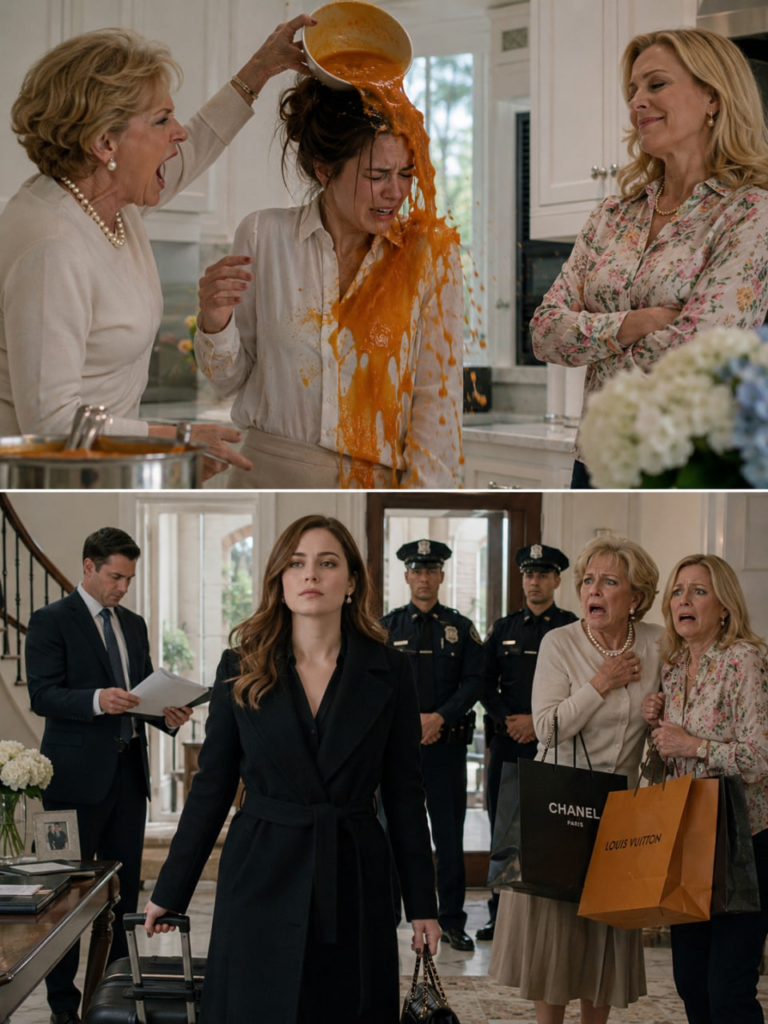
The soup hit my face before I even saw my mother lift the bowl.
One second, I was sitting at the kitchen table in my blouse from work, my laptop still open beside my untouched glass of iced tea, trying to explain calmly that no, Violet could not borrow my car, take my laptop, and wear the necklace my father left me.
The next second, my skin was on fire.
The broth splashed across my cheek, my jaw, the side of my neck. Pieces of onion and carrot slid down my blouse. Steam rose from my collarbone. For a few terrible seconds, I forgot how to breathe. My whole body locked up, not because I was weak, but because pain had grabbed me by the throat and squeezed until the room went white around the edges.
My mother stood over me, holding the empty ceramic bowl in both hands.
Her face was not horrified.
It was cold.
“Give her all your things,” she screamed, “or get out!”
Behind her, Violet Whitaker smiled.
Not nervously.
Not awkwardly.
Not like a woman who had just watched someone get burned in front of her.
She smiled like she had won.
I sat frozen at the kitchen table while boiling chicken soup dripped from my chin onto the front of my blouse. The kitchen smelled like onions, pepper, broth, and betrayal. The marble counters gleamed beneath warm brass lights. The refrigerator hummed. Somewhere outside, the automatic sprinklers clicked on across the back lawn, soft and steady, like nothing had happened.
“All I said,” I whispered, “was no.”
Violet folded her arms over her chest. She was twenty-seven, five years younger than me, and had perfected the helpless little tilt of her head that made strangers want to rescue her and made weak people want to protect her.
“You humiliated me,” she said.
I stared at her through watering eyes. “You asked for my car, my laptop, and Dad’s necklace.”
“It was one interview,” Violet snapped. “One important interview. God, Nora, you act like I asked you to donate a kidney.”
“You asked me for three things that don’t belong to you.”
My mother slammed the empty bowl into the sink so hard it cracked.
“She needs them more than you do,” she said. “Violet has a job interview tomorrow morning. You work remotely. You don’t need a car.”
“I paid for that car.”
“You live under my roof.”
The words landed strangely.
Under my roof.
I slowly looked around the kitchen.
The marble countertops my father had picked after three trips to the showroom because he wanted something bright enough to make my mother happy. The brass fixtures he had installed himself because he said electricians charged too much for “twisting wires and pretending it’s magic.” The wide window over the sink where he used to stand in the morning with coffee in one hand and the newspaper in the other.
Near the pantry, the crooked wedding photo of my mother and my father hung in a silver frame.
My mother always loved calling this place her house.
She conveniently forgot the deed carried my name.
My father had left the property to me when he died six years earlier.
Quietly.
Legally.
Permanently.
I never corrected her when she called it hers. At first, grief softened me. Then guilt silenced me. Then peacekeeping became a habit so deep I mistook it for kindness.
But pain sharpens memory.
And that day, with soup burning my face and Violet smiling behind my mother’s shoulder, I remembered everything.
Violet stepped closer, her heels clicking against the tile. “Face reality, Nora. You’re thirty-two, single, and invisible. Mom’s the only reason you’re not completely alone.”
My mother pointed toward the hallway.
“Pack a bag,” she said. “Leave the keys. Leave the car. Leave anything Violet needs.”
I looked at her.
This woman had held me when I had chickenpox at seven. She had braided my hair badly before school pictures because Dad was worse at it than she was. She had once cried into my hospital blanket when I was eleven and broke my wrist falling from the oak tree in the yard.
That mother had disappeared slowly after Dad got sick.
Or maybe she had been disappearing long before that, and I had been too young to notice.
I rose from the chair.
Soup slid down my neck. My cheek throbbed violently. My hands trembled once, then steadied.
“Okay,” I said.
That startled both of them.
My mother blinked. “Okay?”
Violet narrowed her eyes. “That’s it?”
I took a napkin from the holder in the center of the table, pressed it gently against my face, and walked past them.
Violet laughed behind me.
“That’s it? No tears?”
At the staircase, I stopped and turned back.
“No,” I said quietly. “No tears.”
Then I went upstairs, shut my bedroom door, locked it, and stood very still in the center of the room.
For the first time in years, I listened to the house.
Not the people inside it.
The house.
The faint groan of old wood settling. The hum of central air. The quiet click from the security camera in the hallway outside my bedroom, one of eight I had installed after Violet’s friends began “accidentally” wandering into my office when I was out.
Dad had taught me to document everything.
“People who understand paperwork don’t disappear,” he used to say.
At twelve, I thought that was boring.
At thirty-two, I understood it was survival.
I went into the bathroom and looked in the mirror.
The left side of my face was red and angry, especially along my cheekbone. My neck was blotched. My blouse clung wetly to my skin.
For one second, my knees weakened.
Not from the pain.
From the realization.
My mother had burned me.
For Violet.
For a woman who had moved into our lives after Dad died and somehow convinced my mother that love meant taking from me until Violet felt equal.
I washed carefully. I changed into loose clothes. I wrapped a clean towel around my neck and took three photos of my face from different angles.
Then I made three phone calls.
The first was to an urgent care clinic.
The second was to Marcus Hale, my father’s estate attorney.
The third was to a private security company that monitored the cameras inside and outside the house.
When the security technician answered, I said, “I need footage from the kitchen camera between 6:10 and 6:25 tonight preserved and sent to my attorney.”
The man on the line asked, “Is everyone safe, Ms. Bell?”
I looked at my reflection.
“No,” I said. “But everyone is recorded.”
At urgent care, the doctor photographed my injuries and wrote careful notes. Thermal injury caused by hot liquid. Patient reports assault by mother, Elaine Whitaker. Redness to left cheek, jawline, and neck. No corneal damage. Follow-up recommended.
He asked whether I wanted to call the police.
I said, “Not yet.”
He looked at me like he wanted to argue, but something in my expression must have told him I wasn’t confused.
By the time I left the clinic, that medical report was already scanned to Marcus.
When I returned to the house, I parked in the driveway and sat for a moment with the engine off.
The lights were glowing in almost every downstairs window.
My mother had always loved that. A bright house. A beautiful house. A house that made neighbors jealous.
My house.
I walked inside with gauze taped carefully to my cheek and burn cream cooling the damaged skin. My suitcase was still upstairs, half packed from a business trip I had canceled the week before. I filled it with only what I truly needed.
Clothes.
Passport.
Medical paperwork.
My father’s necklace.
Not the designer handbags Violet had been eyeing for months. Not the jewelry case she opened whenever she thought I was sleeping. Not the laptop she wanted because mine was newer, faster, and more expensive. Not the framed photographs. Not the vintage coats. Not the hard drive labeled HOUSE DOCUMENTS in my office drawer.
That came with me separately.
Everything else stayed exactly where it was.
For now.
Downstairs, Violet was celebrating loudly enough for me to hear through the floorboards.
“She finally learned her place,” she said.
My mother replied, “She’ll come crawling back before morning.”
I stood in the hallway and listened.
There are moments when people tell the truth because they think the person they’re talking about is powerless.
Those moments are gifts.
I recorded them on my phone.
When I came downstairs with my suitcase, my mother barely looked at me.
“Keys,” she demanded.
I placed a single key on the table.
Violet frowned immediately. “That’s not the car key.”
“It’s the guest-room key.”
My mother’s eyes narrowed. “Don’t get smart with me.”
I gave her a tired smile. “Wouldn’t dream of it.”
Violet stepped forward. “Where’s the car key?”
“In my purse.”
“You’re not taking the car.”
“I am.”
“You don’t need it.”
“I bought it.”
My mother’s voice sharpened. “Nora.”
I looked at her for a long moment.
For years, that tone had worked on me.
That sharp little warning.
That reminder that being loved in this house was conditional, fragile, and always one mistake away from disappearing.
But that night, my cheek burned under white gauze, and my father’s necklace rested cold against my throat.
“Nora,” she repeated.
I picked up my suitcase.
“Goodbye, Mom.”
Violet laughed again, but this time it sounded uncertain.
I walked out before either of them could stop me.
Outside, I sat inside my car for ten full minutes watching the house through the windshield.
The upstairs lights glowed warm. The porch looked peaceful. The flower beds had been trimmed that morning by a landscaper I paid. My father’s Japanese maple stood in the front yard, bare branches lifting against the dark sky.
I thought about Dad teaching me to ride a bike in that driveway.
I thought about Mom clapping from the porch.
I thought about Violet standing in that kitchen, smiling while my skin burned.
Then I started the engine.
By the time my mother began calling, I was already checked into a hotel downtown.
I ignored every call.
She rang twelve times.
Violet texted thirty-one.
Ungrateful witch.
Bring the car back.
Mom says she’s changing the locks.
You’ll regret this.
I read every message.
Then I replied with only one sentence.
Do whatever you think is smart.
They did.
PART TWO — THE HOUSE THEY THOUGHT WAS THEIRS
The next morning, Violet posted a driveway selfie beside my car.
She wore oversized sunglasses, red lipstick, and the cream wool coat I had bought in Chicago after my first real promotion. The caption read:
New chapter. Finally getting what I deserve.
I stared at the photo from my hotel bed while the left side of my face pulsed beneath the bandage.
She was leaning against my driver’s side door like a model in a cheap commercial. Behind her, my mother’s rose bushes bloomed along the porch rail. My car keys dangled from Violet’s fingers.
She must have taken the spare from the ceramic dish in the mudroom.
I screenshotted the post.
Then I sent it to Marcus.
His reply came two minutes later.
Do not engage. Preserve everything.
I smiled despite the pain.
Marcus Hale had been my father’s lawyer for nearly twenty years. He wore dark suits, spoke in calm sentences, and had the terrifying patience of a man who knew courts rewarded paperwork more than volume.
My father trusted him completely.
So did I.
At 9:12 a.m., Violet posted another update.
Wish me luck at my interview. Some people finally learned sharing is caring.
Screenshotted.
Sent.
At 10:47, my mother called again.
I let it go to voicemail.
Her voice came through tight and furious.
“Nora, this childish tantrum has gone far enough. You embarrassed Violet this morning by making her nervous before her interview. She took the car because you refused to be reasonable. You need to come home tonight, apologize, and stop acting like a victim. Also, I’m having the locks changed. I will not have you storming in and out of my house whenever you feel like punishing the family.”
I saved the voicemail.
Then I replayed one line.
My house.
My mother had said it so confidently.
That was her greatest mistake.
The house had been built by my father before he married her. He bought the land when he was thirty, worked construction weekends to afford the foundation, and built the first version with help from two friends and a cousin who owed him money. My mother moved in after the wedding and made it beautiful, yes. She picked curtains and tiles and paint colors. She planted the hydrangeas. She turned rooms into warmth.
But Dad had built the bones.
And when he got sick, he started putting his affairs in order quietly.
He told me about the deed one Tuesday afternoon when I was twenty-six and he was thin enough that his wedding ring kept slipping from his finger.
We were sitting in the downstairs study. He was wrapped in a brown blanket despite the August heat. The sunlight came through the window and made him look almost transparent.
“Nora,” he said, “I need you to understand something before the paperwork gets loud.”
“Dad, don’t talk like that.”
“I’m dying, sweetheart. Avoiding the word won’t keep me here.”
I cried then.
He waited.
My father was good at waiting.
When I finally stopped, he handed me a folder.
“The house goes to you.”
I stared at him. “What?”
“The house. The land. Most of the furniture that came from my parents. The antique desk. The portrait. The foundation accounts. Your mother will be allowed to live here as long as you permit it, but legally it’s yours.”
I shook my head. “Dad, Mom will be devastated.”
“She will be taken care of. There’s insurance money, retirement accounts, cash assets. But this house belongs to our family line, and you are my only child.”
“She’s your wife.”
“And you are my daughter.”
I still remembered how his hand felt when he covered mine.
Weak.
Warm.
Certain.
“Promise me you’ll understand the paperwork,” he said. “Not because I want you suspicious of everyone. Because I want you protected when people tell stories louder than the truth.”
Six years later, my mother was telling stories.
Violet was dancing in them.
And I had finally stopped trying to make liars comfortable.
That afternoon, my mother hired a locksmith.
I knew because the exterior camera over the garage recorded the van pulling into the driveway at 3:16 p.m. The locksmith stepped out in a blue polo shirt, spoke to my mother on the porch, and then changed the front, back, and mudroom locks on property she legally did not own.
I watched the footage from my hotel room with Marcus on speakerphone.
“Excellent,” he said.
“Excellent?”
“Unauthorized lock change. False claim of ownership. Constructive exclusion of the legal property owner. We now have a cleaner civil record.”
“She thinks she’s winning.”
“She is helping us.”
That evening, Violet invited friends over.
I watched through social media, because people like Violet never commit cruelty privately when applause is available.
There were six of them at first. Then nine. Then twelve.
They drank wine from my wine fridge. They wore my coats. Two women filmed themselves walking through my closet saying, “This is what happens when the boring sister moves out.”
One man put on my father’s reading glasses and pretended to be a rich old lawyer.
Violet posted a video dancing beneath my father’s portrait in the living room.
The caption read:
Bad energy gone. House feels lighter already.
My mother commented with three heart emojis.
I saved every video.
Every comment.
Every username.
Every timestamp.
It is strange how quickly grief turns to clarity when someone else is proud of hurting you.
By the third day, my face had begun healing, but the red mark across my cheek remained bright enough that strangers glanced at it and looked away.
Marcus arrived at my hotel suite at noon.
He wore a dark charcoal suit and carried a leather folder that looked older than I was.
The moment he saw my bandaged cheek, he went completely still.
I had known Marcus Hale since I was fifteen. He had eaten at our Thanksgiving table. He had once helped me change a tire in the rain outside the courthouse. I had never seen anger show on his face.
Until then.
“Do you want to press criminal charges?” he asked.
I stood by the window overlooking the city. Below, cars moved through downtown traffic like silver fish.
“I want them to understand exactly what they tried to steal.”
Marcus set the folder on the table and opened it.
“We have the deed. Trust paperwork. Estate inventory. Security footage. Medical records. The voicemail where your mother says she is changing locks on ‘her house.’ Evidence of the illegal lock replacement. Social media footage showing use of your personal property. The car post. Defamation claims from Violet’s videos. Possible unauthorized vehicle use, depending on whether she had permission.”
“She didn’t.”
“Then we can move quickly.”
“How quickly?”
“Fast enough to surprise them.”
I touched the edge of Dad’s necklace resting against my throat.
“No,” I said. “They never saw me clearly enough to be surprised.”
Marcus looked at me carefully. “Nora, once this starts, they will try to turn emotional. Your mother especially. She may cry. She may apologize. She may accuse you of destroying the family.”
“She already destroyed it.”
He nodded.
“Then I need you to decide how clean you want this.”
“What does clean mean?”
“It means we remove your property, serve notices, report crimes where appropriate, and recover damages through legal channels. No threats. No public argument. No dramatic confrontation beyond what the law requires.”
I looked at my reflection in the dark hotel window.
My cheek was bruised red under medical tape. My eyes looked older than they had a week ago.
“I want clean,” I said. “But I want them present when they learn the truth.”
Marcus closed the folder.
“That can be arranged.”
The estate company arrived the following morning.
Not movers.
An estate company.
They handled high-value property, inheritance inventories, insured removal, and asset preservation. My father had used them years earlier when my grandmother died. I remembered their logo from a white truck parked outside her old brownstone.
Three trucks came this time.
Marcus coordinated everything.
The police were notified in advance because of the assault allegation and illegal lock change. Two officers agreed to be present during the property access to prevent escalation. The locksmith who had changed the locks returned after receiving a call from Marcus and looked like he wished he had chosen another career.
At 8:02 a.m., I unlocked the back door with proof of ownership in one hand and a new court filing in the other.
The house smelled stale.
Perfume.
Wine.
Violet’s vanilla candles.
Something fried in the kitchen trash.
For a moment, I stood in the mudroom and felt the old instinct return.
Clean it up.
Fix it.
Smooth everything over.
Then I touched my cheek and kept walking.
Every item removed had already been documented.
Furniture I purchased.
Artwork inherited from Dad.
Books.
Rugs.
Wine fridge.
My office equipment.
The antique desk.
The dining table.
The bedroom set in the room my mother had claimed as “hers” even though it came from my father’s parents.
The portrait of my father.
The jewelry safe.
The designer coats.
The guest room linens.
The patio furniture.
The kitchen appliances I had paid to upgrade after the old ones failed.
Everything I had purchased, inherited, insured, registered, or documented left the house under supervision.
The estate company was careful.
Professional.
Quiet.
That somehow made it more powerful.
No screaming.
No smashing.
No revenge speech.
Just clipboards, labels, bubble wrap, inventory numbers, and the slow disappearance of a fantasy my mother had mistaken for ownership.
Only their belongings remained.
Two suitcases stood in the upstairs hall.
Violet’s glitter heels near the staircase.
My mother’s cheap floral robe over the banister.
A pile of Violet’s beauty products on the bathroom counter.
A framed photo of Violet and her late father on the mantel, left untouched.
I was not cruel enough to take what was truly theirs.
That was the difference between us.
At 3:40 p.m., Marcus checked his watch.
“They should be home within twenty minutes.”
I knew because Violet had posted from the mall.
Retail therapy with Mom because some weeks deserve a little luxury.
The comments were full of hearts.
I stood in the living room where my father’s portrait had hung. The wall behind it was pale where sunlight had not faded the paint.
“Are you ready?” Marcus asked.
I looked around the empty room.
For six years, I had mistaken endurance for love.
“Yes,” I said. “I am.”
PART THREE — THE RECKONING
My mother and Violet came home at 4:07 p.m.
I heard Violet before I saw her.
She was laughing outside, bright and careless, the kind of laugh people use when they want the world to know they have never paid for their own consequences.
Then the front door opened.
The laughter stopped.
For three seconds, there was no sound at all.
Then Violet screamed.
“Mom!”
Shopping bags hit the floor.
My mother’s voice followed, sharp with panic. “What is this?”
I stood in the hallway, just out of sight.
Marcus stood in the living room beside two uniformed police officers. His leather folder was tucked beneath one arm. His face was calm enough to make the room feel colder.
My mother stepped deeper inside, her expensive handbag still looped over her wrist. She looked around the empty living room, the bare walls, the blank squares on the hardwood where furniture had stood for years.
“Where is everything?” Violet demanded.
Her sunglasses sat on top of her head. She wore my coat again.
The cream wool one.
It looked smaller on her than she wanted it to.
Marcus took one step forward.
“Mrs. Whitaker. Miss Whitaker. I represent Nora Bell.”
My mother froze.
Violet blinked. “Nora?”
My mother recovered first. “Who let you in?”
Marcus opened his folder.
“The legal owner of the property.”
My mother’s face twisted with outrage. “This is my house.”
“No,” Marcus replied evenly. “It is not.”
He handed her a document.
She snatched it from him, scanned the page, and went pale so quickly I thought she might fall.
Violet grabbed her arm.
“Mom? What is it?”
Marcus continued in the same calm, merciless tone.
“The property was transferred solely to Nora Bell through her father’s estate six years ago. You were permitted to reside here as guests. That permission has now been revoked.”
Violet let out a short laugh.
“That’s fake.”
Marcus looked at her. “It is a certified deed record.”
“My mom lives here.”
“She did.”
My mother looked up at him, lips parted.
“You can’t just throw us out,” she whispered.
“No one is being thrown out unlawfully,” Marcus said. “You are being served formal notice. Given the documented assault, unauthorized lock change, and use of the legal owner’s property without permission, we are also pursuing additional remedies.”
“Assault?” my mother said weakly.
Marcus tapped the folder.
“Medical documentation. Security footage. Witness statements. Social media evidence. A voicemail in which you stated you were changing locks on a home you do not own.”
Violet turned toward the officers.
“This is insane. She’s lying. Nora is unstable.”
My voice came from the doorway.
“Hello, Violet.”
Both of them turned sharply.
I stepped into the living room wearing a black coat, dark slacks, and low heels. My hair was pulled back from my face. The burn had faded from angry red to raw pink along my cheek and neck. It still hurt when I smiled.
So I didn’t.
My father’s necklace rested against my throat.
My mother’s expression cracked the moment she saw me.
“Nora, sweetheart—”
“Don’t.”
The word cut cleanly across the room.
She stopped.
I looked at the coat Violet was wearing.
“That belongs to me.”
Violet crossed her arms. “You abandoned it.”
“I left my property in my house.”
“You moved out.”
“You told me to get out after my mother burned my face with boiling soup.”
My mother flinched.
For a second, there she was.
Not the woman who had thrown the bowl.
Not the woman who had stolen the spare keys.
My mother.
Older.
Frightened.
Cornered by the truth.
Then her pride rushed back in.
“You made me do that,” she said.
The room went still.
Even Violet glanced at her.
Marcus’s eyes sharpened.
One of the officers shifted slightly.
I stared at my mother.
“I made you do it?”
“You kept provoking Violet. You know how sensitive she is.”
Violet’s mouth tightened, but she didn’t interrupt.
“You embarrassed her. You refused to help. You acted superior.”
“I said no.”
“You always say no when it matters.”
I laughed once.
Quietly.
It hurt my cheek.
“When did saying no become a crime in this house?”
My mother’s eyes filled with tears.
I knew those tears.
I had obeyed them for years.
They arrived whenever she wanted sympathy without accountability.
“Nora,” she whispered, “we are family.”
“No,” I said. “Dad and I were family. You were my mother. Then somewhere along the way, you chose being Violet’s shield over being mine.”
Violet snapped, “Don’t talk about me like I’m some villain.”
I turned to her.
“You wore my coat while dancing under my father’s portrait after telling people I had a mental breakdown.”
“You did have one.”
“I have the videos.”
Her face shifted.
Just a flicker.
But enough.
Marcus removed several printed screenshots from his folder and placed them on the bare mantel. Violet’s captions. Her friends in my closet. Her hand on my car. The post about getting what she deserved.
One of the officers looked at the car photo.
“Miss Whitaker,” he said, “did you drive that vehicle?”
Violet’s chin lifted. “My mom said I could.”
“The vehicle is registered to Nora Bell.”
“I thought Mom owned it.”
I looked at her. “You texted me asking me to bring the car back. You knew it was mine.”
Marcus produced the printed text thread.
Violet’s lips parted.
The officer asked, “Do you currently have a valid driver’s license?”
Silence.
My mother looked at Violet sharply.
“Violet?”
Violet swallowed. “It’s complicated.”
“How complicated?” the officer asked.
Marcus’s faint smile contained no warmth.
“Her license was suspended two months ago for reckless driving. Public record.”
My mother stared at Violet.
“You told me that was handled.”
“It is handled,” Violet snapped.
“Apparently not,” Marcus said.
For the first time since entering the house, Violet looked afraid.
Not sorry.
Afraid.
There is a difference.
My mother turned back to me, tears spilling now.
“Nora, please. Where are we supposed to go?”
I looked past her to the hallway.
Two suitcases stood near the stairs.
Violet’s glitter heels sat abandoned beside them.
My mother’s floral robe hung over the banister like a surrender flag.
I thought about being eight years old hiding behind the laundry-room door while my mother told Dad I was “too sensitive.”
I thought about being sixteen and watching her blame me when Violet broke a vase during one of her visits because “Violet was only trying to feel at home.”
I thought about being twenty-six, signing probate paperwork while my mother asked who would get the master bedroom.
I thought about six years of swallowing insults at dinner, paying property taxes quietly, fixing leaks quietly, replacing broken appliances quietly, while my mother told friends she was “letting me stay until I figured myself out.”
I thought about soup hitting my face.
And Violet smiling.
“You told me to get out,” I said. “I’m simply returning the advice.”
My mother sobbed.
Violet exploded.
“You evil bitch!”
She lunged toward me, but one officer stepped between us immediately.
“Miss Whitaker,” he warned.
Violet pointed around him. Her finger shook.
“You think you’re so powerful because of paperwork? You’re pathetic. You hid behind your dead daddy’s money because nobody wants you.”
I watched her scream.
A week earlier, those words would have entered me like knives.
Now they sounded like a woman pounding on a locked door.
“My father gave me protection,” I said. “You mistook it for weakness because I didn’t use it to hurt people.”
Violet laughed bitterly. “You’re hurting us now.”
“No,” I said. “I’m stopping you.”
Marcus handed my mother the formal notices.
“These documents outline the termination of your permission to reside here. Given the circumstances, Ms. Bell is also requesting immediate removal from the premises today. You may collect personal belongings under supervision. Additional arrangements can be made through my office.”
My mother looked at the papers without seeing them.
“This can’t be happening,” she whispered.
“It already did,” Marcus said.
The neighbors had begun gathering outside.
Of course they had.
Violet used to love being seen in my driveway. She loved posing near the Japanese maple and pretending the house reflected her success. She loved performing inside a story where I was invisible and she was chosen.
Now people watched from porches and windows while she stood in the doorway wearing my coat and panic.
My mother noticed them.
Her face crumpled.
“Please,” she whispered to me. “Not in front of everyone.”
I almost laughed again.
Not because it was funny.
Because of all the things she regretted, being seen ranked highest.
“Take off the coat,” I said.
Violet stared at me. “What?”
“The coat is mine.”
“You’re serious?”
“Yes.”
She looked at the officers, then at Marcus, then at my mother.
Nobody helped her.
Slowly, furiously, Violet pulled off the cream wool coat and threw it at my feet.
Marcus looked at one officer.
The officer said, “Pick it up and hand it to her properly.”
Violet’s mouth dropped open.
“What?”
“You heard me,” he said.
For one breathtaking second, Violet looked like she might refuse.
Then she bent, picked up the coat, and shoved it toward me.
I did not take it.
Marcus did.
“Thank you,” he said.
That polite little phrase wounded her more than shouting would have.
My mother gathered her purse with trembling hands. Violet grabbed her shopping bags, but Marcus stopped her.
“Those appear to contain merchandise purchased today. Keep the receipts available. Any purchases made with funds improperly accessed from Ms. Bell’s accounts will be reviewed.”
Violet scoffed too quickly.
“What accounts?”
My mother’s eyes flickered.
I saw it.
Marcus saw it too.
He looked at me.
I nodded.
“We’ll discuss the credit card charges separately,” he said.
Violet went silent.
My mother’s tears stopped.
There it was.
Another door opening.
Another lie waiting behind it.
They had not just tried to take my car, laptop, necklace, and home.
They had been helping themselves in smaller ways for months.
Maybe years.
A charge here.
A cash transfer there.
A card “accidentally” used for household expenses that somehow included Violet’s salon appointments, shoes, and subscription boxes.
I had suspected.
Now I knew where to look.
The officers escorted them outside while Violet cursed under her breath and my mother begged the neighbors not to stare.
The neighbors stared anyway.
I stood in the doorway of the empty house and watched them leave.
My mother looked back once.
For a moment, our eyes met.
I expected to feel triumph.
Instead, I felt tired.
Not guilty.
Not uncertain.
Just tired in the way a person feels after finally setting down something heavy they were never supposed to carry.
When their car disappeared down the street, Marcus stood beside me.
“You did well.”
I touched my cheek.
“I don’t feel well.”
“You may not for a while.”
Inside, the house echoed.
Without the furniture, every step sounded louder. The rooms looked unfamiliar. Bare. Honest.
Marcus waited.
He knew better than to fill silence.
Finally, I said, “What happens next?”
“Next,” he said, “we make sure they can’t rewrite what happened.”
PART FOUR — WHAT PAPERWORK REMEMBERS
My mother called that night from a motel.
I let it go to voicemail.
“Nora,” she said, and this time her voice was soft in the way it used to be when I was sick as a child. “I know today got out of hand. I know you’re angry. But you embarrassed me in front of the entire neighborhood. You brought police to your family home. I don’t know what Marcus has told you, but lawyers make money by dividing families. Please call me. We can fix this like adults.”
I deleted nothing.
The next message came eleven minutes later.
“This is your mother. You do not get to ignore me.”
Then:
“Violet is having a panic attack because of what you did.”
Then:
“I hope you’re proud of yourself.”
Then:
“Your father would be ashamed.”
That one made me sit down.
I was in the empty kitchen on a folding chair, eating crackers from a paper plate because the dining table was in storage and I had not yet decided what belonged in the house now.
Your father would be ashamed.
For six years, that sentence had been the leash around my throat.
Every time I objected to Violet taking my things, my mother said Dad would want me to be generous.
Every time I asked for respect, she said Dad hated conflict.
Every time I reminded her that I paid taxes, maintenance, insurance, utilities, and repairs, she said Dad would never throw family numbers in her face.
My father’s memory had become a weapon in my mother’s hands.
But that night, sitting alone in the kitchen he built, I finally heard his real voice under hers.
People who understand paperwork don’t disappear.
I opened the storage box Marcus had left for me.
Inside were copies of the deed, estate plan, insurance documents, inventory lists, medical reports, police notes, screenshots, and transcripts.
Paperwork did not cry.
It did not exaggerate.
It did not rewrite itself to make abusers comfortable.
It simply remembered.
The next two weeks became a storm made of documents.
Marcus filed civil claims for property misuse, illegal lock changes, and damages. The police investigation moved forward on the assault. Violet’s unauthorized use of my vehicle became more complicated after her suspended license surfaced. The credit card issue widened after Marcus’s forensic accountant reviewed statements.
At first, I thought it would be a handful of charges.
It was not.
Violet had used one of my household cards for clothing, gas, hair appointments, makeup, concert tickets, delivery meals, and hotel stays. My mother had approved some purchases by claiming they were “family expenses.” Other purchases were hidden under vague labels and split payments.
The total made me sit very still.
Twenty-three thousand, eight hundred and fourteen dollars.
That was not borrowing.
That was looting with receipts.
When Marcus told me, I stared at the number until it blurred.
“How did I miss this?”
He looked at me kindly.
“You were busy surviving inside the situation.”
I hated how true that was.
People imagine betrayal arrives dramatically, with slammed doors and obvious villains.
Sometimes it arrives as a $74 charge you don’t question because you are exhausted.
A $112 purchase your mother says was for groceries.
A $300 salon bill hidden under a family card.
A $1,200 “emergency” Violet promises to repay and never mentions again.
Abuse does not always kick down the door.
Sometimes it moves into the guest room and asks why you’re being selfish.
Violet’s friends began deleting videos.
Too late.
Marcus had preserved everything.
Then came the neighborhood rumors.
Apparently, my mother told people I had suffered a breakdown after being dumped by a man who never existed. Violet told others I was addicted to pills. One of her friends posted that I had “weaponized inheritance trauma” because I was jealous of Violet’s beauty.
I read that phrase three times.
Weaponized inheritance trauma.
It sounded like something someone says when they have no defense but own a ring light.
Marcus drafted cease-and-desist letters.
Two days later, the posts disappeared.
One week later, three of Violet’s friends sent stiff, terrified apologies through email.
I did not answer them.
My mother and Violet moved into a short-term rental across town. The rental had beige carpet, thin walls, and no marble counters. Violet hated it publicly. My mother hated it privately.
I knew because she kept leaving voicemails.
“Nora, I found your father’s old gardening gloves in one of my boxes. Do you want them?”
“Nora, the rental company needs references. This is humiliating.”
“Nora, Violet lost that job opportunity because she was emotionally destroyed by your cruelty.”
“Nora, I raised you.”
That last one came at midnight during a rainstorm.
I listened to it three times.
I raised you.
Yes.
She had.
And somehow she thought that meant she owned me.
The criminal case moved slowly, as criminal cases do. My mother’s attorney argued the soup spill was accidental. Marcus provided the footage.
That ended that argument.
In the video, there was no accident.
The camera showed my mother lifting the bowl and throwing it forward. It showed me flinching backward. It showed Violet smiling before I even touched my face.
The first time I watched the footage, I threw up in the downstairs bathroom.
Not because of the violence.
Because part of me had still wondered if I remembered it wrong.
That is what long-term manipulation does.
It makes you distrust pain that left marks.
The footage gave my memory back to me.
I watched it again the next day with Marcus present.
He offered to turn it off.
“No,” I said. “I need to see it clearly.”
Onscreen, my mother screamed.
Onscreen, Violet smiled.
Onscreen, I sat frozen.
Then rose.
Then walked upstairs.
No tears.
Marcus watched quietly beside me.
When the video ended, he said, “You were very composed.”
“I was in shock.”
“Both can be true.”
Winter approached slowly.
I began rebuilding the house room by room.
Not restoring it.
Reclaiming it.
The kitchen was first.
I had the marble counters professionally cleaned. The cracked sink bowl was replaced. The brass lights came down, not because they were ugly, but because my mother had chosen them, and I was tired of living under her taste.
I painted the kitchen a soft warm white and replaced the lights with simple matte black fixtures.
Then the living room.
I rehung my father’s portrait, but not in the same spot.
For years, it had hung above the fireplace like a shrine my mother used whenever she wanted moral authority.
Now I placed it near the front window, where morning light touched his face.
It made him look less like a ghost.
More like Dad.
The antique desk returned to the study. My books came back. My coats went into a locked closet, though eventually I stopped locking it because no one lived there who would steal them.
Silence filled the house at first.
Then it changed.
Silence without fear feels different.
It is not empty.
It is spacious.
One Saturday morning, I made coffee and sat on the back steps wrapped in a blanket. The Japanese maple had dropped its last leaves. The grass glittered with frost. Somewhere down the street, a dog barked.
I realized no one had criticized how I held my mug.
No one had asked why I looked tired.
No one had sighed because I chose the wrong tone.
No one had entered the room wanting something from me.
I cried then.
Not loudly.
Not dramatically.
Just enough to let my body understand it was safe.
The civil settlement discussions began in December.
My mother wanted leniency.
Violet wanted denial.
Their attorney wanted reality.
Marcus called me after the first meeting.
“Your mother is willing to pay restitution over time if you agree to recommend a reduced charge.”
“What does Violet say?”
“Violet says none of this is her fault.”
“Of course she does.”
“There are probation issues from the driving offense. Unauthorized vehicle use could trigger additional consequences. She is scared.”
“Good.”
Marcus paused.
“Good is allowed, Nora.”
I closed my eyes.
That was the problem with becoming free.
You have to meet the parts of yourself that anger kept alive.
“I don’t want them destroyed,” I said. “I want them stopped.”
“Then we aim for accountability, not annihilation.”
That became the line.
Accountability.
Not revenge.
Restitution.
Not cruelty.
Legal consequences.
Not personal warfare.
My mother pleaded guilty to a reduced assault charge. She was ordered to pay restitution and attend anger management. The court record did not say “family misunderstanding.” It said assault.
That mattered.
Violet faced consequences for unauthorized vehicle use and probation violations. She avoided jail, barely, but received extended probation, fines, and community service. Her social media vanished for a while. When it returned, her posts were vague quotes about betrayal, healing, and “toxic family systems.”
I did not follow her.
People sent me screenshots anyway.
I asked them to stop.
The hardest part was not winning.
It was learning what to do with a life no longer organized around losing.
PART FIVE — NOTHING BURNED
Six months after the soup, the house felt warm again.
Not perfect.
Not fully healed.
But warm.
The kitchen no longer smelled like chicken stock and betrayal. It smelled like coffee in the morning, lemon cleaner after noon, and sometimes cinnamon when I remembered to bake.
I sold the car Violet had wanted so badly.
Not because it was damaged.
Because every time I looked at it, I saw her leaning against it in sunglasses, captioning theft like destiny.
I bought a smaller car she would have hated.
Practical.
Quiet.
Reliable.
Entirely mine.
I replaced my laptop too, even though nothing was wrong with the old one. I donated it after wiping the drive professionally. Somewhere, a student who actually needed it received the machine Violet had demanded as tribute.
That made me happy.
Dad’s necklace stayed around my throat for months.
Then one morning, I took it off and placed it in a velvet box beside my bed.
Not because I loved it less.
Because I no longer needed proof that I belonged to him.
I belonged to myself.
My mother wrote one letter.
Not a text.
Not a voicemail.
A letter.
It arrived in a plain white envelope with my name written in handwriting I recognized from every childhood permission slip and Christmas tag.
I left it unopened on the kitchen counter for three days.
On the fourth, I made tea and read it by the window.
Dear Nora,
I have started this letter many times.
I know you may never forgive me. I am not sure I deserve it. What I did was wrong. I have told myself many stories about stress, grief, Violet, your father, money, fear, and loneliness. Some of those things are true, but none of them excuse what I did.
I threw hot soup at my daughter.
Seeing that sentence written plainly makes me sick.
I was angry that you would not bend. I was ashamed that you had power I did not want to acknowledge. I convinced myself that because I was your mother, everything you had was somehow connected to me.
That was wrong.
Your father trusted you. I resented that. I think I resented it before he died, and after he died, I let that resentment become something ugly.
I am sorry for hurting you.
I am sorry for letting Violet hurt you.
I am sorry for making you feel alone in your own home.
I do not expect anything from you. My counselor says apologies should not be fishing hooks. So I am trying not to make this one into that.
I only wanted to say I know what I did.
Mom
I read it once.
Then again.
Then I folded it and placed it in a drawer.
I did not forgive her that day.
But I did believe one sentence.
I know what I did.
That was more than she had given me before.
Violet never apologized.
That did not surprise me.
People like Violet do not apologize when the mirror cracks. They simply find softer lighting.
I heard she moved two counties away and worked at a boutique owned by a friend of her late father’s cousin. I heard she told people I had stolen her childhood home. I heard she had a new boyfriend with a truck, a temper, and a mother who didn’t like her.
I wished her no harm.
I also wished her nowhere near me.
My life became smaller in the best way.
I worked.
I gardened.
I learned how to sleep without listening for footsteps.
I invited a few friends over for dinner and watched them admire the house without trying to own it.
One of them, Jenna, stood in the kitchen with a glass of wine and said, “It feels like you now.”
I looked around.
The clean counters.
The black fixtures.
The simple wooden table.
The framed recipe card in Dad’s handwriting near the stove.
“Yeah,” I said softly. “It does.”
On the first night of winter, I decided to make soup.
For a long time, I had avoided it.
I told myself I was too busy, or it was too warm outside, or I didn’t have the right ingredients. But the truth was simpler.
Soup scared me.
Not logically.
Physically.
My body remembered before my mind could argue.
But that night, snow dusted the front lawn, and the house was quiet, and I wanted something warm that did not belong to fear.
So I took out a pot.
I chopped onions, carrots, celery, and garlic.
The knife moved steadily beneath my hand.
No trembling.
No footsteps behind me.
No Violet laughing.
No mother waiting to turn love into a bill.
I added chicken, herbs, salt, pepper, broth.
Steam rose gently.
For one second, the smell tightened my chest.
Then it passed.
I stirred slowly.
Outside, the Japanese maple stood bare under the porch light. Inside, my father’s portrait watched over the living room from its new place by the window.
When the soup was ready, I ladled it into a bowl.
A ceramic bowl.
Blue.
One I had bought myself.
I sat at the kitchen table and waited until the steam softened.
Then I took a spoonful.
It was good.
Not perfect.
A little too much pepper.
Dad would have said so immediately, then eaten two bowls anyway.
I smiled.
My cheek no longer hurt.
There was only the faintest mark if the light hit my skin just right. Most people didn’t notice. Sometimes I did. Sometimes I touched it without thinking.
A scar is not always a wound.
Sometimes it is a signature.
Proof that something happened.
Proof that it ended.
I ate the soup slowly.
Spoon by spoon.
The house held around me, warm and quiet.
For years, I had believed peace would arrive like applause. Big. Loud. Dramatic. A final scene with everyone watching and justice standing in the doorway wearing a dark suit.
But real peace came softly.
It came in changed locks that belonged to me.
In bills paid from my account and no one else’s secrets.
In a kitchen where no one screamed.
In a bowl of soup that warmed my hands and did not burn my skin.
When I finished, I washed the bowl, dried it, and placed it carefully in the cabinet.
Then I turned off the kitchen light.
Before going upstairs, I paused beside my father’s portrait.
“People who understand paperwork don’t disappear,” I whispered.
And for the first time in a very long while, I knew I had not disappeared.
I had simply been waiting for myself to come home.
THE END